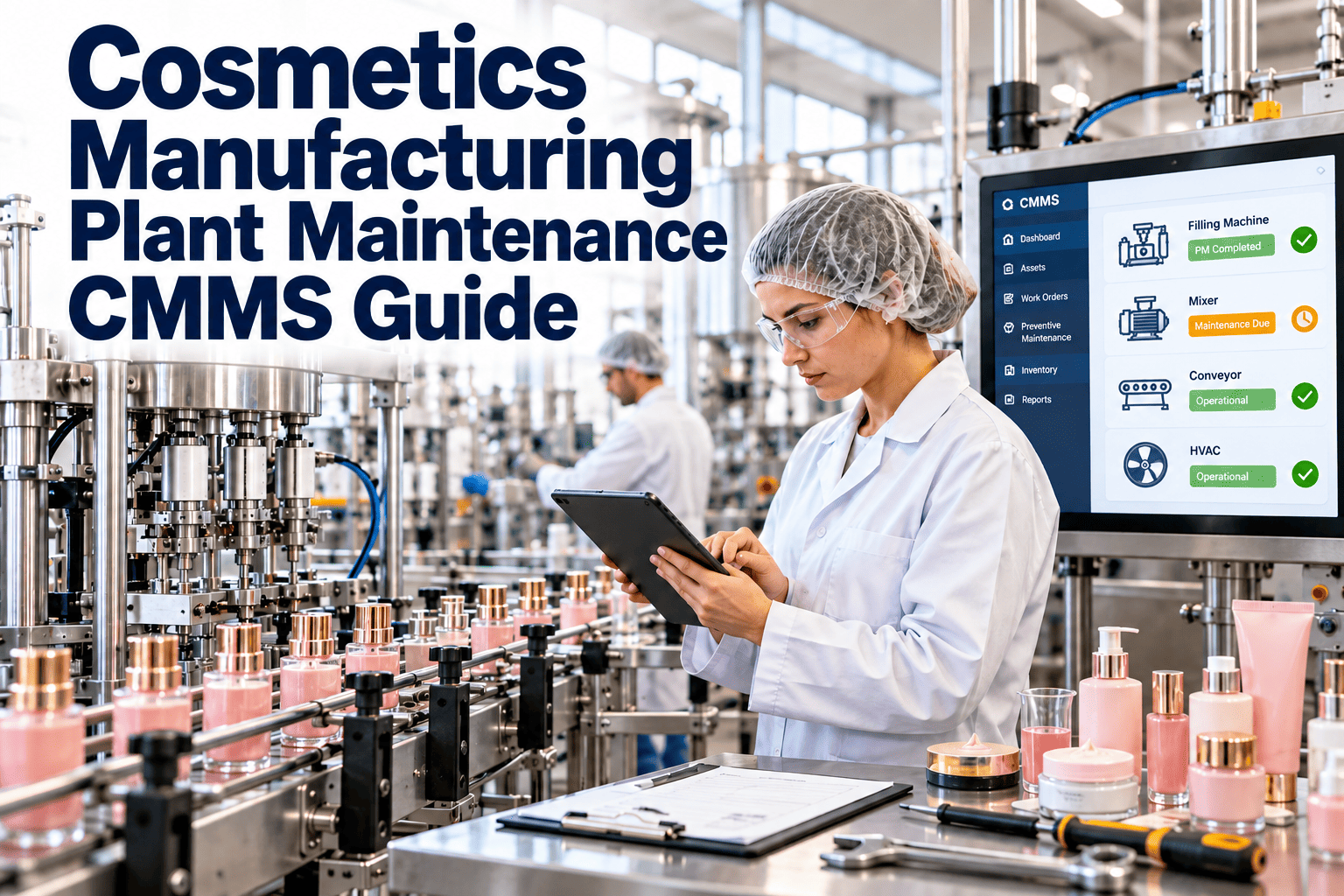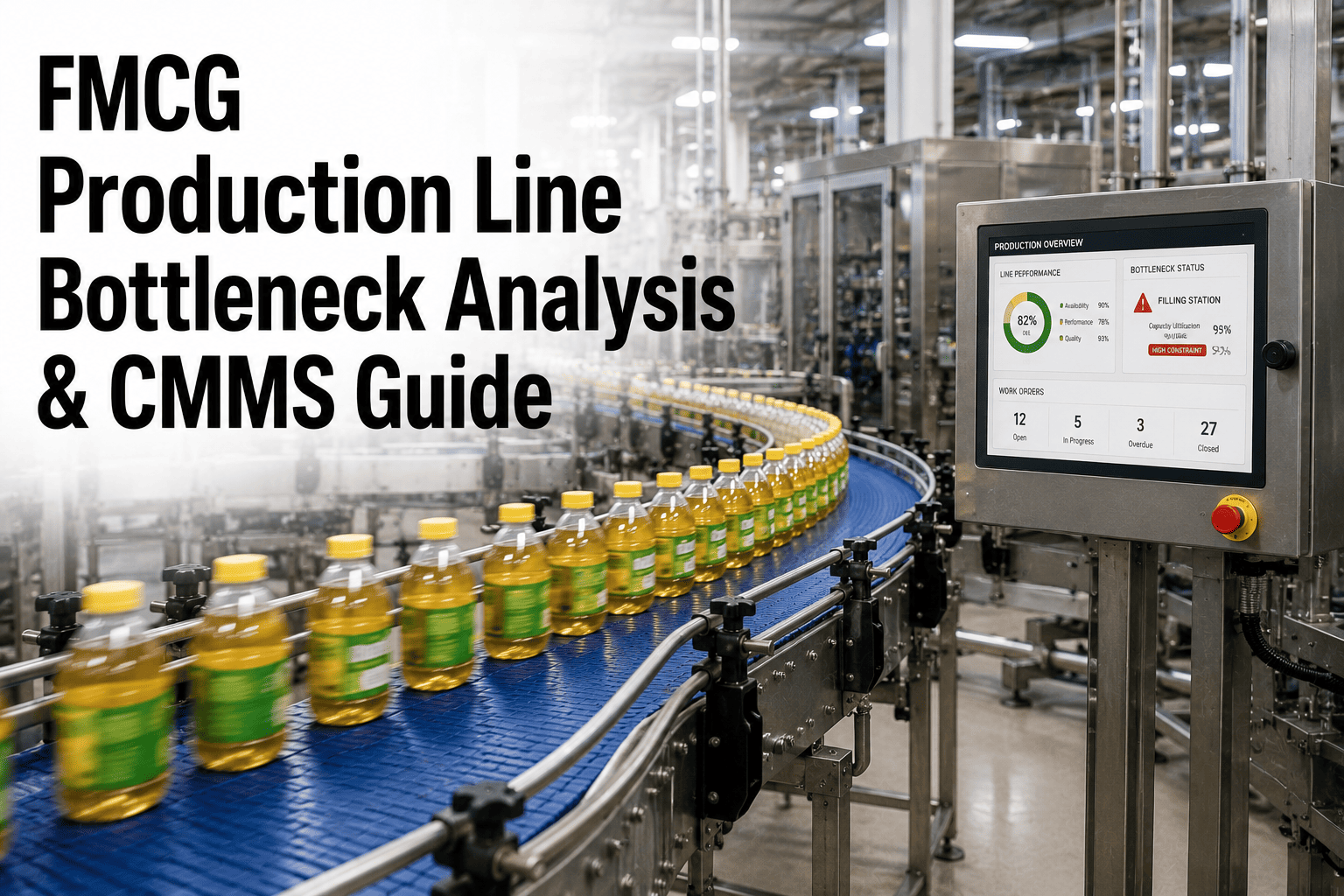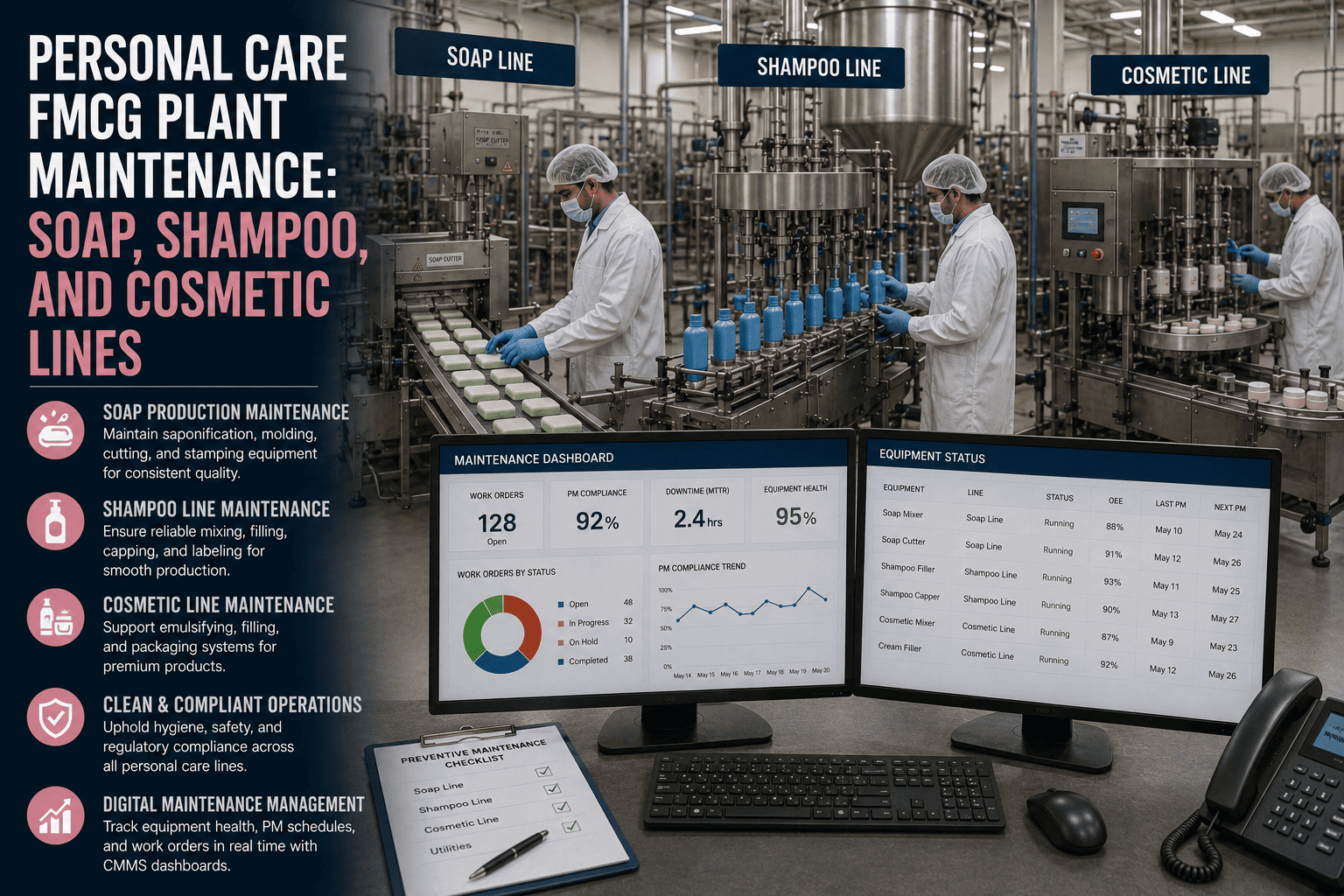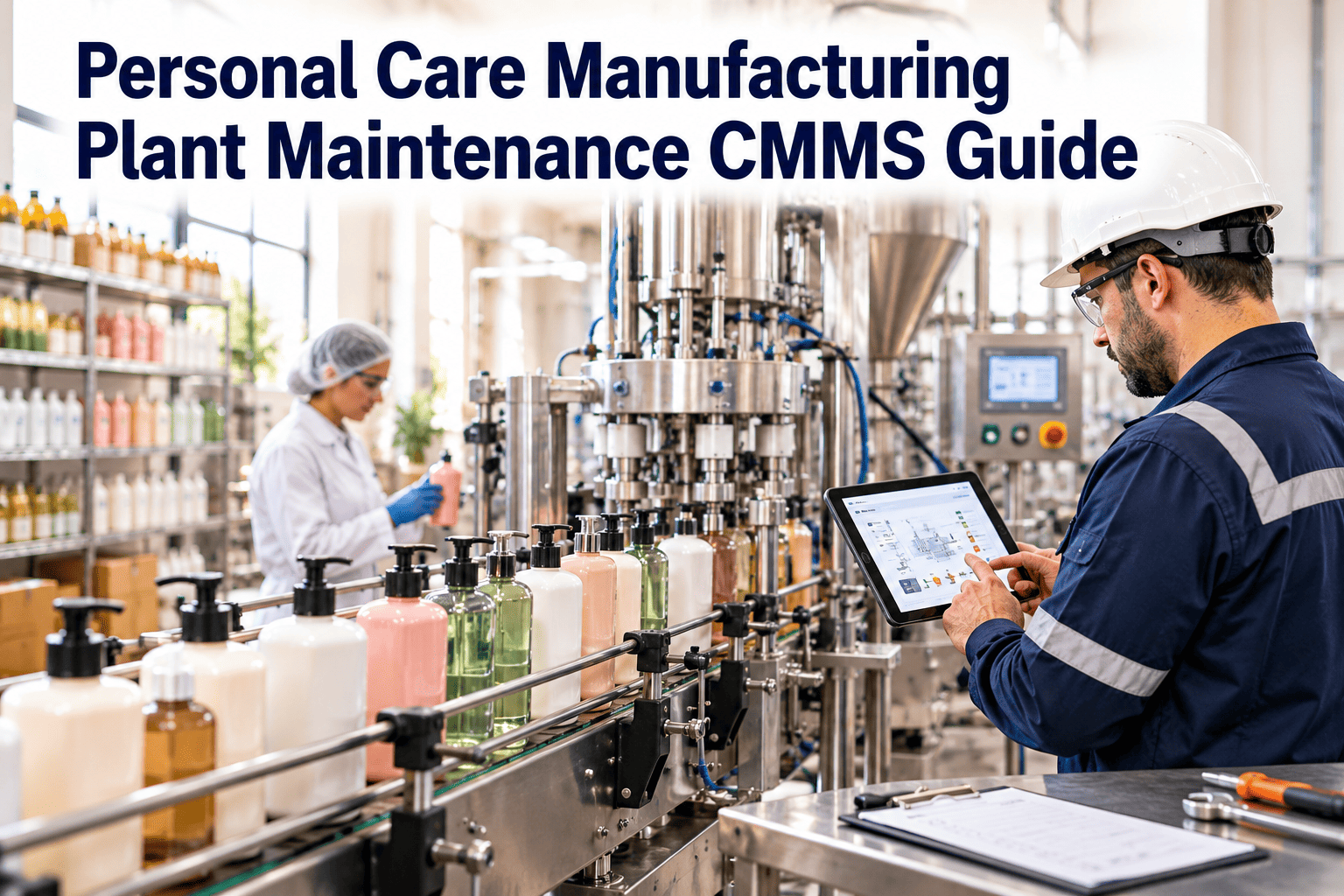
Personal care plants make shampoos, lotions, creams, gels, and deodorants on lines that must switch between formulas, viscosities, and pack formats several times a week. The equipment is a mix of hygienic process vessels, high-shear mixers, tube and bottle fillers, and cappers, and each one fails differently when it is neglected. Maintenance has to protect product quality and hygiene as well as uptime, and that is hard to do from notebooks and spreadsheets. This guide covers the main assets, the failure modes that matter, and how a CMMS can organize preventive work, inspections, and records across the whole plant.
Personal Care Manufacturing Plant Maintenance: Mixing, Tube Filling and Capping
From the first batch tank to the last cap torque check, every stage has wear parts, hygiene risks, and records that need to be kept. Organize them once and the plant becomes easier to run and to audit.
Why Personal Care Maintenance Is Different From General FMCG
A cosmetic or personal care formula can be spoiled by contamination that would pass unnoticed in many other products, and it can be unpleasant to clean off equipment. That changes how maintenance must be planned and documented.
Plant realities that shape maintenance
- Frequent formula and pack changeovers with cleaning between each one.
- Viscous, sticky, and sometimes abrasive products that load pumps, valves, and seals.
- Hygienic design requirements that make some parts harder to reach and replace.
- Fragrances, colorants, and actives that can carry over between batches.
What that means for the maintenance team
- Seals and gaskets are consumables that need a stock and a schedule.
- Maintenance work on product-contact parts needs cleaning and verification afterward.
- Changeover tasks overlap with preventive tasks, so scheduling has to avoid duplication.
- Records must show what was done, by whom, and when, in a form that audit teams can retrieve.
From Batch Tank to Packed Unit: The Maintenance Map
Mixing and Emulsifying Equipment
Process vessels set the texture and stability of the product, so equipment condition affects batch quality directly. The inspections below are the ones that most often prevent a bad batch.
| Component | Typical failure | Effect on product or process | Preventive action |
|---|---|---|---|
| Mechanical seals on mixers and homogenizers | Face wear, flush loss, or elastomer damage | Leaks, product in the gearbox side, or contamination from lubricant | Inspect seal flush, check leak points, replace on condition and on hours |
| Rotor-stator or homogenizer head | Gap increase from wear or damage | Coarser emulsion, longer processing time, inconsistent texture | Measure the gap or inspect the head at set intervals, keep a spare |
| Scraper and agitator blades | Edge wear and fatigue | Poor heat transfer and product left on the wall | Check blade condition and clearance at each major clean |
| Jacket heating and cooling | Scale, blocked passages, or valve failure | Slow heat-up, overshoot, or poor batch control | Check temperature sensors, valve response, and flow |
| Vacuum system | Pump wear or leaking joints | Entrapped air and unstable batches | Test leak rate, check oil or liquid ring condition, inspect gaskets |
Where Hygiene Risk and Batch Impact Meet
Not every maintenance task carries the same risk. Rank the work by how directly it touches product and by how many batches it can affect, so the strictest controls go where they matter.
Tube Filling and Sealing Maintenance
Tube fillers do three things at once: orient the tube, dose the product, and seal the end. Each can fail on its own, and the symptoms often look alike at the end of the line.
Bottle Filling and Capping: Where Leaks and Rejects Begin
Cappers combine mechanical tooling with torque control. A small drift can create loose caps that leak in transit or tight caps that crack closures.
Compliance and Records for Personal Care Plants
Cosmetic good manufacturing practice is commonly based on ISO 22716, and regulators in several markets expect documented control of equipment, cleaning, and calibration. Check the current rules for each market you sell into, including the United States where recent cosmetics legislation has added new requirements.
Maintenance records that auditors usually ask for
- Preventive maintenance schedules and evidence they were completed.
- Calibration records for scales, temperature probes, and pressure gauges.
- Cleaning and verification after maintenance on product-contact parts.
- Corrective maintenance history for critical assets.
How a CMMS supports them
- Inspection templates produce a time-stamped checklist for each asset.
- Work orders record who did the work, the parts used, and the findings.
- Calibration due dates sit with the instrument asset and trigger tasks.
- Records can be searched by asset, date, or batch period for an audit.
Before and After: Managing the Plant on Paper or on One System
Paper and spreadsheet maintenance
- Seal changes and cleaning checks are logged in several different places.
- Preventive tasks are missed when changeovers are heavy.
- Technicians repeat work that was done and recorded by another shift.
- A batch complaint triggers a search for maintenance history.
Connected maintenance
- Each vessel, filler, and capper has one asset record with its tasks and history.
- Schedules can be planned around production and changeover windows.
- Findings and parts are visible to every shift.
- Maintenance history around a batch date is retrievable in minutes.
Utilities and Water: The Maintenance Nobody Sees on the Packing Line
Purified water, steam, compressed air, and vacuum feed every batch. A weak point in any of them appears downstream as a quality problem that is hard to trace.
Utility checks that protect product
- Water loop sanitization records, sampling points, and filter or membrane condition.
- Steam trap and valve inspections that keep heat-up times consistent.
- Compressed air filtration and dryer checks, since air contacts packaging and drives actuators.
- Vacuum pump condition and leak testing on every vessel that needs it.
What goes wrong when they are ignored
- Slow or uneven heating causes batch delays and temperature overshoot.
- Moist air damages pneumatic parts and can contaminate packaging.
- Vacuum leaks cause aeration and variable batch quality.
- Poor water system records create audit findings that are difficult to close.
Failure Scenarios and How Maintenance Records Resolve Them
| Scenario | First suspicion | Records to check | Likely corrective action |
|---|---|---|---|
| Batch texture varies between runs | Mixing or homogenizer condition | Seal and head inspections, vessel temperature records | Replace worn head or blades, verify sensors and vacuum |
| Tube seals fail in transit | Sealing jaws or heater settings | Sealer PM, air supply checks, recent tooling changes | Clean or replace tooling, restore settings, verify seal strength |
| Caps loosen after distribution | Capper torque drift | Torque check history, chuck and clutch inspections | Replace worn chucks, reset torque, increase check frequency |
| Fill weight drifts at one position | Nozzle or dosing seal wear | Cycle count, seal change dates | Replace seals and nozzle, add the head to a tighter inspection |
| Fragrance carryover between products | Cleaning or valve leakage | Cleaning verification and valve maintenance records | Repair leaking valves, review cleaning method and verification |
Spare Parts Strategy for Short-Run Personal Care Lines
KPIs for a Personal Care Maintenance Program
Where Personal Care Maintenance Is Heading
Plant Readiness Checklist
- Mixer and homogenizer seals inspected and flush systems confirmed.
- Jacket temperature sensors checked against a reference.
- Transfer hoses and gaskets inspected for wear and leaks.
- Vacuum and compressed air systems checked for leaks and quality.
- Tube sealing tooling cleaned, aligned, and verified.
- Capper torque tested with a torque tester on the current closure.
- Registration sensors and coders cleaned and set for the current pack.
- Spare seals, gaskets, and tooling stocked and linked to the asset.
Begin with the assets that touch product, and record every seal, gasket, and tooling change against the asset so repeat failures become visible. Then and the lines that change over most often. Add the supporting equipment as the schedules and checklists prove their value.
Adopting the program in stages
First 30 days
- Register the highest-risk assets: mixers, homogenizers, fillers, and cappers.
- Load existing PM tasks and calibration dates.
- Start recording seal and gasket changes by asset.
Following months
- Add inspection checklists and torque or seal checks.
- Review repeat repairs and adjust intervals.
- Extend to utilities, conveyors, and packing equipment.