The Definitive Guide to CMMS for FMCG Manufacturing in 2026
By Jonas on March 17, 2026
Most FMCG plants that implement a CMMS for the first time discover the same thing within 90 days: they had no idea how much money they were leaving on the floor. A dairy processor in Gujarat reduced unplanned downtime by 34% in the first quarter after deploying Oxmaint — not because their equipment suddenly got better, but because they could finally see what was breaking, when, and why. A snack manufacturer in Maharashtra recovered $280,000 in the first year by identifying dead stock in their storeroom during the initial asset audit. A beverage plant in Tamil Nadu cut emergency maintenance spend by 41% by replacing reactive call-outs with scheduled PM work orders. None of these results required new capital equipment. They required structured data and a platform to act on it. This guide covers everything FMCG maintenance leaders need to evaluate, select, implement, and extract maximum value from a CMMS in 2026 — from the core features that matter to ROI calculation frameworks and deployment strategies that actually work in food, beverage, and CPG manufacturing environments. Start your free trial or book a demo to see Oxmaint in action on live FMCG plant data.
Oxmaint CMMS — Built for FMCG Manufacturing
The CMMS That FMCG Maintenance Teams Actually Use — and Keep Using.
Oxmaint is purpose-built for food, beverage, and CPG manufacturing — with mobile-first work orders, asset-linked spare parts, food safety compliance tracking, and energy monitoring in one platform. Deploy in 48 hours. No IT team required.
reduction in unplanned downtime within 12 months of CMMS deployment in FMCG plants
15–20%
MRO inventory cost reduction from asset-linked spare parts management and reorder automation
$280K
average dead stock recovered in first storeroom audit after CMMS deployment
48 hrs
time to deploy Oxmaint from sign-up to first live work order on production equipment
What a CMMS Actually Does — and What It Does Not
A Computerised Maintenance Management System (CMMS) is the operational platform that manages everything your maintenance team does — work orders, PM schedules, asset records, spare parts inventory, technician assignments, and compliance documentation — in one system that replaces spreadsheets, paper logs, and tribal knowledge. Understanding what a CMMS does and does not do is the first step to selecting the right platform and setting realistic expectations for deployment.
What a CMMS Does
✓Creates, assigns, tracks, and closes work orders with full history
✓Schedules preventive maintenance by time, runtime hours, or meter reading
✓Maintains complete asset records — specs, manuals, history, and cost data
✓Manages spare parts inventory with reorder automation and BOM linking
✓Generates compliance documentation and audit trails for food safety inspections
✓Enables mobile access for technicians on the plant floor
✓Tracks energy consumption alongside maintenance activities
What a CMMS Does Not Do
✗Replace the judgement and skills of your maintenance team
✗Automatically fix equipment or predict failures without sensor data input
✗Replace ERP for financial accounting, payroll, or procurement approvals
✗Manage production scheduling or quality control processes
✗Deliver results without data input — "garbage in, garbage out" applies fully
✗Replace regulatory inspectors or certify compliance independently
✗Operate without technician adoption — platform value depends on usage
✗Deliver ROI without a change management plan alongside deployment
The 12 Core CMMS Features FMCG Plants Must Evaluate
Not all CMMS platforms are built for manufacturing environments — and within manufacturing, food and beverage has specific requirements around food safety documentation, allergen management, and regulatory compliance that generic maintenance software does not address. These are the 12 features that separate platforms built for FMCG from generic work order tools.
01
Mobile-First Work Orders
Must-Have
Technicians work on the plant floor, not at desks. A CMMS that requires desktop access loses 60–70% of its compliance and data capture value immediately. Evaluate: offline capability, photo capture, checklist completion, barcode/QR scanning, and digital signature capture on mobile.
02
PM Scheduling Engine
Must-Have
Automated PM generation by calendar interval, runtime hours, production cycles, or meter readings. Look for: multi-trigger scheduling (time AND meter), rolling vs fixed schedules, seasonal adjustment, and the ability to auto-generate work orders with pre-populated checklists and required parts.
03
Asset Hierarchy and Registry
Must-Have
Complete asset records linking location, equipment specs, maintenance history, spare parts BOM, and cost data. FMCG-specific requirement: food contact surface classification, allergen zone designation, and CIP circuit membership must be trackable per asset for audit purposes.
04
Spare Parts and MRO Inventory
Must-Have
Asset-linked BOM mapping, min-max reorder automation, and multi-site stock visibility. Critical differentiator: parts should be staged to work orders automatically so technicians never search for components. Evaluate reorder trigger logic and supplier integration depth.
05
Food Safety and Compliance Audit Trail
Must-Have
Every maintenance action timestamped, operator-attributed, and permanently stored. For FMCG: GMP compliance records, sanitation logs, allergen changeover documentation, and calibration certificates must be retrievable by inspectors in under 5 minutes. Paper-based systems fail this test.
06
KPI Dashboard and Reporting
Must-Have
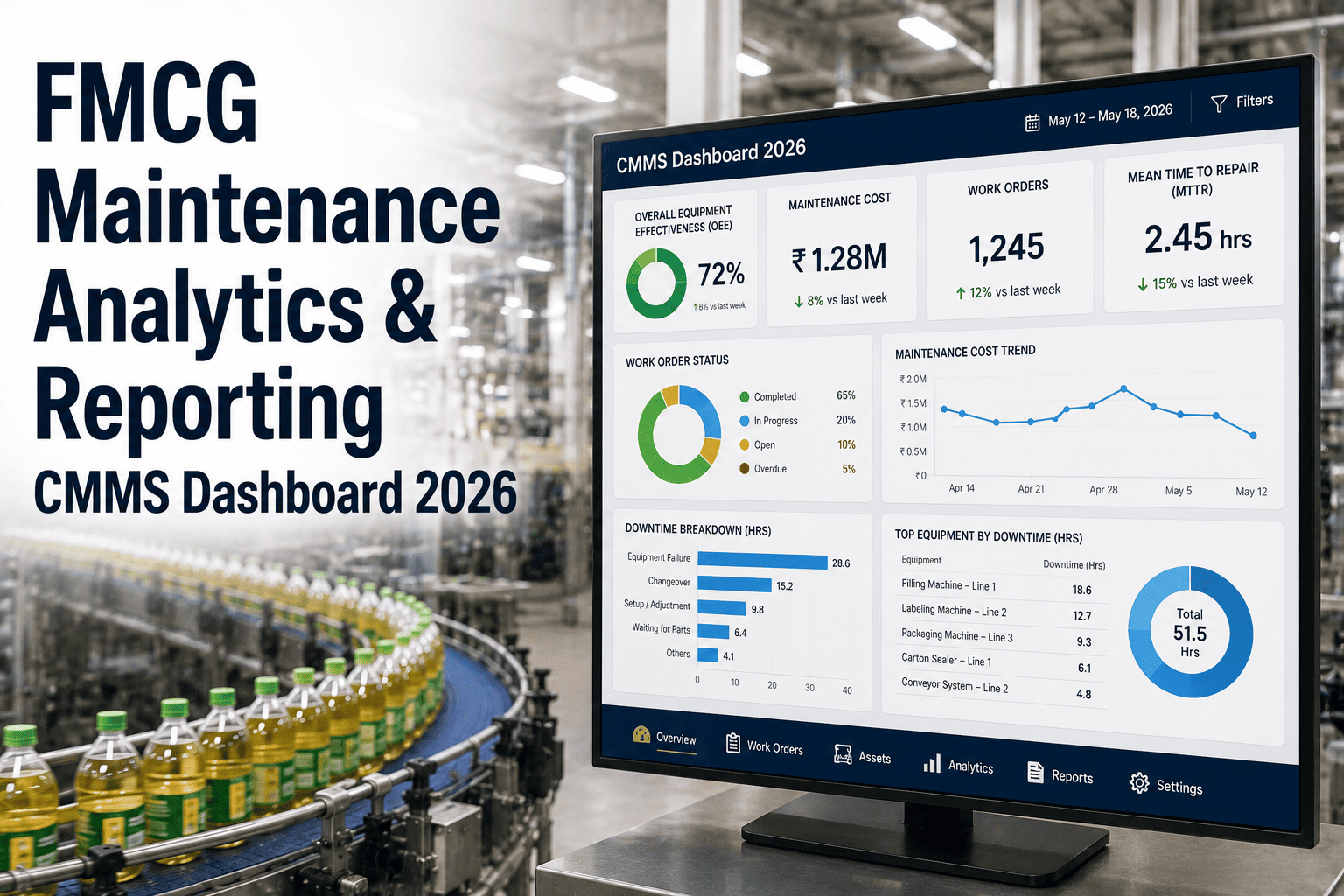
Real-time visibility of MTBF, MTTR, PM compliance rate, backlog hours, maintenance cost per asset, and OEE contribution. Evaluate whether dashboards are pre-built or require configuration, and whether reports can be scheduled and exported for management reporting without manual data extraction.
07
Energy and Sustainability Tracking
High Value
Correlating energy consumption data with maintenance activities reveals $120K–$800K in annual recoverable waste at a typical 5-line FMCG plant. Look for: kW draw logging per asset, energy trend alerts, and automatic carbon equivalent calculation for ESG reporting from maintenance data.
08
IoT and Sensor Integration
High Value
Condition monitoring data from vibration sensors, temperature probes, and pressure transmitters should auto-generate work orders when parameters drift outside normal bands. Evaluate: supported sensor protocols (MQTT, OPC-UA, Modbus), API openness, and whether integration requires custom development.
09
Multi-Site and Multi-Team Management
High Value
Portfolio-level visibility across all production facilities — single dashboard, consolidated reporting, cross-site stock visibility for MRO. Evaluate: role-based access control (site manager vs technician vs plant director), and whether multi-site is standard or requires expensive add-on licensing.
10
ERP and SCADA Integration
High Value
Bi-directional data flow with SAP, Oracle, Microsoft Dynamics for purchase order creation and financial posting. SCADA integration for automatic runtime hour capture from PLC data. Evaluate: native connectors vs API-only integration, and whether integration is included or charged separately.
11
Contractor and Permit Management
Useful
Digital permit-to-work, contractor induction records, and third-party work order management. Important for FMCG plants with significant external maintenance spend on specialist equipment — boiler servicing, refrigeration, compressed air — where contractor compliance documentation is required for insurance and audits.
12
Predictive Maintenance Analytics
Useful
AI-driven failure prediction from historical work order data, sensor inputs, and asset age profiles. Evaluate realistically — predictive maintenance requires 12–24 months of clean data to deliver reliable predictions. Useful for mature deployments; do not let this feature drive selection for first-time CMMS buyers.
All Platform Features — Oxmaint CMMS
All 12 Features. One Platform. Deployed in 48 Hours.
Oxmaint delivers every must-have and high-value CMMS feature for FMCG manufacturing — mobile work orders, PM automation, food safety audit trails, spare parts inventory, energy tracking, and IoT integration — without the enterprise price tag or 6-month implementation timeline.
FMCG-Specific CMMS Requirements: What Generic Platforms Miss
Generic maintenance management software built for facilities management or heavy industry misses critical requirements that are specific to food, beverage, and CPG manufacturing. These gaps become audit failures, compliance incidents, and operational inefficiencies that the CMMS was supposed to prevent. Here are the eight areas where FMCG requirements diverge from standard CMMS functionality.
1
Food Safety Regulatory Documentation
FDA FSMA, BRC Global Standard, SQF, IFS, and HACCP prerequisite programme records must be generated automatically from maintenance activities — not manually assembled before audits. Generic CMMS platforms store work orders but do not structure data to meet food safety audit requirements without extensive custom configuration.
Compliance Critical
2
Allergen Zone and Changeover Management
Assets must be classified by allergen zone — high-care, allergen-containing, allergen-free. Allergen changeover work orders require a specific documented sequence and sign-off before line release. This workflow does not exist in generic CMMS and requires FMCG-specific configuration or platform support.
Food Safety
3
Sanitation and CIP Record Keeping
CIP cycle parameters — chemical concentration, temperature, contact time, conductivity — must be logged per cycle against validated targets, with deviation flagging and corrective action linkage. This is a food safety data capture requirement that generic work order systems are not designed to handle.
Regulatory
4
Hygienic Design and Food-Grade Materials Tracking
Replacement parts on food contact surfaces must be food-grade certified — correct material specification (304 vs 316 stainless, food-grade PTFE seals vs standard elastomers). The CMMS must flag when a non-food-grade part is being assigned to a food contact asset. Generic systems have no concept of food-grade material classification.
Food Safety
5
Calibration and Measurement Equipment Records
Temperature probes, pressure gauges, flow meters, scales, and pH sensors used in food production require periodic calibration with full traceability to national standards. FMCG CMMS must manage calibration schedules, store certificates, and flag expired calibrations before equipment is used in production — not just record that calibration occurred.
Compliance
6
Environmental Monitoring Integration
ATP swab results, microbiological test results, and environmental monitoring trend data must link to the maintenance actions that caused or corrected deviations. When an ATP fail occurs, the corrective action work order should reference the CIP cycle records from the same shift — a closed-loop that generic platforms cannot provide without custom development.
Food Safety
7
Shift-Based and High-Volume Checklist Operations
FMCG plants run 3 shifts, 24/7, generating hundreds of operator inspection records per day across multiple lines. The CMMS must handle high-frequency checklist completion at scale — mobile-first, with offline capability for poor-connectivity areas, and without creating administrative burden for maintenance supervisors managing daily record volumes.
Operational
8
OEE and Production Line Integration
Maintenance downtime must be classified and reported in a format that feeds OEE calculations — distinguishing planned maintenance stops from unplanned failures, and categorising failures by root cause for Pareto analysis. FMCG operations managers need maintenance data in production reporting language, not just maintenance department terminology.
Performance
The CMMS ROI Framework for FMCG Plants
Calculating CMMS ROI requires quantifying five distinct value streams — each measurable, each documented in FMCG deployments. The total annual value consistently exceeds platform cost by 5–15x, with payback periods of 2–6 months. Use this framework to build your internal business case.
Annual CMMS ROI — Mid-Size FMCG Plant Model
5-line food/beverage plant · 22-person maintenance team · $3.2M annual maintenance spend · 2 production sites
Unplanned Downtime Reduction
25% reduction in breakdown events × $18,000/hr average production value × 340 hrs annual downtime baseline
40% reduction in parts search + 30% less admin time × 22 technicians × avg $52K fully loaded annual cost
$228,800
Audit and Compliance Cost Avoidance
Elimination of audit remediation costs, regulatory penalties avoided, reduced third-party audit preparation time
$185,000
Oxmaint Platform Investment
Full platform licence — all features, both sites, unlimited work orders, mobile apps, onboarding support included
$120K–$180K/yr
Net Annual Value — Oxmaint CMMS Deployment
$3.3M+ · 18–27x ROI
Downtime reduction alone typically delivers 8–12x platform cost in the first year. The MRO dead stock recovery from the initial storeroom audit typically covers the full annual licence cost — making the programme self-funding before ongoing savings are counted.
CMMS Selection: How to Evaluate Platforms Without Getting Burned
The CMMS market has over 200 platforms — from legacy enterprise systems requiring 18-month implementations to lightweight tools that look good in demos but collapse under real plant operating conditions. This evaluation framework separates platforms that work in FMCG from those that look good on paper.
Demo the Mobile App First
Ask to see the mobile app before the desktop interface. If the mobile experience is clunky, requires training to navigate, or lacks offline capability — reject the platform. Your technicians will not use a system that slows them down, regardless of how impressive the reporting dashboards look.
Test: Hand phone to a technician during demo
Ask for FMCG Reference Customers
Request 3 reference contacts from food, beverage, or CPG manufacturing plants of similar size. Ask them specifically about: implementation timeline vs what was promised, technician adoption rate after 6 months, and whether the platform handles food safety audit documentation. Generic manufacturing references are insufficient.
Test: Call references — not emails
Test Data Import with Your Own Asset List
Provide your actual asset list (even a subset of 50 assets) and ask the vendor to import it during the pilot. Platforms that handle real data gracefully — with correct hierarchy, duplicate detection, and field mapping — are built for operational reality. Those that struggle with basic import will struggle with everything else.
Test: Import 50 real assets in trial
Evaluate Total Cost of Ownership
The licence price is not the cost. Add: implementation services, data migration, training, customisation charges, integration development, per-user vs unlimited pricing at scale, and annual price escalation clauses. Enterprise CMMS platforms frequently have TCO 3–5x higher than the headline licence cost once all fees are included.
Watch: Hidden implementation fees
Verify Implementation Timeline Claims
Ask for the actual go-live timeline from contract signature to first live work orders — in writing. Enterprise CMMS implementations average 8–18 months. Cloud-native platforms like Oxmaint deploy in 48 hours. If a vendor promises 4 weeks but requires a "discovery phase" and "configuration workshops," the 4 weeks is not an honest number.
Watch: "Go-live" definition varies
Test the Support Model
Submit a support ticket during the trial period and measure response time. Ask what happens when your maintenance manager leaves — is onboarding support for new users included or charged? Ask whether support is in your timezone. A CMMS that fails silently or responds slowly during a breakdown is not a maintenance management tool — it is a liability.
Test: Submit a ticket during trial
Oxmaint CMMS — Free Trial
Test Oxmaint With Your Real Asset Data. No Demo Environment. No Commitment.
Start a free trial and import your actual asset list, run real work orders, and see live dashboards from your plant data — not a vendor sandbox. Decide with evidence, not presentations.
CMMS Implementation: The 90-Day Deployment That Actually Works
Most CMMS implementations fail not because of technology but because of scope. Plants try to configure everything at once, overwhelming technicians and maintenance managers before the system delivers any visible value. The 90-day phased approach below is proven in FMCG environments — delivering measurable ROI at every phase while building adoption organically.
Days 1–15
Foundation
Import asset register — focus on production-critical equipment only (not utilities or ancillary)
Configure user accounts and roles — maintenance manager, technician, read-only for operations
Run first work orders manually — convert 5–10 existing paper jobs to digital
Mobile app training — 1-hour session with technicians, not classroom instruction
First KPI review — MTBF, PM compliance rate, and backlog hours from live data
Output: Audit-ready records from Day 1
Days 61–90
Optimise and Scale
Energy monitoring activation — log compressor kW, boiler consumption per shift
Expand asset coverage — utilities, HVAC, compressed air, water treatment
First management ROI report — documented downtime reduction and MRO savings
Identify dead stock from first full inventory review — typically $200K–$500K flagged
Output: Proven ROI report for leadership
CMMS Adoption: Why Technicians Resist and How to Overcome It
The number one reason CMMS implementations fail is not technology — it is adoption. Technicians who have used paper and tribal knowledge for years will not switch to a digital system because management said so. Understanding the resistance and addressing it directly is what separates deployments that stick from those that quietly revert to whiteboards within 6 months.
Common Resistance Reasons
"This is just more admin work on top of my actual job"
"The mobile app is slower than writing it down"
"Management will use the data to track how long jobs take"
"The system doesn't match how we actually work"
"I already know what needs to be done without a system telling me"
"We tried software before and it never worked"
Proven Adoption Strategies
Start with wins: show technicians how parts staging to work orders saves them search time
Involve senior technicians in checklist design — they own the system they helped build
Frame data as protecting them — digital records prove work was done correctly
Mobile-first: if it works fast on a phone, resistance drops 70% vs desktop-only systems
Show the KPI dashboard in team meetings — technicians respond to visible results
Manager must use the system too — adoption follows leadership, not policy
Oxmaint vs Alternatives: What the FMCG Market Looks Like in 2026
The CMMS market in 2026 has three distinct tiers. Understanding which tier fits your operation — and what you sacrifice in each — is the foundation of a good selection decision.
CMMS Market Tiers — FMCG Buyer's Guide 2026
Platform category, deployment speed, FMCG fit, and total cost of ownership comparison
Category
Go-Live Time
FMCG Fit
Mobile Quality
Annual TCO
Oxmaint Cloud-native, FMCG-purpose-built
48 hours
Purpose-built
Mobile-first
$40K–$180K
Enterprise CMMS SAP PM, IBM Maximo, Infor EAM
8–18 months
Configurable
Desktop-first
$400K–$2M+
Mid-Market CMMS Fiix, eMaint, Limble, Hippo
2–8 weeks
Generic mfg
Adequate
$60K–$300K
Light CMMS / Apps Maintenance Care, MaintainX basic
Days
Minimal
Good
$8K–$40K
Enterprise platforms deliver full functionality but require IT departments, implementation consultants, and 12–18 month timelines that most FMCG operations cannot sustain. Light apps deploy fast but lack food safety documentation, inventory management, and energy tracking that FMCG plants require. Oxmaint occupies the purpose-built middle: FMCG-specific features, cloud-native speed, and a total cost of ownership accessible to single-site and multi-site operators alike.
CMMS Selection — Oxmaint
Skip the 18-Month Implementation. Get Live Work Orders in 48 Hours.
Oxmaint deploys in 48 hours — no IT team, no implementation consultants, no 6-month configuration project. Import your assets, build your PM schedules, and run your first digital work orders within 2 days of sign-up.
It depends entirely on the platform. Cloud-native CMMS platforms like Oxmaint can be live with real work orders within 48 hours of sign-up — no IT infrastructure, no implementation project. Enterprise platforms (SAP PM, IBM Maximo) require 8–18 months of configuration, data migration, and user training. Mid-market platforms typically take 4–12 weeks. The 90-day phased approach described in this guide delivers measurable ROI at each phase regardless of platform — start with critical production assets and PM scheduling before expanding to inventory and energy tracking. The fastest path to value is narrow scope deployed well, not full scope deployed poorly. Start your Oxmaint free trial to experience 48-hour deployment firsthand.
Documented FMCG CMMS deployments consistently show 8–27x return on platform investment in year one, with payback periods of 2–6 months. The three fastest ROI drivers are: (1) unplanned downtime reduction — typically 25–40% fewer breakdown events within 12 months, worth $500K–$2M annually at standard FMCG production loss rates; (2) MRO dead stock recovery — the first storeroom audit typically identifies 25–30% of inventory as unused for 2+ years, recovering $200K–$600K in locked capital; (3) emergency maintenance premium elimination — 40–65% reduction in reactive purchasing premiums within 90 days of min-max automation deployment. The model in this guide shows $3.3M net annual value for a mid-size 5-line FMCG plant against $120K–$180K platform investment.
SAP Plant Maintenance (SAP PM) is a CMMS — but one built for enterprise environments requiring dedicated SAP administrators, extensive configuration, and IT support infrastructure that most FMCG sites cannot sustain at plant level. The common pattern is that SAP PM is configured at corporate level but never adopted on the plant floor because the mobile experience is poor and the system is too complex for daily technician use. Plants that have SAP PM on paper but run maintenance on whiteboards and spreadsheets in practice get the cost of SAP without the value. A purpose-built plant-level CMMS that integrates with SAP for financial posting gives you the best of both: operational simplicity on the floor and financial integrity at corporate level.
Three tactics that consistently drive adoption in FMCG maintenance teams: First, start with what saves technicians time — specifically, parts staging to work orders. When a technician completes a digital work order and the required spare parts are already pulled and waiting, the system has proven its value in concrete personal terms. Second, involve senior technicians in building PM checklists — they will use a system they helped design, and they will resist one imposed from above. Third, use the KPI dashboard in team meetings to show the impact of their work — MTBF improvements, downtime reduction, and PM compliance rates attributed to their team make the value tangible and create positive reinforcement for system use. Avoid mandating usage without demonstrating value first.
FDA FSMA, BRC 9, and SQF auditors focus on four CMMS data areas: (1) Preventive maintenance completion records — evidence that scheduled PM was performed on time, with actual technician sign-off and date, not just scheduled dates; (2) Calibration records — current calibration certificates for all measurement equipment used in food safety monitoring, with traceability to national standards and expiry dates clearly visible; (3) Sanitation and CIP records — per-cycle parameter logs showing time, temperature, concentration, and conductivity against validated targets, with deviation documentation; (4) Corrective action records — evidence that out-of-spec findings triggered documented corrective actions with root cause analysis and closure sign-off. The common audit failure mode is complete records for 90% of requirements and missing records for the 10% the inspector specifically requests — typically from an unannounced shift 6 weeks ago. Book a demo to see how Oxmaint structures these records for instant audit retrieval.
Oxmaint CMMS — All Platform Features
The CMMS Built for FMCG. Live in 48 Hours. ROI in 90 Days.
48 hrs
to first live work order
25–40%
downtime reduction yr 1
18–27x
documented ROI
$3.3M+
net annual value (5-line plant)
✓Mobile-first work orders — offline capable, photo capture, digital sign-off
✓PM scheduling — time, runtime, meter, and multi-trigger automation
✓Food safety audit trail — GMP, FSMA, BRC, SQF records from Day 1
✓Spare parts MRO — BOM linking, min-max reorder, dead stock identification
✓Energy tracking — kW per asset, carbon equivalent, ESG reporting
✓Multi-site dashboard — portfolio visibility, cross-site stock transfer


.png)