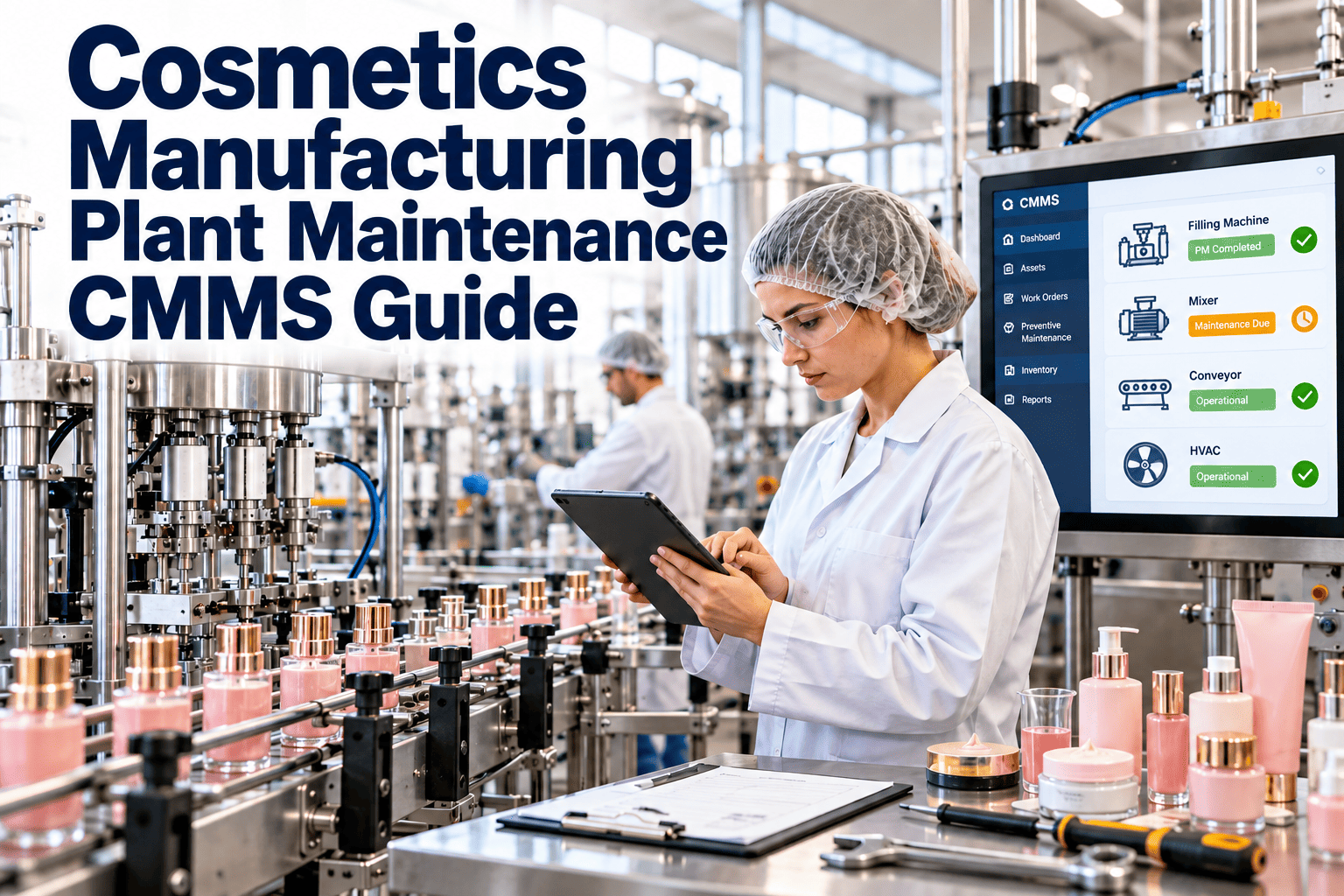
Cosmetics are made in batches, and each batch is only as good as the vessel, mixer, and filling line that produced it. An emulsion that separates, a cream that has air in it, or a bottle that is a little under target can all trace back to a worn seal, a drifting sensor, or an unnoticed leak. Cosmetic plants also work under documentation expectations that go beyond uptime, so maintenance has to leave a clear record. This guide covers the key assets and how a CMMS can support planned maintenance, inspection records, and corrective work in a cosmetics plant.
Cosmetics Manufacturing Plant Maintenance: Emulsifying Vessels, Vacuum Mixers and Filling Lines
Texture, stability, and fill accuracy are decided by equipment condition. Maintain the vessel, the mixer, and the filler as parts of one quality system.
Why Equipment Condition Shows Up in the Product
In cosmetics the customer feels the result: texture, scent, color, and consistency. Many of those qualities depend on mechanical and thermal control during the batch.
Emulsifying Vessel and Vacuum Mixer Maintenance
| Component | Typical wear or fault | Effect on the batch | Preventive action |
|---|---|---|---|
| Homogenizer rotor and stator | Gap increase, edge wear, or damage | Coarser emulsion, longer processing, texture variation | Inspect and measure at intervals, keep a spare set, record run hours |
| Mechanical seals | Face wear, flush loss, or elastomer failure | Leaks, vacuum loss, or lubricant contamination risk | Check flush and leak points, replace on condition and hours |
| Scraper blades and anchors | Edge wear, fatigue, or loose fittings | Poor wall scraping, heat transfer loss, product left on the wall | Inspect blade condition and clearance at each major clean |
| Jacket and temperature control | Scale, valve failure, or sensor drift | Overshoot, slow cooling, and inconsistent phase temperatures | Calibrate probes, check valve response, inspect heat transfer circuits |
| Vacuum pump and lines | Pump wear, oil or liquid condition, leaking joints | Air in the batch and variable density | Run leak tests, service pumps, replace gaskets and hoses |
| Load cells and weighing | Drift or damage from cleaning and shocks | Formula inaccuracy | Verify with test weights and keep calibration records |
Where Batch Quality Risk Concentrates
Filling Line Preventive Maintenance
The filling line decides whether the finished product reaches the customer in the right quantity and in an intact pack. Cosmetic products range from thin lotions to heavy creams, so fillers and nozzles must be matched and maintained accordingly.
Common filling issues
- Stringing and tails on thick products that soil the container and cap.
- Fill variation as piston seals wear or air enters the line.
- Cap cross-threading or inconsistent torque.
- Label skew from worn rollers or dirty sensors.
What the maintenance plan should include
- Cycle-based inspection of piston, seat, and nozzle parts.
- Torque checks with a tester at set intervals and after repairs.
- Sensor cleaning and alignment on labelers and coders.
- Parts stock for seals, nozzles, and wear items linked to each filler.
Compliance, Calibration, and Records
Cosmetic good manufacturing practice is commonly based on ISO 22716, and many markets expect documented control of premises, equipment, and calibration. Confirm the requirements for each market you serve, including any recent legal changes.
Records that tend to matter
- Preventive maintenance completion on critical equipment.
- Calibration of balances, temperature probes, and pressure gauges.
- Cleaning and verification after maintenance on product-contact parts.
- Deviation and corrective action links to equipment faults.
How a CMMS supports them
- Scheduled tasks and sign-offs create a dated record for each asset.
- Calibration due dates are tracked with the instrument.
- Work orders can capture cleaning verification steps and findings.
- Equipment history can be pulled for a batch investigation or audit.
Before and After: Batch Records and Maintenance Records Kept Apart or Together
Separate and informal
- Batch problems are investigated without a clear view of equipment condition.
- Seal and sensor changes are recorded in different places.
- Calibration status is checked by opening folders.
- Repeat faults on the same vessel are not seen across shifts.
Connected through the asset
- Maintenance history can be reviewed alongside the production period.
- Parts, seals, and repairs are logged against the vessel or filler.
- Calibration tasks and results are visible by instrument.
- Repeat faults show up in asset reports and prompt a root-cause review.
Failure Scenarios in Cosmetic Production and What the Records Should Show
| What the plant sees | First suspicion | Records to review | Likely corrective action |
|---|---|---|---|
| Emulsion separates after storage | Homogenizer wear or temperature deviation | Rotor-stator inspection, probe calibration, batch temperature trend | Replace worn parts, recalibrate sensors, confirm speed and time settings |
| Cream has visible air bubbles | Vacuum leak or seal damage | Vacuum hold tests, seal and gasket history | Repair leaks, replace seals and hoses, retest before the next batch |
| Batch weight or formula accuracy drifts | Load cell or dosing pump error | Calibration records, cleaning and shock events | Recalibrate or replace cells, inspect dosing pumps |
| Fill weight varies on thick products | Piston or valve wear, air in line | Cycle counts, seal changes, fill spread by head | Replace seals, bleed the line, tighten the inspection interval |
| Contamination complaint on a product | Seal failure or poor cleaning verification | Seal and gasket changes, cleaning sign-offs, repair notes | Review the repair, replace affected parts, correct the cleaning method |
Utilities That Quietly Control Cosmetic Quality
Purified water, steam, cooling water, and compressed air do not appear on the batch record as equipment, yet each one changes the outcome of a batch when it drifts.
Choosing Between Time-Based and Condition-Based Tasks
Where time-based tasks fit
- Gasket and o-ring replacement on vessels with a known life.
- Calibration of balances and probes on a defined interval.
- Lubrication and filter changes on pumps and drives.
- Safety and guard inspections that must happen regardless of condition.
Where condition-based tasks fit
- Homogenizer head replacement based on measured gap and run hours.
- Mechanical seal replacement based on leak and flush findings.
- Pump and motor work triggered by vibration or temperature trends.
- Tooling replacement on fillers based on fill spread and cycle counts.
Changeover and Cleaning: The Overlap With Maintenance
Building the Program in Your CMMS
Spare Parts and Consumables: What Is Worth Holding On Site
Safety Around Heated and Pressurized Vessels
Hazards to plan for
- Hot surfaces and steam on jackets, lines, and valves.
- Vacuum and pressure on vessels and lids during opening and closing.
- Rotating mixers and scrapers during cleaning and inspection.
- Slippery floors from product spills near vessels and fillers.
Controls to record with the work
- Lockout and isolation steps for each vessel and mixer.
- Pressure and temperature checks before opening any vessel.
- Guard and interlock verification after every repair.
- Spill cleanup and floor condition checks before returning the area to production.
KPIs for Cosmetics Plant Maintenance
Maintenance Maturity for Cosmetics Plants
Batch Readiness Checklist
- Vessel seals, gaskets, and lid fittings inspected.
- Vacuum hold test completed and recorded.
- Homogenizer condition and run hours reviewed.
- Load cells and temperature probes verified.
- Filler seals, pistons, and nozzles inspected by head.
- Capper torque tested against specification.
- Labeler sensors and coder printheads cleaned.
- Spare seals and wear parts confirmed for the asset.
A practical way to begin is to pick one emulsifying vessel and the filler it feeds, load their tasks, calibration dates, and spare parts, and run the program for a full month of batches. The first reports usually show which seals, sensors, and nozzles cause the most repeat work, and that evidence makes the case for extending the same structure to the rest of the plant, one line at a time, without disrupting production schedules or overloading the team with new paperwork.