Robotic Grippers & End-Effectors: Choosing the Right Tool for FMCG Products
By Oxmaint on February 21, 2026
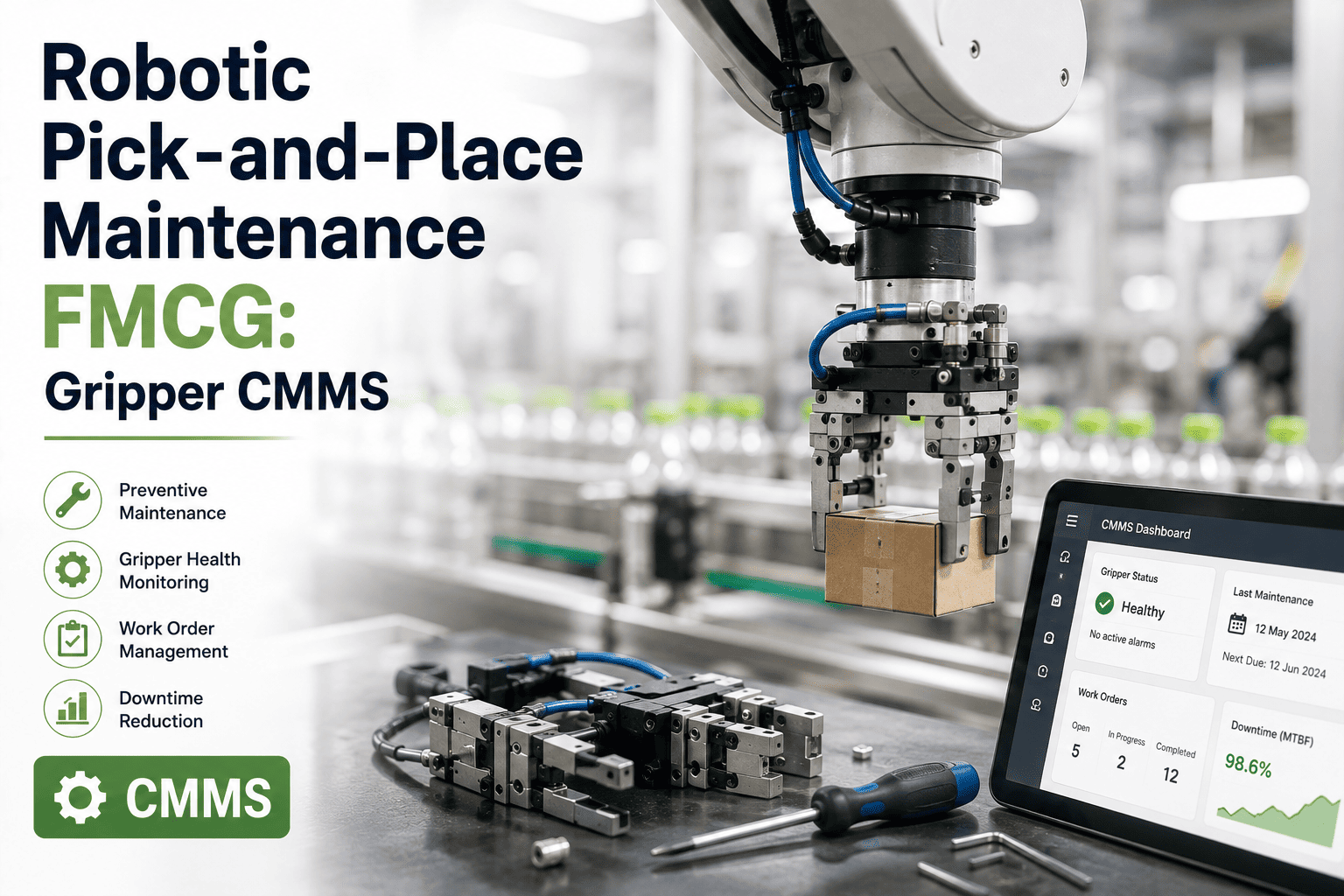
A confectionery manufacturer in Pennsylvania was losing 2,300 units per shift to gripper-related damage — vacuum cups on the pick-and-place robots were leaving surface marks on chocolate-enrobed bars during summer months when ambient temperature softened the coating below its deformation threshold. The engineering team had specified the grippers for winter production conditions and never recalibrated vacuum force for seasonal variation. A second line running bagged snacks was dropping 1 in every 85 picks because the universal flat vacuum cups could not maintain seal on the irregular bag surfaces created by nitrogen flush packaging. Both problems had the same root cause: gripper selection and maintenance treated as a one-time commissioning decision rather than an ongoing operational discipline. After switching to temperature-compensating soft grippers on the chocolate line, adaptive foam-tip cups on the snack line, and tracking gripper wear metrics through Oxmaint, surface damage dropped to zero, pick reliability improved to 1 in 11,400 cycles, and unplanned gripper replacements fell 74% because wear was detected weeks before failure. Oxmaint tracks gripper wear and PM schedules for every end effector — Book a Demo.
The Right Gripper Picks the Product. The Wrong One Destroys It.
FMCG products span the full spectrum of handling difficulty — fragile confections, deformable pouches, rigid bottles, slippery films, variable-weight trays, and temperature-sensitive frozen goods. Each demands a gripper engineered for its specific material properties, and every gripper demands a maintenance program that tracks wear before it becomes product damage. This guide covers gripper selection, maintenance protocols, and changeover management for every major FMCG product category.
No single gripper technology handles every FMCG product. Selecting the wrong type causes product damage, reduced throughput, and accelerated wear — while selecting the right type with the wrong maintenance program produces the same failures on a longer timeline.
Gripper Technology Comparison for FMCG Applications
Mixed-SKU palletizing, variety packs, promotional displays with multiple formats
60–140/min
All components from combined technologies plus changeover mechanisms
500–2,000 hrs
How Gripper Failures Manifest in FMCG Production
Gripper degradation in FMCG environments follows predictable patterns that are detectable through maintenance monitoring well before they cause product damage or line stoppages — but only if wear metrics are tracked systematically.
Gripper Failure Progression: From Wear to Production Impact
⚙️ Normal Grip → Wear Onset → Performance Drift → Product Damage → Line Stop
Each gripper type has distinct failure signatures detectable weeks before production impact
Vacuum Cup Degradation (2–6 weeks)
Cup lip hardening reduces seal conformance. Vacuum hold force drops 5–15% before visible cracking. Manifests as increased pick failures on irregular surfaces before flat-surface picks are affected. Monitor vacuum level at cup vs. generator — growing differential indicates cup wear.
Soft Gripper Fatigue (1–4 weeks)
Silicone finger actuators lose elasticity after 100,000–500,000 cycles. Grip force decreases gradually — detectable as increasing cycle time when the controller compensates by slowing approach speed. Surface coating wear creates friction changes that mark delicate products before drops occur.
Mechanical Jaw Wear (3–8 weeks)
Jaw pad material compresses and hardens, reducing grip friction. Pivot pin wear introduces angular play that shifts product centering. Spring fatigue reduces clamping force by 10–20% before pad replacement would normally be scheduled. Track jaw closure time — increasing time signals actuator or spring degradation.
Sensor Drift (2–4 weeks)
Force sensors and proximity detectors on grippers drift from calibration due to vibration, temperature cycling, and contamination from product residue. Miscalibrated force sensors allow excessive grip pressure (product deformation) or insufficient pressure (drops). Recalibrate on fixed PM cycles.
Gripper Selection by FMCG Product Category
Cartons, Cases & Trays
Vacuum or Mechanical
Primary Gripper: Vacuum suction cups — flat-lip silicone cups for smooth carton surfaces, foam-tip cups for textured or printed surfaces, bellows cups for uneven tops Key Specification: Vacuum force must exceed product weight by 3–4× safety factor to handle acceleration forces during high-speed pick-place motions Common Failure: Cup lip hardening from UV exposure and cleaning chemical contact — replace cups on 500–1,000 hour cycles regardless of visual condition CMMS Tracking: Log cup replacement dates, vacuum generator maintenance, filter changes, and pick-fail-rate trending per robot per shift
Pick reliability target: 99.95% — 1 miss per 2,000 picks or better
Bottles, Cans & Jars
Jaw or Magnetic
Primary Gripper: Mechanical jaw grippers with contoured pads for PET bottles, parallel grippers for cans, three-finger centering grippers for jars and irregular shapes Key Specification: Jaw pad material must match container surface — soft urethane for glass (scratch prevention), textured TPU for slippery PET, food-safe silicone for open-top containers Common Failure: Jaw pad compression set from sustained clamping — pads lose 30–40% of surface friction after 50,000–100,000 cycles even without visible wear CMMS Tracking: Track pad replacement by cycle count, jaw parallelism checks, actuator stroke time, and grip force verification per PM cycle
Grip force accuracy: ±5% of setpoint — exceeding causes container deformation or label damage
Baked Goods & Confections
Soft Adaptive
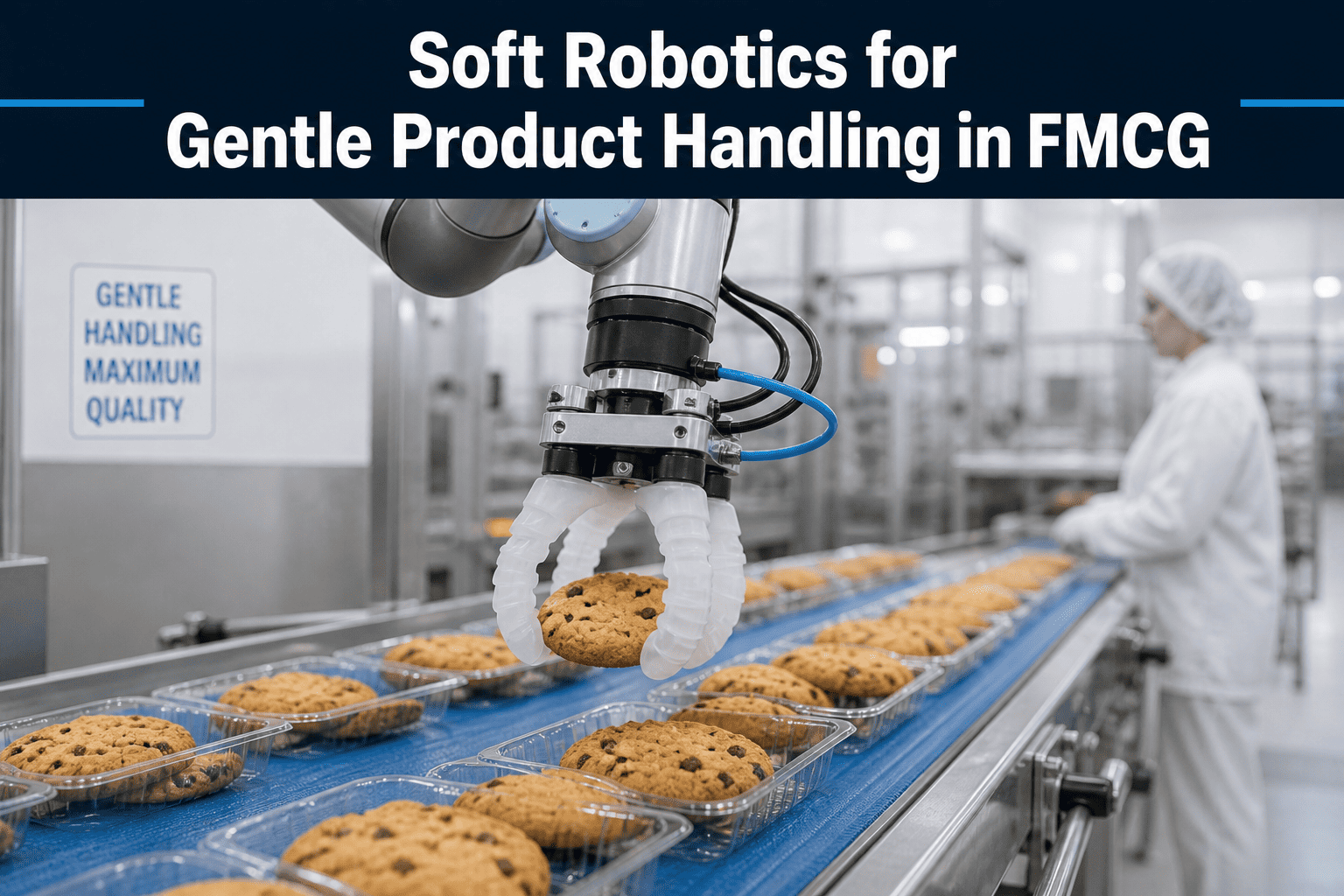
Primary Gripper: Soft pneumatic grippers with silicone fingers that conform to product shape without applying concentrated pressure — granular jamming grippers for extremely fragile items Key Specification: Maximum contact pressure below product deformation threshold — typically <0.5 psi for decorated cakes, <2 psi for cookies, <5 psi for bread loaves Common Failure: Silicone finger surface contamination from product oils, sugars, and coatings creates adhesion that damages decorated surfaces on release — clean fingers every shift CMMS Tracking: Track finger replacement by cycle count and durometer hardness readings, cleaning logs, and product damage correlation per gripper set
Surface damage tolerance: zero visible marks on decorated products after grip-release cycle
Pouches, Bags & Flexible Packaging
Vacuum or Pinch
Primary Gripper: Foam-tip vacuum cups for flat pouches, bellows cups for nitrogen-flush bags with irregular surfaces, pinch grippers for stand-up pouches gripped at the seal area Key Specification: Vacuum cups must seal against film surfaces that shift and wrinkle — foam inserts conforming to surface irregularity outperform flat-lip cups by 3–5× on flexible packaging Common Failure: Film residue (oils, powders, coatings) accumulates on cup surfaces and degrades seal quality — pick failure rate climbs 200–400% between cleaning intervals CMMS Tracking: Track cup cleaning frequency, foam insert replacement, vacuum leak-down rate testing, and pick-failure trending segmented by SKU and film type
Flexible packaging pick success: 99.8%+ requires shift-level cup cleaning protocols
Every Gripper Is a Wear Part. Your CMMS Should Track It Like One.
Oxmaint tracks gripper wear metrics, cup replacement cycles, pad durometer readings, force calibration records, and pick-failure trending for every end effector across your robotic fleet — so you replace wear parts on schedule, not after product damage forces a line stop.
Gripper maintenance in FMCG environments is more demanding than in general industrial applications because food-contact requirements add cleaning, sanitization, and material compliance layers on top of standard mechanical wear management. Oxmaint manages food-safe gripper PM with material traceability — Sign Up Free.
Vacuum Gripper Maintenance Protocol
Every Shift — Cup Surface Cleaning: Wipe cup contact surfaces with food-safe solvent to remove product residue, oils, and powder contamination. Residue buildup is the #1 cause of vacuum seal failure on flexible packaging. Log cleaning completion in mobile CMMS with timestamp per robot.
Weekly — Vacuum Leak-Down Test: Seal each cup against a reference surface and measure vacuum decay rate over 10 seconds. Decay exceeding 15% indicates cup lip damage, hose leak, or fitting deterioration. Compare results against baseline — trending upward decay means replacement is needed within 1–2 weeks.
500–1,000 Hours — Cup Replacement: Replace all vacuum cups regardless of visual condition. Silicone and polyurethane cups lose 20–30% of lip flexibility before visible cracking appears. Use operating-hour triggers in your CMMS, not calendar dates — a robot running 20 hours/day wears cups 3× faster than single shift.
1,000–2,000 Hours — Vacuum Generator Service: Replace inline filters, check ejector Venturi wear, verify vacuum pressure at cup vs. at generator (differential >10% indicates line restriction). Rebuild or replace vacuum generators showing >15% pressure loss from rated specification.
Quarterly — Hose and Fitting Inspection: Inspect all vacuum hoses for cracks, kinks, and internal contamination. Check quick-disconnect fittings for seal wear. Replace any hose with visible cracking or hardening. Contaminated hoses restrict airflow and reduce cup performance even when cups are new.
Vacuum gripper maintenance cost: $800–$2,500/year per robot. One prevented product damage incident ($5,000–$25,000 in rejected product, line downtime, and rework) pays for 2–10 years of gripper PM.
Mechanical Gripper Maintenance Protocol
Daily — Jaw Pad Visual Inspection: Check pad surfaces for scoring, embedded debris, compression set, and delamination. Any visible damage requires immediate replacement — a scored pad will scratch container surfaces on every pick. Log pad condition in mobile CMMS with photo documentation.
Weekly — Grip Force Verification: Use a force gauge to verify actual clamping force at the jaw face matches the controller setpoint within ±5%. Force drift outside this band indicates actuator wear, spring fatigue, or pneumatic leak. Trend force readings — declining force at constant setpoint is an early wear indicator.
1,000–2,000 Hours — Jaw Pad Replacement: Replace pads on cycle-count triggers. Measure pad durometer hardness during replacement — hardness increase >10 Shore A points from new condition confirms correct replacement interval. Adjust interval if hardness change is minimal (extend) or excessive (shorten).
2,000–4,000 Hours — Pivot and Guide Overhaul: Inspect pivot pins, guide rails, and linear bearings for wear and backlash. Measure jaw parallelism with a dial indicator — deviation >0.1 mm indicates guide wear requiring replacement. Lubricate all pivot points with food-safe grease (NSF H1).
Mechanical gripper maintenance cost: $1,200–$4,000/year per robot. Jaw pad inventory management through CMMS prevents the most common failure: running worn pads because replacements were not in stock.
Soft Gripper Maintenance Protocol
Every Shift — Surface Cleaning and Inspection: Clean all product-contact surfaces with approved food-safe cleaner. Inspect for tears, punctures, discoloration, and surface coating wear. Soft grippers contact products directly — any surface defect transfers to the product as a mark, scratch, or contamination risk.
Weekly — Actuation Cycle Time Test: Measure open-to-close and close-to-open cycle times against baseline. Soft actuators slow as they fatigue — a 15–20% increase in cycle time indicates the actuator is approaching replacement threshold. Track in CMMS as a trending metric.
300–1,000 Hours — Finger/Bladder Replacement: Replace silicone fingers or pneumatic bladders on cycle-count schedule. Durometer testing confirms replacement timing — silicone softening >15 Shore A from baseline indicates material fatigue. Keep pre-assembled replacement finger sets in inventory for sub-10-minute swap.
Monthly — Pneumatic System Check: Verify air pressure at the actuator matches regulator setpoint (typical: 1–3 bar for soft grippers). Check all pneumatic connections for leaks using soap solution test. Inspect tubing for kinks, hardening, or contamination. A 10% pressure drop at the actuator causes 20–30% grip force loss.
Soft gripper maintenance cost: $2,000–$6,000/year per robot due to higher consumable costs. Essential for products where surface damage tolerance is zero — the alternative is manual handling at 3–5× the labor cost.
End Effector Changeover Management
FMCG lines running multiple SKUs require gripper changeovers that are fast, repeatable, and documented. A changeover that takes 45 minutes instead of 12 costs $2,000–$5,000 per occurrence in lost production — and changeovers performed without verification create quality escapes that cost far more. Oxmaint tracks changeover times and verification steps per SKU — Book a Demo.
End Effector Changeover Best Practices
Practice
Implementation
Impact
CMMS Role
Quick-Change Tool Plates
Standardize tool plate interfaces (ISO 9409-1) across all robots — swap entire end effector assemblies instead of individual components
Changeover time: 45 min → 8–12 min per robot
Track tool plate serial, hours on each assembly, last PM date
Pre-Staged Gripper Kits
Maintain ready-to-install gripper assemblies for each SKU family — cleaned, inspected, and verified before production needs them
Eliminates mid-changeover assembly and adjustment
PM work orders for staged kits, inventory levels, expiry tracking
Digital Verification Checklist
Post-changeover checklist: vacuum test, force verification, first-article pick test, photo confirmation of gripper configuration
Prevents quality escapes from incorrect or incomplete changeover
Mobile checklist with pass/fail, photo upload, e-signature
Recipe-Linked Parameters
Store gripper parameters (vacuum level, grip force, approach speed, pick offset) per SKU recipe — auto-load on changeover
Eliminates manual parameter entry errors
Recipe management linked to asset configuration records
"We spent $180,000 on soft robotic grippers for our bakery lines and then ran them for eight months without a structured PM program. By month six, three robots were leaving finger marks on decorated cakes because silicone fatigue had changed the contact pressure profile. We were blaming the robot OEM for a maintenance problem. Once we started tracking durometer readings, cycle counts, and cleaning compliance through the CMMS, the same grippers ran 14 months before replacement — and zero surface damage incidents in between. The gripper technology was never the issue. The maintenance discipline was."
Wear Is Invisible Until It's Not
Gripper wear happens gradually — cups lose flexibility, pads lose friction, fingers lose elasticity. The damage shows on products before it shows on the gripper. Measurement-based PM catches it first.
Cleaning Is Maintenance
In FMCG, gripper cleaning is not housekeeping — it is a maintenance activity that directly impacts pick reliability and product quality. Track it in the CMMS with the same rigor as parts replacement.
Spares Win Changeovers
Pre-staged, pre-inspected gripper assemblies for each SKU family turn 45-minute changeovers into 10-minute swaps. Inventory management through CMMS ensures ready assemblies are always available.
Your Grippers Touch Every Product You Ship. Your CMMS Should Track Every Gripper You Run.
Oxmaint manages gripper wear metrics, cup and pad replacement schedules, durometer trending, changeover verification checklists, force calibration records, and spare parts inventory for every end effector in your FMCG fleet — one platform for the full gripper lifecycle alongside your robot maintenance program.
How do I select the right gripper for a new FMCG product?
Start with the product's deformation threshold — the maximum contact pressure it can withstand without visible damage. Soft, decorated, or temperature-sensitive products (baked goods, confections, fresh produce) require soft adaptive grippers operating below 0.5–5 psi contact pressure. Rigid containers (bottles, cans, cartons) work with vacuum or mechanical grippers. Flexible packaging (pouches, bags) requires foam-tip vacuum cups or pinch grippers depending on seal-area accessibility. Request gripper samples from 2–3 vendors and run pick-place trials on actual production product at target cycle speed — a gripper that works at 60 picks/minute may fail at 120 due to higher acceleration forces. Document the validated gripper specification, operating parameters, and PM requirements in your CMMS asset record for the end effector.
How often do vacuum cups need replacement in FMCG applications?
Replacement intervals depend on cup material, product type, and cleaning chemical exposure. Silicone cups handling dry cartons last 1,500–2,000 operating hours. The same cups handling oily flexible packaging may need replacement at 500–800 hours because product oils accelerate material degradation. Polyurethane cups offer better chemical resistance but shorter life in high-temperature environments. The most reliable replacement trigger is the weekly vacuum leak-down test — when decay rate exceeds 15% of the baseline reading, replace within the next planned maintenance window regardless of operating hours. Track leak-down test results as a trending metric in your CMMS to establish the actual replacement interval for each robot and product combination rather than relying on generic manufacturer recommendations.
Can one gripper handle multiple FMCG product types?
Hybrid multi-mode grippers can handle 2–4 product formats by combining vacuum zones, mechanical fingers, and adaptive surfaces in a single end effector. However, multi-mode grippers are 40–60% more expensive, have more wear points to maintain, and typically compromise peak performance on any single product versus a dedicated gripper optimized for that format. The better approach for most FMCG plants is quick-change tool plates with dedicated gripper assemblies per SKU family — changeover takes 8–12 minutes with pre-staged kits, each gripper is optimized for its product, and maintenance is simpler because each assembly has a single set of wear characteristics to track. Hybrid grippers make sense only when changeover frequency exceeds 6–8 times per shift and changeover time directly limits production output.
What food safety requirements apply to robotic grippers in FMCG?
All gripper materials contacting food or primary packaging must be FDA 21 CFR compliant (US) or EC 1935/2004 compliant (EU) for food contact. Silicone, certain polyurethanes, and specific stainless steel grades meet these requirements — but not all formulations within those material families are food-safe. Lubricants used on gripper mechanisms must be NSF H1 certified for incidental food contact. Cleaning chemicals must be compatible with gripper materials and approved for food production environments. Gripper design should minimize crevices that trap product residue and resist biofilm formation. Track material certifications, cleaning chemical compatibility, and sanitation compliance in your CMMS per gripper assembly — auditors will ask for this documentation during food safety inspections.
How does Oxmaint track gripper maintenance?
Oxmaint registers each end effector as a child asset under its parent robot with its own PM schedule, wear metric tracking, and spare parts inventory. Cup replacements, pad changes, and finger swaps are scheduled by operating hours with automatic work order generation when thresholds are reached. Weekly vacuum leak-down test results and force gauge readings are logged as condition monitoring data points with automated alerts when trending toward replacement thresholds. Changeover verification checklists run on mobile devices with pass/fail steps, photo documentation, and electronic sign-off. Gripper spare parts inventory tracks stock levels per SKU family with automated reorder triggers. Material certifications, cleaning logs, and food safety compliance records attach to the gripper asset record for audit readiness.