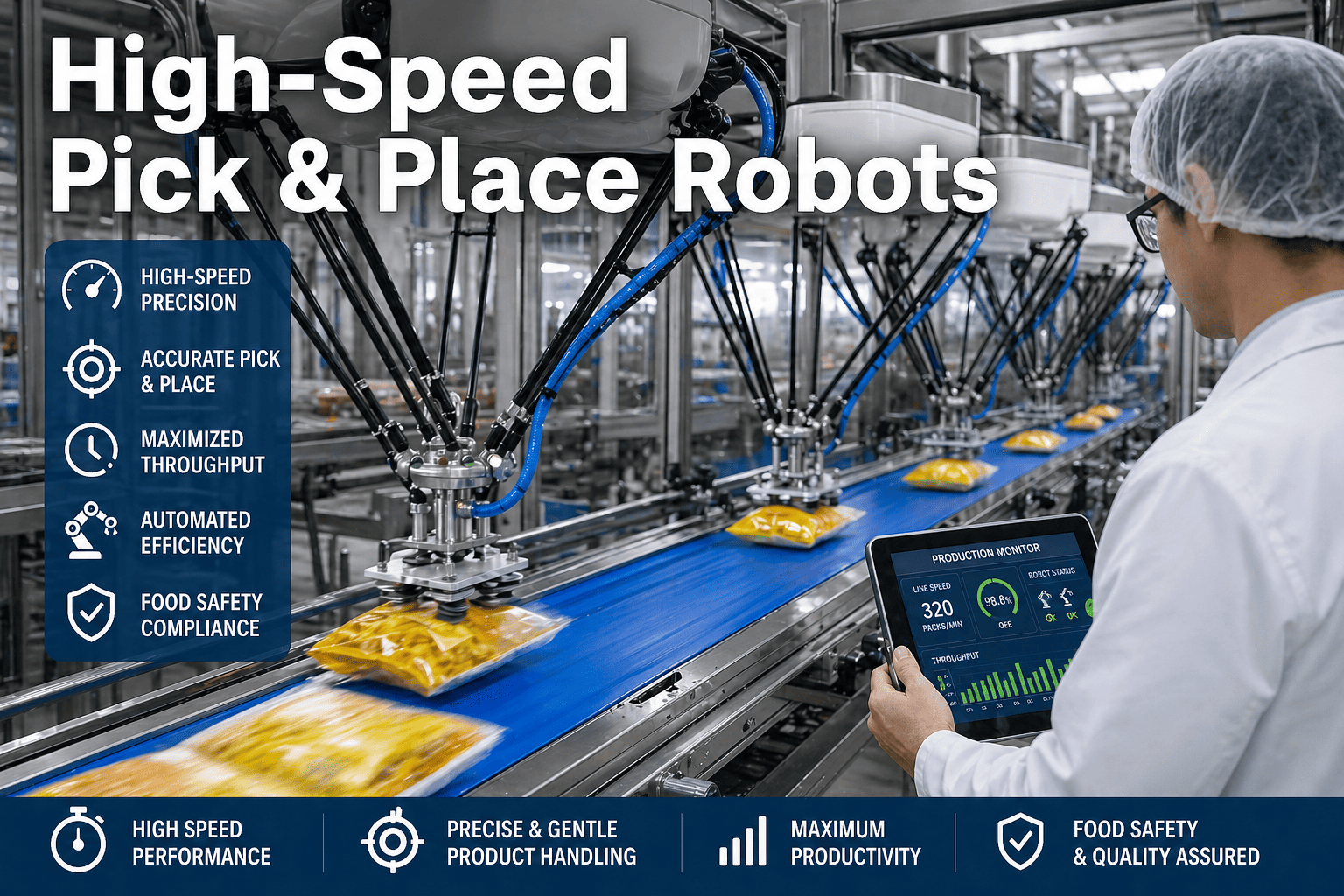
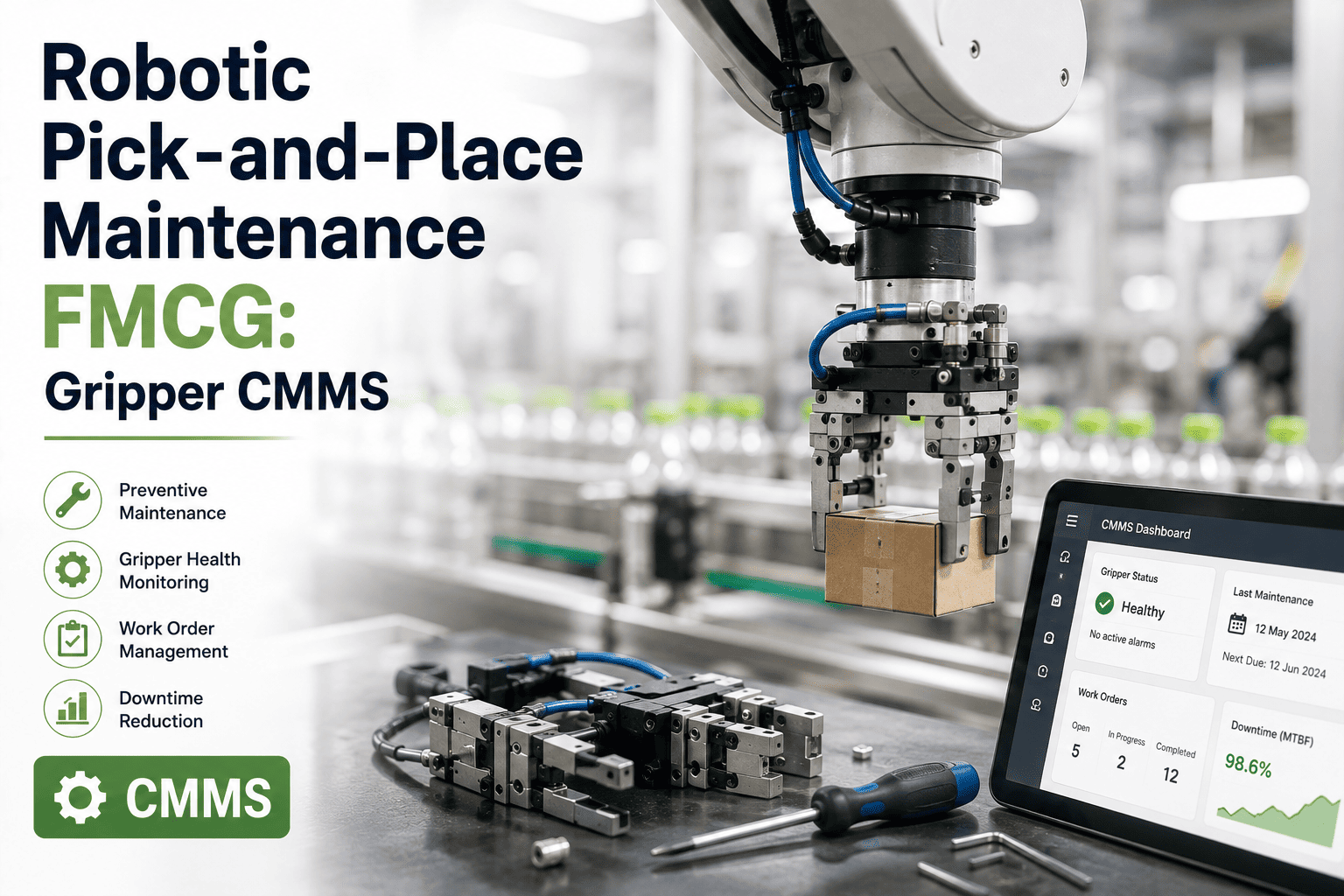
FMCG production lines are a race against physics. A consumer packaged goods facility producing 600 units per minute cannot afford a pick-and-place station that misses 2% of product, cycles at 80 picks per minute instead of the validated 120, or goes down unplanned for 40 minutes at a shift handover. The robotic systems that run high-speed sorting, packaging, and product handling are among the highest-utilization assets in any FMCG plant — and they are almost universally undermaintained, because most facilities track their production output but not the asset health that produces it. Book a demo to see how Oxmaint structures pick-and-place robot maintenance programs, OEE tracking, and work order management for FMCG production environments.
Core Insight
Pick-and-place robots deliver speed and consistency that human lines cannot match — but only when the underlying maintenance program matches the asset's operational intensity. A delta robot running 150 picks per minute accumulates wear on end effectors, vacuum generators, and servo drives faster than any other plant asset class. Without cycle-count-based PM, OEE tracking at the individual robot level, and real-time downtime capture, the speed advantage erodes silently. Oxmaint builds the maintenance infrastructure that keeps robotic pick lines at world-class OEE.
150+
picks per minute — top-spec delta robots in food and pharma FMCG lines
23%
of FMCG production downtime attributed to robotic handling system failures — OEE study
85%
OEE — world-class benchmark for robotic pick-and-place lines; most plants run 65–72%
4x
higher throughput for delta robots versus manual pick stations at comparable accuracy rates
The Two Robot Types That Run FMCG Pick-and-Place Lines
Most FMCG facilities run two robot architectures for high-speed handling — delta (parallel kinematic) systems for ultra-fast light-payload picking, and SCARA systems for precision assembly and secondary packaging. Understanding the mechanical differences matters for maintenance planning: each architecture has distinct wear profiles, PM intervals, and failure modes. Treating them identically in the maintenance system is one of the most common reasons OEE drops below target without a clear root cause. Start a free trial and register your pick-and-place robots in Oxmaint's asset hierarchy with type-specific PM templates built for FMCG production intensity.
Speed
100–150 picks/min
Payload
0.5–3 kg typical
Best Application
Primary packaging, confectionery, bakery, produce sorting
Key Wear Points
Universal joints, end effector vacuum cups, servo amplifiers
PM Interval
Every 500,000–1M cycles or 500 operating hours
Critical PM Task
Universal joint play check — 0.1mm tolerance breach causes pick miss cascade
Speed
40–80 picks/min
Payload
1–20 kg range
Best Application
Case packing, secondary packaging, kitting, palletizing light loads
Key Wear Points
Harmonic drive gearboxes, Z-axis ballscrew, wrist rotation seal
PM Interval
Every 1,000 operating hours or 12 months — whichever first
Critical PM Task
Harmonic drive backlash measurement — early indicator of precision loss
The Hidden OEE Destroyers in Pick-and-Place Lines
OEE losses on robotic pick lines rarely announce themselves. They accumulate in micro-stoppages, marginal speed reductions, and quality rejections that individually look like noise but collectively represent 15–20% of available production capacity. The four patterns below account for the majority of OEE gap between world-class and average FMCG robotic line performance.
01
End Effector Wear Goes Untracked
Vacuum cups, grippers, and suction pads degrade with every pick cycle. Performance drops gradually — pick success rate falls from 99.8% to 97.5% before anyone notices. At 120 picks per minute, that 2.3% miss rate produces 165 misses per hour and downstream product damage that triggers line stops.
OEE impact: 3–5 percentage points
02
Vision System Calibration Drift
Camera calibration shifts with temperature changes, lens contamination, and conveyor belt tracking variation. Pick accuracy degrades before the vision system generates a fault code. Recalibration happens reactively — after the rejects pile up — rather than on a preventive schedule tied to production hours.
OEE impact: 2–4 percentage points
03
Servo Drive Thermal Cycling Damage
High-speed FMCG lines run servo drives at 80–95% of rated duty cycle. Thermal cycling without adequate cooling interval or lubrication schedule degrades motor windings and encoder accuracy over 12–18 months. MTBF is compressible — most plants compress it by 40% through inadequate PM.
OEE impact: 5–8 percentage points
04
No Production-Based PM Triggers
Calendar-based PM misses the critical variable: how hard the robot is actually working. A robot on a seasonal confectionery line may run 400,000 cycles in Q4 and 80,000 in Q1. The PM interval should track cycles — not months. Calendar PM either over-services during slow periods or under-services during peak production.
OEE impact: cumulative compounding effect
How Oxmaint Manages Pick-and-Place Robot Fleets
Pick-and-place robots are high-intensity assets that need a maintenance management approach built around their operational reality — cycle counts, OEE by line, end effector replacement tracking, and vision system calibration schedules. Oxmaint delivers this through a unified platform that connects production data to maintenance work orders automatically. Start a free trial and map your robotic line into Oxmaint's OEE dashboard within the first week of deployment.
OEE Tracking
Real-Time OEE at Line Level
Availability, performance, and quality tracked per individual pick robot — not just per line or per shift. OEE trends show degradation weeks before a failure occurs. Benchmark dashboards compare robots across facilities and identify the 15% variance that separates average from world-class.
PM Scheduling
Cycle-Count-Based Preventive Maintenance
PM work orders triggered by production counters — cycles completed, hours operated, units handled. End effector replacement, servo lubrication, vision calibration, and joint inspection all fire at manufacturer-specified intervals tied to actual usage, not the calendar. Seasonal production spikes are captured automatically.
Downtime Capture
Fault Code to Work Order Routing
Robot controller fault codes integrated directly — each alarm auto-generates a work order with fault code, affected robot, and priority classification. No production supervisor manually logging downtime. MTTR tracking shows which fault categories consume the most repair time across the fleet.
Spare Parts
Critical Spare Parts Inventory
End effectors, vacuum cups, servo drives, encoder batteries, and vision system lenses tracked per robot model in the MRO inventory module. Reorder triggers prevent the 6-hour wait for an overnight courier when a suction pad batch runs out during peak production. Lead time buffers calculated automatically.
Asset Registry
Full Robot Asset Hierarchy
Each robot registered with model, serial number, installation date, cycle counter baseline, and component-level hierarchy — arm, wrist, end effector, vision system, servo drives. Failure history is attached to the specific component, not just the robot serial number. Root cause trends emerge from data, not memory.
Changeover
SMED and Changeover Management
Product changeover tasks for pick-and-place lines — end effector swap, program change, vision retrain, conveyor speed adjustment — structured as digital work orders with step-by-step instructions and time targets. SMED analysis identifies the changeover steps that exceed benchmark and compresses total changeover time.
Before Oxmaint vs After — Pick Line Performance Shift
Results FMCG Plants Report After 90 Days
OEE Improvement
+14%
Average OEE gain on robotic pick lines after cycle-based PM implementation. Plants tracking at 68% OEE reach 82% within two quarters of full deployment.
Unplanned Downtime
-52%
Unplanned stoppages on pick-and-place lines reduced when PM fires before wear reaches failure threshold. Servo and end effector failures drop most sharply in the first 90 days.
Mean Time to Repair
-38%
Technicians arrive at faults with fault history, last PM record, and spare parts confirmation already in hand. No time spent tracing failure history or waiting on parts confirmation.
Changeover Time
-22%
Structured digital changeover work orders with step timing reduce average changeover duration on pick lines. SMED analysis identifies the 3–4 steps that consume 60% of changeover time.
Frequently Asked Questions
QHow does Oxmaint track cycle counts from robot controllers automatically?
QCan Oxmaint handle different PM intervals for delta versus SCARA robots on the same line?
Yes. Each robot is configured as a distinct asset with its own PM schedule templates, component hierarchy, and trigger conditions. A delta robot PM template includes universal joint inspection, vacuum cup replacement at 200,000 cycles, and vision calibration at 500 hours. A SCARA template in the same facility runs on different intervals and tasks. The platform manages both simultaneously with zero conflict.
QHow does OEE data connect to maintenance decisions in Oxmaint?
OEE at the individual robot level is displayed on the production dashboard with breakdown into availability, performance, and quality components. When performance drops below a configured threshold — say, a pick rate decline of more than 3% from baseline — the system generates a condition-based work order for end effector inspection or vision calibration. The OEE data becomes the trigger, not a report produced after the fact.
QWhat happens to changeover management when pick programs change between SKUs?
Each product changeover type is a structured work order template in Oxmaint — listing every step from end effector swap and program upload to vision system retrain and first-article inspection. Steps are assigned to specific roles with time targets. Actual completion times are captured per step, making SMED analysis straightforward and identifying where changeover overruns originate at the task level, not just total time.
Stop Losing OEE to Robotic Pick Line Failures You Could Have Predicted
Oxmaint connects cycle counts, OEE data, fault codes, and spare parts inventory into a maintenance program that keeps your FMCG pick-and-place robots running at world-class performance — without adding headcount or replacing your existing systems.
OEE at Robot Level
Cycle-Based PM Triggers
SMED Changeover Tracking
Fault Code Work Orders