IoT Sensors & Robotic Monitoring in FMCG Manufacturing: Implementation Guide
By spencer on March 6, 2026
A UK confectionery plant spending £1.8M on maintenance discovered 54% was emergency spend, 38% of PMs were performed on perfectly healthy assets, and 22% of failures happened within 72 hours of a completed inspection. The problem was not the team — it was the strategy. FMCG plants running the right maintenance hierarchy — reactive for non-critical assets, preventive as the foundation, predictive for critical equipment, and robotic inspection for quality — consistently achieve 25–40% reductions in total maintenance cost. Start your free trial today or schedule a 30-minute demo with our FMCG maintenance specialists.
Four Maintenance Strategies: At a Glance
How reactive, preventive, predictive, and robotic maintenance compare on the metrics that drive FMCG profitability
Reactive
When You Act
After Failure
Avg Cost Multiplier
4.7x Planned Rate
OEE Impact
Lowest — 62–74%
Best Used For
Non-critical, cheap-to-replace assets
Preventive
When You Act
On Fixed Schedule
Avg Cost Multiplier
1.8x Optimal Rate
OEE Impact
Moderate — 74–82%
Best Used For
High-volume consumables, regulated assets
Predictive
When You Act
When Data Signals Risk
Avg Cost Multiplier
1x Benchmark Rate
OEE Impact
High — 84–92%
Best Used For
High-cost critical assets with sensor data
Robotic
When You Act
Continuously, 24/7
Avg Cost Multiplier
0.6x — Prevents Defects
OEE Impact
Highest — Quality Layer
Best Used For
Quality inspection, safety monitoring
FMCG Plants Using All Four Strategies in the Right Hierarchy: 25–40% Lower Total Maintenance Cost
Strategy 1: Reactive Maintenance — When It Makes Sense and When It Destroys Value
Reactive maintenance — fix it when it breaks — is not always wrong. For truly non-critical assets where failure costs less than the labour required to prevent it, reactive is the rational choice. The problem is that most FMCG plants apply reactive maintenance to assets it should never touch. Understanding exactly where reactive maintenance is appropriate, and where it bleeds capital, is the first step toward building an intelligent maintenance hierarchy.
Reactive Maintenance: The Hidden Cost Breakdown
Emergency Labour Premium
2.8x
Overtime, contractor callout fees, and weekend rates multiply the true cost of every unplanned repair event
Expedited Parts Costs
3.4x
Same-day courier, premium supplier pricing, and substitution costs when the exact part is unavailable at 2 AM
Production Loss Value
$1,400–$3,800/hr
Average FMCG line output value lost during every unplanned stoppage — before you factor in downstream schedule disruption
Cascade Damage Cost
68%
Of reactive failures cause secondary damage to adjacent components — a $400 bearing failure becomes a $3,200 shaft and housing replacement
Quality Batch Impact
34%
Of unplanned line stops in FMCG result in at least one quality hold or batch investigation, adding £8K–£42K per event in recall-adjacent costs
OTIF Penalty Exposure
£15K–£80K/yr
Average annual penalty invoice value from major UK and EU retailers when unplanned downtime causes missed delivery windows
Preventive maintenance is the backbone of every serious FMCG maintenance programme — and it should be. Calendar-based PMs reduce failure frequency, satisfy regulatory audit requirements, and create the technician discipline that more advanced strategies depend on. But preventive maintenance has a fundamental structural flaw that every plant manager recognises but rarely quantifies: you maintain assets on a schedule, not based on their actual condition. That gap between schedule and reality is where maintenance budget goes to waste.
Industry Data: Where Preventive Maintenance Budget Actually Goes
1
38% of scheduled PM tasks are performed on assets in good condition that did not require intervention — pure labour waste
2
22% of failures occur within 72 hours of a completed PM inspection — the interval is wrong, not the technician
3
PM-induced failures account for 11% of all breakdown events — disturbing a running system introduces new failure risk
4
Only 41% of PM budget in a typical FMCG plant is spent on tasks that directly prevent failures that would otherwise occur
Preventive maintenance is not being abandoned — it is being augmented. Condition-based and predictive intelligence does not replace PM schedules; it optimises them by identifying which assets actually need intervention at each maintenance window, eliminating the wasted 59% while ensuring nothing genuinely at risk is missed.
Strategy 3: Predictive Maintenance — The Data-Driven Edge
Predictive maintenance replaces the fixed-interval assumption of preventive maintenance with a continuous question: what does the actual condition of this asset tell us about when it needs attention? By monitoring vibration signatures, thermal profiles, current draw trends, pressure differentials, and dozens of other parameters in real time, predictive systems detect the specific degradation patterns that precede each failure mode — giving maintenance teams 2–16 weeks of advance warning on assets that calendar-based PM would either miss entirely or service unnecessarily. FMCG plants that transition from purely preventive to condition-based predictive maintenance on their critical assets consistently report 25–35% reductions in total maintenance spend within the first year of deployment through Oxmaint.
Predictive Maintenance: Detection Windows by FMCG Asset Type
How far in advance AI-powered monitoring detects failure signals — and the cost avoided per event
Asset Type
Detection Lead Time
Avg Cost Avoided
Filling & Capping Lines
3–10 Weeks
$48,000–$120,000
VFFS & Packaging Machines
2–8 Weeks
$22,000–$68,000
Mixers, Blenders & Homogenisers
4–14 Weeks
$35,000–$95,000
Conveyors & Material Handling
3–12 Weeks
$14,000–$42,000
Boilers & Steam Systems
6–18 Weeks
$60,000–$180,000
Cold Chain & Refrigeration
4–16 Weeks
$80,000–$240,000
The 13% of failures that cannot be predicted are sudden catastrophic events — power surges, foreign object impacts, manufacturing defects. Every gradual wear, fatigue, and contamination failure mode produces detectable data signatures weeks before breakdown.
Strategy 4: Robotic Inspection — The 24/7 Quality and Safety Layer
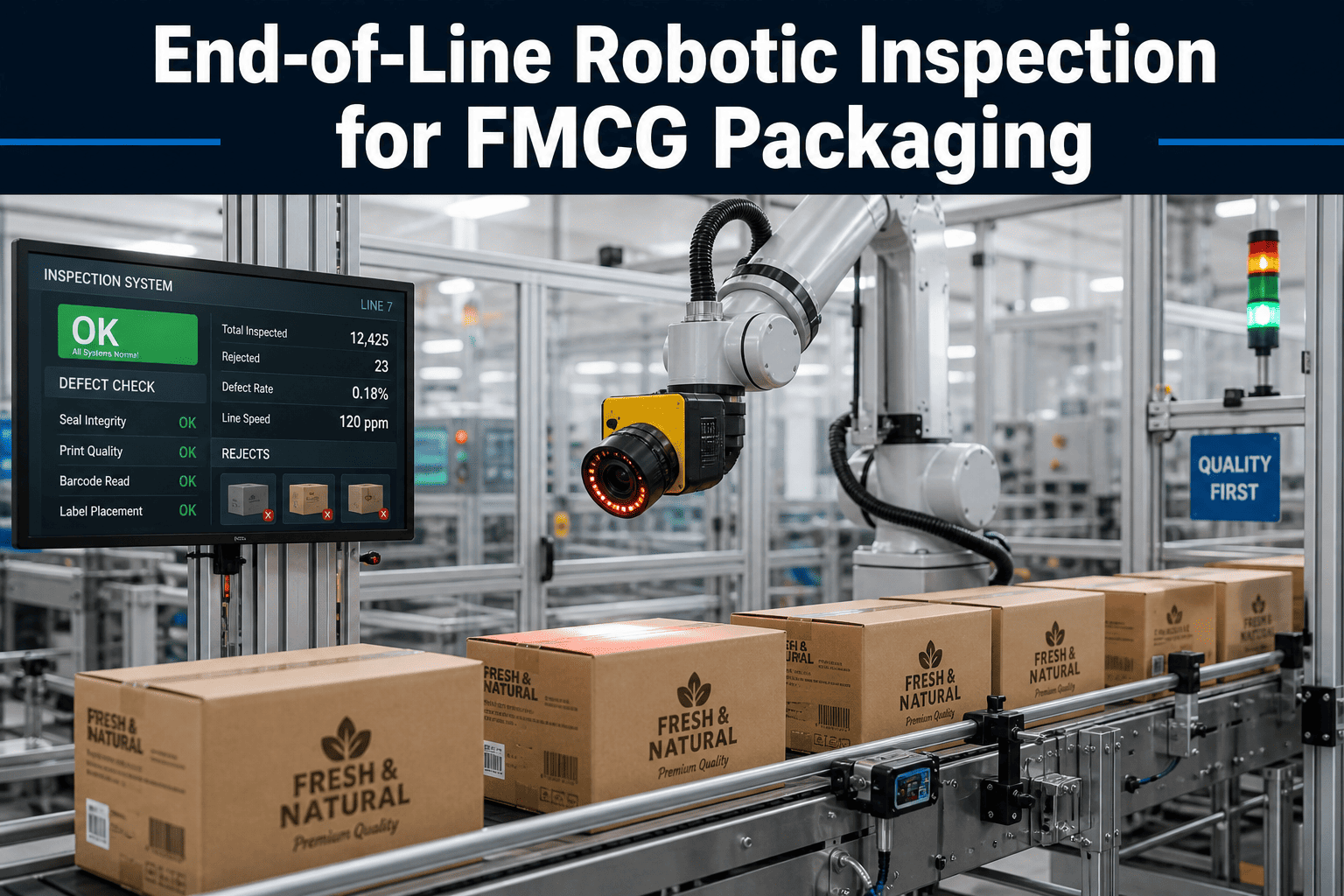
Robotic inspection is not a maintenance strategy in the traditional sense — it does not replace technicians or prevent mechanical failures. What it does is something human inspection physically cannot: monitor every single unit produced at line speed, continuously, without fatigue, shift changes, or attention drift. In FMCG manufacturing, where a single underfilled container, compromised seal, or mislabelled product reaching retail can trigger a costly recall or regulatory action, the economics of 100% autonomous inspection are compelling at almost any production volume above 50,000 units per shift.
What Robotic Inspection Monitors in FMCG Lines
Seal Integrity Verification
100%
Every unit inspected at line speed — seal defects detected before products reach secondary packaging or distribution
Fill Level & Weight
±0.1%
Continuous fill volume and net weight verification against FSMA and weights-and-measures regulatory tolerances
Label Placement & Legibility
99.7%
Accuracy rate for label position, print quality, barcode readability, and batch code compliance verification
Foreign Object Detection
<0.3mm
X-ray and vision-based detection of metal, glass, bone, and dense plastic contaminants — below regulatory minimum thresholds
Cap & Closure Torque
Every Unit
Automated torque verification on caps, lids, and closures — cross-threading and undertorque detection before downstream seal failure
Robot & Camera Health
Self-Monitoring
Inspection systems track their own confidence scores and calibration drift — alerting maintenance teams before detection accuracy degrades
The Strategy Comparison That Actually Matters: Total Cost Per Unit
Industry debates about maintenance strategy often focus on the wrong metric — comparing programme costs rather than total cost per unit produced. When you account for emergency repair premiums, production loss, quality rejects, spare parts waste, and compliance exposure, the true cost picture is fundamentally different from what appears in a maintenance department budget alone.
All four strategies working in hierarchy — AI optimises PM, predictive prevents failures, robotic catches quality, reactive only for non-critical
$0.7M–$1.1M
Savings vs. Reactive-Only Baseline
$1.7M–$3.1M/yr
The full AI and robotic stack does not cost more than the reactive approach it replaces — platform, sensors, and robotic inspection nodes total $280K–$480K annually. The $1.7M–$3.1M savings figure is net of full programme investment, not gross. Return: 4–7x in year one.
How to Build the Right Strategy Hierarchy for Your FMCG Plant
No FMCG plant should run on a single maintenance strategy. The optimal approach is a hierarchy that assigns each asset to the strategy that delivers the best risk-adjusted cost outcome given that asset's criticality, failure cost, and data availability. Building that hierarchy is a structured process — not a guesswork exercise — and it begins with asset criticality analysis, not technology procurement.
Four-Step Process for Building Your Maintenance Strategy Hierarchy
01
Criticality Classification
Score every asset: safety, quality, throughput, cost
Robotic inspection deployed on quality-critical lines
Output: Live Asset Intelligence
04
Continuous Optimisation
PM intervals adjusted quarterly based on MTBF data
AI models retrained with new failure patterns
Asset tier reclassification as equipment ages
Output: Compound Improvement
Preventive vs Predictive vs Robotic: Detailed Head-to-Head
For FMCG plant managers evaluating which strategy to implement first — or where to invest incremental maintenance budget — the following comparison covers the eight decision criteria that matter most in consumer goods manufacturing environments.
Preventive vs. Predictive vs. Robotic: Eight Decision Criteria
How each strategy performs on the metrics that drive maintenance investment decisions in FMCG manufacturing
Preventive
Implementation Complexity
Low — schedules and checklists
Upfront Investment
Low — CMMS + labour only
Failure Prevention Rate
40–55% of potential failures
Data Requirements
Minimal — scheduling records
Regulatory Compliance Value
High — audit trail, documentation
Quality Impact
Indirect — equipment kept serviceable
Scalability
Good — applies to all assets
Best ROI Timeline
3–6 months to positive ROI
Predictive
Implementation Complexity
Medium — sensors, AI, integration
Upfront Investment
Medium — $80K–$250K sensor deploy
Failure Prevention Rate
87% of gradual-onset failures
Data Requirements
Significant — sensors + CMMS history
Regulatory Compliance Value
High — condition records timestamped
Quality Impact
Strong — catches degradation before rejects
Scalability
Best for high-cost critical assets
Best ROI Timeline
6–10 months to full ROI positive
Robotic Inspection
Implementation Complexity
High — hardware, calibration, integration
Upfront Investment
High — $40K–$90K per inspection station
Failure Prevention Rate
N/A — quality, not equipment failure
Data Requirements
Self-generating — inspection feeds CMMS
Regulatory Compliance Value
Highest — 100% inspection record, audit-ready
Quality Impact
Direct — 70–85% reject rate reduction
Scalability
Best for high-speed packaging lines
Best ROI Timeline
8–14 months depending on reject rate
Optimal Outcome: Run All Three in Hierarchy — Each Strategy Covers the Gaps of the Others
How Oxmaint Enables All Four Strategies From One Platform
The challenge with running a multi-strategy maintenance hierarchy is that most FMCG plants end up managing four separate systems — a CMMS for preventive schedules, an IoT platform for predictive data, a vision system for robotic inspection, and a spreadsheet that tries to connect them. The data never truly integrates. The insights from one layer never automatically trigger actions in another. Oxmaint solves this by providing a single connected platform where preventive schedules, predictive AI alerts, robotic inspection data, and automated work orders all operate on the same asset registry and the same data infrastructure.
How Oxmaint Connects All Four Maintenance Strategies
Preventive Scheduling
Optimised
PM intervals automatically adjusted by Oxmaint based on MTBF data — eliminating over-maintenance waste while ensuring nothing at risk is missed
Predictive AI
87–94%
AI models trained on your specific asset baselines detect degradation 2–16 weeks before failure and auto-generate work orders with parts and priority
Robotic Integration
Connected
Robotic inspection confidence scores feed directly into Oxmaint as asset health indicators — camera degradation triggers maintenance alerts automatically
Automated Work Orders
Auto-Generated
Every strategy trigger — PM due date, predictive alert, inspection failure — automatically generates a work order with the right parts, priority, and technician assignment
Frequently Asked Questions
Should an FMCG plant replace preventive maintenance with predictive maintenance?
No — and this is one of the most common misconceptions in FMCG maintenance strategy. Predictive maintenance does not replace preventive maintenance; it augments and optimises it. Preventive maintenance remains essential for regulatory compliance documentation, lubrication programmes, consumable replacements, and assets where the cost of sensors exceeds the value of condition-based intelligence. What predictive maintenance replaces is the fixed-interval assumption — the belief that every asset needs attention every 30, 60, or 90 days regardless of its actual condition. In practice, adding predictive intelligence to a preventive programme typically eliminates 35–45% of unnecessary PM tasks while simultaneously catching the failures that PM intervals were missing. The result is less total maintenance labour, better failure prevention, and lower overall maintenance spend.
At what production volume does robotic inspection deliver positive ROI in FMCG?
The ROI threshold varies by product type and existing reject rate, but as a general benchmark: plants producing more than 40,000–60,000 units per shift on lines where the cost of a quality escape — batch hold, recall investigation, regulatory citation — exceeds $50K per event typically achieve positive ROI within 10–16 months. The calculation is straightforward: take your current quality reject rate, multiply by unit value, add your annual compliance investigation costs and OTIF quality penalties, and compare against the $40K–$90K per inspection station investment. Plants with reject rates above 0.8% and high-value products almost always achieve sub-12-month payback. For commodity FMCG with very low margin per unit, the recall risk protection — rather than reject reduction — typically drives the business case.
What is the right order to implement these four strategies at an FMCG plant?
The optimal sequence is: (1) Establish structured preventive maintenance with a CMMS — this creates the data foundation and technician discipline that everything else depends on. (2) Add predictive monitoring on your top 10–15 highest-cost critical assets — this delivers the fastest ROI and proves AI maintenance value to your leadership team. (3) Activate automated work order generation linked to predictive alerts — this multiplies the value of your AI data by ensuring alerts always result in the right action at the right time. (4) Deploy robotic inspection on your highest-volume quality-critical packaging lines — this caps the programme by closing the quality escape loop that equipment maintenance alone cannot prevent. Plants that attempt to deploy all four simultaneously typically struggle with implementation complexity and data quality issues that slow each layer's value realisation.
How does reactive maintenance fit into a modern FMCG maintenance strategy?
Deliberately and intentionally — for the right assets. Reactive maintenance (run-to-failure) is the correct strategy for non-critical assets where the cost of failure is low, replacement is cheap and fast, and there is no safety or quality implication. Typical examples include office HVAC units, non-production lighting, certain conveyor belt sections with spare stock on-site, and small pumps in non-critical utilities. A mature FMCG maintenance programme allocates roughly 15–25% of its asset base to intentional reactive maintenance, freeing technician time and budget for the critical assets where prevention actually matters. The problem is not using reactive maintenance — it is using it by default on critical production assets because there is no condition visibility to know better. That is what predictive intelligence replaces: not reactive maintenance as a strategy, but reactive maintenance as the only strategy.
How long before a predictive maintenance programme reaches reliable AI prediction accuracy?
Most FMCG plants see their first reliable predictive alerts within 6–10 weeks of connecting sensor data to an AI platform. The timeline has two phases: weeks 1–4 are dominated by data collection and baseline learning — the AI establishes what "normal" looks like for each asset across different production SKUs, speeds, and environmental conditions. Weeks 5–10 produce the first anomaly detections, which the maintenance team validates against what they know about each machine. By week 10–12, false positive rates typically drop below 12%, and by month 6 most plants report 87–92% prediction accuracy on their critical assets. The accuracy improvement does not plateau at month 6 — it continues to improve as the AI accumulates more failure events and learns the subtle signatures that precede each specific failure mode on your specific equipment.
Can a small FMCG plant with a 3–4 person maintenance team benefit from AI and robotic maintenance?
Yes — and the ROI argument is often stronger for smaller teams than larger ones. A 3–4 person maintenance team is spending a disproportionate share of its hours on reactive firefighting because there is no capacity for proactive work. Every unplanned stoppage consumes the entire team for hours. AI predictive maintenance does not require additional headcount to operate — it generates alerts and work orders automatically, and the team acts on them during planned windows rather than scrambling reactively. The result is the same small team spending 40–50% more of its hours on value-generating preventive and predictive work rather than emergency repairs. Robotic inspection removes the need for human visual inspection rounds, which for small teams often means 6–10 hours per week of technician time that can be redirected to higher-value maintenance tasks. Start with the highest-risk two or three assets and prove the model before expanding.
The Right Maintenance Strategy Mix Pays for Itself. The Wrong One Quietly Drains Your Budget Every Quarter.
Oxmaint runs all four strategies from one connected platform — preventive schedules optimised by condition data, predictive AI alerts on critical assets, robotic inspection feeds, and automated work orders. No separate systems. No data silos. Just the right action on the right asset at the right time.