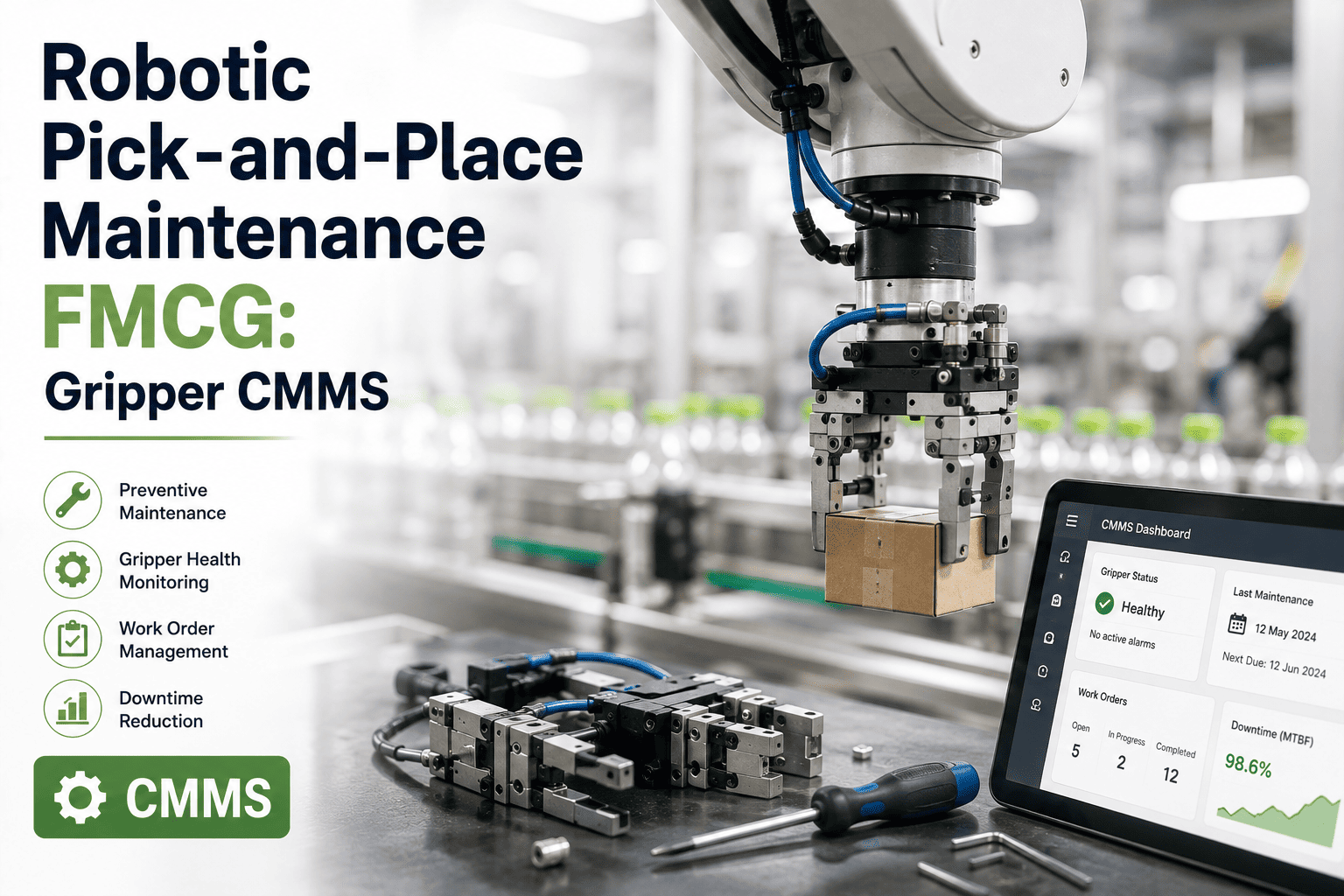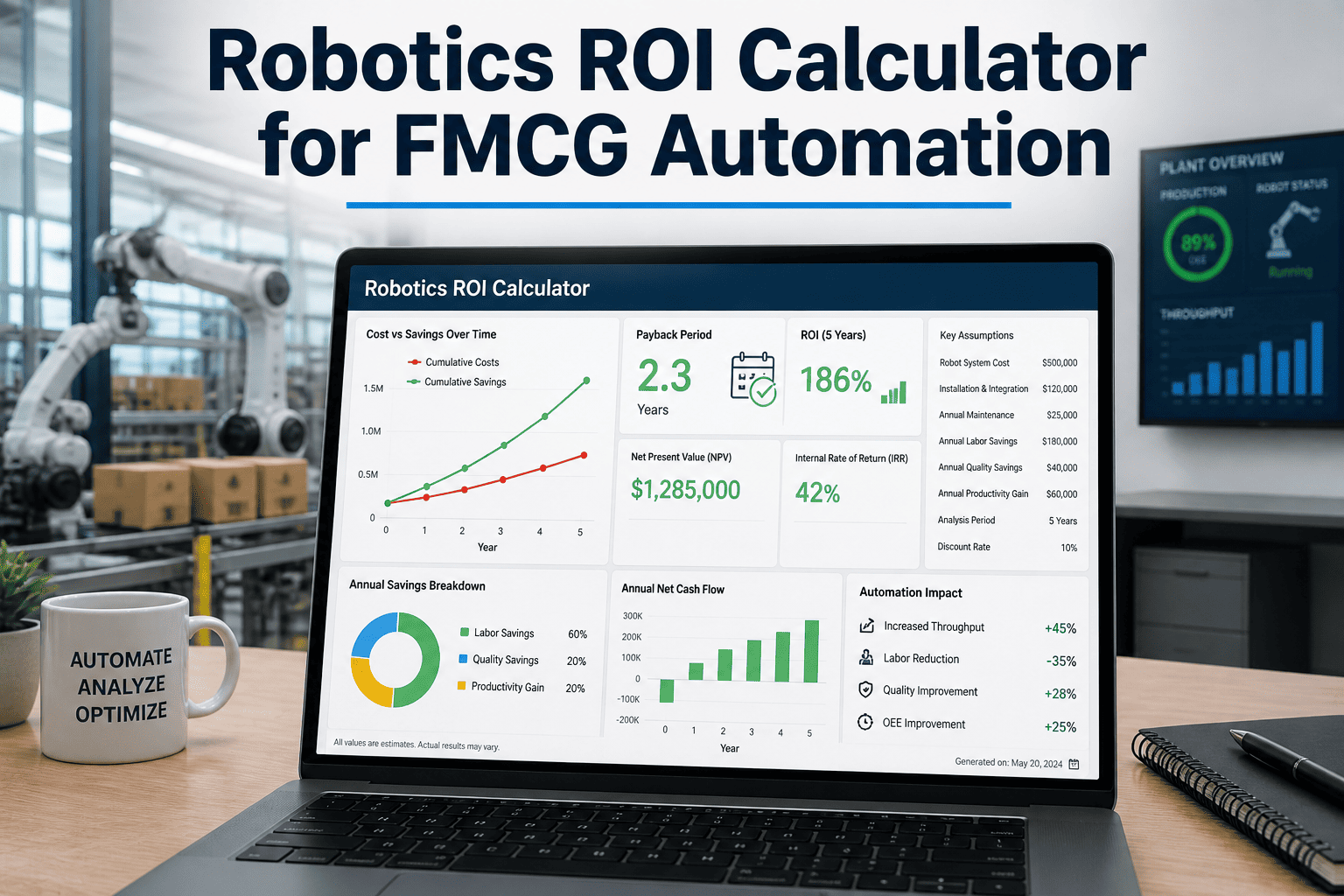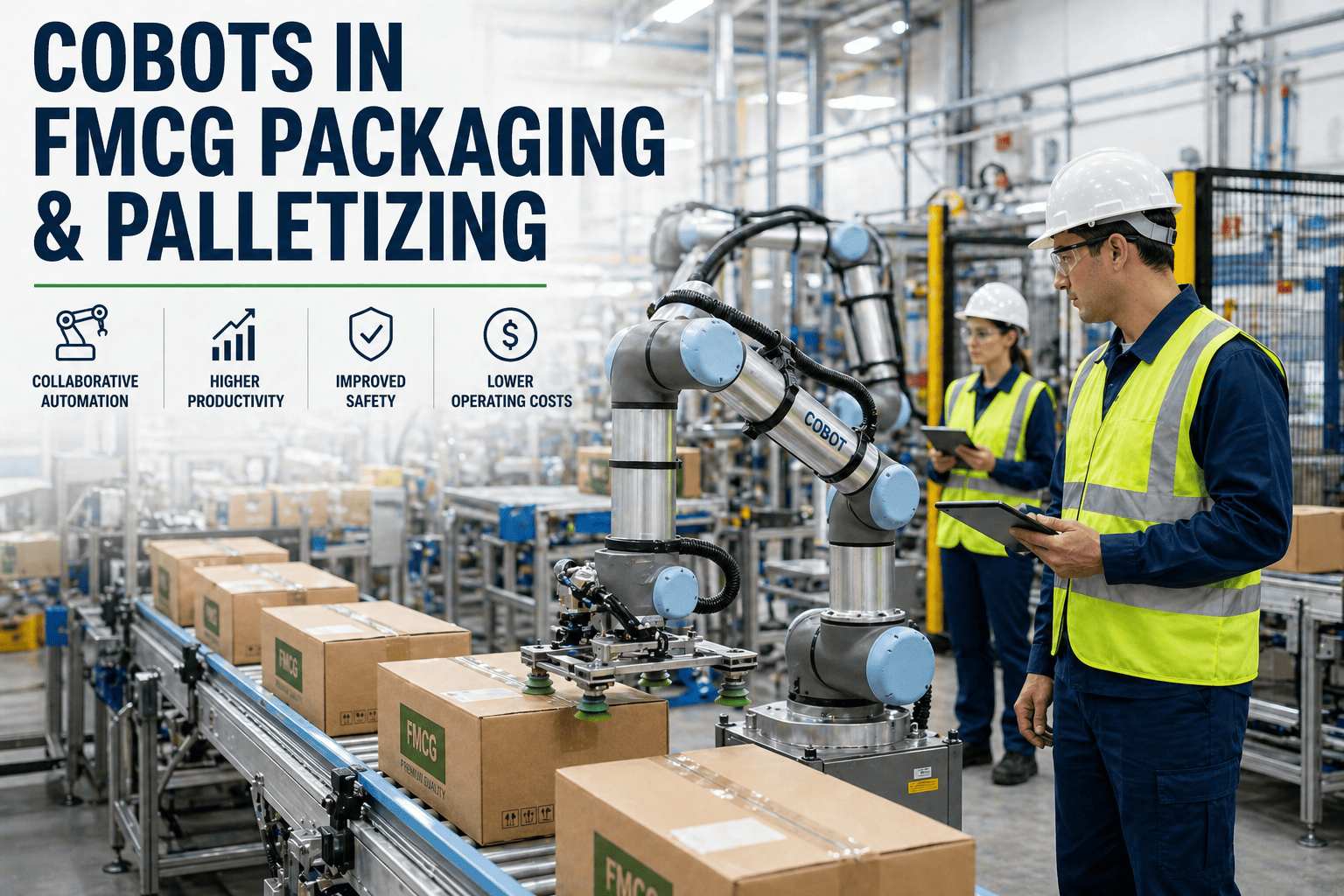
An Ohio snack manufacturer running 14 packaging lines lost a $186,000 cobot palletising proposal three quarters in a row. The CFO kept rejecting it because the labour-savings number alone could not survive scrutiny — until the maintenance team rebuilt the case with the full picture. Hidden inside that single line were $94,000 in product damage from manual case stacking, $67,000 in workers' compensation from repetitive lifting injuries, $41,000 in unscheduled overtime covering for absent palletisers, and $23,000 in maintenance reduction because the cobot end-of-arm tooling needed less corrective work than the conveyor handoff system it replaced. The proposal that returned with all four numbers attached was approved in 11 days. This is the FMCG cobot conversation in 2026 — the technology is mature, the payback is real, but the business case lives or dies on whether you can model it like a maintainable asset, not a piece of equipment. A cobot maintenance and lifecycle programme inside OxMaint registers each cobot as a tracked asset with cycle counters, payload utilisation logs, reach-envelope wear monitoring, and OEM diagnostic-port integration — so the machine that runs your packaging line at 6 AM Monday is the same machine that ran it Friday afternoon, with full traceability between. FMCG plants treating cobots as a maintainable fleet rather than a CapEx event are seeing 12 to 18 month payback, 20 percent productivity lifts, and 40 percent OEE improvement on packaging lines. Want to see how cobots fit into your packaging strategy and lifecycle plan? Book a demo with OxMaint to walk through your line economics.
Cobots in FMCG Packaging and Palletising — A Maintenance-First Deployment Guide
Cobots are no longer a pilot project — they are a packaging-line standard. This is the operations-leader playbook for evaluating, deploying, and maintaining collaborative robots across FMCG case-packing, palletising, pick-and-place, and labelling cells with full lifecycle visibility from day one.
What a Cobot Actually Is — And Why FMCG Is Adopting Them Faster Than Any Other Industry
A collaborative robot — a cobot — is a robotic arm engineered to operate in shared workspace with humans, governed by force-limiting safety standards (ISO/TS 15066) and torque-sensing joints that stop on contact. Unlike traditional industrial robots that require fenced cells, light curtains, and exclusive zones, cobots integrate directly into existing packaging lines without rebuilding the floor plan. For FMCG plants — where line layouts shift with SKU mix, where product changes weekly, and where labour shortages on repetitive packaging tasks have become structural — the cobot's flexibility is the entire reason they are winning the automation budget.
A collaborative robot is a programmable mechanical arm with integrated force, torque, and proximity sensors that allow safe operation alongside humans without physical safeguarding — designed for redeployable, flexible automation of repetitive tasks in dynamic production environments. In FMCG, cobots typically operate at payloads between 3kg and 35kg, reaches between 850mm and 1,800mm, and cycle speeds suited to case rates of 8 to 30 cases per minute.
Cobot vs Traditional Industrial Robot vs Manual Labour — The FMCG Decision Matrix
Most operations leaders inherit the assumption that the choice is automation or manual. The real choice has three columns, and cobots win the FMCG case for very specific reasons — flexibility, footprint, and payback velocity. Here is how the three options compare across the metrics that actually decide a packaging-line investment.
| Decision Factor | Manual Palletising | Traditional Industrial Robot | Cobot |
|---|---|---|---|
| Capital cost (single cell) | $0 upfront | $150K–$400K | $50K–$150K |
| Annual labour cost (2 shifts) | $95K–$140K | $25K (oversight) | $15K (oversight) |
| Installation footprint | Existing | Fenced cell, 30–60 sq m | Open cell, 8–15 sq m |
| SKU changeover time | Immediate (verbal) | 4–8 hours reprogramming | 15–45 min teach-pendant |
| Productivity vs manual | Baseline | 180–240% | 120–160% |
| Workers' comp injury risk | High (lifting, repetitive) | Eliminated | Eliminated |
| Typical payback period | N/A | 3–5 years | 12–18 months |
| Suitability for SKU-rich FMCG | Moderate | Low (rigid) | High (redeployable) |
Six FMCG Cobot Application Areas — Where the ROI Is Already Proven
Cobots are not a generalist solution — they are a focused tool that wins decisively in specific packaging tasks. These six application areas account for over 85 percent of FMCG cobot deployments globally, and each has an established business case that maintenance-aware operations leaders can replicate. Want to model your line against these benchmarks? Start a free trial of OxMaint to track the asset economics from day one.
The single largest FMCG cobot use case. Cobot palletisers stack cases onto pallets at 8–20 cases per minute with payloads up to 35kg, replacing two-shift manual palletising teams. Cell cost ranges $25K–$300K depending on payload and end-of-arm tooling. Workers' comp savings alone often exceed labour savings on repetitive-lifting heavy SKUs.
Loading retail cases or shelf-ready cartons from primary packaging. Cobots handle 12–30 case loads per minute with vacuum or jaw end-of-arm tooling, consistently maintaining pack patterns that human teams drift from over a shift. Particularly strong on SKUs where pack quality directly affects retail acceptance and shrink rates.
Loading pouches, bottles, jars, or trays into outer packaging. Cobots paired with vision systems handle SKU variation, orientation correction, and gentle handling — essential for fragile, irregular, or premium-packaged products where damage costs exceed the labour they replace. Common in personal care, premium snacks, and dairy.
Unloading inbound raw material pallets and sorting onto production lines. Cobots reduce the inbound bottleneck that often gates production start-up, with vision-guided depal handling mixed-SKU pallets that traditional automation cannot address. Particularly impactful for plants running multiple raw material feeds with variable supplier packaging.
Applying pressure-sensitive labels, inspecting label placement, and verifying barcode readability at line speeds of 30–120 units per minute. Cobots paired with machine vision flag mislabelled product before it reaches retail, addressing a recall-risk category that costs FMCG brands tens of millions annually when undetected.
Loading individual portions into multi-cavity trays for ready-meal, frozen, and bakery applications. Cobots handle the high-mix, high-cycle loading task that human teams find cognitively exhausting over an 8-hour shift, with consistent pattern accuracy that lifts retail-pack quality scores.
A Cobot Without a Maintenance Strategy Is a CapEx Bet, Not an Asset
OxMaint registers every cobot in your plant as a tracked asset — recording cycle counts, payload utilisation, reach-envelope wear, end-of-arm tooling change-out intervals, and OEM diagnostic data feeds. PM is triggered on cycles, not calendar drift. ROI is reported on actuals, not assumptions.
The Hidden Cost of Manual Packaging — What Gets Missed in the Business Case
The most common reason cobot proposals get rejected is not the price tag — it is an incomplete business case. Operations leaders quote labour savings and stop. CFOs reject proposals that ignore the four cost categories below, because they know those costs are real even if uncounted. Building the cobot case the right way starts by quantifying every line in this chart.
Two-shift manual palletising team for a single line: $95K–$140K annually loaded. This is the number every cobot proposal leads with, and the only number that cannot stand alone.
Manual case stacking damages 0.4–0.9% of cases on heavy SKUs, costing $80K–$120K per line annually in finished goods write-offs and retail chargebacks that rarely show up in the maintenance budget.
Repetitive-lifting injuries on packaging lines drive 35–55% of FMCG plant workers' comp claims. Annual cost ranges $50K–$95K per line including premium loading, claims, and time-off coverage.
Coverage cost for absent palletising staff runs $30K–$55K annually per line. This is the silent cost that scheduling teams know intimately but that never makes it into the cobot business case.
How OxMaint Manages Your Cobot Fleet as a Maintainable Asset Class
A cobot deployed without lifecycle visibility behaves like every other piece of equipment that aged faster than expected. OxMaint connects cobot telemetry, work orders, and capital planning into one workflow — so your cobots stay productive across a 7–10 year lifecycle, not a 3-year disappointment.
Cobot Maintenance Schedule — What to Track and When
Cobot maintenance intervals run on cycle count and payload-weighted runtime, not the calendar. A cobot doing 85,000 cycles per month at 80 percent rated payload ages very differently from one doing 30,000 cycles at 40 percent payload. Tracking the average across your fleet hides the outliers — and it is always one cobot on one line that fails the morning shift.
| Maintenance Task | Light Duty (under 50K cycles/mo) | Heavy Duty (over 80K cycles/mo) | Performed By | OxMaint Trigger |
|---|---|---|---|---|
| Joint lubrication & backlash check | Every 2,500 hours | Every 1,500 hours | Maintenance technician | Runtime hour counter |
| End-of-arm tooling inspection | Weekly | Daily shift handoff | Line operator | Calendar PM work order |
| Force-torque sensor calibration | Quarterly | Monthly | Robotics technician | Cycle count threshold |
| Brake performance test | Semi-annually | Quarterly | Robotics technician | Calendar PM work order |
| Vision & pose calibration | Monthly | Bi-weekly | Vision specialist | Performance drift alert |
| Safety-function verification | Annually | Semi-annually | Certified safety auditor | Compliance PM work order |
| Controller firmware update | Per OEM release | Per OEM release | Robotics technician | OEM advisory trigger |
| Vacuum cup & gripper replacement | Every 250K cycles | Every 150K cycles | Line operator | Cycle counter auto-trigger |
Cobot ROI Strip — Numbers from Real FMCG Deployments
Industry data from 2024–2026 cobot deployments across food, beverage, personal care, and household FMCG categories shows a remarkably consistent pattern. The numbers below represent median outcomes for plants that registered cobots as tracked assets and ran cycle-based maintenance from commissioning. Want to see how these numbers map to your line economics? Book a demo to model your specific deployment with the OxMaint team.
Six-Stage Cobot Deployment Roadmap — From Proposal to Productive Asset
FMCG cobot deployments succeed or fail in the first 90 days. Plants that follow a structured roadmap — registering the cobot in their CMMS before commissioning, integrating diagnostic data from cycle one, and building the lifecycle record from day one — protect the ROI they sold to the CFO. Plants that skip the lifecycle setup discover the gap 18 months in, when nobody can answer why productivity drifted.
Frequently Asked Questions
How does OxMaint integrate with cobots from different OEMs like Universal Robots, Fanuc, and Doosan?
What is the realistic payback period for a packaging cobot in FMCG?
Can cobots handle the SKU variation typical of FMCG plants?
What scale of cobot deployment justifies a CMMS-based maintenance programme?
Cobots Are Assets, Not Equipment Purchases. Manage Them That Way From Day One.
OxMaint registers every cobot as a tracked asset, integrates OEM diagnostic data for cycle-based PM, manages EOAT and consumable inventory per cobot, and reports productivity and ROI against the original business case — so the CapEx you defended actually delivers the payback you promised.