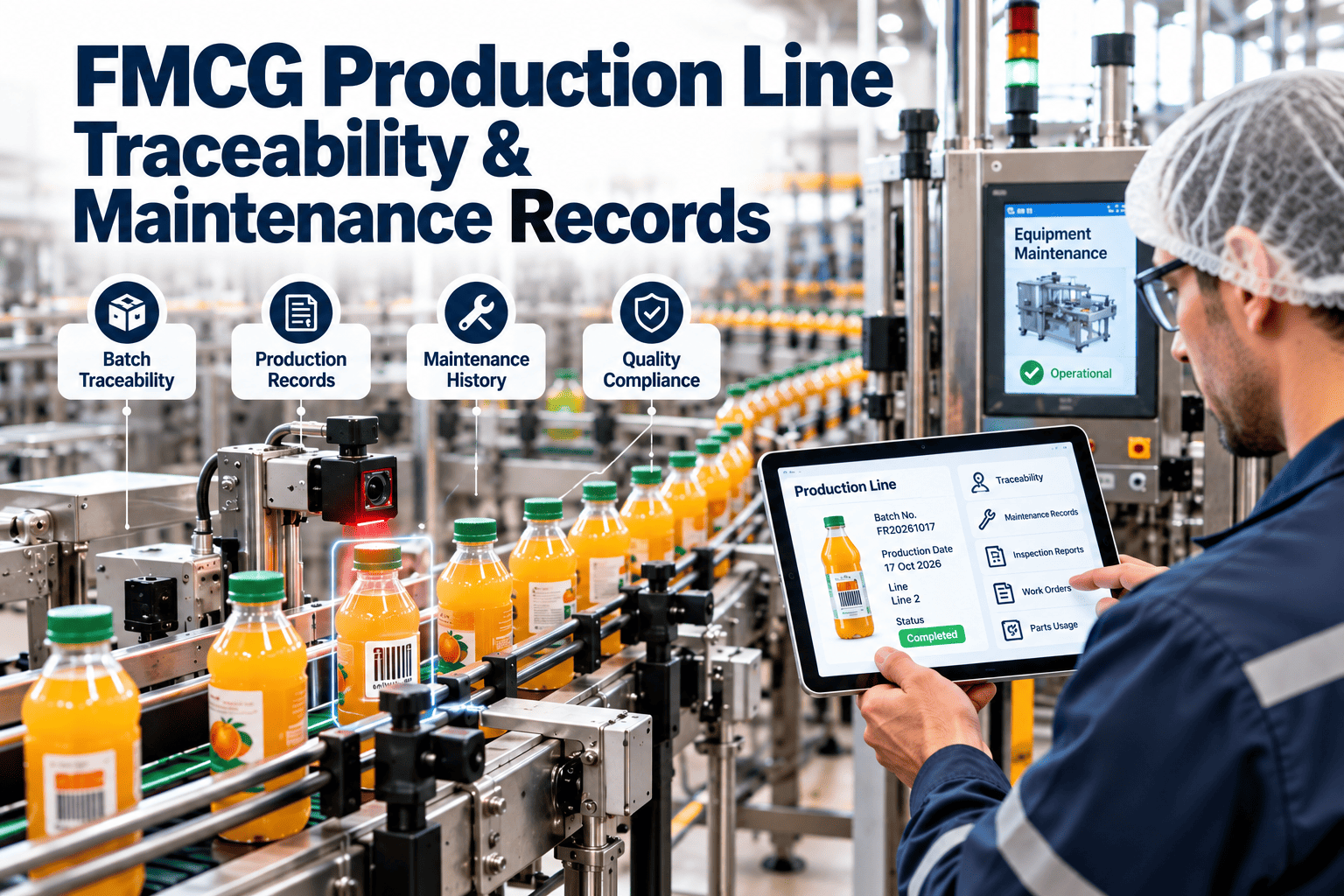
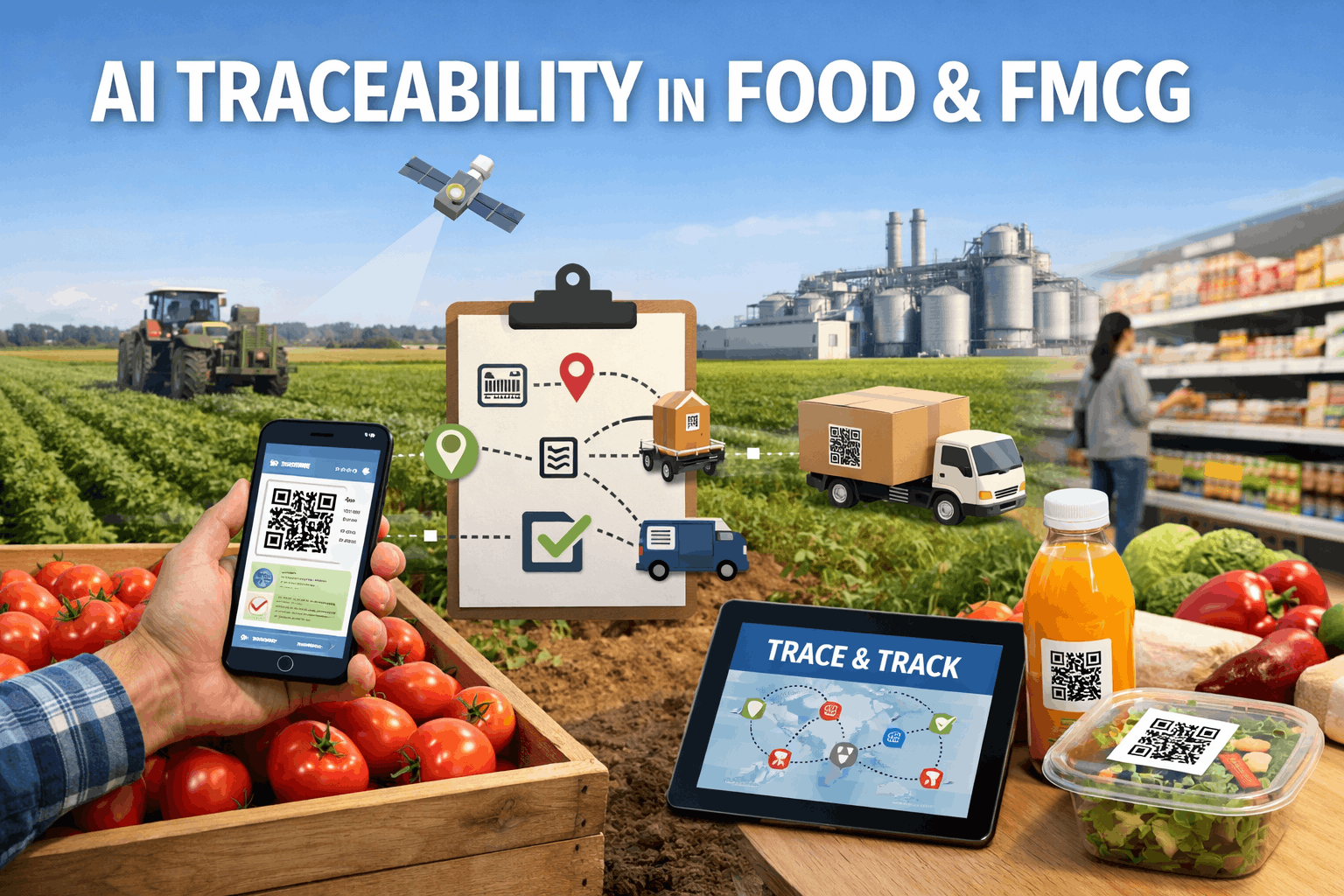
A product recall without a robust traceability system is a worst-case operational scenario: you don't know which batches are affected, which retailers received them, or how far the product has moved through the supply chain. The average FMCG recall costs $10 million in direct costs and takes 52 days to resolve — but companies with barcode and RFID-enabled end-to-end traceability contain recalls to a fraction of the affected product, resolving in days rather than weeks. Regulators are tightening requirements: the FDA's FSMA Rule 204 and the EU's FIC Regulation both mandate lot-level traceability for high-risk food categories, with enforcement escalating through 2025 and beyond. If your traceability data lives in production paper records, disconnected ERP modules, or unmaintained barcode systems, start a free OxMaint trial and connect your production and maintenance data to your traceability infrastructure — or book a demo to see how FMCG operations teams use OxMaint to support traceability programs.
FMCG Supply Chain · Traceability
FMCG Traceability with Barcode & RFID: From Batch to Shelf
Lot tracking, batch serialization, recall management, and regulatory compliance — the complete framework for implementing end-to-end traceability across FMCG production and supply chain operations.
Average direct cost of an FMCG product recall event without fast traceability
52 days
Average recall resolution time without end-to-end batch traceability
74%
Of FMCG retailers now require full batch-level traceability from suppliers
3 days
FDA FSMA Rule 204 recall response requirement for high-risk food products
The 4 Levels of FMCG Traceability
Traceability in FMCG is not binary — it exists on a maturity spectrum from basic lot tracking to real-time, item-level supply chain visibility. Most companies operate between Level 1 and Level 2. Regulatory requirements and major retailer mandates are pushing the minimum toward Level 3.
Level 1
Batch Recording
Paper or spreadsheet batch records linking production date and quantity. No system integration, no real-time data.
Covers: Internal production records only
Gap: Cannot perform forward or backward trace without manual document retrieval
Level 2
Lot-Level Barcode Tracking
GS1 barcodes or QR codes on cases and pallets linked to lot number, production date, and batch record in a database. Scan-at-dispatch enables forward trace to first customer.
Covers: Plant gate to first customer delivery
Gap: No visibility beyond first customer in multi-tier supply chains
Level 3
Supply Chain RFID Traceability
RFID tags on pallets and cases tracked automatically through receiving, storage, pick, dispatch, and retail distribution. Real-time location and custody chain without manual scanning.
Covers: Raw material through retail distribution center
Gap: Last-mile retail shelf visibility typically not covered
Level 4
Item-Level Serialization
Unique serial number on every consumer unit enabling item-level authentication, retail scan data integration, and complete chain of custody from ingredient to consumer.
Covers: Farm-to-fork or ingredient-to-consumer
Current standard: Infant formula, pharmaceuticals, premium FMCG segments
Barcode vs RFID: Technology Comparison for FMCG Traceability
Both technologies have their place in FMCG traceability — the choice depends on throughput, environment, budget, and the supply chain visibility level required.
Capability
1D / 2D Barcode
QR Code
RFID (UHF)
Read Speed
1 unit at a time
1 unit at a time
100+ tags simultaneously
Line-of-Sight Required
Yes
Yes
No — through cartons and pallets
Data Capacity
Limited (GTIN + lot)
Medium (URL + data)
High (full product history writable)
Tag Cost
Under $0.01
Under $0.01
$0.05–$0.30 per tag
Infrastructure Cost
Low
Low
High (portal readers, middleware)
Best Application
Unit and case labeling
Consumer engagement + compliance
Warehouse, logistics, high-value SKUs
6 Critical Components of FMCG Traceability Infrastructure
End-to-end traceability requires more than label printers and scanners. These six infrastructure components determine whether your traceability system performs under recall pressure — when speed and accuracy matter most.
Label Printing & Application Systems
Thermal transfer printers applying GS1-128 barcodes, date codes, and lot numbers to every unit, case, and pallet. Print-and-apply systems for high-speed lines. Printer PM and printhead replacement schedules are food safety maintenance — a blurred barcode breaks the traceability chain.
Vision-Based Barcode Verification
100% barcode verification cameras confirm every printed code is readable before product leaves the line — not sampled spot checks. Grade C barcodes cause retail scanner failures and supply chain data gaps. In-line verification prevents unreadable codes reaching the distribution chain.
Batch Record Management System
Digital batch records linking every production run to raw material lot numbers, process parameters, equipment used, operator records, and QC inspection results. The database backbone that makes forward and backward trace possible within minutes rather than hours of manual document retrieval.
Warehouse Management Integration
FIFO and FEFO lot rotation enforcement through WMS ensures older batches ship first, reducing expiry losses and ensuring traceability integrity in dispatch records. Pallet scan-at-dispatch creates the outbound traceability record linking production lot to delivery address.
Recall Management Protocols
Pre-planned recall procedures that define exactly who does what, which systems are queried, how the lot scope is determined, and how retailer notification is executed. The plan is only as good as the traceability data it queries — which means the data must be complete and current before the crisis, not during it.
Traceability Mock Recall Testing
Quarterly mock recall drills that test the complete forward and backward trace capability — selecting a random lot number and verifying the system can produce a complete dispatch history within the time target (typically 2–4 hours). Failures in mock recalls are far cheaper than failures in real ones.
How OxMaint Supports FMCG Traceability Programs
OxMaint provides the maintenance and asset management layer that traceability infrastructure depends on — ensuring the printers, scanners, RFID readers, and vision systems that generate traceability data are maintained to specification and never the cause of a traceability data gap. Build a maintenance program that supports your traceability goals — start your free trial today or book a demo to see how FMCG traceability equipment is managed in OxMaint.
PM
Label Printer and Printhead PM Schedules
Every thermal transfer printer registered in OxMaint with PM schedules for printhead replacement, platen roller inspection, and calibration verification. Printhead wear causes gradual print quality degradation — barcodes become unreadable long before the printer "fails." PM triggers at defined print-meter milestones keep code quality inside GS1 grade standards.
CHK
Scanner and Reader Calibration Records
Barcode scanners and RFID readers require periodic calibration and performance verification — particularly after firmware updates or physical impacts. OxMaint maintains calibration records for every reader in the traceability chain, with PM work orders generated before calibration lapses. An uncalibrated scanner that misreads lot codes silently corrupts traceability data without triggering any alarms.
INSP
Traceability System Audit Checklists
Digital inspection checklists in OxMaint cover all traceability system verification points: barcode print quality check, scanner read rate verification, batch record completeness review, and label application accuracy. Monthly traceability system audits confirm end-to-end data integrity — not just individual component function — and provide the documented evidence required for FSSC 22000 and BRC traceability audits.
LINK
Equipment Record Linked to Batch History
When a quality event requires batch investigation, OxMaint provides the equipment maintenance context: which filler, sealer, labeler, or inspector was operating at the time the batch was produced, what PM was completed or outstanding on those assets, and whether any corrective actions were open at the time of production. This equipment context is the missing link in most batch investigations — connecting product quality outcome to equipment maintenance history.
Traceability Program Performance Benchmarks
20min
Target forward trace time
From lot number to complete dispatch list across all customers — achievable with GS1-compliant digital traceability
74%
Retailer traceability mandate rate
Of major FMCG retailers now requiring batch-level digital traceability from all suppliers
60%
Recall cost reduction
Average cost containment improvement when recalls are confined to the precise affected lot vs. product-wide withdrawal
3 days
FSMA Rule 204 response window
Required traceability record production time for FDA investigations — non-compliant companies face enforcement action
Frequently Asked Questions
What does FSMA Rule 204 require from FMCG manufacturers?
FDA's FSMA Rule 204 (Food Traceability Rule) requires covered food manufacturers to maintain Key Data Elements (KDEs) at Critical Tracking Events (CTEs) — specifically: receiving, transformation (production), and shipping events. For each CTE, specific data must be recorded and maintained for two years, including lot codes, quantities, dates, and immediate previous and next supply chain partners. The rule applies to foods on the Food Traceability List (FTL), including fresh produce, ready-to-eat deli, soft cheeses, shell eggs, nut butters, and finfish. Compliance requires that records be producible within 24 hours of an FDA request — making paper-based systems operationally inadequate for most mid-to-large FMCG operations. Full compliance was required by January 2026.
What is a mock recall and how often should FMCG plants conduct them?
A mock recall is a planned exercise that simulates a real recall scenario to test the speed and accuracy of the traceability system under pressure. The exercise selects a real production lot from the past 90 days and measures how quickly the quality team can produce: a complete backward trace (all raw material lots used), a complete forward trace (all customers and quantities shipped), and a total affected quantity figure. BRC Global Standard requires at least one mock recall per year as a minimum, with most high-care and high-risk facilities conducting quarterly exercises. The results — trace time, data completeness, any gaps identified — should be documented and corrective actions taken for any gaps identified. The mock recall is the only reliable way to know your system will perform when it's needed most.
How does RFID compare to barcode for FMCG traceability in practice?
RFID has significant operational advantages for warehouse and logistics traceability: pallets can be scanned without line of sight, multiple items read simultaneously, and scan gates can operate without manual intervention. However, RFID has challenges in FMCG environments — metallic packaging and high-moisture products interfere with UHF RFID performance, making it less reliable for item-level tracking of canned goods or wet products. In practice, most FMCG operations use barcodes at the item and case level (where line-of-sight printing and scanning is manageable) and RFID at the pallet and warehouse level (where portal reads and automatic receiving are the primary benefit). The two technologies are complementary rather than competing in the FMCG traceability architecture.
Why is maintenance of traceability equipment a food safety issue?
Traceability equipment failures create silent data gaps — the system appears to be operating, but traceability records are incomplete or corrupted. A thermal printhead worn past specification produces barcodes that scan inconsistently, creating gaps in the lot tracking database that only appear when a trace is attempted during an audit or recall. A barcode reader out of calibration may misread digits in a lot code, creating incorrect dispatch records that point to the wrong batch during an investigation. An RFID reader with a reduced read range may miss 10–15% of pallet scans at a warehouse gate, creating inventory and dispatch record gaps. These failures don't generate alarms — they just quietly degrade the traceability data that a recall depends on. Regular maintenance and performance verification of all traceability equipment is therefore a food safety maintenance requirement, not just an operational one.
Traceability That Works When It's Needed Most
Traceability Data Is Only Reliable If the Equipment Generating It Is Maintained. OxMaint Closes That Gap.
Label printer PM schedules. Barcode scanner calibration records. RFID reader performance verification. Traceability audit inspection checklists. Equipment maintenance history linked to production batch records. The operational foundation that makes your traceability system defensible under audit and reliable under recall pressure.