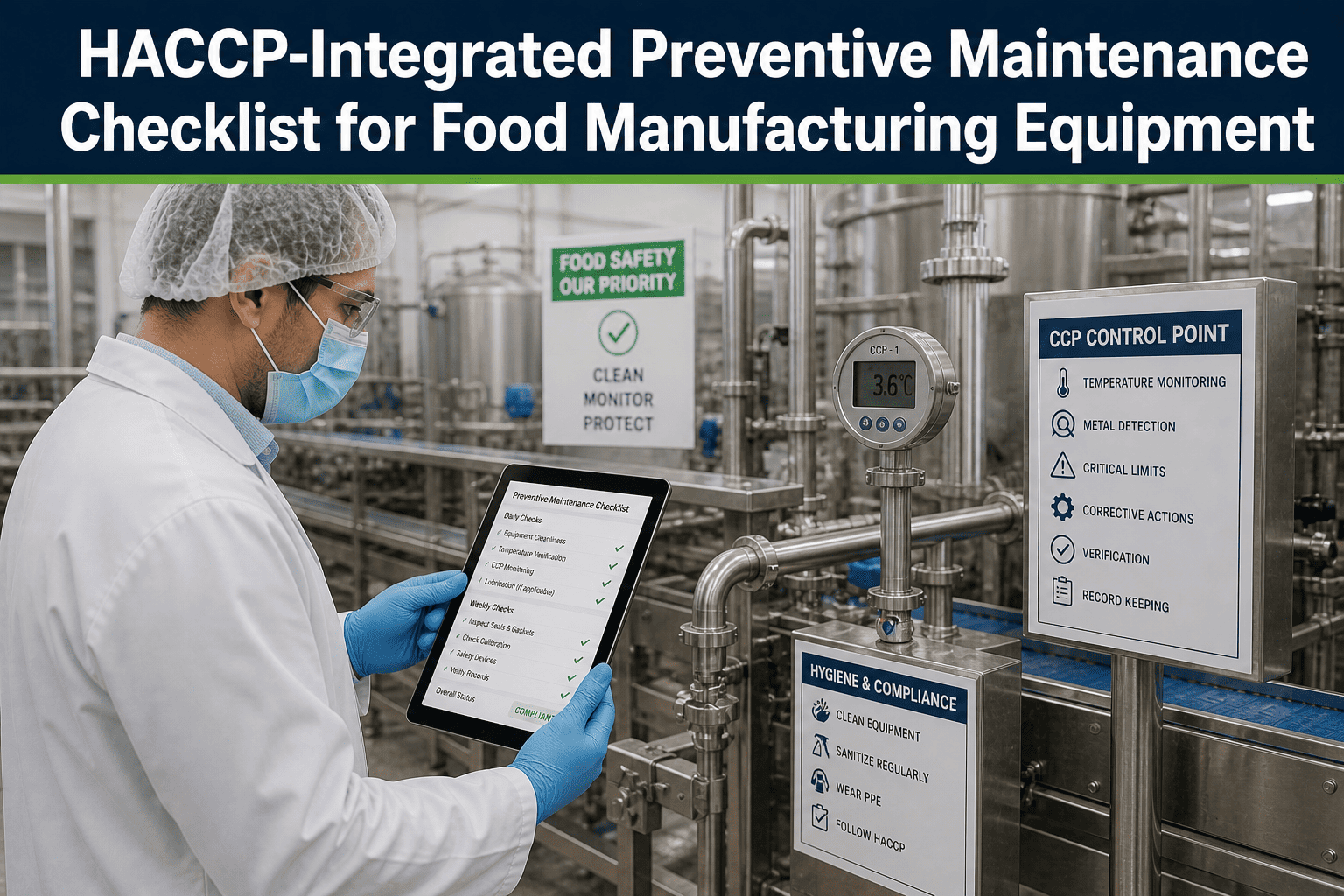
Meat and poultry processing facilities operate under the most demanding regulatory environment in food manufacturing. Every production shift takes place under continuous USDA FSIS inspection, with documented sanitation, equipment maintenance, and HACCP compliance requirements that cannot be deferred without triggering regulatory action. For maintenance managers, operations directors, and food safety leads in slaughter, processing, and further processing facilities across the USA, Canada, UK, Australia, UAE, and Germany, the maintenance program is not a background function — it is a prerequisite for the operating license. The facilities achieving consistent USDA compliance, minimal downtime, and zero critical non-conformances run structured, CMMS-managed maintenance programs that treat every piece of equipment as both a production asset and a food safety control. Ready to build that program? start a free trial or book a demo to see how Oxmaint supports meat and poultry facility maintenance.
USDA-Ready Maintenance Programs Built for Meat and Poultry Plants
Oxmaint structures sanitation, equipment PM, HACCP documentation, and compliance tracking into one mobile-first CMMS platform — purpose-built for the inspection demands and operational pace of meat and poultry processing environments.
The Regulatory Landscape: What USDA FSIS and HACCP Require from Maintenance
USDA FSIS regulations under 9 CFR Parts 416 and 417 establish explicit requirements for sanitation and HACCP that directly implicate maintenance program quality. Equipment that cannot be adequately cleaned and sanitized due to wear, corrosion, or design degradation creates prerequisite program failures that undermine the entire HACCP system. Inspectors do not separate maintenance from food safety — they evaluate them as one integrated program. start a free trial and build your USDA-aligned maintenance documentation in Oxmaint from day one.
Sanitation Requirements
All equipment and utensils shall be cleaned and sanitized as frequently as necessary to prevent the creation of insanitary conditions and the adulteration of product. Equipment that cannot be adequately cleaned — due to worn surfaces, inaccessible joints, or degraded gaskets — creates a direct 9 CFR 416 compliance failure regardless of sanitation procedure quality.
HACCP System Requirements
Prerequisite programs supporting HACCP — including Good Manufacturing Practices and sanitation standard operating procedures — must be documented, implemented, and verified. Equipment maintenance that affects the ability to control identified hazards at CCPs must be captured in the HACCP system with documented corrective actions and verification activities.
Sanitation SOPs and Pre-Op Inspection
Facilities must maintain written SSOPs describing pre-operational and operational sanitation procedures. Pre-op inspection records — verified by establishment supervision before production begins — must document equipment condition findings and corrective actions. Equipment defects found during pre-op require documented maintenance escalation with resolution tracking.
Noncompliance Records and Appeals
When FSIS inspectors issue Noncompliance Records (NRs), facilities must provide documented corrective actions addressing root cause — not just immediate remediation. Recurring NRs for the same equipment or zone trigger regulatory action. A CMMS with corrective action tracking demonstrates systematic response to inspector findings and supports NR appeals with documented evidence.
The 6 Equipment Categories Driving Maintenance Priority in Meat and Poultry Plants
Slaughter and Evisceration Equipment
Stunning equipment, bleed rails, defeathering machines, and evisceration lines require daily pre-op inspection for surface integrity, knife sharpness, and cleanability — with any defect creating an immediate USDA compliance issue. Scheduled blade replacement, mechanical linkage inspection, and scalder temperature verification are the primary PM tasks.
Chilling and Cold Chain Systems
USDA FSIS requires carcasses to reach 7°C within defined timeframes. Blast chiller compressors, evaporator coils, and temperature monitoring systems are CCPs in most HACCP plans — making refrigeration PM a regulatory requirement, not an operational preference. Compressor PM, coil defrost systems, and data logger calibration are core scheduled tasks.
Cutting and Deboning Lines
Bandsaw blades, deboning tables, conveyor belts, and portion control equipment require daily cleanability verification and scheduled maintenance. Conveyor belt integrity — cracks and inaccessible joints — is the most frequently cited equipment deficiency during FSIS inspection of processing lines.
Cooking and Thermal Processing
Cook-chill operations require oven temperature calibration, humidity control verification, and continuous temperature monitoring at the coldest point. Any deviation from validated thermal process parameters — undocumented or uncorrected — creates a Critical CCP violation requiring product hold and potential regulatory notification.
Packaging and Labeling Lines
Vacuum packaging machine seals, tray sealer temperature profiles, and modified atmosphere gas delivery systems require scheduled maintenance to ensure seal integrity and gas mix accuracy. Failed seals compromise shelf life and safety — with vacuum loss in retail packs creating spoilage risk that traces back to maintenance records.
Sanitation Infrastructure
Floor drains, coved coving, wall panel condition, high-pressure wash down systems, and chemical dosing equipment are maintenance assets that directly affect the facility's ability to achieve sanitation SOPs. Deferred maintenance on drain covers, coved bases, or washdown hose systems creates SSOP non-conformances that FSIS inspectors cite consistently.
Maintenance Failures That USDA FSIS Inspectors Cite Most Often
Pitted, Cracked, or Inaccessible Conveyor Surfaces
Conveyor belt and table surface defects that prevent effective cleaning — cracks, missing end caps, inaccessible underframes — are among the most common FSIS NR categories across all processing facility types. Without scheduled surface condition inspections, degradation accumulates until inspector citation.
Chilling System Temperature Excursions
Chilling CCP temperature monitoring that records excursions without documented corrective actions creates compounding HACCP violations. Deferred compressor PM or blocked evaporator coils that cause temperature rise during the chilling cycle represent both a maintenance failure and a product safety event.
Pre-Op Inspection Records With Unsigned Defect Entries
SSOP pre-op records with defect entries that lack maintenance escalation documentation — no work order, no corrective action record, no resolution sign-off — are a direct FSIS citation. The paper trail from defect identification to verified correction must be complete.
Drain and Floor Infrastructure Defects
Cracked coved coving, damaged floor drains, and standing water accumulation from drainage failures create harborage conditions that undermine sanitation programs regardless of cleaning frequency. These structural items require scheduled inspection and maintenance with documented corrective action records.
How Oxmaint Supports USDA Compliance in Meat and Poultry Plants
Oxmaint connects the maintenance documentation, corrective action tracking, and asset management capabilities that USDA FSIS compliance demands into one platform — giving maintenance and food safety teams the audit trail that supports HACCP verification, SSOP documentation, and NR appeals. book a demo to see the compliance workflow in action.
CCP Equipment PM Tracking
Tag all equipment involved in HACCP CCPs in the asset register. PM work orders for these assets receive elevated priority flags and mandatory sign-off fields — creating the verified maintenance record that HACCP auditors require.
Pre-Op Defect to Work Order Flow
Pre-op inspection findings entered in Oxmaint automatically generate maintenance work orders with location, defect description, and required response time — creating the complete escalation trail from SSOP defect detection to verified corrective action.
NR Response Documentation
When FSIS issues a Noncompliance Record, Oxmaint generates a structured corrective action work order with root cause fields, investigation requirements, and closure verification — creating the documented response package that supports the NR appeal process.
Refrigeration CCP Asset PM
Blast chiller compressors, evaporators, and temperature data loggers are on automated PM schedules with calibration certificate tracking — ensuring chilling CCP equipment is always maintained within the validated process parameters.
Sanitation Infrastructure PM
Schedule floor drain, coved coving, wall panel, and washdown system inspections alongside equipment PM — with photo evidence and repair tracking ensuring structural sanitation deficiencies are documented and resolved before FSIS identification.
FSIS-Ready Maintenance History
Complete maintenance history by equipment, zone, or date range is retrievable in seconds. FSIS inspectors and third-party HACCP auditors receive documented evidence of systematic maintenance without requiring manual file compilation.
Reactive vs. CMMS-Managed: Compliance and Cost Impact
Compliance and Operational ROI
Frequently Asked Questions
What maintenance documentation does USDA FSIS require during facility inspection?
USDA FSIS inspectors assess whether facilities maintain documentation supporting their SSOP and HACCP programs — including pre-operational inspection records documenting equipment condition and corrective actions, sanitation monitoring records for operational procedures, CCP monitoring records covering critical limits and corrective actions, and verification activity records demonstrating that the HACCP system is functioning as intended. Maintenance records supporting SSOP pre-op findings — work orders, corrective action logs, completion verification — are regularly requested during inspection to demonstrate that equipment defects identified during pre-op are being systematically resolved rather than just recorded.
Which equipment in a meat or poultry plant requires HACCP-linked maintenance records?
Any equipment whose condition directly affects the control of a food safety hazard identified in the HACCP plan requires maintenance documentation that supports HACCP verification. In most meat and poultry facilities, this includes refrigeration and chilling equipment (temperature CCPs), cooking and thermal processing equipment (lethality CCPs), metal detection and x-ray equipment (physical hazard CCPs), and packaging equipment where seal integrity affects safety shelf life. The specific list depends on each facility's validated HACCP plan — and the HACCP coordinator and maintenance manager must align on which assets carry HACCP-linked maintenance requirements.
How should a meat plant respond when USDA FSIS issues a Noncompliance Record?
When FSIS issues a Noncompliance Record, facilities must provide a documented response addressing both the immediate corrective action (what was done to correct the specific condition) and the preventive corrective action (what will be done to prevent recurrence). In the CMMS context, the NR should generate a structured corrective action work order that captures root cause analysis, the immediate remediation action with completion date and technician sign-off, and the preventive measure — typically a modification to the PM schedule or inspection procedure. This documented response package supports the NR closure process and demonstrates systematic program response to regulatory findings.
Can Oxmaint manage maintenance for both slaughter and further processing operations within one facility?
Yes. Oxmaint's asset hierarchy supports complex multi-zone facility structures — organizing assets by facility zone (slaughter floor, chilling, deboning, cooking, packaging) with zone-specific PM schedules, inspection protocols, and compliance documentation requirements configured independently. Maintenance managers see a unified view of all zones, while technicians receive zone-specific work orders with the correct procedures and documentation requirements for each area. FSIS inspectors can be directed to zone-specific asset history and corrective action records without exposing data from other facility zones during inspection.
USDA Compliance Starts with Maintenance. Let Oxmaint Build the Foundation.
Meat and poultry processing facilities across the USA, Canada, UK, and Australia use Oxmaint to maintain FSIS-ready documentation, HACCP-linked equipment records, and structured corrective action programs that make every inspection day the same as every other day.