From Data Chaos to Predictive Intelligence: AI Data Architecture for Food Plants

By Obito Furr on March 2, 2026

ai-data-architecture-food-manufacturing-maintenance

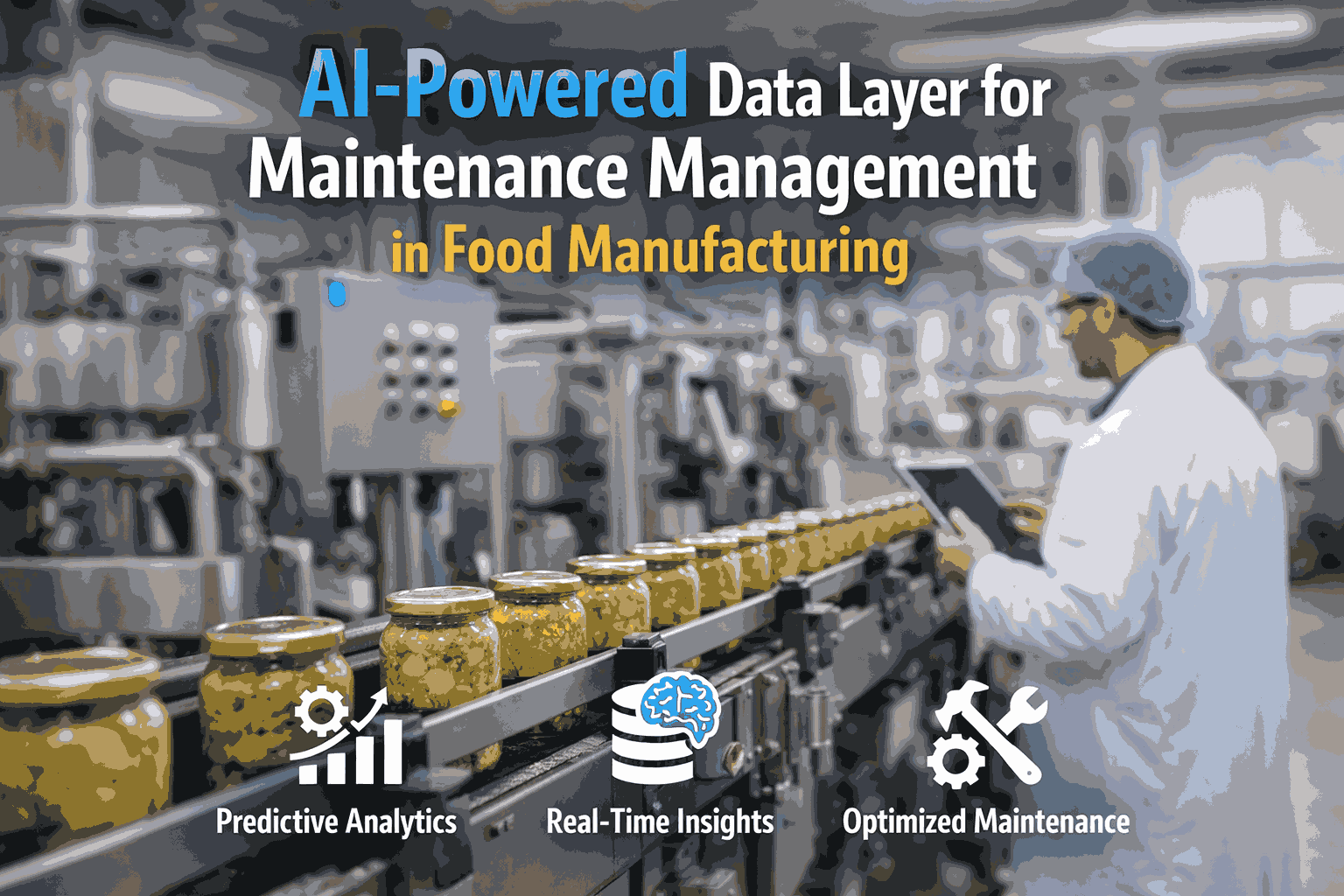
A mid-size protein processor in Iowa had invested $2.1 million in sensors, PLCs, and data logging systems across four facilities over three years. Every production line generated thousands of readings per hour. Yet when the VP of Operations asked a simple question — "which of our assets is most likely to fail in the next 30 days?" — no one could answer it. The data existed. The intelligence did not. Maintenance ran on one CMMS. Operations ran on an ERP. Engineering logged into a historian. Quality worked through a LIMS. None of it was connected. The company was sitting on the richest possible raw material for AI-powered predictive maintenance and converting none of it into decisions. After rebuilding their data architecture around Oxmaint's unified AI platform, all four facilities could answer that question — in real time, for every asset — within 90 days. Sign up for Oxmaint to stop collecting data and start generating intelligence from it.

AI Architecture Guide  ·  AI Strategy

From Data Chaos to Predictive Intelligence: AI Data Architecture for Food Plants

Most food manufacturing facilities are data-rich and intelligence-poor. Sensors run, systems log, and databases fill up — but the data lives in silos that no single question can cross. The right AI data architecture transforms this chaos into a continuously learning predictive layer that tells you what will fail, when, and exactly what to do before it happens.

$2.1M
Average data infrastructure spend in mid-size food plants — generating near-zero predictive value

6–9
Disconnected data systems in a typical food plant with 50+ assets

92%
Of food plant data never analyzed — collected and stored but never connected to decisions

90 days
Time to first AI-generated predictive insight after proper architecture deployment
Why This Happens

The Three Root Causes of Food Plant Data Chaos

The instinct when facing data chaos is to blame the systems. "Our CMMS is outdated." "We need better sensors." In most food plants, the systems are fine. The problem is architectural — how systems relate to each other, how data flows between them, and whether any unified intelligence layer exists to make sense of the combined picture.

01
The Silo Problem

Food plants typically operate 6–9 separate systems that each capture maintenance-relevant data independently. CMMS holds work order history. ERP holds parts and cost data. SCADA holds real-time production parameters. A historian holds sensor time-series. A LIMS holds quality results. Each was purchased to solve a specific problem. None was designed to share data with the others. A technician who wants to understand why a motor is failing must log into four different systems, manually correlate data across different time formats, and hope the connection is obvious enough to find without analytical tools.

6–9disconnected data systems in a typical 50+ asset food plant
02
The Format Problem

Even when food plants attempt manual data consolidation, they hit the format wall: every system stores data differently. The historian records temperatures as floating-point numbers with UTC timestamps. The CMMS records maintenance events in free-text fields with technician-specific vocabulary. SCADA uses equipment tag names that don't match CMMS asset IDs. Paper inspection logs — still in use at 60%+ of food plants — require manual transcription before any digital analysis can even begin. A skilled data analyst cannot build a coherent picture from these fragments without months of mapping and normalization work that most maintenance teams cannot staff.

60%+of food plants still use paper inspection logs for at least some assets
03
The Latency Problem

Even in food plants with solid digital systems, the data reaching decision-makers is typically hours to days old. A sensor reading indicating a developing bearing failure at 11 PM reaches the maintenance manager at 9 AM Wednesday — after being logged, exported, reported, and emailed. In the 10-hour gap, the bearing kept degrading. In some failure modes, that 10-hour gap is the entire remaining useful life. Real AI-driven predictive maintenance requires architecture that delivers anomaly signals in minutes, not hours. The difference between a 15-minute alert and a 10-hour report is the difference between a planned repair and an emergency shutdown.

10 hrstypical data latency from sensor event to maintenance team awareness without AI architecture
The Architecture

What a Food Plant AI Data Architecture Actually Looks Like — Layer by Layer

A properly designed AI data architecture for food manufacturing is not a replacement for existing systems — it is a unification layer that sits above them, ingests data from all sources, normalizes it, and feeds a continuously learning model that generates actionable maintenance intelligence. Here is the complete architecture.

All Your Existing Data Sources
IoT / Sensors
SCADA / PLC
CMMS Records
Manual Inspections
ERP / Quality
Environment

Layer 1
Unified Data Ingestion
API connectors, MQTT brokers, OPC-UA adapters, and structured form capture normalize all incoming data into a common asset-tagged time-series format. Every data point is tagged: asset ID, timestamp, data type, source system, and quality confidence score. Paper data enters through structured mobile forms that convert observations to machine-readable records at the moment of capture.
Layer 2
Context Enrichment Engine
Raw data is enriched with operational context: which product was running, which shift was active, what maintenance had recently been performed, what environmental conditions existed, and what the production throughput was. This context layer is what lets AI distinguish real anomalies from normal operational variation — a conveyor drawing 15% above baseline current looks very different when running heavy glass jars versus light pouches at reduced speed.
Layer 3
AI Pattern Analysis Core
The Oxmaint AI engine applies simultaneous multi-variate anomaly detection, temporal correlation mining, and failure probability modeling to the enriched data stream. Pattern matches are scored by statistical confidence and production impact severity. New patterns are learned continuously from operational outcomes — every inspection result and work order completion improves future prediction accuracy without any manual model retraining.
Layer 4
Intelligence Delivery
Analyzed intelligence is packaged into role-specific outputs — prioritized work orders for technicians, asset health dashboards for plant managers, compliance report exports for food safety teams, and reliability KPI summaries for executive leadership. Each output is formatted for the specific decision it enables, ensuring that complex AI analysis translates into simple, actionable guidance for every person in the organization.
Layer 5
Continuous Learning Loop
Every inspection outcome, work order result, and failure event feeds back into the AI model — continuously improving pattern recognition accuracy, reducing false alert rates, and extending failure prediction windows. The system becomes measurably more accurate every week it operates. Facilities in their 12th month of operation typically see 2–3x improvement in alert precision compared to their first month, with failure prediction windows extending from 2–3 weeks to 6–8 weeks on well-modeled assets.

Maintenance Team
Prioritized AI work orders
Plant Manager
Live asset health scores
QA / Food Safety
Compliance records
Leadership
Reliability KPIs
Ready to unify your food plant's data into real predictive intelligence?
Oxmaint connects to your existing systems — CMMS, ERP, SCADA, sensors, and paper logs — and begins generating AI-powered maintenance intelligence without replacing anything you already have in place.
Data Sources

Every Data Source in Your Food Plant — What It Contributes and How to Connect It

A food plant AI data architecture is only as powerful as the breadth and quality of sources feeding it. Understanding what each source contributes, what its limitations are, and how it connects to the AI layer helps maintenance leaders make informed decisions about where to invest next.

IoT Sensors & Condition Monitors
Highest Value — Real-Time

Vibration sensors, temperature probes, current transducers, pressure transmitters, and acoustic emission sensors generate the highest-frequency, highest-resolution data in the food plant. This stream enables the shortest failure prediction lead times — detecting bearing wear 4–8 weeks before failure through vibration signature analysis that no other source can replicate. Not all assets require sensors; Oxmaint's inspection-first approach lets you start without any sensor infrastructure and add sensors selectively where the failure cost justifies the investment.

Connection: MQTT, OPC-UA, REST API, direct database
AI value: Real-time anomaly detection, 4–8 week failure prediction windows
SCADA / PLC Systems
Very High Value — Near Real-Time

SCADA and PLC systems already monitor most critical production parameters — motor running states, valve positions, conveyor speeds, temperature setpoints versus actuals, and alarm histories — at 1–10 second resolution. This is the richest underutilized data source in most food plants: it exists, it's real-time, and it's almost never connected to maintenance systems. Connecting SCADA data to the AI maintenance layer is typically the single highest-impact integration action a food plant can take after digitizing inspections.

Connection: OPC-UA, OPC-DA, Modbus TCP, historian APIs
AI value: Process parameter drift detection, alarm pattern recognition
CMMS / Work Order History
High Value — Historical Foundation

Work order history is the most underutilized data asset in most food plants. Every completed work order contains failure mode data, repair actions, parts consumed, time to repair, and technician observations — exactly the historical outcome data that AI uses to train failure prediction models. Most food plants have years of this sitting in their CMMS generating zero predictive value because it has never been connected to an analysis layer. Historical data migration is the single highest-value data architecture action because it gives the AI years of failure outcome data immediately.

Connection: REST API, direct database export, CSV migration
AI value: Failure mode libraries, MTBF modeling, maintenance-induced pattern detection
Digital Inspection Records
High Value — Structured Observations

Digital inspection data — structured measurement readings, checklist completions, and technician observations through mobile applications — provides the human observational layer that sensors cannot replace. A technician who hears an unusual noise or notices oil discoloration generates a qualitative data point that carries significant predictive value when connected to an AI system that correlates it with concurrent sensor readings. Each completed Oxmaint inspection feeds the AI model directly — no integration required.

Connection: Native Oxmaint mobile capture — no integration required
AI value: Human observation correlation, inspection interval optimization
ERP / Parts & Procurement
Medium-High Value — Cost Intelligence

ERP data on parts inventory, procurement history, and maintenance costs provides the financial intelligence layer. When the AI predicts a bearing failure in 23 days, parts availability data from ERP tells it whether the required bearing is in stock, how long procurement takes, and what the cost differential is between planned purchase and emergency sourcing. This integration enables fully costed maintenance recommendations — not just "what will fail" but "what it costs to act now versus wait."

Connection: REST API, SAP/Oracle connectors, CSV scheduled export
AI value: Parts pre-staging, cost-optimized scheduling, emergency procurement reduction
Quality / LIMS Data
High Value — Food Safety Correlation

Quality and LIMS data represents the ultimate downstream indicator of maintenance effectiveness in food manufacturing. Product quality failures — off-spec fill weights, seal integrity failures, microbial count deviations — are often driven by equipment degradation patterns that appear in maintenance data before showing in quality results. Connecting LIMS to the AI maintenance layer enables bidirectional correlation: equipment anomalies predict quality events, and quality events trigger equipment investigation.

Connection: LIMS API, scheduled database export
AI value: Equipment-quality correlation, recall risk pattern detection
The Critical Variable

Why Data Quality Determines AI Success or Failure

The most sophisticated AI model cannot compensate for poor data quality at the input layer. Here is an accurate, practical guide to what data quality actually means for food plant AI systems — and how to solve each problem systematically.

01
Completeness Gaps

Not all assets monitored, not all inspections consistently completed, not all maintenance events documented. An AI model built on 60% complete inspection data has significant detection gaps. The solution is not to delay deployment until data is perfect — deploy digital inspection workflows immediately, build completeness from day one, and let the AI improve as coverage grows. Oxmaint's pre-trained failure libraries compensate for historical gaps during ramp-up.

Digital inspection workflows with required-field enforcement. Weekly completeness reports by asset class visible to supervisors.
02
Consistency Problems

When different technicians describe the same failure condition differently — "vibration high," "machine shaking," "rough operation" — the AI cannot recognize these as the same condition. This free-text inconsistency is endemic in CMMS systems with open-ended failure description fields. Structured taxonomy: standardized failure mode codes, controlled vocabulary dropdowns, and structured symptom selection instead of free-text. Oxmaint's food manufacturing inspection templates are pre-configured with structured failure taxonomies that eliminate this problem from day one.

Replace free-text work order fields with structured failure code selection using Oxmaint's pre-built food manufacturing failure taxonomy.
03
Timestamp Accuracy

AI temporal correlation — the capability that identifies cross-asset cascade failure patterns — depends entirely on accurate event timestamps. When maintenance events are documented hours after they occur, the time correlation revealing the upstream cause is lost. A bearing that failed at 2:15 AM but whose work order was created at 9:00 AM cannot be accurately correlated with the gearbox temperature spike at 1:45 AM. Mobile work order capture at point-of-event is the only reliable solution.

Mobile work order creation at point of event with system-generated timestamps, not manual time entry. Shift-code and location auto-tagging.
04
Asset Identity Fragmentation

In most food plants, the same physical asset has a different identifier in every system that touches it. "CV-L3-001" in CMMS, "CONV_3_MAIN" in SCADA, "Line 3 Conveyor" in the historian, "Asset #4471" in ERP. Before any AI can correlate data about this conveyor from multiple sources, all four identifiers must be mapped to one master asset record. This mapping exercise is typically the most labor-intensive step of architecture deployment — and the most valuable once complete.

Create a master asset registry in Oxmaint with all alternate system identifiers mapped. Use as the authoritative record for all cross-system correlation.
05
Sensor Calibration Drift

A temperature sensor drifted 2°C from calibration doesn't just generate inaccurate readings — it generates a slow-drift anomaly signature that eventually triggers a false alert on the sensor, not the equipment. Uncalibrated sensors corrupt the baseline models that AI anomaly detection depends on. A food plant AI architecture must include sensor calibration tracking — recording when each sensor was last calibrated and flagging readings from sensors outside calibration intervals before they reach the AI analysis layer.

Track sensor calibration dates in Oxmaint as PM tasks. Flag readings from out-of-calibration sensors as quality-uncertain and exclude from AI baseline calculations until recalibrated.
06
Context Data Absence

AI anomaly detection requires operational context to distinguish actual anomalies from expected variation. A conveyor motor drawing 15% above baseline may be normal at full speed with heavy product — genuinely alarming at 70% speed with light product. Without context data — which product, at what line speed, in what conditions — the AI generates either excessive false alerts or misses real anomalies depending on threshold settings. Production context tagging on every inspection record and work order is essential.

Auto-tag all inspection records with active production context from MES/ERP integration. Build production condition fields into all inspection form templates.
Don't let data quality gaps delay your AI deployment.
Oxmaint's food manufacturing deployment methodology addresses all six data quality challenges systematically — using pre-built inspection templates, structured failure taxonomies, and automated context tagging to build AI-ready data from the first day of operation.
Answered in Minutes vs. Hours

The Same Question — Two Completely Different Answers

The difference between data chaos and unified AI architecture is not the volume of data — it is what your organization can do with it. This is what happens when you ask the same question from two different architectural states.

Question: "Which of our assets is most likely to fail in the next 30 days, and what should we do about it?"
Data Chaos Architecture
1
Maintenance manager opens CMMS and reviews recent work orders. Identifies 3 assets with recent repairs. No trend data available — only event records in isolation.
2
Opens historian in a separate system. Cannot cross-reference with CMMS asset IDs — naming conventions don't match. Manually searches by equipment name hoping something aligns.
3
Calls operations manager to ask about production issues. Gets a verbal report of "some vibration on Line 3" from two weeks ago. No documentation found in any system.
4
Compiles a subjective list of "suspect" assets based on experience and recent conversations. Cannot quantify risk or predict timing. Takes 3–4 hours total.
5
Delivers a list with no confidence level, no failure probability, no recommended actions, no parts requirements. Decisions made on gut feel.
Subjective list · 3–4 hours · Unknown accuracy
Unified AI Architecture
1
Opens Oxmaint AI command center. Dashboard loads with real-time asset health scores for all 140 assets across 4 facilities — updated continuously from all connected data sources.
2
AI has already ranked all assets by 30-day failure probability, cross-referencing sensor trends, inspection history, work order patterns, and production load data simultaneously.
3
Top 5 at-risk assets displayed with failure probability score, predicted failure window, specific anomaly signatures detected, recommended inspection actions, and required parts with current inventory status.
4
Maintenance manager reviews, approves AI-generated work order recommendations, and assigns to technicians for the next production window. Takes 12 minutes total.
5
Technicians execute targeted inspections, confirm AI-flagged issues, complete repairs during planned downtime. Zero emergency events from the flagged assets in the subsequent 30 days.
Quantified probabilities · 12 minutes · 70%+ alert accuracy
90-Day Roadmap

Building Your Food Plant AI Data Architecture — From Day 1 to First Prediction

The most effective deployments follow a structured progression that delivers operational value at every stage — rather than requiring months of infrastructure work before any intelligence is generated. This is the roadmap Oxmaint's food manufacturing customers use to reach their first AI-generated predictive insight within 90 days.

Days 1–14
Foundation: Asset Registry & Data Inventory
Master Asset Registry
Catalogue every production asset with manufacturer specifications, PM intervals, and all alternate system identifiers. Oxmaint's food manufacturing templates cover conveyors, mixers, metal detectors, refrigeration, packaging lines, CIP systems, and more. Most facilities complete 30–150 assets in 3–5 days using template-guided entry. This master registry becomes the authoritative asset record that all future cross-system data correlation references.
Historical Data Migration
Export and migrate historical work order records from existing CMMS into Oxmaint's AI-ready format. This is the single highest-value data architecture action: it gives the AI years of actual failure outcome data immediately — compressing the baseline learning period from 6–12 months to 4–8 weeks. Even partial historical data significantly accelerates pattern recognition accuracy in the early weeks of deployment.
Week 2 milestone: Complete asset registry, cross-system ID mapping, and historical failure data available for AI baseline training.
Days 15–45
Activation: Digital Inspection & First AI Learning
Inspection Workflow Digitization
Convert all paper inspection checklists to structured digital forms with measurement fields, threshold definitions, and structured failure code selection. Technicians complete first digital inspection within their first production shift after mobile onboarding. Each completed digital inspection generates structured AI-ready data from day one — every form submission feeds the pattern model in real time.
Primary System Integration & Baseline Establishment
Connect highest-value existing data sources — typically SCADA/historian and existing CMMS — through Oxmaint's integration layer. With 30 days of structured digital inspection data and integrated system feeds, the AI establishes asset-specific baseline models. Normal operating envelopes are defined per asset per production configuration. Most facilities see their first AI-generated pattern alert between days 30–45 of this phase.
Day 45 milestone: All assets monitored digitally, primary systems integrated, AI baselines established, first pattern alerts generating.
Days 46–90
Intelligence: Predictive Detection & Optimization
Secondary Source Integration & Alert Calibration
Connect remaining high-value data sources — ERP for parts and cost data, LIMS for quality correlation, environmental monitoring, and any IoT sensors not yet integrated. Simultaneously, Oxmaint's customer success team works with your maintenance manager to calibrate alert thresholds based on actual inspection outcomes. This is where the false alert rate drops to the 70%+ alert-to-real-issue ratio that makes the system genuinely actionable for daily maintenance decisions.
Full Predictive Intelligence Activation
By day 90, the AI has sufficient data and calibration to generate reliable predictive maintenance recommendations ranked by failure probability, predicted failure window, recommended action, and required parts. The maintenance team transitions from calendar-based scheduling to AI-driven condition-based maintenance. The first prevented failure event typically occurs within this phase — often covering the full annual platform cost in a single avoided downtime event.
Day 90 milestone: Full predictive intelligence operational. First hidden patterns detected. Condition-based PM replacing calendar-based. ROI accumulation begins.
Security & Compliance

OT/IT Security, Data Governance, and Compliance in Food Plant AI Architecture

OT/IT security and data governance concerns are legitimate and must be addressed directly — not dismissed. Here is how Oxmaint's architecture addresses each primary requirement food manufacturing IT directors and compliance teams raise.

OT / IT Security
Operational Technology Boundary Protection

The most common OT security concern is the network boundary between operational technology (which controls physical production equipment) and IT networks (which connect to the internet and cloud). Oxmaint's integration architecture uses one-directional data flow: data moves from OT systems to the AI platform, but no commands can flow back from the AI platform to OT systems. Read-only, outbound-only connections preserve OT network isolation while enabling full data analysis. For facilities requiring air-gap compliance, on-premises deployment options are available with zero cloud connectivity requirement.

Data Governance
Data Ownership, Retention & Access Control

All maintenance data ingested by Oxmaint remains the exclusive property of your organization. Data is never used for training shared models across other customers without explicit written consent. Role-based access controls ensure technicians see only their assigned assets, managers see their facility's data, and corporate roles see cross-facility aggregates. Data retention policies are configurable per your organizational requirements. Complete data export in open formats is available at any time — zero vendor lock-in on the data asset itself.

Food Safety Compliance
FDA FSMA, HACCP & GFSI Documentation

Food safety regulations require documented evidence that preventive controls are being executed at defined intervals — and that records are maintained with sufficient integrity for regulatory inspection. Oxmaint's architecture is built around this requirement: every maintenance record is timestamped at point of action, digitally signed by the executing technician, GPS-tagged, and stored in immutable format meeting FDA 21 CFR Part 11 electronic records requirements. Audit-ready compliance documentation is available for any date range, any asset, and any regulatory framework in minutes — not days of manual compilation.

Encryption & Authentication
Data Encryption and Access Standards

All data transmitted between food plant systems and Oxmaint is encrypted in transit using TLS 1.3. Data at rest is encrypted using AES-256. Multi-factor authentication is enforced for all user accounts. Single sign-on integration with existing corporate identity providers — Active Directory, Okta, Azure AD — eliminates separate credential management. Session management includes automatic timeout and concurrent session controls. All access events are logged in an immutable audit trail accessible to security administrators at any time.

Frequently Asked Questions

AI Data Architecture for Food Plants — Common Questions Answered

These are the questions maintenance directors, plant engineers, CIOs, and operations leaders ask most frequently when evaluating AI data architecture for their food manufacturing maintenance programs.

Do we need to replace our existing CMMS to deploy Oxmaint's AI data architecture?
No. Oxmaint is specifically designed to integrate with existing CMMS systems rather than replace them during transition periods. For organizations with significant existing CMMS investments, Oxmaint can operate as the AI intelligence layer above the existing system — ingesting historical work order data, adding AI-powered analysis, and generating prioritized recommendations while the existing system continues to handle PM scheduling and work order management. For organizations ready to fully consolidate, Oxmaint also functions as a complete CMMS replacement with all standard work order, PM scheduling, and asset management capabilities. The architecture decision is made based on your existing investment and migration appetite — not forced by platform limitations.
How long does the AI need to learn before it starts delivering accurate predictions?
Detection capability begins immediately through Oxmaint's pre-trained food manufacturing failure mode libraries — which allow the AI to recognize known failure signatures from day one without any historical data from your specific facility. Facility-specific pattern learning — discovering failure patterns unique to your equipment configuration, operating conditions, and product mix — typically produces confident pattern alerts at 30–60 days of consistent structured data collection. Historical data migration from your existing CMMS compresses this timeline significantly, as the AI trains on years of your actual failure history rather than starting from zero. Most Oxmaint food manufacturing customers identify their first facility-specific hidden failure pattern within 45 days of deployment.
What does connecting SCADA data to Oxmaint actually require?
Most SCADA-to-Oxmaint integrations are completed in 2–5 days by Oxmaint's integration team. The typical process: identify the highest-value SCADA tags to ingest (usually 20–50 tags per production line covering motor currents, temperatures, valve states, and alarm counts), confirm OT network access protocol (OPC-UA is standard in most modern systems), configure the Oxmaint data bridge with read-only access credentials, and validate data flow in the Oxmaint staging environment before going live. IT department involvement is typically limited to approving the read-only OT access request. For facilities with strict OT/IT separation, on-premises data bridge options eliminate cloud connectivity entirely while still enabling AI analysis.
We have multiple facilities. Can the AI architecture scale across all of them?
Yes — and cross-facility AI architecture is one of the highest-value configurations for multi-site food manufacturers. When the same equipment model shows a specific failure pattern at a facility in Ohio, the AI immediately applies that learned pattern as a monitoring template at similar equipment in facilities in Texas and California — often identifying the same developing failure before it occurs. Corporate maintenance directors use Oxmaint's multi-site command view to see which failure patterns are active across all facilities simultaneously, enabling targeted knowledge sharing and proactive cross-plant maintenance coordination. The data architecture scales horizontally across unlimited facilities with the same core integration methodology.
We don't have IoT sensors on most equipment. Can we still benefit from AI data architecture?
Absolutely. Oxmaint's AI data architecture is specifically designed to deliver value without any sensor infrastructure as a prerequisite. The inspection-first approach — digitizing your existing PM inspection checklists with structured measurement capture and connecting your CMMS work order history — provides sufficient data for meaningful AI pattern detection in most food manufacturing environments. Sensor integration then becomes a targeted investment decision: where are the failure costs high enough, and the failure modes fast enough, to justify the additional sensor infrastructure? Oxmaint's ROI modeling helps identify which asset-sensor combinations will generate the fastest return based on your actual failure history and production impact data.
How does the AI handle seasonal production changes and product mix variation in food plants?
Seasonal variation and product mix changes are explicitly modeled in Oxmaint's baseline system. When environmental conditions shift — higher ambient humidity in summer, lower temperatures in winter — the AI's baseline model updates to reflect the new operating context, preventing false alerts from treating normal seasonal variation as anomalies. Product mix changes are handled through production context tagging in work orders and inspection records, building separate baseline models for different production configurations on the same equipment. A packaging line's normal operating signature when running glass jars is different from when it runs lightweight flexible pouches — and the AI models these distinctly to detect actual anomalies rather than expected configuration differences.
What is the typical ROI timeline for a food plant AI data architecture investment?
Across Oxmaint's food manufacturing customer base, the average cost differential between a planned repair triggered by AI early detection and an emergency repair for the same failure is 8:1 to 15:1. The emergency repair costs 8–15 times more than the planned equivalent when emergency parts procurement premiums, overtime labor, production line downtime, and collateral component damage are included. For context, a single recurring packaging line motor failure with 8 hours of unplanned downtime at a typical food plant carries a total cost approaching $290,000 per event. An AI-detected planned repair for the same root cause costs $420–$1,500 in planned time. One prevented failure event in the first 90 days typically covers the full annual platform cost — making the ROI calculation straightforward for any plant experiencing more than 2–3 significant unplanned failures per year.
How much IT involvement is required to deploy and maintain Oxmaint's AI architecture?
For standard cloud-based deployment, IT involvement is typically limited to approving the integration access request for SCADA/CMMS connections and confirming network access for mobile device usage — typically 4–8 hours of IT time spread across the deployment period. Oxmaint's implementation team handles all integration configuration, API setup, and data pipeline validation. Ongoing maintenance of the AI data architecture requires zero dedicated IT resources — the platform is fully managed as a cloud service with automatic updates, security patching, and infrastructure scaling handled by Oxmaint's engineering team. For on-premises deployments, IT involvement is higher during initial setup but remains minimal for ongoing operation.
Start Building Today

Your Food Plant Is Already Generating the Data That Could Prevent Every Failure. The Missing Piece Is Architecture.

Every sensor reading, every inspection record, every work order in your system contains a signal. Oxmaint's AI data architecture connects those signals — across every asset, every shift, every facility — and turns them into the one thing that prevents failures: actionable intelligence delivered before it's too late.

Share This Story, Choose Your Platform!