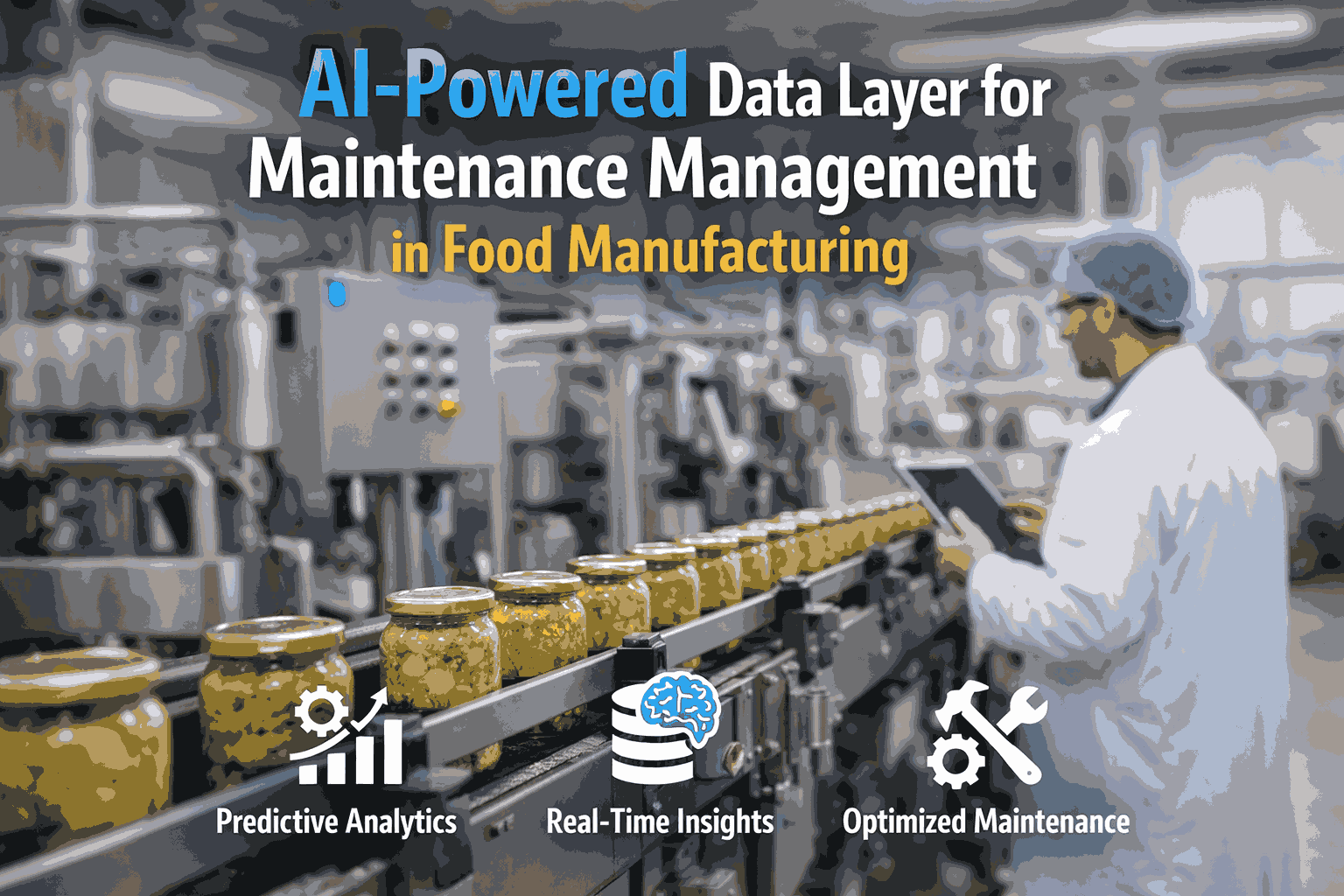
AI-Powered Data Layer for Maintenance Management in Food Manufacturing

By Washington Larry on March 2, 2026

ai-powered-maintenance-data-layer-food-manufacturing

Most food manufacturing plants are running three, four, or five disconnected systems — a CMMS that handles work orders, a separate spreadsheet tracking calibration records, a paper binder for sanitation logs, an ERP with asset purchase history, and sensor data sitting in a PLC that nobody has time to decode. Each system holds a piece of the maintenance picture. None of them talk to each other. And when a filler pump starts showing early signs of bearing failure at 11 PM on a Thursday, none of those systems generate an alert — because no single system has enough context to know what "abnormal" looks like. That is the data layer problem. And it is why food plants that have invested in sensors and CMMS platforms still experience the same unplanned downtime they did five years ago. The AI-powered maintenance data layer is the infrastructure that connects these fragments into a single intelligent system — one that sees across your entire operation, learns what normal looks like for every asset, and surfaces the right information to the right person before a failure happens. Sign up for Oxmaint and see how a unified AI maintenance data platform eliminates the blind spots costing your plant thousands per hour.

AI Architecture Guide · Food Manufacturing · 2026

The AI Data Layer That Turns Fragmented Maintenance Records Into Real-Time Predictive Intelligence

Your CMMS logs it. Your sensors detect it. Your ERP tracks the cost. But none of them share the same language — and that silence is where failures hide. Here is how food manufacturers are replacing data silos with an AI-powered maintenance intelligence layer that finally makes all your systems talk.

$80.6B
Global predictive maintenance market by 2033 — growing at 22.8% CAGR

65%
of maintenance teams plan to adopt AI in the next 12 months

25%
reduction in maintenance costs with AI and ML — Deloitte 2025

75%
decrease in unplanned downtime reported by plants combining AI with automated work orders — IDC 2025
The Root Cause

Why Food Plants Keep Having the Same Failures Year After Year

The answer is almost never "we didn't have the data." Most food plants have sensors. Most have a CMMS. Many have vibration meters, thermal cameras, and OEE dashboards. The real answer is: the data was never connected into a single intelligence layer that could reason across all of it simultaneously. A bearing failure leaves signatures in four different systems — elevated current draw in the PLC, a technician observation note buried in the CMMS three weeks earlier, a deviation flagged during the last calibration check, and a subtle slowdown in cycle time visible in the OEE dashboard. No single person sees all four at once. And the AI model you installed last year can't either — because it was only trained on sensor data, not the full picture.

The Fragmented Maintenance Data Problem — What Most Food Plants Look Like Today
CMMS
Work orders (incomplete)
PM records (calendar-based)
Labor hours logged
Gap: no sensor context
PLC / SCADA
Real-time sensor feeds
Alarm logs
Cycle counts
Gap: no maintenance history
Spreadsheets / Paper
Calibration records
Sanitation sign-offs
Shift observations
Gap: not searchable or linked
ERP System
Spare parts inventory
Procurement history
Asset purchase records
Gap: disconnected from the floor
The result:
Each system captures a fragment. No system sees the full picture. Failures remain invisible until they become emergencies — and the emergency costs between $8,000 and $50,000 per hour depending on your line.
The Architecture

What an AI-Powered Maintenance Data Layer Actually Is

An AI maintenance data layer is not a new piece of software sitting on top of your existing systems. It is the connective tissue that ingests data from every source in your plant — sensors, CMMS records, calibration logs, production schedules, quality deviations, and sanitation records — normalizes it into a single unified format, and feeds it continuously into machine learning models that are trained specifically on your equipment behavior. The output is not another dashboard. The output is an intelligent alert that tells a technician: "Pump motor on Line 3 is drawing 12% above its 90-day baseline during the first two hours of production — this pattern preceded the last two bearing failures on this asset class. Recommended action: inspect and lubricate before next washdown window."

How the AI Data Layer Works — From Raw Signal to Actionable Intelligence
Layer 1
Data Ingestion
IoT sensors, CMMS records, PLC feeds, calibration logs, ERP data, sanitation sign-offs — all collected continuously in real time
IoT SensorsCMMS RecordsPLC / SCADACalibration LogsERP Data
Layer 2
Normalization and Contextualization
Raw data is cleaned, timestamped, tagged by asset and production context, and cross-referenced to build a complete operational picture for each piece of equipment
Layer 3
AI Pattern Recognition
Machine learning models establish normal behavior baselines for each asset, continuously compare real-time signals against those baselines, and identify deviation patterns that historically precede failures
Layer 4
Actionable Output
Specific, contextualized alerts routed to the right technician via mobile, with pre-populated work orders, relevant equipment history, and recommended intervention — automatically
Why Food Manufacturing Is Different

Three Reasons a Generic AI Maintenance Platform Will Not Work in Your Plant

Food manufacturing has compliance requirements, sanitation cycles, and food safety traceability obligations that no general industrial AI maintenance platform was designed to handle. The data layer architecture must be built for these realities from the ground up — not bolted on afterward.

01
Sanitation Disrupts Every Baseline
In a food plant, equipment goes through daily washdown cycles — which temporarily alter vibration signatures, current draw, temperature patterns, and fluid pressure readings. An AI model that does not know the difference between a normal post-CIP reading and an abnormal operating reading will generate false alarms on every shift. The data layer must contextualize every data point against the production and sanitation schedule.
02
Maintenance Events Must Link to Food Safety Records
Under FSMA and HACCP requirements, every maintenance event on a food-contact surface or critical control point must be traceable to the production batches that ran before, during, and after the repair. A data layer that only connects sensor data to work orders — without linking those work orders to batch records — creates regulatory gaps that no AI prediction capability can compensate for.
03
Cold, Wet Environments Accelerate Degradation Patterns
Dairy, meat processing, and frozen food environments subject equipment to temperature cycling, moisture ingress, and lubricant breakdown at rates that industrial baseline models built for dry manufacturing do not account for. The AI model must be trained on data from comparable environments — or it will systematically misread degradation rates and recommend maintenance interventions too late or too early.
The Intelligence Pipeline

Five Stages of AI Maintenance Intelligence — From Data Collection to Failure Prevention

Stage 1
Unified Asset Registry
Every piece of equipment in the plant — from CIP stations and pasteurisers to conveyor drives and filling heads — is registered in a single digital asset registry with its full profile: model, install date, criticality classification, failure mode library, sensor mapping, and compliance category. This registry is the foundation every AI model trains against. Without it, predictive models assign equal monitoring attention to a $200 pump and a $200,000 homogeniser. With it, the system knows exactly where to focus first.
Outcome: Critical asset coverage complete in 48 hours using guided asset import templates
Stage 2
Continuous Multi-Source Data Ingestion
The data layer continuously pulls from every source simultaneously — vibration and temperature sensors on rotating equipment, current sensors on motors, pressure transducers on hydraulic systems, CMMS work order completions, calibration records, production batch start and end times, and sanitation cycle flags. Each data point is timestamped to the second and tagged with the operational context at that moment: was the line running, during CIP, starting up, or under load? This context is what allows the AI to learn what "normal" actually means for each asset under each condition.
Outcome: Baseline model established within 6–8 weeks of sensor deployment — 94.3% prediction accuracy
Stage 3
Cross-Variable Correlation Engine
A single sensor deviation rarely tells the complete story. A bearing that is beginning to fail shows up as elevated current draw, slightly increased vibration amplitude, a marginal temperature rise, and — if you have production data connected — a 0.4-second increase in cycle time. In a disconnected system, each signal is too small to trigger an alert individually. The correlation engine tracks all four simultaneously and recognizes the pattern — because it has seen the same combination precede failures on similar assets across the maintenance history of the entire fleet. This is the critical difference between threshold-based alerting and true AI pattern recognition.
Outcome: 15–30% better defect detection vs. single-variable threshold systems — Food Institute 2025
Stage 4
Automated Work Order Generation
When the AI identifies a failure-precursor pattern, it does not just send an alert to a dashboard that nobody checks. It generates a pre-populated work order in the CMMS: asset identified, failure mode flagged, relevant historical maintenance context attached, recommended intervention steps listed, spare parts cross-referenced against current inventory, and the right technician notified via mobile. The loop from detection to action closes in minutes rather than hours. Plants combining AI prediction with automated work order generation report 75% less unplanned downtime than plants using manual alert-to-action processes.
Outcome: Work order backlog reduced 32% at AI pilot sites — Deloitte 2025
Stage 5
Compliance and Traceability Linking
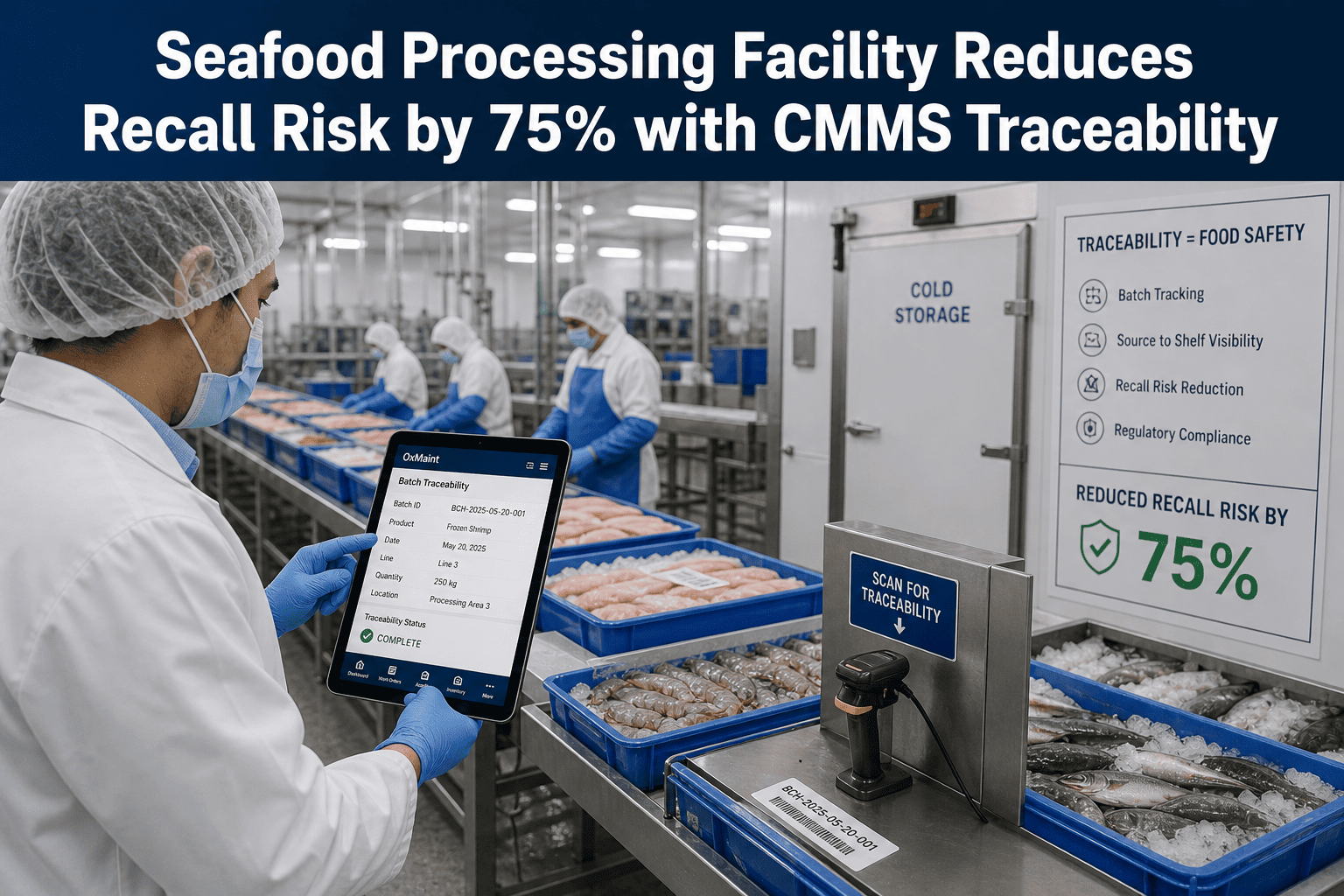
Every work order completed through the data layer is automatically linked to the production batches running at that time — creating a continuous, searchable, timestamped audit trail that satisfies FSMA Rule 204 requirements, HACCP corrective action documentation, and FDA inspection requests. When an inspector arrives and asks for every maintenance event on your pasteuriser over the past 18 months, including all batch records associated with each event, the response is a 60-second export — not a three-day manual file retrieval exercise. This is the compliance value that no other AI maintenance platform was designed to deliver for food manufacturing.
Outcome: Audit documentation export in under 60 seconds — complete regulatory traceability from day one
See the data layer in action at your plant

Stop managing five disconnected systems. Start running one intelligence layer that sees everything.

Proven Outcomes

What Food Plants Are Achieving With a Unified AI Maintenance Data Layer

10–30x
ROI within 12–18 months
Food plants deploying AI predictive maintenance into a prepared data environment achieve 10:1 to 30:1 ROI in the first year and a half — driven primarily by avoided emergency repair costs, reduced unplanned production losses, and lower spare parts inventory through predictive scheduling.
70%
Fewer equipment breakdowns
AI and ML combined with connected maintenance workflows reduce breakdowns by up to 70% compared to calendar-based preventive maintenance programs running on disconnected data — because the AI catches what scheduled maintenance cannot: random-mode failures developing between PM cycles.
$233B
Annual savings at full adoption
Fortune 500 manufacturers are estimated to save $233 billion in maintenance costs annually with full adoption of condition monitoring and predictive maintenance. For individual food plants, even partial deployment typically saves $500,000 to $2 million per year depending on plant size and asset complexity.
94%+
PM compliance achieved
Plants using Oxmaint's automated scheduling and mobile notification system consistently achieve 94% or higher PM compliance — compared to the 25–40% compliance rates typical of manual calendar-based systems where technicians prioritize reactive work over scheduled tasks.
Before vs. After

The Operational Reality: Disconnected Data vs. AI Intelligence Layer

Without an AI Data Layer
Failure detection
After the breakdown occurs
Warning lead time
Zero — reactive response only
Data systems
4–6 disconnected platforms
PM compliance
25–45% — reactive work dominates
Audit preparation
3–5 days of manual assembly
Emergency repair ratio
55–70% of all maintenance activity
Downtime cost per incident
$8,000–$50,000 per hour unplanned
With Oxmaint AI Data Layer
Failure detection
2–4 weeks before failure occurs
Warning lead time
14–28 days for most failure modes
Data systems
Single unified intelligence platform
PM compliance
94%+ — scheduled work completed
Audit preparation
Under 60 seconds — auto-export
Emergency repair ratio
Below 15% of all maintenance activity
Downtime cost per incident
Avoided — intervention before failure
Industry Context

Where Food Manufacturing Stands on AI Maintenance Adoption in 2026


88%
of organizations use AI in at least one function — McKinsey State of AI 2025

65%
of maintenance teams plan to adopt AI in next 12 months — State of Industrial Maintenance 2025

32%
have fully or partially implemented AI maintenance — still only one in three plants

58%
of facilities spend less than half their time on scheduled maintenance — reactive chaos still dominates

39%
of maintenance leaders say knowledge capture is the most valuable AI use case — State of Industrial Maintenance 2025
The gap between the 65% planning to adopt AI and the 32% who have actually done it is almost entirely explained by one thing: the data layer was never built. Plants attempted to deploy AI prediction on top of fragmented, incomplete, or noisy data — and the models produced enough false alarms and missed detections to kill team confidence before the technology had a chance to prove itself. Building the data layer first is the prerequisite that most AI maintenance pilots skip — and it is the reason most of them fail.
Detailed FAQ

Everything Food Plant Leaders Ask About AI Maintenance Data Layers

We already have a CMMS and IoT sensors. Why do we still have unplanned downtime?
This is the most common question we hear from food plant engineers, and the answer reveals exactly why the AI data layer concept matters. A CMMS and sensors are two of the five data sources that need to be connected — but having them separately does not create intelligence. Your CMMS knows a work order was completed on a motor last Tuesday. Your sensor knows that same motor is drawing elevated current this morning. But neither system knows the other's information. The AI data layer is what connects those two data points, correlates them with the 18-month failure history of that motor class, cross-references the current draw pattern against historical pre-failure signatures, and sends a specific alert before the failure happens. If your CMMS and sensors are not connected to the same intelligence layer, they are just two more isolated data silos — and unplanned downtime will continue regardless of how good each individual system is.
How long does it take to build a working AI maintenance data layer from scratch?
With Oxmaint, the foundational data layer is operational within 48 hours of platform deployment. The asset registry, CMMS records migration, and mobile workflow deployment happen in the first two days. PM scheduling automation goes live in week one. IoT sensor integration — if sensors are already installed — typically completes within two to four weeks. The AI prediction layer begins generating validated failure alerts within six to eight weeks of sensor data ingestion, once the baseline models have enough operational history to distinguish normal patterns from developing failure signatures. For plants starting from scratch with no sensors, add four to six weeks for sensor procurement and installation. Most Oxmaint customers achieve their first validated AI prediction within 10–12 weeks of go-live — and that is when the ROI calculation becomes straightforward.
Our maintenance records are in spreadsheets and paper binders. Can we still build an AI data layer?
Yes — and this is the most common starting point for food plants moving to Oxmaint. Paper and spreadsheet records are imported using guided data import tools during the go-live process. Historical maintenance records, calibration histories, and equipment files are digitized and structured into the asset registry. The AI models begin training on this historical data immediately — which means the longer your paper-based history, the stronger the initial baseline models. A plant with three years of paper maintenance records for a critical filling line actually has a significant advantage: three years of failure event data, repair patterns, and part replacement cycles that teach the AI what deterioration looks like for that specific asset class. The data layer can learn from all of it once it is digitized.
What data sources does the Oxmaint AI data layer connect, and how does integration work?
Oxmaint connects to IoT sensors via standard industrial protocols including MQTT, OPC-UA, and Modbus. For legacy PLC and SCADA systems, API-based middleware handles data extraction without requiring equipment replacement or line shutdowns. ERP systems including SAP, Oracle, and Microsoft Dynamics integrate through pre-built connectors for spare parts inventory and asset purchase history. Calibration management systems, quality management software, and sanitation scheduling tools can connect via REST API. In most food manufacturing environments, the full integration set — sensors, CMMS migration, ERP connection, and compliance documentation linking — is completed within the first four weeks of deployment. No custom development is required for standard integrations. For legacy systems with non-standard protocols, Oxmaint's implementation team handles custom integration as part of the go-live process.
How does the AI data layer handle food safety compliance requirements specifically?
This is where Oxmaint's food manufacturing-specific design differs from general industrial AI maintenance platforms. Every maintenance event completed through Oxmaint is automatically linked to the production batch records running at that time — creating the maintenance-to-batch traceability that FSMA Rule 204 and HACCP corrective action procedures require. When a maintenance event occurs on a food-contact surface or critical control point, the system automatically flags the associated batch records, records the nature of the maintenance activity, documents who performed the work and when, and generates a timestamped corrective action record. Audit documentation covering any date range — six months, eighteen months, or three years — is exportable in under 60 seconds. This means an FDA inspector arriving for an unannounced audit can receive complete documentation while still standing at the front desk.
How does the AI avoid generating too many false alarms that will make the maintenance team distrust the system?
False alarm rates are the primary reason AI maintenance pilots fail in food manufacturing — and they almost always stem from the same root cause: the AI model was trained without production context. When a model does not know that a motor's elevated current reading at 6 AM is normal because the line is just starting up after overnight sanitation, and that the same reading at 2 PM during full production is abnormal, it generates alarms on both. Oxmaint's data layer solves this by continuously tagging every data point with its operational context — production running, CIP in progress, startup, shutdown, or idle. The AI models train against context-aware baselines rather than flat threshold values. The result is that alert precision in food manufacturing environments typically reaches 80–90% after the 8-week baseline period, meaning the large majority of alerts the system generates indicate genuine developing failures — not noise from normal operational variation.
What is the realistic ROI calculation for a mid-size food plant deploying this system?
For a typical mid-size food plant running 16–24 hours per day with 50–150 critical assets, the ROI calculation has four components. First, avoided emergency repair costs: each prevented major failure saves $15,000–$50,000 in direct repair costs, expedited parts, and overtime. Second, avoided production downtime: at $8,000–$30,000 per unplanned production hour, preventing even four to six major failures per year generates $50,000–$180,000 in avoided losses. Third, PM efficiency gains: automating scheduling and mobile workflows typically recovers 2–4 hours per technician per week — significant at scale. Fourth, compliance value: eliminating manual audit preparation saves 20–40 hours per audit and reduces the regulatory risk associated with documentation gaps. Combined, most mid-size food plants see full ROI within 3–6 months of deployment, with 10:1 to 30:1 returns over 18 months — consistent with industry benchmarks for AI predictive maintenance in prepared environments.
Your data is already there. It just needs to be connected.

Oxmaint builds the AI maintenance data layer that turns your plant's fragmented records into real-time predictive intelligence — starting in 48 hours.

Asset registry, CMMS digitization, IoT sensor integration, AI failure prediction, automated work orders, and full compliance documentation — all in one platform designed specifically for food manufacturing.
48 hrs
To go live

6–8 wks
First AI prediction

94%+
PM compliance

10–30x
ROI in 18 months

60s
Audit export

Share This Story, Choose Your Platform!