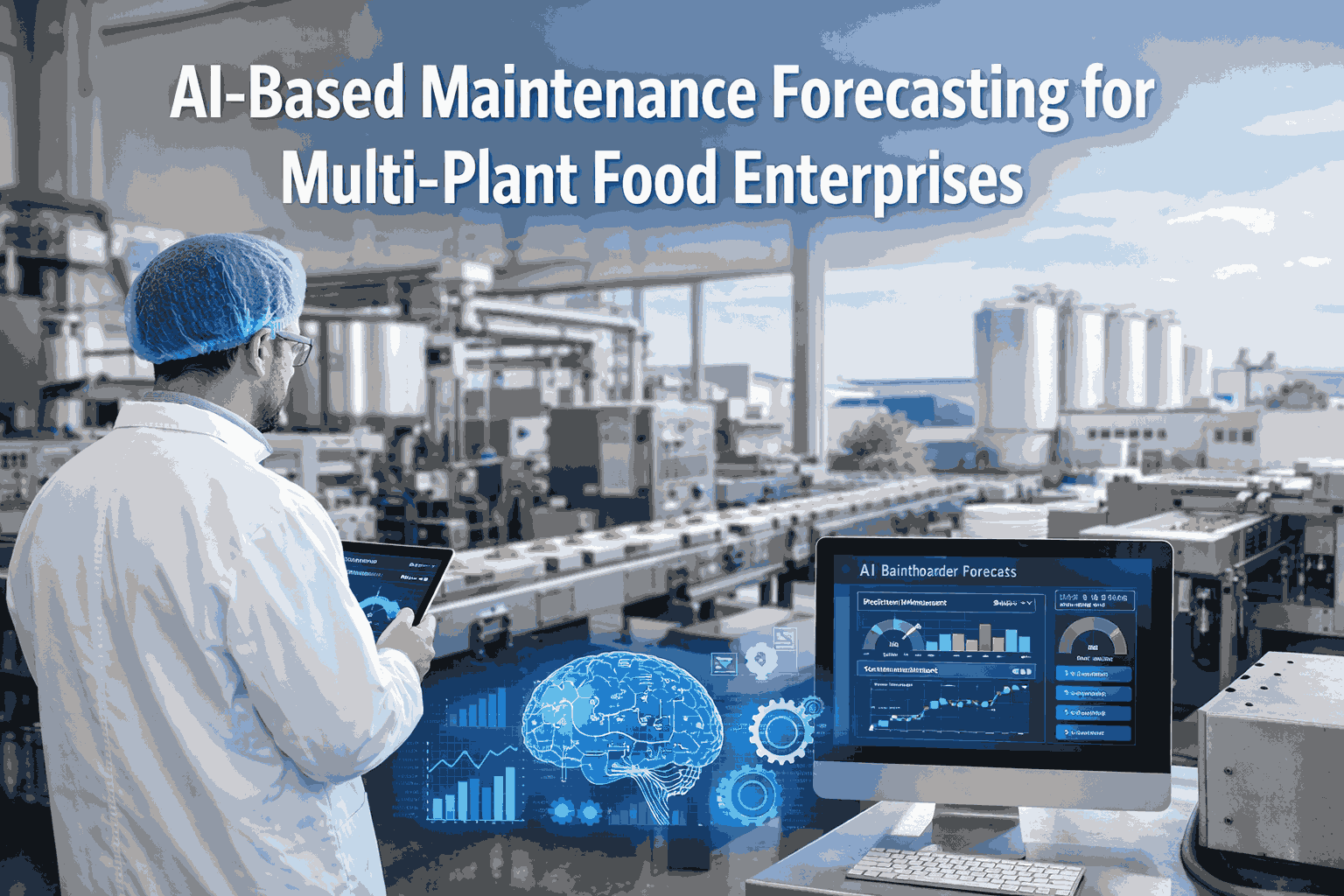
AI-Based Maintenance Forecasting for Multi-Plant Food Enterprises

By Luffy son on March 2, 2026

ai-maintenance-forecasting-multi-plant-food-enterprises

A 14-plant snack food enterprise operating across five states experienced the same conveyor gearbox failure at three separate facilities within eight months — each one treated as an isolated incident, each one costing between $180,000 and $340,000 in unplanned downtime. The pattern was hiding in plain sight across their data. After deploying AI-based maintenance forecasting enterprise-wide, the same failure signature was detected at two additional plants with 19 days of advance warning — both replaced during scheduled windows at planned-maintenance cost. Sign up for Oxmaint to connect your plant network and start catching cross-site failure patterns before they become shutdowns.

Enterprise AI  ·  AI Predictive Systems  ·  Multi-Plant Operations

AI-Based Maintenance Forecasting for Multi-Plant Food Enterprises

How enterprise food manufacturers are eliminating cross-site blind spots, predicting failures weeks before they happen, and converting unpredictable downtime costs into measurable, compounding ROI — across every plant in the network simultaneously.

58%
Reduction in Unplanned Downtime

83%
Failures Predicted Before Occurrence

6.2x
Average Enterprise ROI — Year One

21 Days
Average Advance Failure Warning
The Core Problem

Your Plants Have the Data. Nobody Is Reading It.

Enterprise food manufacturers operating 6, 10, or 20 facilities generate enormous volumes of equipment data every hour — sensor readings, motor currents, cycle counts, error logs, work order histories. The signals that predict failures exist in this data right now. But without AI connecting them across sites, every plant operates as an isolated silo. A failure pattern that repeats across your network stays invisible until the third or fourth breakdown forces a post-mortem that reveals what the data was telling you for months.

  • $1.4M average annual downtime cost per plant — multiply by your facility count to see the true enterprise exposure hiding in your current maintenance approach
  • 76% of equipment failures show detectable early signals — current draw anomalies, vibration shifts, temperature drift — all present in data you already collect but cannot act on without AI
  • Cross-plant patterns stay invisible — when the same conveyor model fails at Plant A and Plant C, traditional CMMS treats each as a first occurrence rather than a network-wide warning
  • 34% of food recalls trace to equipment failures — maintenance breakdowns are not just production events; they are food safety events with $10M+ recall cost exposure
Enterprise Blind Spot — Live Risk by Plant
Without AI cross-plant analysis, this view does not exist
Plant — Ohio

82% — Critical
Plant — Indiana

67% — Elevated
Plant — Wisconsin

51% — Moderate
Plant — Michigan

29% — Stable
Plant — Illinois

14% — Stable
Updated every 15 minutes across all connected facilities
How AI Forecasting Works

From Raw Operational Data to Ranked, Actionable Predictions

AI-based maintenance forecasting is not a smarter alert threshold. It is a continuously learning system that ingests multi-source operational data from every plant, builds equipment-specific behavioral baselines, identifies multi-variable failure signatures weeks before any single threshold is breached, and surfaces prioritized recommendations to the right team member at the right time. Book a demo to see how Oxmaint's AI processes your existing data infrastructure.

  • Multi-source ingestion — Sensor telemetry, SCADA, PLC, historian databases, work order histories, and inspection records stream continuously from every asset at every plant into a unified data layer
  • Equipment-specific baseline modeling — LSTM neural networks establish behavioral baselines per asset, accounting for production load, ambient temperature, washdown cycles, and seasonal variation
  • Multi-variable anomaly detection — Predictions surface only when anomalies are confirmed across multiple independent data streams simultaneously — keeping false positives below 8%
  • Cross-plant pattern propagation — Failure signature detected at one plant triggers immediate network-wide search across all matching equipment types in under 4 minutes
AI Forecasting Engine — Data Flow
01
Data Ingestion
Sensors, SCADA, PLC, work orders — all plants, all assets, continuous stream
02
Baseline Modeling
AI builds equipment-specific behavioral baseline per asset across all conditions
03
Anomaly Detection
Multi-variable deviation confirms failure signature — not single threshold alert
04
Risk-Ranked Work Order
Auto-generated, prioritized, parts pre-checked — ready for technician action
Case Study

9-Plant Dairy Enterprise — $3.1M Annual Downtime Losses Eliminated

A Midwest dairy enterprise operating nine facilities across three states was spending $4.8M annually in unplanned downtime costs. Each plant managed its CMMS independently. When a specific pasteurizer pump model began failing at the Ohio facility, the same pump at Wisconsin and Indiana showed identical early-stage current anomalies — but no one connected the dots until both failed within six weeks. After deploying Oxmaint AI forecasting across all nine plants, cross-plant visibility emerged for the first time. Within 90 days, 1,847 assets were baselined. By month six, 84% of maintenance was planned vs. 28% before deployment. Sign up for Oxmaint to start building cross-plant intelligence across your network.

"The first time the AI flagged a bearing failure at our Eau Claire plant, we thought it was a false positive. We inspected it anyway. The bearing was already showing stress fractures. We replaced it during a scheduled window and avoided a 9-hour shutdown worth $180,000. That was the day we stopped doubting the system."
— Director of Plant Operations, 9-Facility Dairy Enterprise
12-Month Outcomes — 9 Plants
Unplanned Downtime Reduction
−61%
Annual Downtime Cost Eliminated
$3.1M
Failures Predicted in Advance
214/247
Emergency Maintenance Spend
−54%
Audit Findings — Maintenance
−78%
Platform ROI — Year One
7.4x
Your Plants Are Generating Failure Signals Right Now. Is Anyone Reading Them?
Oxmaint connects to your existing sensors and operational data — no infrastructure overhaul. Most enterprises see first AI-predicted failure within 11 weeks of deployment.

Traditional CMMS vs. AI Forecasting — What Changes at the Enterprise Level

The gap between CMMS-only maintenance and AI forecasting is not incremental improvement. It is a fundamentally different operational reality — at every level of the organization, across every plant in the network, every single day.

Traditional CMMS-Only
Failure Detection
After breakdown — reactive scramble
Cross-Plant Intelligence
None — isolated data silos
Maintenance Scheduling
Calendar-based — ignores actual condition
Parts Management
Reactive ordering — emergency freight
Corporate Visibility
Monthly reports — backward looking
Risk Prioritization
Gut-feel — loudest complaint wins
35% of issues lost between shifts and sites
AI Forecasting with Oxmaint
Failure Detection
14–28 days before — planned replacement
Cross-Plant Intelligence
One plant's failure protects all plants
Maintenance Scheduling
Condition-based — actual asset health data
Parts Management
AI pre-orders — parts arrive before needed
Corporate Visibility
Live risk scores — every asset, every plant
Risk Prioritization
Data-driven — highest-risk assets surface first
Zero information loss across network

What AI Monitors — Critical Equipment and Early Warning Signals

Oxmaint's AI models are trained on food manufacturing failure modes specifically — not generic industrial machinery applied to food processing as an afterthought. Each equipment category has sector-specific failure signatures the AI recognizes weeks before a technician would notice anything unusual. Sign up for Oxmaint to configure monitoring for your specific asset inventory.

Filling & Dosing Systems
Line-Stopping Critical
Fill weight statistical drift beyond ±0.3% tolerance
Valve actuation timing deviation from cycle baseline
Nozzle pressure drop indicating partial blockage
Avg. advance warning: 17 days
CIP & Sanitation Systems
Food Safety Critical
Pump flow rate deviation cycle-to-cycle
Temperature ramp time trending beyond specification
Valve seal integrity via pressure hold-test trending
Avg. advance warning: 12 days
Conveyor & Transfer Systems
Cascade Risk
Drive motor current draw vs. production load
Belt tension loss across shift-to-shift comparisons
Bearing vibration frequency signatures
Avg. advance warning: 22 days
Pasteurizers & Heat Exchangers
Regulatory Critical
Holding tube temperature consistency per run
Heat transfer efficiency degradation from fouling
Pressure differential across plates above baseline
Avg. advance warning: 19 days
Packaging & Sealing Machines
Output Critical
Sealing jaw temperature uniformity across surface
Film tension consistency at roll change and mid-roll
Reject rate correlation to specific machine parameters
Avg. advance warning: 11 days
Compressors & Refrigeration
Environmental Critical
Suction/discharge pressure differential trending
Motor amp draw vs. ambient temperature ratio
Defrost cycle duration trending longer over time
Avg. advance warning: 28 days

Enterprise ROI — Four Financial Impact Categories That Compound Across Every Facility

Enterprise maintenance leaders evaluate AI forecasting on financial return, not technology merit. The business case is built on four measurable categories that grow with every plant you add and every month the AI models improve with accumulated network data.

Downtime Cost Elimination
Prevented Hours × $260/min × 60
A network preventing 180 unplanned hours annually eliminates $2.8M in direct losses before accounting for scrapped product, emergency labor, or customer penalties. Across a 10-plant network, this single category delivers $2.4M–$4.2M per year.
$2.4M – $4.2M / year · 8-plant network
Emergency Maintenance Savings
Reactive Cost (3–5×) → Planned Cost (1×)
Emergency repairs cost 3 to 5 times more than scheduled maintenance. Shifting from 30% planned to 85% planned across a 10-plant network saves $800K–$1.4M in direct maintenance spend annually without reducing maintenance quality.
$900K – $1.4M / year savings
Compliance & Recall Risk Avoidance
Prevented Events × $10M+ Average Recall Cost
A single food safety recall costs an average of $10M in direct costs plus brand damage. AI monitoring of food-contact equipment and CIP systems eliminates the maintenance failures that drive 34% of recalls — the highest-value risk mitigation in food manufacturing.
Risk-adjusted value: $1.2M – $3.4M / year
Labor Productivity Recapture
Hours Redirected from Reactive to Planned Work
Maintenance technicians at reactive plants spend 60–70% of their time responding to emergencies. AI forecasting shifts this to planned work — recapturing 20–30% of total labor capacity for higher-value activities without adding headcount across the network.
$400K – $800K / year in labor productivity
Combined Enterprise ROI Impact — 8 to 12 Plant Network
$5.0M — $9.8M annual value creation
Against an average Oxmaint enterprise platform investment of $800K–$1.4M annually, the financial case consistently delivers 5–8× ROI in year one, growing as AI models improve with accumulated network data in years two and three.

Frequently Asked Questions

Detailed answers to what maintenance directors, operations VPs, and food safety leaders ask when evaluating enterprise AI forecasting. For questions specific to your network, book a demo with an Oxmaint enterprise specialist.

How does AI forecasting differ from the predictive features already in our CMMS?
Standard CMMS predictive features offer threshold alerting — notify when temperature exceeds X. True AI forecasting uses machine learning models that identify complex, multi-variable failure signatures weeks before any single threshold is breached. More critically, enterprise AI operates across your entire plant network simultaneously, recognizing patterns that span sites and equipment categories — something no single-site alert system can do. Oxmaint's models continuously learn from failure outcomes across your network, becoming more accurate over time in a way static rule-based alerting never can.
What data sources does the AI need, and do we have to replace our existing sensors?
Oxmaint is designed to work with your existing infrastructure. It ingests data from current sensors, SCADA systems, PLCs, historian databases, work order records, and manual inspection logs — no infrastructure replacement required. The platform has pre-built connectors for OPC-UA, Modbus, MQTT, and direct integrations with Rockwell, Siemens, and Allen-Bradley controllers. Most food enterprises already collect 70–80% of the sensor data needed for meaningful AI predictions — they simply haven't connected it to an analytics platform capable of using it across sites.
How long until the AI models are accurate enough to trust and act on?
Oxmaint uses a two-phase accuracy ramp. In Phase One (weeks 1–8), pre-trained food manufacturing industry models deliver useful predictions immediately at 65–72% accuracy. In Phase Two (months 3–6), models fine-tune to your specific equipment, environments, production patterns, and failure history. Network-specific accuracy reaches 80–87% by month six. Enterprises with richer historical CMMS data reach Phase Two accuracy faster — often within 10–12 weeks of deployment.
How does the system handle food safety compliance documentation for FDA and FSMA requirements?
Every AI-generated risk alert, the work order it creates, the technician who completes it, and the outcome they record — all time-stamped and linked in a searchable audit trail. For FSMA Preventive Controls, maintenance is documented not just as "completed" but as "completed in response to a detected risk signal" — demonstrating a proactive, data-driven food safety culture that auditors increasingly recognize as the gold standard. Audit-ready reports for food-contact and CIP equipment are generated automatically on any schedule you configure.
What happens when AI identifies a failure risk at a plant that lacks the parts or skills to fix it?
When the AI predicts a failure, it simultaneously checks centralized parts inventory across the network — if the required part is available at a nearby facility, the system flags it for inter-site transfer. For skill gaps, the system provides detailed repair guidance from historical successful resolutions of the same failure pattern network-wide. The 21-day average advance warning window exists specifically to ensure that resource gaps — parts, skills, contractor availability — can be addressed before urgency eliminates your options.
Can the AI distinguish between a genuine failure signal and normal operational variation?
False positive rates are the central concern for every enterprise evaluating AI forecasting — a system that cries wolf gets ignored. Oxmaint addresses this through multi-signal validation: predictions surface only when anomalies are confirmed across multiple independent data streams simultaneously. A single elevated temperature reading does not trigger an alert. Elevated temperature combined with increased current draw and a subtle vibration shift developing over 72 hours does. This multi-signal approach keeps false positive rates below 8% while catching 83% of failures before they occur.
How does AI forecasting scale as we acquire new facilities or add production lines?
New facilities are onboarded by connecting to existing data infrastructure and configuring the asset registry — typically completed in 2–4 weeks per new site. Crucially, new facilities immediately benefit from AI models already trained on your existing network. If you have ten plants running Oxmaint and acquire an eleventh, that facility's similar equipment begins generating predictions based on failure patterns learned from the entire existing network from day one — not starting from scratch. This network effect means AI accuracy improves and ROI per new site accelerates as your enterprise grows.
How do we build the business case for AI forecasting investment with our CFO?
Lead with three numbers your CFO already tracks: total annual unplanned downtime cost across the network (hours × $260/minute × 60), current emergency maintenance spend as a percentage of total maintenance budget, and any compliance penalty or recall cost from the past three years. Apply conservative improvement factors — 45% downtime reduction, shift from 30% to 80% planned maintenance, zero compliance events — and calculate the annual value created. In virtually every food enterprise scenario, the 5–8× first-year ROI clears any capital approval threshold. Book a financial modeling session — Oxmaint builds this calculation using your actual facility data at no cost.
Start Predicting Enterprise-Wide Failures Today

Your Plants Are Generating the Data. AI Turns It Into Decisions.

Oxmaint's AI forecasting platform gives multi-plant food enterprises the cross-site intelligence, predictive accuracy, and risk prioritization needed to stop fighting fires and start preventing them — across every facility, every shift, every asset in your network.
No infrastructure overhaul required  ·  Enterprise onboarding support included  ·  ROI modeling session at no cost

Share This Story, Choose Your Platform!