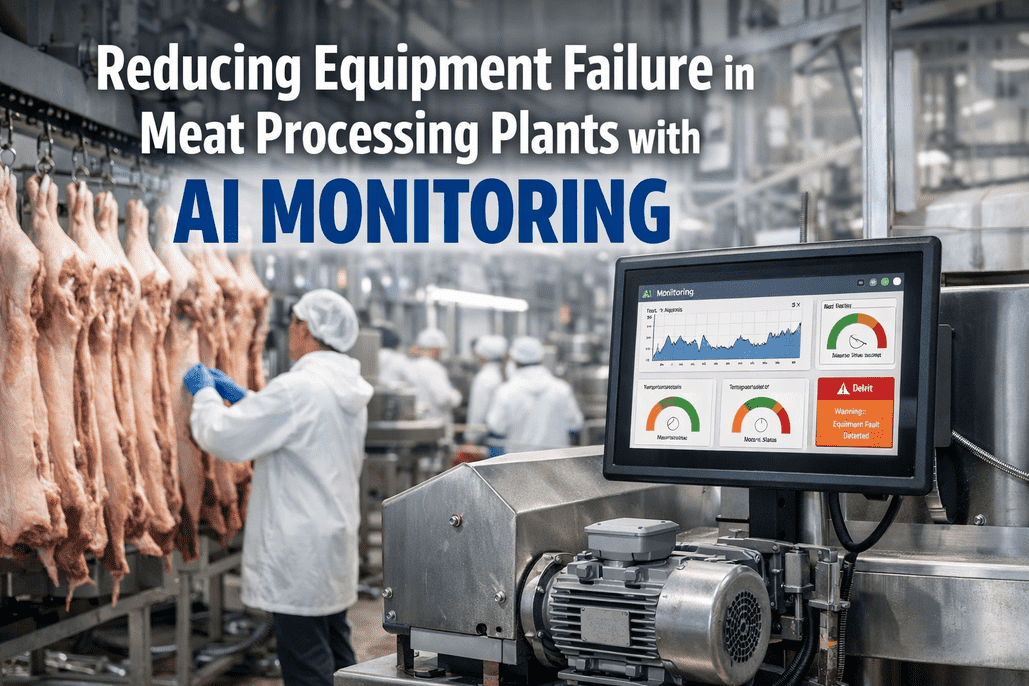
AI-powered predictive maintenance is fundamentally changing how food and beverage manufacturers protect their production lines — detecting equipment failure signals 2 to 8 weeks before a breakdown occurs, preserving product quality, maintaining HACCP compliance, and eliminating the unplanned downtime that costs food plants an average of $3,000 to $5,000 per minute in lost output. For production line managers and plant engineers, the shift from reactive repairs to machine learning-driven equipment health scoring is no longer a future investment — it is the operational standard separating high-efficiency food factories from their struggling competitors. Sign up free and see how AI predictive maintenance transforms food production line reliability from day one.
Stop production line failures before they happen. Oxmaint's AI predictive maintenance platform gives food manufacturers real-time equipment health scoring, IoT sensor integration, and automated CMMS work orders — in one unified system.
What Is AI Predictive Maintenance in Food Manufacturing?
AI predictive maintenance in food production combines IoT sensors, machine learning algorithms, and real-time analytics to continuously monitor the health of critical processing equipment — conveyors, fillers, mixers, pasteurizers, packaging lines, and refrigeration systems — and predict failure events with actionable lead time. Unlike time-based preventive maintenance, which services equipment on fixed calendar schedules regardless of actual condition, AI-driven food plant maintenance dispatches technicians based on measured degradation signals: vibration anomalies, temperature drift, motor current variance, and pressure fluctuation patterns that precede mechanical failure by days or weeks.
The core technology stack for production line AI monitoring includes edge-mounted condition sensors, a machine learning model trained on historical fault patterns, and a maintenance management platform that translates failure probability scores into prioritized work orders. When this system is deployed on a food processing line, every motor, gearbox, pump, and sealing unit continuously broadcasts health data — and the AI flags deterioration the moment it deviates from normal operating baselines, not after the deviation has already caused a product loss event.
Industry Benchmark
Food manufacturers implementing AI predictive maintenance report 35–50% reductions in unplanned downtime, 20–35% lower maintenance costs, and significant improvements in OEE (Overall Equipment Effectiveness) — with ROI breakeven typically achieved within 9–14 months of full deployment.
Why Food Production Lines Are Uniquely Vulnerable to Equipment Failure
Food and beverage processing environments place exceptional mechanical stress on production line equipment. High-moisture environments accelerate bearing corrosion. Frequent CIP (clean-in-place) thermal cycling stresses seals and gaskets. Continuous high-speed operation of filling, capping, and labeling machinery generates cumulative fatigue that conventional maintenance schedules cannot reliably intercept. And unlike manufacturing sectors where a line stoppage is purely a cost event, food plant breakdowns carry a second risk layer: contamination exposure, temperature exceedance, and product hold situations that create HACCP non-conformances with regulatory and commercial consequences.
Traditional reactive maintenance in food factories is operationally unsustainable because the consequences of failure extend far beyond equipment repair costs. A seized conveyor motor during a production run can mean thousands of units of open product exposed to environmental contamination. A failed pasteurizer heat exchanger can trigger a product hold requiring full batch disposition. A packaging line sealer failure during peak season can cascade into missed retailer delivery windows with contractual penalties. Book a demo to see how Oxmaint's predictive analytics food manufacturing module addresses these specific failure scenarios with food-industry-tuned detection models.
How AI Predicts Food Equipment Failures 2–8 Weeks in Advance
The predictive lead time that machine learning delivers — the 2 to 8 week advance warning window — is a direct function of the failure mode being monitored and the quality of the sensor data feeding the model. Understanding how different failure types are detected helps food plant teams prioritize sensor deployment and AI model configuration for maximum protective coverage.
01
Vibration Signature Analysis
Accelerometers on motors, pumps, and gearboxes detect bearing degradation, imbalance, and misalignment through spectral frequency shifts. Bearing failure typically produces detectable vibration anomalies 4–8 weeks before mechanical seizure — enough lead time for planned replacement during a scheduled CIP window rather than an emergency line stoppage.
02
Thermal Imaging and Temperature Trending
Infrared sensors and thermal cameras identify heat buildup in electrical panels, motor windings, and heat exchangers before it reaches failure thresholds. Gradual temperature rise above baseline — often 2–3°C over several weeks — is a reliable leading indicator for insulation breakdown, restricted coolant flow, and refrigeration system degradation.
03
Motor Current Signature Analysis (MCSA)
Current draw patterns from drive motors contain encoded information about mechanical load, rotor condition, and torque variability. MCSA algorithms detect rotor bar faults, eccentricity, and coupling degradation weeks before observable performance decline — making it one of the most cost-effective predictive techniques for food conveyor and mixer drives.
04
Pressure and Flow Deviation Monitoring
In liquid food processing lines — dairy, beverage, and sauce production — subtle pressure drop increases across homogenizers, heat exchangers, and CIP circuits signal fouling and partial blockage. AI models correlating pressure differential trends with cleaning cycle history predict heat exchanger performance collapse 2–4 weeks before critical efficiency loss occurs.
05
Ultrasonic Leak and Seal Detection
Ultrasonic sensors detect compressed air leaks, valve seat deterioration, and seal degradation in packaging machinery before they cause product integrity failures. In modified atmosphere packaging (MAP) lines, early seal failure detection is critical to preventing underfilled or compromised packs reaching retail distribution.
06
Oil Analysis and Lubrication Health Scoring
In-line oil condition sensors measuring viscosity, particle count, and contamination levels provide real-time lubrication health data for gearboxes and hydraulic systems. Degrading lubrication is a primary precursor to accelerated wear in high-speed food processing machinery — and automated oil health scoring triggers relubrication or oil change work orders before wear damage becomes irreversible.
AI Predictive Maintenance and HACCP Compliance: A Critical Connection
HACCP (Hazard Analysis and Critical Control Points) compliance in food manufacturing depends on the reliable, documented performance of critical process equipment at defined control points — pasteurization temperatures, fill weights, seal integrity, and refrigeration holding conditions. When equipment at a CCP degrades without detection, the consequence is not only a maintenance event but a food safety deviation requiring documented corrective action, potential product hold, and regulatory notification in serious cases. AI-powered food equipment failure prediction directly strengthens HACCP compliance by ensuring that equipment critical to food safety operates within validated parameters continuously — not just at the moment of the last scheduled inspection.
An AI maintenance platform integrated with food production line monitoring generates a continuous, timestamped audit trail of equipment operating parameters at every critical control point. This documentation satisfies FSMA preventive controls requirements, supports BRC and SQF audit evidence, and provides the equipment performance history that GFSI-aligned facilities need to demonstrate due diligence in process control. Get started free with Oxmaint and build an AI-driven maintenance and compliance record system your auditors will recognize immediately.
Compliance Insight
Food plants using AI-driven equipment health monitoring report significantly cleaner GFSI audit outcomes — with continuous CCP equipment performance logs replacing manual inspection records that auditors increasingly view as insufficient evidence of process control rigor.
Predictive Maintenance vs. Preventive Maintenance in Food Plants: A Direct Comparison
The decision between calendar-based preventive maintenance and AI-driven predictive maintenance is one of the most consequential maintenance strategy choices a food plant manager makes. Understanding the operational and financial differences between the two approaches is essential for building the business case for AI food plant maintenance investment.
| Maintenance Factor |
Calendar Preventive Maintenance |
AI Predictive Maintenance |
| Failure Detection Timing |
After failure or at scheduled interval |
2–8 weeks before failure |
| Unplanned Downtime Risk |
High — interval-based gaps |
Low — continuous monitoring |
| PM Labor Efficiency |
Low — fixed schedule regardless of need |
High — condition-based dispatch |
| HACCP Documentation |
Manual inspection records |
Automated continuous audit trail |
| Energy Waste Detection |
Not available |
Real-time anomaly flagging |
| Parts Inventory Optimization |
Overstock or reactive procurement |
Demand-signal-driven ordering |
| Equipment Lifespan Extension |
Limited — over/under-maintenance common |
Significant — precise intervention timing |
| ROI Timeline |
Immediate but diminishing |
9–14 months to breakeven, compounding gains |
IoT Sensor Deployment for Food Production Line Monitoring
The sensor infrastructure underpinning AI predictive maintenance in food factories must balance data richness with the practical constraints of food-grade installation environments — moisture resistance, thermal cycling tolerance, hygienic design compliance, and integration with existing PLCs and SCADA systems. A well-designed IoT food processing sensor network covers critical rotating equipment, thermal process equipment, and packaging line machinery with the appropriate sensor technology for each failure mode.
Critical Rotating Equipment Priority
Conveyors, mixers, pumps, and compressors should receive vibration and temperature sensors first. These assets have the highest failure frequency, longest procurement lead times for replacements, and greatest impact on line throughput when they fail — making them the highest-ROI targets for initial IoT sensor investment in any food plant.
Food-Grade Sensor Specifications
Sensors installed in food processing zones require IP67 or IP69K ingress protection ratings, materials compatible with CIP chemical exposure, and mounting configurations that do not create sanitation harborage points. Wireless sensor options eliminate cable routing through food zones while maintaining data transmission reliability sufficient for real-time monitoring.
PLC and SCADA Data Integration
Most modern food production lines already generate rich operational data through their PLC and SCADA systems — run speeds, temperature set points, cycle counts, and alarm histories. AI predictive maintenance platforms that integrate directly with existing plant control systems can deliver significant predictive value without additional hardware investment on well-instrumented lines.
Edge Computing for Real-Time Processing
In high-speed food processing environments where millisecond-resolution data matters — rotary filler heads, high-speed packaging lines, in-line checkweighers — edge computing nodes process sensor data locally before transmitting aggregated health scores to the cloud platform, ensuring low-latency anomaly detection without network bandwidth constraints.
AI Equipment Health Scoring: How Machine Learning Quantifies Failure Risk
At the core of any AI predictive maintenance system for food manufacturing is the equipment health score — a machine learning-derived probability metric, typically expressed as a 0–100 index, that represents the current condition of a monitored asset relative to its normal operating baseline and its historical failure signature. Health scores give maintenance planners and production managers an intuitive, actionable way to prioritize the maintenance queue without requiring deep technical expertise in signal processing or reliability engineering.
Machine learning models generating equipment health scores in food plants are trained on combinations of real-time sensor data, historical fault records from the CMMS, equipment nameplate specifications, and operational context — production rate, product type, ambient temperature — that affects wear rate. As the model accumulates facility-specific operating history, its predictions become increasingly precise for the specific failure patterns in that plant's environment. Book a demo to see how Oxmaint's AI health scoring engine is configured for food production line assets during a guided onboarding session.
1
Sensor Data Ingestion and Normalization
Raw sensor streams — vibration, temperature, current, pressure — are ingested, normalized against equipment operating context, and cleaned of noise artifacts before entering the ML model pipeline.
2
Baseline Deviation Calculation
The AI model compares current readings against the equipment's learned normal operating signature, calculating the statistical significance of deviations across multiple parameters simultaneously.
3
Failure Pattern Matching
Deviation patterns are matched against a library of known pre-failure signatures derived from historical data and industry fault databases — identifying not just that something is wrong, but what failure mode is developing and at what rate.
4
Health Score Generation and Trending
A composite health score is calculated and updated continuously, with trend trajectory plotted to project the estimated failure date based on current degradation rate — giving planners a maintenance window, not just a warning.
5
Automated Work Order Generation
When a health score crosses a configured threshold, the platform automatically generates a CMMS work order with diagnostic context, recommended actions, and required parts — dispatched to the assigned technician before the production team experiences any performance impact.
Reducing Food Manufacturing Downtime: Quantified ROI of Predictive Analytics
The ROI case for AI predictive analytics in food manufacturing is built on three quantifiable value streams: downtime reduction, maintenance cost optimization, and product loss prevention. Each stream delivers independent financial value, and the combination typically produces a business case that comfortably clears most food manufacturer's capital investment hurdle rates within the first year of deployment.
Unplanned Downtime Reduction
35–50%
Reported reduction in unplanned production line stoppages in food plants deploying AI predictive maintenance across critical rotating and process equipment.
Maintenance Cost Savings
20–35%
Reduction in total maintenance expenditure from eliminating unnecessary PMs, reducing emergency parts procurement premiums, and extending equipment service intervals where health data supports it.
Product Waste Reduction
15–25%
Reduction in product holds, disposals, and rework events attributable to undetected equipment degradation — a value stream unique to food manufacturing that dramatically accelerates ROI compared to non-food sectors.
OEE Improvement
+8–15%
Improvement in Overall Equipment Effectiveness from combined availability and performance gains — translating directly into increased production capacity without capital investment in additional lines.
ROI Breakeven
9–14 Months
Typical time to ROI breakeven for food manufacturers deploying AI predictive maintenance across 20 or more critical production line assets — faster than most capital equipment investments.
Failure Prediction Lead Time
2–8 Weeks
Average advance warning window provided by AI failure prediction algorithms for food production line equipment — sufficient lead time for planned repair during scheduled downtime in virtually all cases.
Oxmaint's AI predictive maintenance platform is purpose-built for food and beverage manufacturers — with IoT sensor integration, equipment health scoring, automated CMMS work orders, and HACCP-aligned compliance documentation in one platform. Join food plants already preventing production failures weeks before they happen.
Smart Food Factory: Integrating AI Maintenance with Production Line Digitalization
AI predictive maintenance does not operate in isolation within a smart food factory — it is one layer of a broader production line digitalization strategy that includes MES (Manufacturing Execution Systems), ERP integration, digital twin modeling, and real-time OEE dashboards. When AI maintenance data flows into this broader operational data environment, the value compounds: production planners can schedule maintenance windows with full visibility of health score urgency; procurement teams receive demand signals for spare parts weeks in advance; and operations directors can see the correlation between equipment health and production yield in a single integrated view.
Food manufacturers achieving the highest returns from production line AI monitoring are those who treat predictive maintenance not as a standalone tool but as an input to a fully integrated operational intelligence platform. The maintenance event is the outcome; the production impact, compliance record, energy consumption, and asset lifecycle cost are the context that makes that outcome meaningful for business performance management. Sign up free and explore how Oxmaint connects predictive maintenance data to production performance dashboards in your smart food factory environment.
Implementation Roadmap: Deploying AI Predictive Maintenance in a Food Plant
Successful AI predictive maintenance deployment in a food manufacturing facility follows a structured implementation sequence that minimizes disruption to production while building the data infrastructure and organizational competency needed for sustained program value. The following roadmap reflects best practices drawn from food and beverage plant deployments across dairy, bakery, beverage, meat processing, and ready meal production environments.
Phase 1
Asset Criticality Assessment and Sensor Prioritization (Weeks 1–3)
Map production line assets by failure consequence — downtime impact, food safety risk, replacement lead time, and repair cost. Deploy initial IoT sensor coverage on the top 15–20 highest-criticality assets to establish baseline operating signatures and deliver early predictive value before full-scale deployment.
Phase 2
Data Integration and Baseline Model Training (Weeks 4–8)
Connect sensor data feeds to the AI platform, integrate historical CMMS fault records and PM history, and configure equipment health scoring models for each monitored asset class. The more historical failure data available, the faster the ML model reaches reliable predictive accuracy for that asset population.
Phase 3
CMMS Work Order Automation Configuration (Weeks 6–10)
Map AI health score thresholds to CMMS work order templates, configure priority routing rules, and establish technician notification workflows. Run parallel-mode validation — comparing AI-generated maintenance recommendations against traditional PM schedules — to build team confidence in the predictive model before full autonomous dispatch is activated.
Phase 4
Full Production Line Coverage and Performance Optimization (Months 3–6)
Expand sensor coverage to the full target asset population, refine alert thresholds based on early operational experience, and activate advanced analytics — energy deviation monitoring, fault frequency reporting, and predictive parts procurement demand signaling. Begin building the ROI documentation baseline against pre-integration downtime and maintenance cost benchmarks.
Frequently Asked Questions: AI Predictive Maintenance in Food Production
How accurate is AI in predicting food production line failures?
Mature AI predictive maintenance systems deployed in food manufacturing environments typically achieve 85–95% prediction accuracy for common mechanical failure modes — bearing degradation, motor winding deterioration, and heat exchanger fouling — with false positive rates that stabilize below 5% after the model accumulates 6–12 months of facility-specific operating data. Accuracy improves continuously as the model learns from confirmed failure events in the plant.
Can AI predictive maintenance integrate with existing food plant SCADA and PLC systems?
Yes. Modern AI maintenance platforms integrate with food production SCADA and PLC systems through standard industrial protocols — OPC-UA, Modbus TCP, BACnet/IP, and REST APIs — enabling equipment operating data already collected by plant control systems to feed the predictive model without additional sensor hardware on well-instrumented lines. A connectivity assessment identifies available data points and integration complexity before implementation begins.
Does AI predictive maintenance help with food safety and HACCP compliance?
Directly and significantly. AI maintenance monitoring generates continuous, timestamped equipment performance records at critical control points — pasteurizer temperatures, fill weight consistency, seal integrity — that satisfy FSMA preventive controls documentation requirements and provide the evidence base GFSI auditors expect for process control validation. Equipment that degrades at a CCP without detection is a food safety risk; AI monitoring eliminates the detection gap.
What types of food processing equipment benefit most from AI predictive monitoring?
The highest-value assets for initial AI monitoring deployment are critical rotating equipment (conveyors, pumps, mixers, compressors), thermal process equipment (pasteurizers, heat exchangers, ovens, retorts), and high-speed packaging machinery (fillers, cappers, sealers, labelers). These asset classes combine high failure consequence with predictable degradation patterns that AI models detect reliably.
How long does it take to implement AI predictive maintenance in a food manufacturing facility?
Initial deployment covering 15–20 high-priority assets with basic health scoring and automated work order generation is achievable in 6–10 weeks for facilities with modern control infrastructure. Full-scale deployment with complete production line coverage, advanced analytics, and optimized ML models typically takes 3–6 months, with meaningful predictive value delivered incrementally from the first sensor installations.