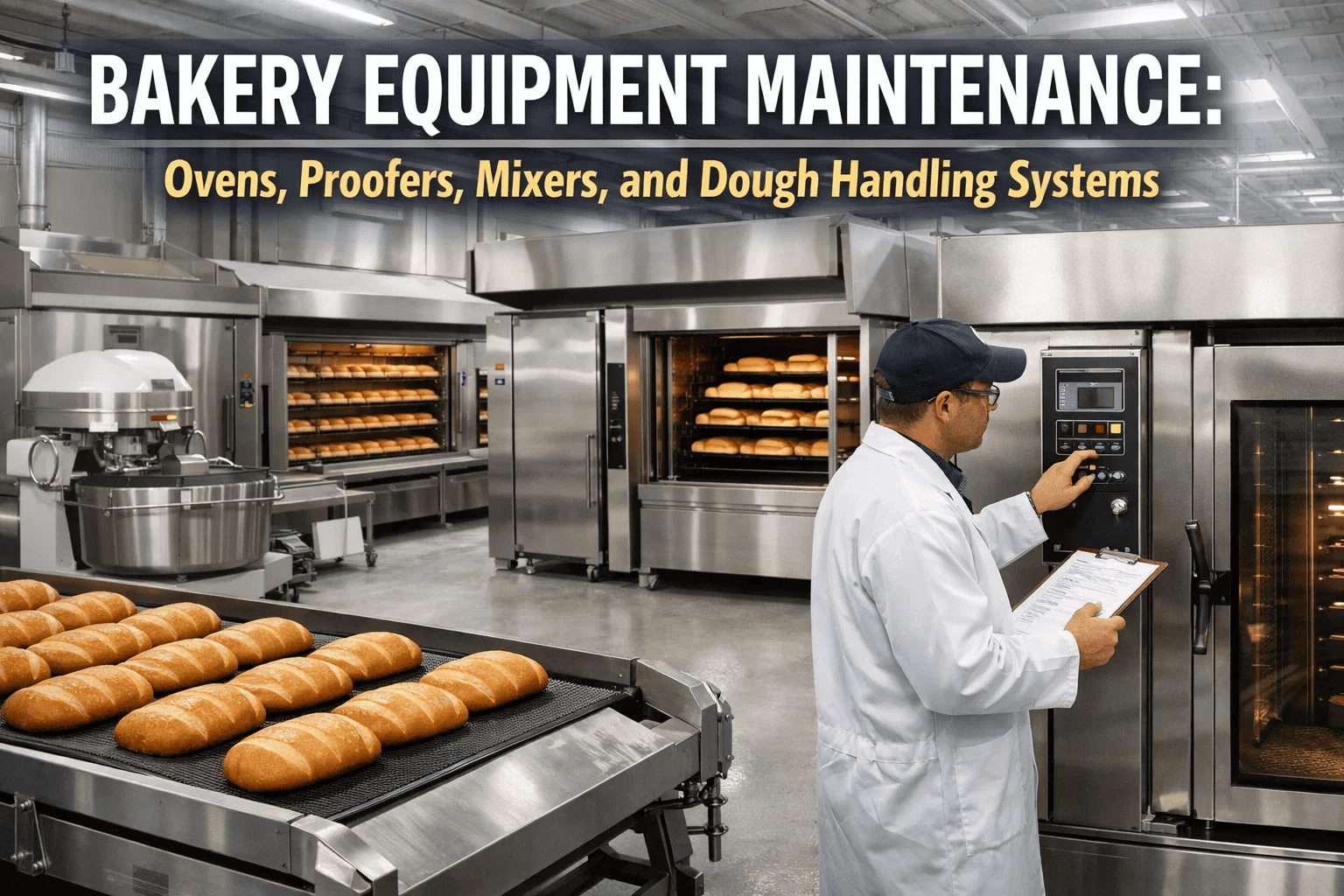
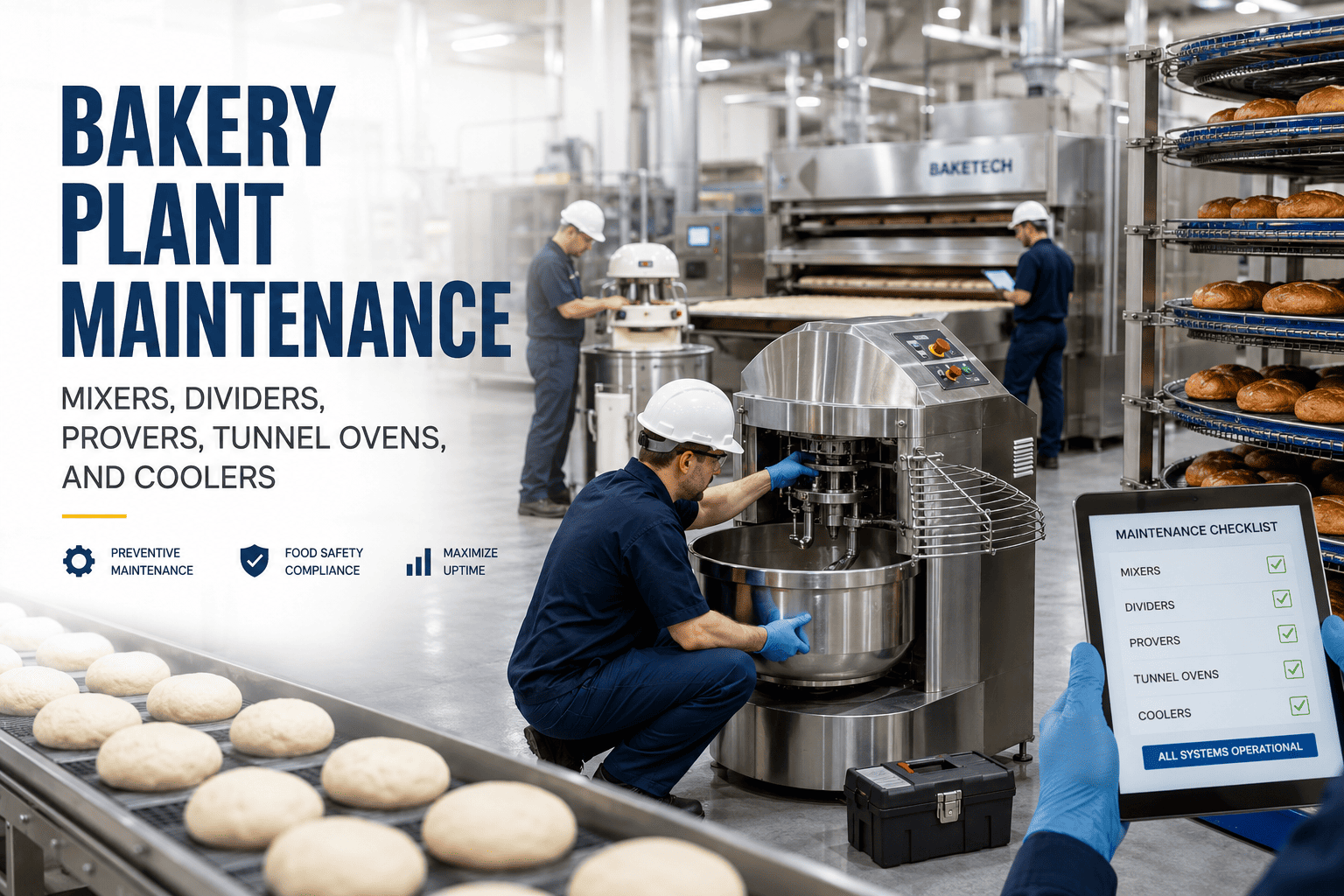
A commercial bakery in Texas running three 24-hour production shifts lost 11 hours of output in a single week — not from a major equipment failure, but from four separate small failures that each took 2 to 3 hours to resolve. A deck oven burner misfire that took 40 minutes to diagnose because nobody could pull up the calibration history. A spiral mixer speed control fault that required a parts run because the spare was not in inventory. A proofer humidity sensor failure that only surfaced when a batch came out flat. And a dough divider blade misalignment discovered by a quality inspection on finished product. None were catastrophic. All were preventable. Structured bakery equipment maintenance in OxMaint puts every oven, mixer, proofer, and dough handling system on a documented PM schedule — with asset history, parts lists, and calibration records accessible in seconds, not hours. Book a demo to see how OxMaint manages a high-throughput bakery equipment programme.
Production Maintenance / Bakery Operations
Bakery Equipment Maintenance: Ovens, Proofers, Mixers, and Dough Handling Systems
Bakery production lines run on precise temperature, humidity, timing, and mechanical tolerances that drift without scheduled maintenance. When they go out of specification, the result is not just downtime — it is product consistency failures, waste, and missed production targets.
18%
Average production waste rate in bakeries without structured PM programmes
3.2 hr
Average unplanned downtime per week in a 24-hour bakery operation
64%
Of bakery equipment failures preceded by a missed PM task in the previous 30 days
7x
Cost ratio of emergency oven repair vs. scheduled burner maintenance
Bakery Equipment Systems and Their Critical Maintenance Requirements
Each bakery equipment category has distinct failure modes and maintenance requirements. Treating oven maintenance the same as mixer maintenance is how PM programmes create gaps — and gaps create downtime.
Commercial Ovens
Deck, tunnel, convection, and rack ovens
Burner calibration and combustion tuning — quarterly
Steam injection nozzle cleaning — weekly in high-steam bakeries
Temperature sensor and controller calibration — semi-annually
Conveyor belt tension and alignment — monthly for tunnel ovens
Door seal and gasket inspection — quarterly
Flue and exhaust system inspection — annually
Top failure: Burner misfire or temperature zone drift causing inconsistent product colour
Proofers
Rack proofers, tunnel proofers, retarder-proofers
Humidity sensor calibration — monthly
Temperature uniformity verification — monthly
Drain pan and condensate line cleaning — weekly
Door and panel seal inspection — quarterly
Steam generator element inspection — quarterly
Fan motor bearing check — semi-annually
Top failure: Humidity sensor drift causing over or under-proofed product with no visible warning
Industrial Mixers
Spiral, planetary, horizontal, and continuous mixers
Gear oil analysis and change — per manufacturer / 2,000 hours
Bowl, hook, and attachment inspection — monthly
Drive belt condition and tension — quarterly
Speed controller calibration check — semi-annually
Seal and gasket inspection for oil leak prevention — quarterly
Motor temperature and vibration monitoring — continuous IoT or monthly manual
Top failure: Gear wear and seal degradation — often discovered by oil contamination in product
Dough Handling Systems
Dividers, rounders, moulders, conveyors
Divider blade inspection and sharpness check — weekly
Weight accuracy calibration — monthly
Flour dust management and sensor cleaning — weekly
Belt conveyor alignment and tension — monthly
Lubrication of all moving parts with food-grade lubricant — per interval
Full disassembly cleaning — per allergen changeover protocol
Top failure: Dough weight drift from blade wear — product yield loss before detection
Bakery PM Schedule — Consolidated Reference
| Equipment |
Task |
Interval |
Impact if Missed |
CMMS Trigger |
| Deck / tunnel oven |
Burner calibration and combustion tuning |
Quarterly |
Inconsistent bake colour, energy waste 8–12% |
Calendar PM |
| All ovens |
Temperature sensor calibration |
Semi-annually |
Product spec drift; compliance risk |
Calendar PM |
| Proofer |
Humidity sensor calibration |
Monthly |
Over/under-proofed product — silent yield loss |
Calendar PM |
| Spiral / planetary mixer |
Gear oil analysis and change |
2,000 hours or annually |
Gear wear leading to oil contamination |
Runtime hours PM |
| Dough divider |
Weight accuracy calibration |
Monthly |
Yield variance up to 4% per unit |
Calendar PM |
| All dough handling |
Food-grade lubrication |
Per manufacturer (weekly–monthly) |
Bearing and seal wear accelerated |
Calendar PM |
| Tunnel oven conveyor |
Belt tension and alignment check |
Monthly |
Uneven bake time; product transfer jams |
Calendar PM |
| All equipment |
Post-allergen changeover full clean and inspection |
Per changeover protocol |
Allergen cross-contamination; regulatory recall risk |
Production event trigger |
How OxMaint Manages a Bakery Maintenance Programme
OxMaint gives bakery maintenance teams a unified platform for equipment registration, PM scheduling, work order execution, and compliance documentation — structured around the production realities of a high-volume bakery operation.
01
Equipment Asset Registry
Every oven, mixer, proofer, and dough system registered with manufacturer specs, serial number, installation date, calibration history, and parts list. QR codes on equipment give technicians instant access from the production floor.
02
PM Scheduling by Interval Type
PM tasks run on calendar intervals, production hours, batch count, or production event triggers — whichever is reached first. A single oven can have multiple PM schedules running simultaneously for different task types.
03
Allergen Changeover Tracking
Allergen changeover cleaning and inspection tasks are triggered by production events — not just calendar intervals. OxMaint records the changeover scope, products involved, cleaning protocol, inspection outcome, and sign-off before the next allergen-containing run begins.
04
Temperature and Calibration Records
Oven and proofer calibration records stored against the asset with calibration date, technician, equipment used, before/after readings, and pass/fail result. Calibration history is retrievable by asset for BRC, SQF, and FDA audit requirements.
05
Mobile Work Order Execution
Technicians complete PM tasks on mobile with structured checklists, photo capture for condition records, and digital sign-off. Completed work records are stored immediately — no paper transcription, no missing signatures.
06
Spare Parts Management
Bakery-specific spare parts registered against equipment — oven burner assemblies, mixer seals, proofer humidity sensors, divider blades. Stock levels tracked automatically; reorder alerts triggered before minimum stock is reached.
Bakery Maintenance ROI: What Structured PM Delivers
62%
Reduction in Unplanned Downtime
Bakeries implementing CMMS-driven PM see unplanned downtime fall by an average of 62% in year one
11%
Energy Cost Reduction
Oven burner calibration and preventive maintenance reduces gas consumption by 8–12%
3.4%
Yield Improvement
Dough handling calibration and proofer maintenance reduces production waste by 3–4% of batch weight
94%
PM Completion Rate
CMMS-scheduled bakery PMs complete at 94% vs. 58% completion on manual scheduling systems
Frequently Asked Questions
How should oven calibration records be maintained for food safety audits?
Oven temperature calibration records must include the calibration date, the name and qualification of the person performing the calibration, the calibration equipment used (with its own calibration traceability), the oven's temperature readings before and after adjustment, and the pass/fail determination. In OxMaint, these fields are structured into the calibration work order checklist — so technicians capture all required data at the time of calibration, and the record is stored against the specific oven asset with a digital signature.
Start a free trial to configure your oven calibration tracking.
What is the correct food-grade lubricant management process for bakery dough handling equipment?
Bakery dough handling equipment requires H1-certified food-grade lubricants for any lubrication points with incidental food contact risk. In OxMaint, each lubrication task is configured with the approved lubricant specification (H1 grade, specific product name), quantity, application point, and interval. Technicians confirm the lubricant used when completing the work order — preventing the substitution of non-food-grade lubricants that creates a food safety and recall risk.
Book a demo to see lubrication management in OxMaint.
How does allergen changeover maintenance integrate with production scheduling in OxMaint?
OxMaint supports production event-triggered work orders — when a production scheduler flags an allergen changeover in the system, a structured cleaning and inspection work order is automatically generated for each affected piece of equipment. The work order includes the allergen changeover scope, approved cleaning protocol steps, inspection checkpoints, and requires a QA or supervisor sign-off before the equipment is cleared for the next allergen-containing run. All records are stored with timestamps and linked to the production change event.
What spare parts should a commercial bakery maintain on-site for critical equipment reliability?
Critical bakery spare parts with highest impact on production availability include: oven temperature sensors and burner ignition assemblies, proofer humidity sensors, spiral mixer mechanical seals and drive belts, dough divider blades, conveyor belt sections, and food-grade lubricant stocks for all dough handling equipment. OxMaint tracks minimum stock levels for each part, linked to the equipment it serves. When consumption drops stock below minimum, a reorder work order or purchase request is generated automatically — preventing the parts shortages that turn a 30-minute repair into a 3-hour one.
Build Your Bakery PM Programme
Your Oven Calibration Is Drifting. Your Proofer Humidity Sensor Is Ageing. Your Mixer Needs an Oil Change. OxMaint Knows Before You Do.
OxMaint registers every oven, proofer, mixer, and dough handling system as a tracked asset — scheduling PMs by calendar, runtime hours, and production events, managing food-grade lubrication protocols, tracking allergen changeover maintenance, and generating the calibration and compliance records that your food safety audit requires.