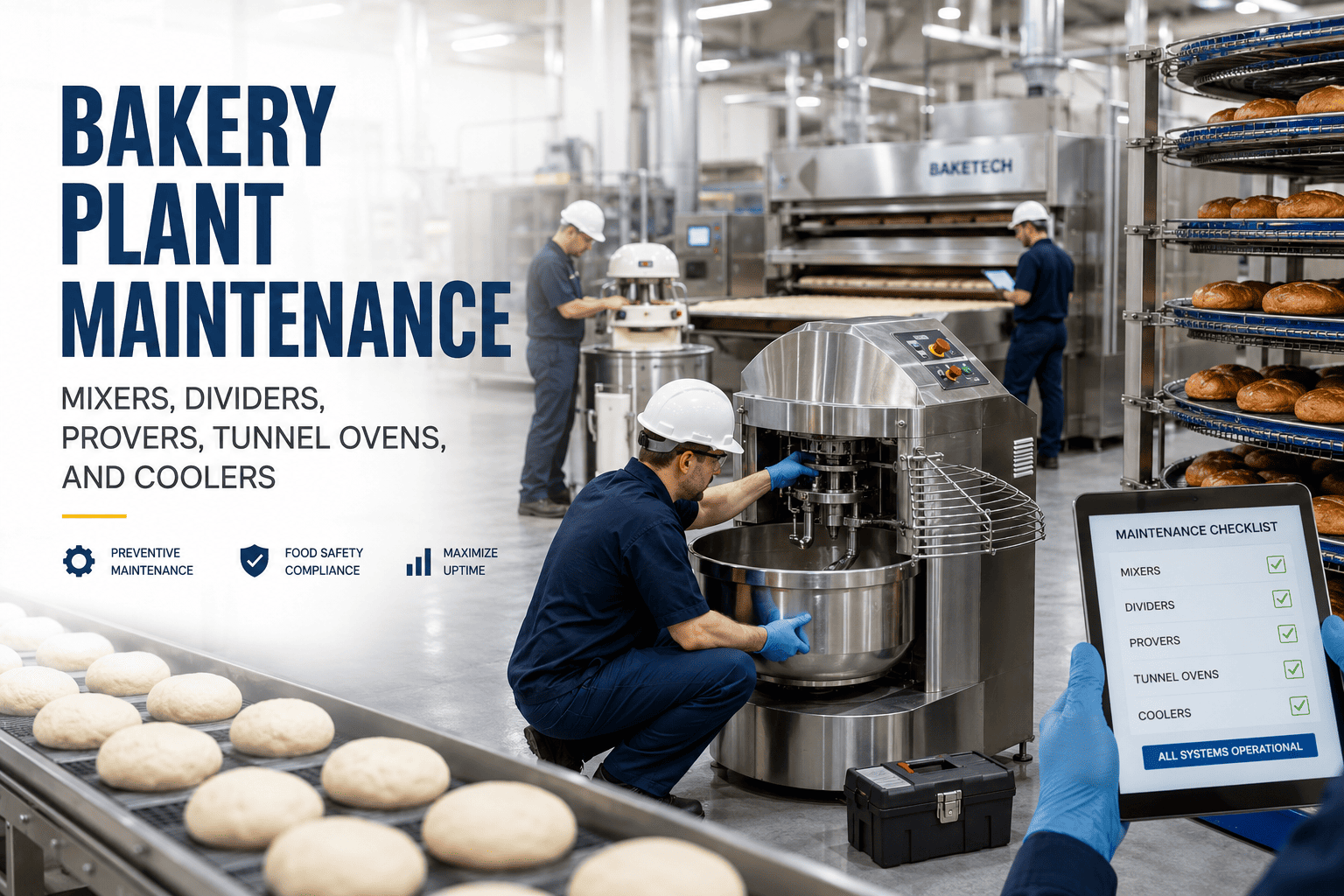
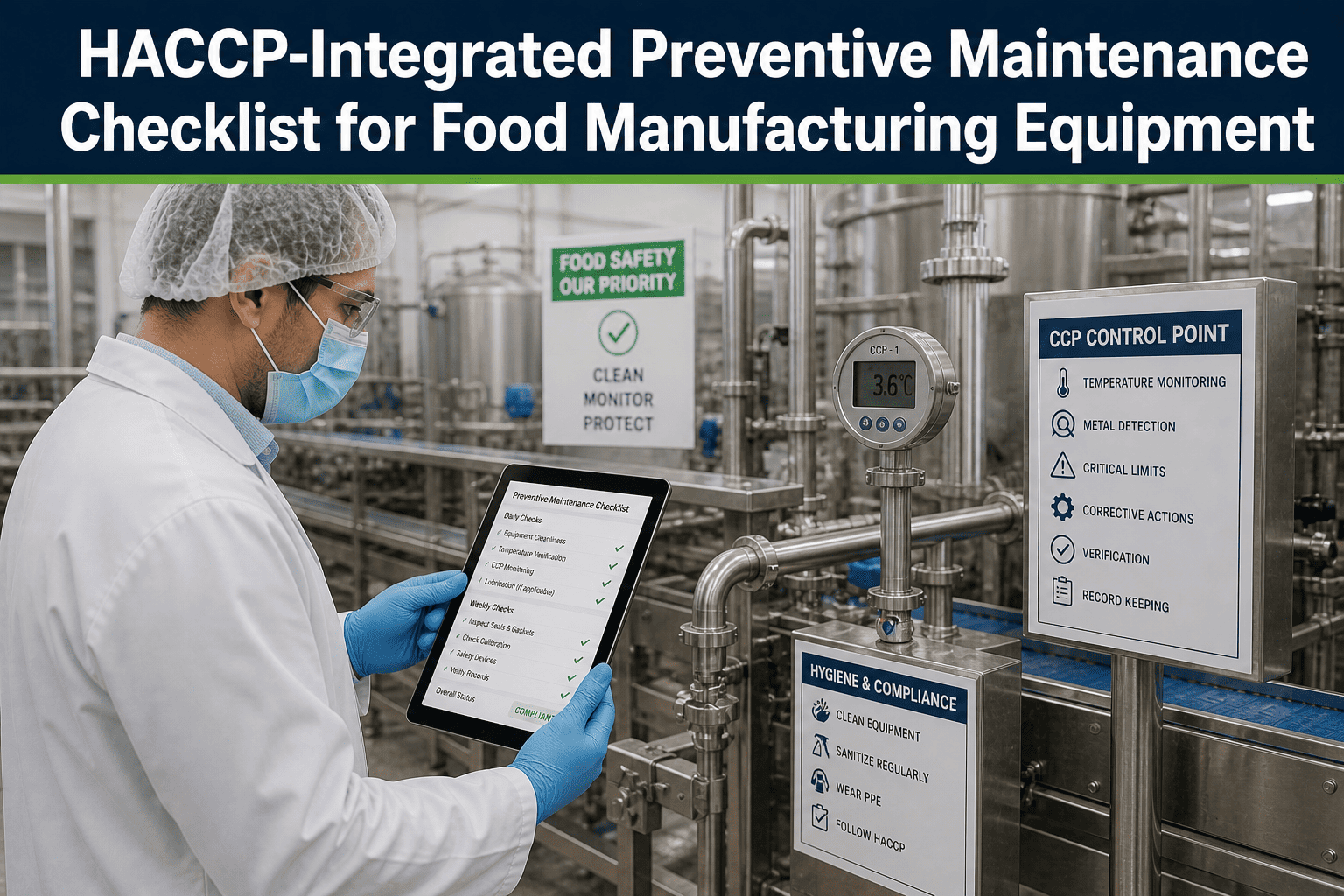
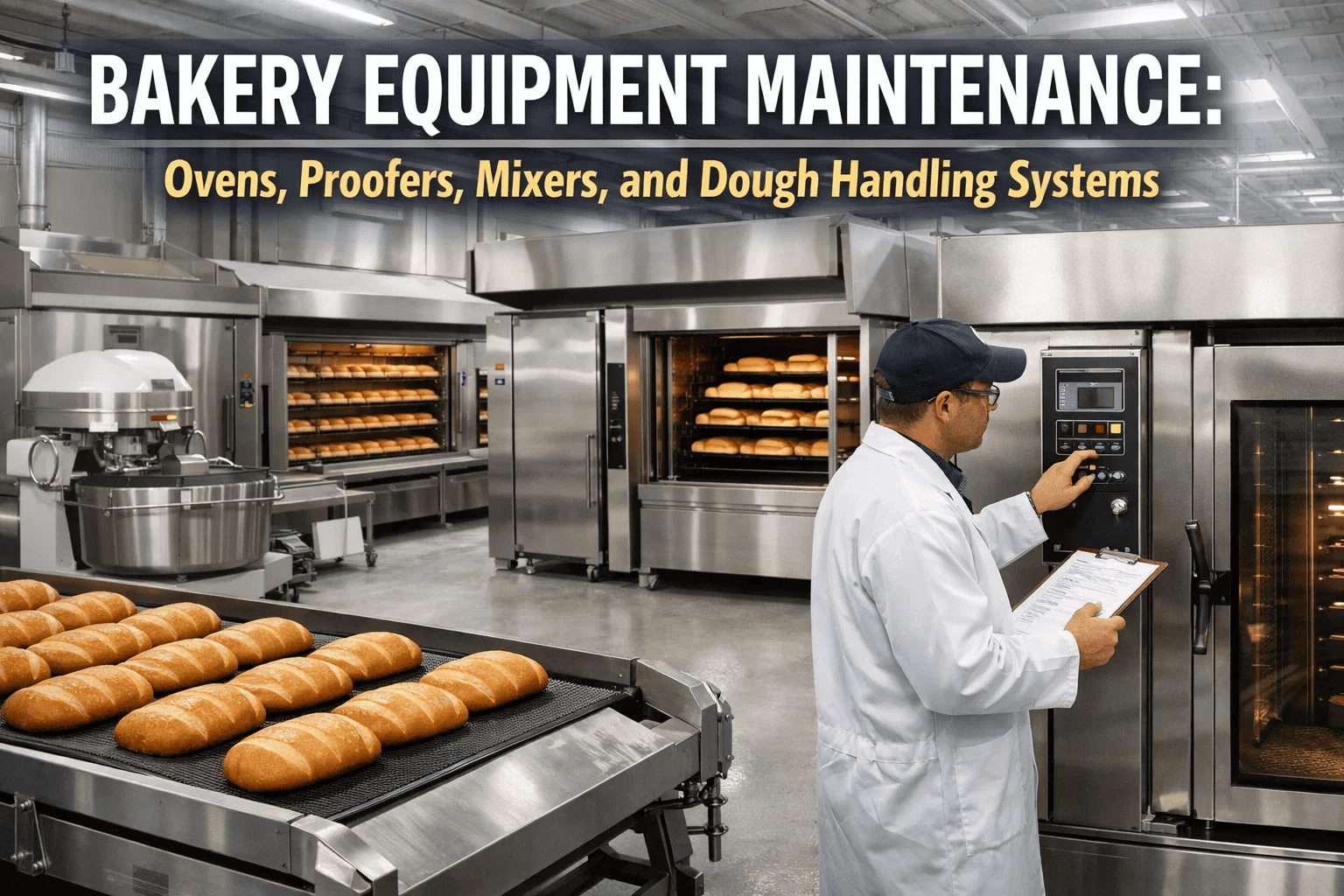
Bakery equipment operates under conditions that accelerate wear faster than almost any other food manufacturing environment — heat cycling in deck and tunnel ovens degrades seals and heating elements within months, flour and sugar residue accumulates in motor housings and conveyor rollers creating simultaneous mechanical and food safety hazards, and fat-based products leave films on depositor valves that harden into blockages if not removed every production cycle. A commercial bakery in Texas running three 24-hour shifts recently lost 11 hours of output in a single week — not from a major failure, but from four separate small, preventable failures: an oven burner misfire, a spiral mixer speed control fault, a proofer humidity sensor failure, and a dough divider blade misalignment. Facilities with structured bakery equipment PM programs report up to 40% fewer unplanned downtime events and significantly extended service life across all equipment categories. This checklist covers every critical PM task for commercial bakery operations, structured by equipment type and frequency. Start a free trial to digitize this checklist in Oxmaint and automate your bakery PM scheduling, or book a demo to see bakery maintenance management in action.
Automate Your Bakery PM Schedule — Never Miss a Critical Inspection Again
Oxmaint digitizes every task in this checklist into automated work orders — scheduled to the right technician, on the right equipment, at the right interval — with mobile execution, photo documentation, and complete audit trail built in.
What Is a Bakery Equipment Preventive Maintenance Checklist?
A bakery equipment preventive maintenance checklist is a structured, frequency-organized list of inspection, lubrication, calibration, and sanitation tasks that keeps commercial bakery equipment operating reliably, safely, and at specification. Unlike reactive maintenance — which addresses equipment after failure — a PM checklist defines the specific interventions that prevent failures before they occur, with tasks organized by daily, weekly, monthly, quarterly, and annual frequency.
Effective bakery PM checklists go beyond generic equipment maintenance templates. They address the specific failure modes of bakery environments: thermal stress degradation in ovens, hygroscopic residue accumulation in motors and conveyors, proofer humidity drift, dough handling lubrication requirements for food-grade compliance, and the sanitation obligations of equipment operating in allergen and GMP environments. A well-designed bakery PM checklist is also the foundation for food safety audit compliance — BRCGS, SQF, and FSSC 22000 auditors specifically look for documented, executed PM programs covering all food-contact and safety-critical equipment.
The most common finding in bakery maintenance audits is not that the PM program does not exist — it is that tasks are incomplete, poorly documented, or not executed at the specified frequency. Digital CMMS implementation eliminates this gap by automating task scheduling, delivering work orders to technicians' mobile devices, and generating timestamped completion records automatically. Start a free trial to build your bakery PM program in Oxmaint.
Bakery PM Checklist — Key Concepts and Framework
Pre-Start Visual Inspection
Check all equipment for visible damage, loose guards, fluid leaks, and unusual odors before production starts. Verify emergency stop function on ovens, mixers, and dough handling systems.
Temperature & Humidity Calibration Check
Verify oven baking temperature accuracy against reference probe. Confirm proofer temperature and humidity sensor readings match setpoint tolerances. Document any deviations and adjust before production batch.
Oven Burner & Heating Element Inspection
Inspect burners for proper ignition, stable blue flame, and correct gas pressure. Check heating elements for hot spots or visible damage. Verify airflow and convection fan RPM within specification.
Door Seal & Gasket Integrity
Inspect all oven and proofer door gaskets for cracks, hardening, or heat leaks. Poor seals cause temperature drift, energy waste, and inconsistent product quality. Use thermal probe to detect energy loss around door frames.
Mixer Motor & Drive Belt Inspection
Inspect spiral and planetary mixer motor for vibration, unusual noise, and heat. Check drive belts for wear, cracking, and tension. Verify gearbox oil level and condition — metal contamination risk begins 2–4 weeks before bearing seizure.
Conveyor Belt Tracking & Tension
Inspect tunnel oven and cooling conveyor belt alignment — tracking drift causes uneven baking 8–12 hours before belt failure. Check tension, splice condition, and drive chain for elongation. Lubricate conveyor drive components with food-grade lubricant.
Full Calibration & Temperature Mapping
Complete temperature calibration of all ovens and proofers using calibrated reference probe. Perform multi-zone temperature mapping to identify hot and cold spots. Document calibration certificates for food safety audit compliance.
Comprehensive Overhaul & Parts Replacement
Full replacement of wear items: oven door gaskets, thermocouple sensors, conveyor belt sections with wear beyond tolerance, mixer mechanical seals, dough divider blades, and food-grade lubricant restocking across all dough handling equipment.
Equipment-Specific PM Checklist: Critical Tasks by Category
Commercial Ovens — PM Tasks
Spiral & Planetary Mixers — PM Tasks
Proofers — PM Tasks
Common Bakery Equipment Failures vs. PM Prevention
Oven Conveyor Belt Tracking Failure
Drift begins 8–12 hours before complete belt failure — causing uneven baking and product discoloration well before the shutdown. Weekly tracking inspection catches alignment deviation when a 15-minute adjustment prevents a 4-hour shutdown plus temperature re-validation.
Mixer Gearbox Oil Degradation
Metal particulate contamination risk begins 2–4 weeks before bearing seizure. Monthly gearbox oil inspection — checking color, viscosity, and metal content — catches degradation before it reaches food-contact risk or causes catastrophic mechanical failure.
Proofer Humidity Sensor Drift
Drift in humidity sensor readings produces inconsistent fermentation — showing up as customer complaints about texture and rise before the sensor failure is discovered. Monthly calibration against a reference sensor catches drift before it reaches product quality impact.
Dough Divider Blade Misalignment
Blade misalignment is often discovered by quality inspection on finished product — after a full batch of incorrectly portioned product has been produced. Regular dough divider inspection and calibration prevents the costly finished-goods waste that follows undiscovered alignment drift.
Non-Food-Grade Lubricant Use
Using non-H1 lubricants on dough contact surfaces is an automatic BRCGS/SQF major non-conformance. Every lubrication point on bakery equipment must be mapped to its approved food-grade lubricant — and that mapping verified during each PM inspection cycle.
Inadequate Spare Parts Inventory
Temperature sensors, door gaskets, drive belts, and igniter electrodes turn 30-minute repairs into multi-day shutdowns when not in stock. A CMMS-managed spare parts register with minimum stock alerts prevents the parts shortages that multiply downtime duration.
Bakery production teams that implement CMMS-automated PM programs eliminate the documentation gaps that generate audit findings and the missed inspections that allow small equipment issues to become production-stopping failures — start a free trial to build this program in Oxmaint, or book a demo to see bakery asset management in action.
How Oxmaint Manages Bakery PM Programs
Every Task, Every Interval — Zero Manual Coordination
Daily, weekly, monthly, and annual bakery PM tasks are scheduled automatically and delivered as mobile work orders to the right technician at the right time. No paper checklists, no missed tasks due to shift changes, no PM slippage during high-production periods.
H1 Lubricant Mapping for Every Dough Contact Point
Each lubrication task in Oxmaint specifies the approved H1-grade lubricant, application point, quantity, and interval — preventing the non-food-grade lubricant errors that generate automatic BRCGS and SQF major non-conformances on bakery equipment.
Oven and Proofer Calibration Certificates on Demand
Every temperature and humidity calibration event generates a timestamped record with technician ID, reference probe data, and deviation findings. Automatic alerts trigger 30 days before calibration is due — eliminating the overdue calibrations that generate audit findings.
Auto-Reorder Alerts Before Stock Runs Out
Critical bakery spare parts — sensors, gaskets, belts, igniters — are tracked with minimum stock levels linked to the specific equipment they serve. When consumption drops below minimum, Oxmaint generates a purchase request automatically — preventing 30-minute repairs from becoming multi-day shutdowns.
Reactive vs. Planned Bakery Maintenance
| Maintenance Scenario | Reactive Approach | Planned PM Approach |
|---|---|---|
| Oven Belt Failure | 4-hour shutdown + temperature re-validation + dumped product batches | 15-minute belt tracking adjustment during scheduled PM — production continues |
| Mixer Bearing Seizure | Emergency shutdown, 2–3 day parts lead time, lost production capacity | Monthly oil inspection detects metal contamination 4 weeks ahead — planned seal replacement during scheduled downtime |
| Proofer Sensor Failure | Entire batch fails QC — customer complaint, potential recall investigation | Monthly calibration check detects drift before quality impact — sensor replaced on schedule |
| Audit PM Documentation | Incomplete paper records — non-conformance from auditor, certification at risk | CMMS generates timestamped digital records automatically — audit evidence always current |
| Repair Cost Per Incident | 4.8x planned maintenance cost — plus production loss and product waste | Planned maintenance cost only — no emergency premium, no lost production |
Bakery PM ROI and Results
Frequently Asked Questions
How often should commercial bakery ovens be calibrated?
Commercial bakery ovens should have temperature accuracy verified daily against a reference probe as part of the pre-production start-up check. A formal calibration using a calibrated reference thermometer should occur monthly, with full multi-zone temperature mapping performed quarterly. Annual calibration certificates from a calibration service provider should be maintained for food safety audit compliance under BRCGS, SQF, and FSSC 22000. Any oven that has undergone repair, heating element replacement, or significant thermal event should be fully calibrated before returning to production use. Start a free trial to automate oven calibration scheduling and record-keeping in Oxmaint.
What food-grade lubricants are required for commercial bakery equipment?
All lubrication points on bakery equipment with incidental food contact risk must use H1-rated (food-grade) lubricants — NSF H1 certification is the standard recognized by BRCGS, SQF, and FDA. H1 lubricants are formulated to be safe for incidental food contact and do not contain additives prohibited in food-contact applications. The specific lubricant type (grease vs. oil), viscosity grade, and application interval vary by equipment — mixer gearboxes, conveyor drive chains, dough divider components, and proofer fan bearings each have different requirements defined in manufacturer specifications. Using non-H1 lubricants on food-contact equipment is an automatic major non-conformance at GFSI audits. Book a demo to see how Oxmaint manages food-grade lubricant registers.
What critical spare parts should every commercial bakery stock?
The highest-impact bakery spare parts to maintain in stock are: oven temperature sensors and thermocouple assemblies, burner igniter electrodes, conveyor belt sections in your standard width, oven door gaskets, spiral mixer mechanical seals and drive belts, proofer humidity sensors, dough divider blades, and food-grade lubricant stocks for all dough-contact lubrication points. These are the parts whose absence most frequently turns a 30-minute repair into a multi-day shutdown — either because they fail suddenly or because failure causes compounding damage if the machine continues operating without them. A CMMS-managed spare parts register with minimum stock level alerts and automatic reorder triggers is the most reliable way to ensure these parts are always available.
How does a CMMS improve bakery PM checklist compliance?
A CMMS improves bakery PM compliance in four direct ways: it schedules every task automatically so nothing is missed due to oversight or shift change; it delivers tasks as mobile work orders to technicians' phones so execution happens at the equipment, not on a clipboard walked back to the office later; it requires photo evidence and checklist completion before tasks can be closed, preventing partial completions from registering as done; and it generates a complete timestamped audit trail automatically, eliminating the paper record gaps that generate non-conformances at food safety audits. The difference between a bakery that passes food safety audits consistently and one that accumulates maintenance non-conformances is almost always documentation quality — and CMMS implementation is the single most effective intervention to close that gap.
Stop Losing Production Hours to Preventable Bakery Equipment Failures
Oxmaint transforms this checklist into an automated, mobile-executed PM program — with every oven, mixer, proofer, and dough handling system on a scheduled inspection cycle, food-grade lubrication properly managed, and complete audit-ready documentation generated automatically.
- Automated PM scheduling across all bakery equipment categories
- Food-grade lubricant register with H1 mapping per equipment
- Calibration tracking with auto-alerts before due dates
See measurable results in 30 days — no heavy implementation required.