Dairy Plant Saves $1.8M Annually with Predictive Maintenance

By Jack Edwards on April 28, 2026

blogpostdairy-processing-facility-saves-1-8m-predictive-maintenance-oxmaint

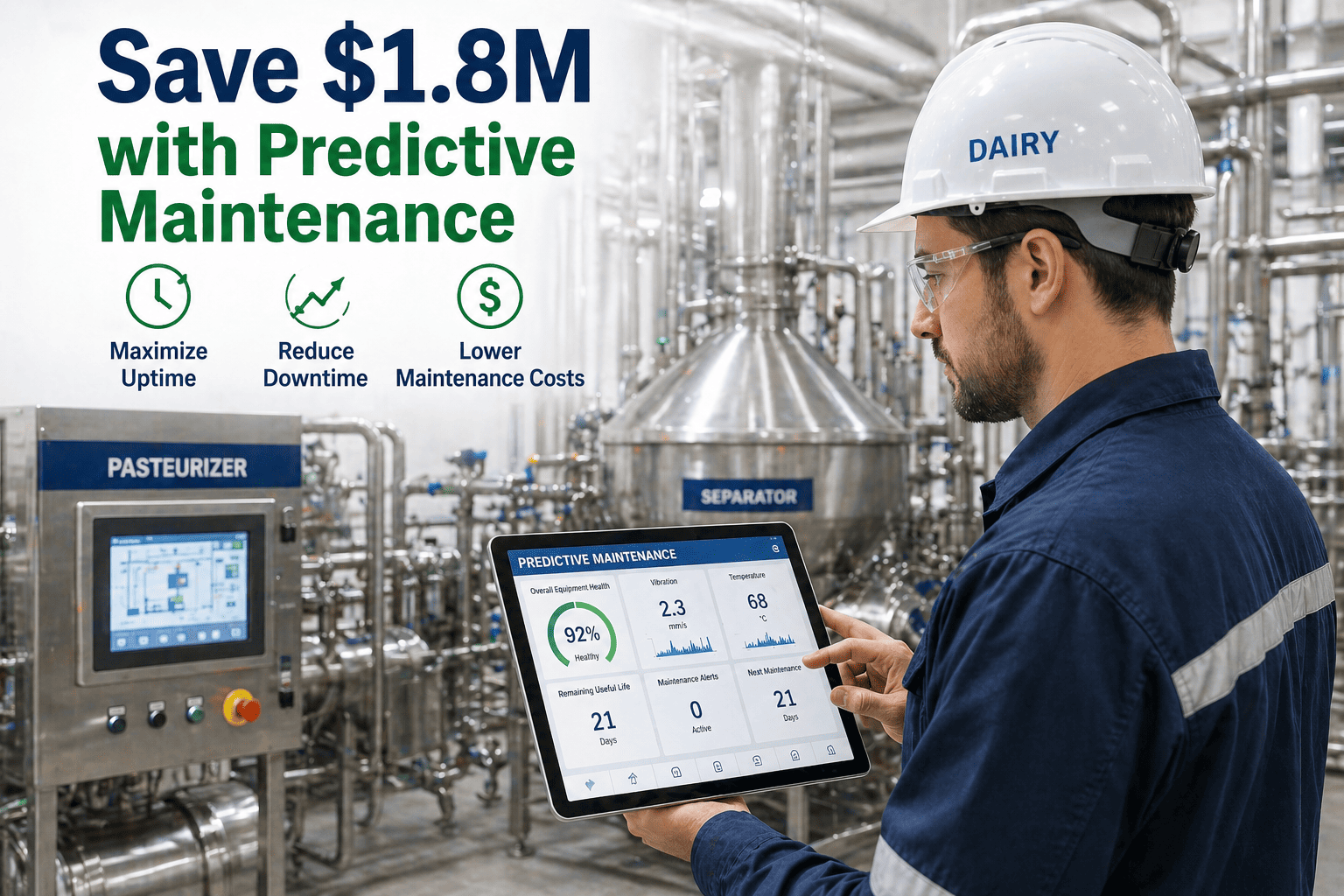
A 220,000 sq ft dairy processing facility in Wisconsin was running on a maintenance philosophy that almost every dairy plant in North America still uses — fix it after it breaks, schedule PMs by calendar, and hope the HTST pasteurizer holds together until the next planned shutdown. Then a homogenizer plunger packing failed mid-shift, forcing a 14-hour line stoppage, $180,000 of dumped product, and a near-miss USDA Grade A audit finding for temperature deviation. The plant manager pulled together the leadership team, sized the annual cost of unplanned dairy downtime at roughly $2.4M, and committed to predictive maintenance — instrumented, scheduled, and managed in OxMaint. Eighteen months later the facility has saved $1.83M annually, cut unplanned downtime by 61%, and turned its homogenizer fleet from a quarterly headache into a non-event. If your dairy plant is still discovering bearing failures by listening for them, you can start a free trial of OxMaint and have your first asset condition baseline running this week. Want to see how the predictive workflows look on your equipment list before you commit? Book a demo with our dairy specialists and we will walk you through the case study line by line.

Case Study / Dairy Processing

Wisconsin Dairy Plant Saves $1.83M Annually with Predictive Maintenance on OxMaint

Vibration sensors on separators. Acoustic monitoring on homogenizers. CIP cycle analytics. Refrigerant leak detection 41 days before catastrophic failure. The full predictive playbook — running on one CMMS — across an 18-month transformation that returned 7.4x ROI in year one alone.

Annual Savings
$1.83M
Validated against 24 months of pre-implementation cost data
61%
Unplanned downtime cut
2.8x
MTBF improvement
9.5 mo
Payback period

The Plant — At a Glance

A mid-sized Wisconsin dairy processor producing fluid milk, cultured products, and ESL beverages across three distinct production lines, supplying eight regional retail brands. The facility runs three shifts, six days a week, with PMO inspections monthly and Grade A certification on all fluid milk output. Pre-implementation, the plant operated on calendar-based PMs and reactive repairs — the standard model for the segment.

Location
Central Wisconsin
Facility Size
220,000 sq ft
Production Lines
3 (fluid, cultured, ESL)
Daily Throughput
485,000 lbs raw milk
Critical Assets
94 monitored units
Grade Certification
PMO Grade A
Maintenance Team
11 technicians + 2 leads
Implementation
18 months phased rollout

Where the $1.83M Came From — Savings Breakdown

The annual savings figure is not one big win — it is the cumulative result of six discrete categories, each measurable against pre-implementation baselines. Every dollar below is documented in finance-validated reports referenced in monthly leadership reviews.

Avoided Unplanned Downtime
$742,000

61% reduction in unplanned events × avg. $48,400 per event (lost production + cleanup)
Product Loss Prevention
$385,000

Eliminated 7 dump events from temperature deviations and CIP failures over 12 months
Energy Efficiency Gains
$268,000

Refrigeration optimisation, fouled HTST detection, compressor load balancing
Reduced Repair Costs
$214,000

Planned repairs cost 4.8x less than emergency interventions on average
Extended Asset Life
$132,000

Deferred CapEx on separators and homogenizers — condition-based replacement triggers
Labor Productivity
$89,000

Mobile work orders, fewer fire-drills, technicians reallocated to PM execution
Total Annual Savings
$1,830,000

The Six Asset Classes Now Under Predictive Watch

Predictive maintenance is only as strong as the asset coverage. The plant prioritised the equipment with the highest failure consequence — and instrumented each class with the right sensing approach. Below is the actual deployment pattern, lifted directly from the OxMaint asset registry.

HTST Pasteurizers
2 units / 161°F holding
Continuous temperature deviation tracking, plate fouling detection via flow vs. pressure differential, regen efficiency curves logged every 90 seconds
Prevents Grade A audit findings, milk dumps, plate replacement crises
Cream Separators
3 units / 6,500 RPM
Triaxial vibration sensors at top and bottom bearings, ISO 10816 thresholds tied to OxMaint work order triggers, bowl balance verification every CIP cycle
Catches bearing wear 30-90 days early, prevents catastrophic bowl failure
Homogenizers
2 units / 250-350 bar
Acoustic emission monitoring on valve seats, plunger packing wear tracked by pressure signature, oil analysis on crankcases at 500-hour intervals
Eliminates plunger packing blowouts mid-shift, planned valve overhauls only
CIP Skids
4 circuits / 3-A compliant
Conductivity, temperature, flow, and contact time logged per cycle. Deviation from validated parameters auto-generates corrective work orders before next production run
Zero CIP-driven reject batches in last 14 months
Refrigeration Systems
Ammonia + glycol loops
Compressor discharge temp, suction superheat, oil pressure, refrigerant leak detection at 5 ppm sensitivity. CapEx forecasting on compressor lifecycles
41-day early warning on R-22 leak averted $180K spoilage event
Filling & Capping Lines
3 lines / 15K units/hr
OEE tracked at line level, cap torque variance alarms, filler valve seat condition scoring, changeover time benchmarks logged in OxMaint per SKU change
22% changeover time reduction, fill weight variance halved
Predictive Dairy Maintenance

If You Run Pasteurizers, Separators, or Homogenizers, You Are Sitting on Six-Figure Annual Savings.

OxMaint registers each piece of equipment with its own condition baseline, integrates vibration and process sensors via OPC-UA or REST API, and turns deviation data into work orders before failures cost you product, audit findings, or downtime. The Wisconsin plant did it in 18 months. Yours can start tomorrow.

Six Predictive Saves — The Failures That Never Happened

Every category in the savings stack is built on individual save events. Below are six representative cases pulled from the plant's OxMaint event log — failures detected, work orders generated, and repairs completed before any production impact occurred. Each entry shows how many days advance warning the system gave.

41days early
Refrigerant Leak — Cold Storage Compressor 2
Leak detector flagged 7 ppm trace at compressor flange. Work order issued, gasket replaced during planned weekend stop. Cost: $4,200. Avoided spoilage of 92,000 lbs of yogurt cultures: $180,000.
68days early
Cream Separator Lower Bearing Wear
Vibration trend on Separator 1 crossed 4.5 mm/s RMS, ISO 10816 alert zone. Bearing replaced during scheduled CIP window. Cost: $11,800. Avoided bowl failure estimated at $310,000 plus 36 hours of line downtime.
22days early
HTST Plate Fouling Acceleration
Pressure differential rising 0.4 bar per shift instead of normal 0.05. CIP cycle parameters re-validated, descaling step extended. Avoided plate pack pull and Grade A deviation report.
15days early
Homogenizer Plunger Packing Degradation
Acoustic signature on Homogenizer 1 showed cavitation pattern at 280 bar. Packing replaced in planned 4-hour window. Avoided mid-shift blowout that caused the original $180K product loss event.
9days early
Filler Valve Seat Wear — Line 3
Fill weight variance trend exceeded SPC upper limit. 6 valve seats replaced during overnight changeover. Avoided regulatory net-weight non-compliance and $48K in giveaway losses.
31days early
Glycol Loop Pump Cavitation
Suction pressure oscillation pattern flagged on chilled glycol pump 4. Strainer found 73% blocked, impeller minor erosion. Cleaned and rebalanced. Avoided cascade temperature loss in storage silo.

Before vs After — The Operational Numbers

Predictive maintenance delivered measurable change across every operational metric the plant tracks. The table below compares the 12 months immediately before OxMaint deployment against the 12 months following full rollout completion.

Metric Before (Reactive) After (Predictive) Change
Unplanned downtime hours / year286 hrs112 hrs-61%
Mean time between failures (MTBF)184 hrs518 hrs+182%
Emergency work orders / month4714-70%
Planned : reactive PM ratio32 : 6889 : 11+178%
Product dumps / year112-82%
HTST CIP failure incidents90-100%
Energy use per 1,000 lbs processed62.4 kWh54.8 kWh-12.2%
OEE (fluid line average)71.4%87.9%+16.5 pts
Maintenance overtime hours3,820 hrs1,140 hrs-70%
PMO inspection findings6 minor / yr0-100%

ROI Math — How $246K Investment Returned $1.83M in Year One

The investment was not small — sensors, OxMaint subscription, integration time, training. But the math works in dairy because the avoided cost per failure is so high. Here is the year-one breakdown the CFO signed off on.

Total Investment Year 1
$246,000
Sensors, OxMaint platform, integration, training
Annual Savings Realised
$1,830,000
Six categories, finance-validated against baseline
Net Year 1 Return
$1,584,000
After all implementation and operating costs
ROI Multiple
7.4x
Year one — improving in years 2 and 3
Payback Period
9.5 months
Cumulative savings exceeded total spend
3-Year Projected Return
$5.2M+
Net of all platform and sensor costs

Frequently Asked Questions

Yes — and the breakdown is documented. With 485,000 lbs daily throughput and three production lines, even a 1% improvement in OEE or a single avoided product dump moves six figures. The savings reflect verified reductions across downtime, dumps, energy, repairs, asset life, and labor productivity. Smaller plants typically see proportional savings on lower volumes.
OxMaint connects to dairy SCADA via OPC-UA, MQTT, or REST API depending on the system in place. Vibration sensors, refrigerant leak detectors, and CIP cycle data feed directly into asset records. Threshold violations create work orders without manual intervention.
Yes. Every CIP cycle, every PM completion, and every corrective action is timestamped, signed, and audit-ready. PMO inspectors and 3-A audit teams can pull complete maintenance histories per asset on demand — which the Wisconsin plant did during its zero-finding inspection.
Most dairy facilities see measurable downtime reduction within 90 days of full rollout. Significant six-figure savings typically appear within months 6 to 9, with full ROI realisation by month 10 to 12 — consistent with the Wisconsin plant's 9.5-month payback.
Essential: vibration on rotating equipment (separators, homogenizer crankcases), refrigerant leak detection, CIP cycle parameter logging. Optional but high-ROI: acoustic emission on homogenizer valves, motor current signature analysis on filler drives, oil analysis programs on critical gearboxes.
Yes. OxMaint is built for portfolio-level visibility — Portfolio to Property to System to Asset to Component hierarchy. Multi-site dairy operators see standardised PM templates, cross-site benchmark dashboards, and rollup CapEx forecasting across every facility from one platform.
Replicate the $1.83M Result

Your Dairy Plant Has the Same Equipment. The Same Failure Modes. The Same Savings Are Available.

OxMaint deploys in 12 to 18 months, integrates with the SCADA and sensor stack you already own, and turns dairy maintenance from a cost centre into a documented profit driver. PMO Grade A audit-ready, 3-A Sanitary aligned, and operated successfully across separator, homogenizer, HTST, CIP, and refrigeration assets right now in plants from Wisconsin to Wales.

Share This Story, Choose Your Platform!