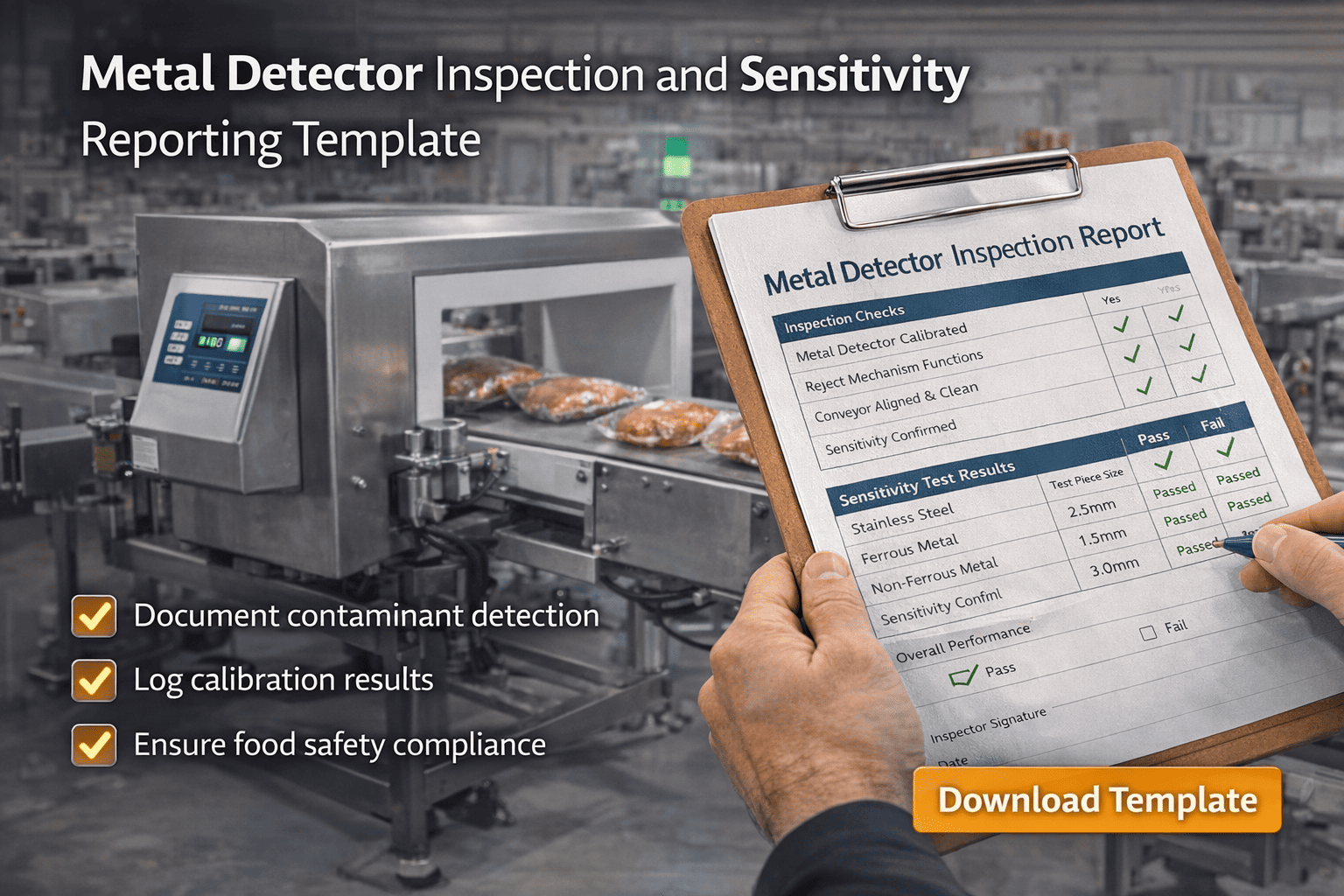
Metal detectors and X-ray inspection systems are usually the last Critical Control Point in a food plant — the final filter between foreign material that survived upstream and the finished package shipped to a retailer. HACCP, BRCGS, SQF, and FSMA all treat them the same way: as CCPs requiring validated sensitivity, daily verification, documented corrective action on every failed test, and an audit trail retrievable in the inspector's window. The failure mode every plant fears is not the equipment breaking — it is the equipment running while sensitivity has drifted, test pieces have been logged on paper that never reached the system, and the BRCGS auditor opens last quarter's CCP book to find gaps. Every documented metal contamination recall in 2025 and early 2026 traced back to the same root cause family: a sensitivity verification that was either not performed, not documented, or not actioned when it failed. Start a free trial to digitise metal detector and X-ray CCP verification — or book a demo to see how Oxmaint turns every test piece pass into audit-ready evidence.
Metal Detector and X-Ray Inspection Equipment Maintenance
Sensitivity verification, test pieces, daily verification, and CMMS-tracked CCP records. See how QA and engineering teams pass BRCGS, SQF, and FDA audits without scrambling, with photo-locked test piece evidence and auto-CAPA on every failed pass.
What CCP Verification on Detection Equipment Actually Covers
CCP verification on metal detectors and X-ray inspection is the documented programme of validation (initial proof of performance per product), daily and shift verification (test pieces passed at defined cadence), corrective action (on every failed test), calibration (sensor and rejection mechanism), and PM (belts, rollers, conveyor alignment, radiation safety inspection on X-ray). HACCP, BRCGS, SQF, and FSMA each treat the equipment as a CCP or critical Operational Prerequisite Programme — and each demands evidence that survives an auditor's first request.
The model matters because the equipment failure that matters most is silent. Sensitivity drift, rejection mechanism delay, conveyor speed shift, or product effect change with formulation can all degrade detection without producing any obvious alarm. The only way these are caught is the test piece pass at the start of every shift — and the only way the pass becomes audit evidence is a CMMS record with photo proof, timestamp, and signed operator. Plants moving from paper CCP logs to a structured CMMS programme typically eliminate the most common BRCGS finding — incomplete CCP verification evidence — within the first quarter. Start a free trial to see CCP discipline on your line.
Six Pillars of a CCP-Ready Detection Programme
Six concepts separate detection programmes that pass HACCP, BRCGS, SQF, and FSMA audits cleanly from those that produce findings on first inspection. Each is a specific control with its own test cadence, evidence requirement, and corrective action workflow.
Where Detection CCP Programmes Break Down
Detection equipment CCP failures repeat across snack, bakery, meat, dairy, ready-meal, and pet-food operations in the same six patterns. Every documented recall and BRCGS finding traces back to two or three of these combined. Plants closing even two of these gaps typically pass their next BRCGS, SQF, and FDA audit cleanly — start a free trial to map your current state.
How Oxmaint Runs Detection CCP Verification
Oxmaint structures every metal detector and X-ray CCP as a single connected workflow — validation per product, shift test piece pass with photo evidence, corrective action on every failed test, rejection mechanism verification, radiation safety records (X-ray), and operator training certificates. Every event is timestamped, signed, and audit-ready in seconds. Start a free trial to see the workflow on your CCPs.
Paper CCP Log vs Structured CMMS CCP Verification — Side by Side
The gap between paper-based CCP verification and a structured CMMS workflow is widest in the four moments BRCGS, SQF, and FDA auditors specifically test — retrieval speed, evidence completeness, CAPA traceability on failed tests, and operator training linkage. The comparison below is built from food plants that completed the transition under HACCP scope.
| CCP Dimension | Paper CCP Log | Structured CMMS CCP |
|---|---|---|
| Test piece evidence | Tick on paper, no proof | Photo + timestamp + operator sign |
| Failed test response | Retry until passing | Auto-CAPA + product quarantine |
| Rejection mechanism | Assumed working | Physically verified per cycle |
| Operator training | Filed separately | Linked to CCP sign-off block |
| BRCGS retrieval | Binder hunt | Filtered export in seconds |
| Radiation safety | Annual cert in a folder | Cert + RPA sign-off + dosimeter |
| Audit window risk | High | Always inspection-ready |
ROI After Digital CCP Rollout
The numbers below come from food plants that completed a 4–8 week move from paper CCP verification to a structured CMMS programme. The pattern is consistent — BRCGS, SQF, and FDA findings drop, recall risk drops, and QA hours per audit cycle drop significantly. The payback is typically the first avoided product hold or BRCGS minor.
Frequently Asked Questions
Does Oxmaint manage both metal detector and X-ray CCP verification in one workflow
How does the system handle failed test pieces and product quarantine
Can operator training be linked so untrained staff cannot sign off CCPs
How fast can a multi-line food plant deploy
Stop Carrying Recall Risk in a Paper Folder
Turn every test piece pass into photo-locked, timestamped, signed evidence — and let every failed test auto-quarantine product and trigger CAPA.