Ingredient handling is the part of a food plant where regulatory exposure, dust hazard, allergen risk, and downtime cost all converge. Silos store thousands of tonnes of flour, sugar, starch, or specialty powders. Bag dumpers move every minor ingredient — leveners, enzymes, vitamin premixes, allergens — into the line at high frequency. Sifters protect downstream equipment from foreign material. Pneumatic conveying moves it all between points without contamination. When any of these systems fails or drifts, the consequence cascades: the line stops, the allergen changeover record gets contested, the dust hazard analysis becomes invalid, or the FDA finds the next 483 in the ingredient room. Industry data shows ingredient handling rooms are the most common origin of food plant deflagration events and the most common source of allergen cross-contact non-conformances — both because the same plant area sits at the intersection of NFPA 61/652 dust control and FSMA/HACCP allergen control. Start a free trial to digitise ingredient room maintenance and documentation — or book a demo to see how Oxmaint unifies PM, dust evidence, and allergen records.
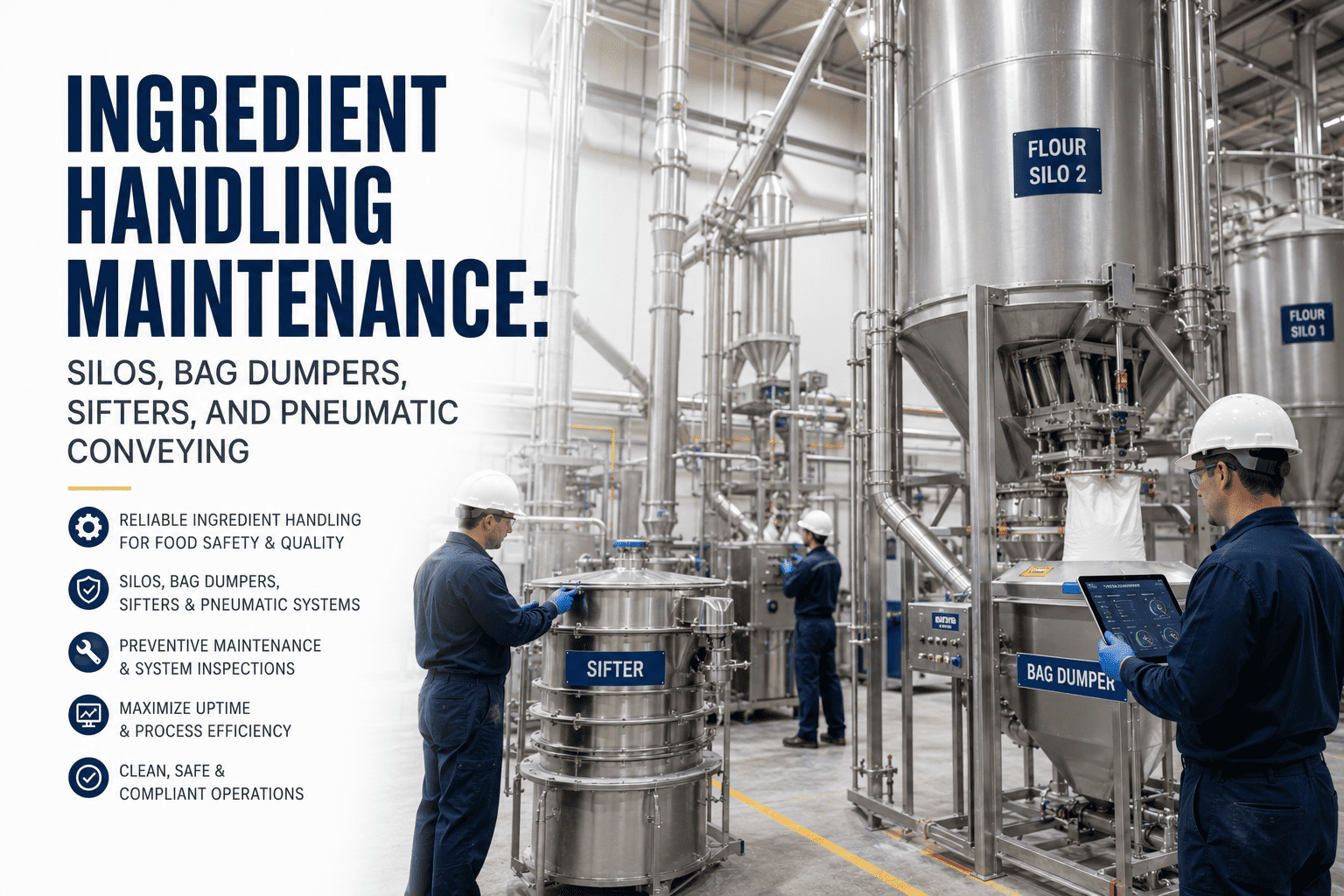
Ingredient Handling Maintenance: Silos, Bag Dumpers, Sifters, and Pneumatic Conveying
Silos, bag dumpers, sifters, pneumatic conveying, and CMMS-tracked PM with dust and allergen documentation. See how plant managers cut downtime, prove FDA and NFPA compliance, and stop losing batches to ingredient room failures.
What Ingredient Handling Maintenance Actually Covers
Ingredient handling maintenance is the PM, calibration, dust-control, and allergen-changeover programme that keeps a food plant's upstream materials flowing safely onto the line. It spans bulk silos (level sensors, dust collector function, NFPA 68 vent panels, rotary airlock isolation), bag dumpers (gasket integrity, bag dust extraction, hood face velocity, operator hand-protection sensors), sifters (screen integrity, magnetic trap check, throughput trending), and pneumatic conveying systems (filter cartridge life, blower bearing condition, line pressure trending, isolation valve verification).
The model matters because every ingredient room failure has two consequences at once. A torn sifter screen means foreign material risk plus a quality hold. A clogged bag dumper hood means flour dust accumulation plus an OSHA finding. A failed allergen changeover means a recall plus an FSMA non-conformance. Plants that move ingredient room maintenance from paper to a structured CMMS programme typically recover 30%+ of ingredient room downtime and produce inspector-ready dust and allergen evidence on demand — start a free trial to see how it runs on your layout.
Six Pillars of an Ingredient Room PM Programme
Six concepts separate ingredient rooms running disciplined PM from those running on operator memory. Each is a documented control that protects production, dust safety, and allergen integrity simultaneously.
Where Ingredient Room Programmes Break Down
Ingredient room failures repeat across milling, bakery, dairy, confectionery, snack, and pet-food operations in the same six patterns. Each one looks small in isolation but takes a line down or fails an audit when combined. Plants that close even two of these gaps typically recover ingredient room availability and pass FSMA, NFPA, and BRCGS audits cleanly — start a free trial to map your own profile.
How Oxmaint Runs Ingredient Room Maintenance and Documentation
Oxmaint puts every silo, bag dumper, sifter, and pneumatic conveying line on its own PM template, with dust evidence and allergen changeover records linked to the same asset record. Bag dumper hood velocity checks, sifter screen integrity, magnetic trap inspections, baghouse filter pressure trends — all surface on one ingredient room dashboard, all auditable in seconds. Start a free trial to see the workflow on your room layout.
Paper Ingredient Room Programme vs Structured CMMS — Side by Side
The gap between paper-based ingredient room records and a structured CMMS programme is widest in the moments where two regulatory frameworks intersect — dust evidence at NFPA 61 audit, allergen changeover at FSMA audit, and PM history at operational review. The comparison below is built from food plants that completed the transition.
| Programme Dimension | Paper Ingredient Room | Structured CMMS Programme |
|---|---|---|
| Allergen changeover record | Paper, often partial | Digital step + signed sign-off |
| Sifter screen check | Operator habit | Scheduled with photo evidence |
| Magnetic trap inspection | Ad-hoc | Documented on PM frequency |
| Bag dumper hood velocity | Annual at best | Trend with alert threshold |
| Dust layer evidence | Paper inspection | Photo + measurement record |
| Conveying filter life | Replaced on trip | Pressure trend + scheduled change |
| Inspector retrieval | Days | Minutes |
ROI After Structured Ingredient Room Rollout
The numbers below come from food plants that completed a 6–12 week move from paper-based ingredient room records to a structured CMMS programme. The pattern is consistent — ingredient room availability up, allergen findings down, NFPA 61 inspections clean.
Frequently Asked Questions
Can Oxmaint manage both NFPA 61 dust evidence and FSMA allergen records in one workflow
Does the system integrate with our silo level sensors and conveying control systems
How does the allergen changeover record satisfy a BRCGS or SQF auditor
How fast can a multi-line food plant deploy
Stop Losing Batches at the Front of the Line
Turn every silo, bag dumper, sifter, and conveying line into a documented, trend-tracked, audit-ready asset — and close both dust and allergen risk in one workflow.