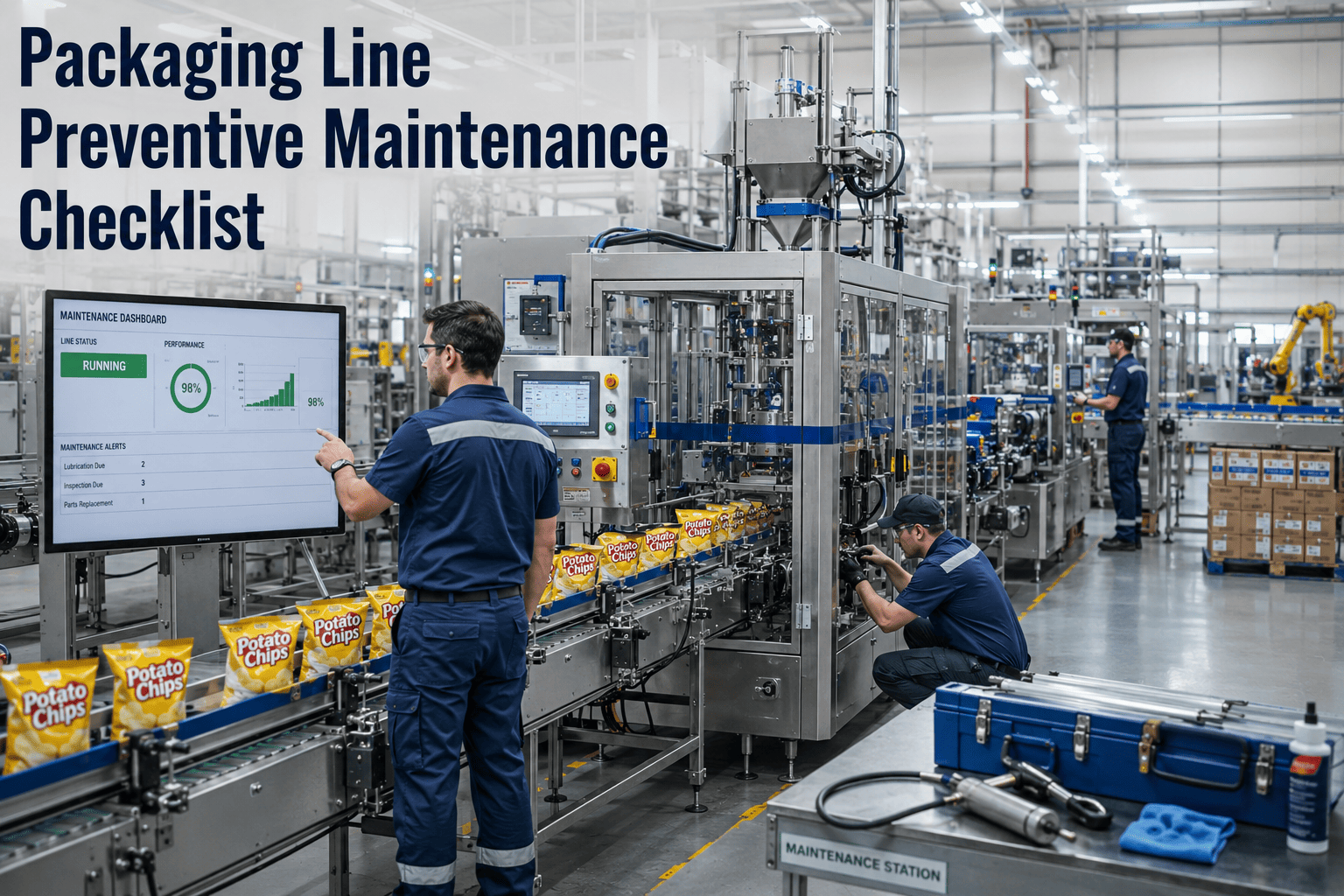
Form-fill-seal machines are the backbone of food packaging — both VFFS lines forming pouches vertically for snacks, coffee, frozen foods, and powders, and HFFS lines forming pillow and stand-up pouches horizontally for cheese slices, ready meals, and confectionery. The economics of these lines are unforgiving: a single jaw misalignment, a film tension fault, or a sensor drift halts 80 to 250 packs per minute instantly, and seal integrity failures trigger BRCGS and FDA non-conformances that scale into recalls. Food plants running structured CMMS programs on their VFFS and HFFS fleets report up to 40% fewer unexpected breakdowns and demonstrably higher OEE, which is why packaging managers chasing line uptime start a free trial to log jaw PMs, film changeovers, and seal integrity tests against the actual line asset record.
Packaging Line Operations Brief
Form-Fill-Seal Packaging Line Maintenance — VFFS and HFFS for Food Plants
Jaws, films, sensors, sealing systems, OEE engines, and CMMS-tracked PM and seal integrity records that survive BRCGS, FDA, and SQF audits.
40%
Fewer breakdowns on lines running daily structured PM
$22K
Lost production per hour of packaging line downtime
85%
World-class OEE threshold; below 70% signals systemic PM failure
68%
Reported downtime cut after CMMS rollout on packaging fleets
01
What VFFS and HFFS Maintenance Actually Covers
VFFS pulls film from a roll over a forming collar, drops product through the tube, and seals top and bottom jaws to release a finished pouch — a continuous vertical cycle. HFFS does the same work horizontally for product shapes that cannot survive vertical fall, like slices, biscuits, or unit-dose pouches. The maintenance scope is the same in shape but different in component criticality: jaws, film tracking, sealing systems, dosing fillers, registration sensors, eye marks, and date coding, all tied to the line OEE clock.
A line running at 120 packs per minute generates 57,600 sealed packs per shift. A single millimeter of jaw misalignment cascades into thousands of failed seals before an operator catches it. The CMMS approach replaces visual catch with scheduled inspection cadence — daily, weekly, monthly, quarterly — where each task carries an operator sign-off, a photo, a reading, and a corrective action route if the inspection fails, so packaging engineers ready to install that cadence book a demo to see the PM library configured against actual VFFS and HFFS assets.
Packaging lines without usage-based jaw PM are running blind — knife sharpness depends on bag count, not the day of the week.
02
The Six Critical Maintenance Domains on a Form-Fill-Seal Line
Every VFFS and HFFS asset breaks down at the same predictable points. Map the PM library to these six domains and the unplanned-stop count drops sharply within the first quarter.
JAWS
Sealing Jaw Cleaning and Alignment
Heated jaws collect film residue and product debris on every cycle. Daily clean-down and weekly alignment check prevent the wave pattern of micro-leaks that ruin seal integrity tests downstream.
FILM
Film Path, Tension and Splice Tracking
Static, humidity, and tension shifts cause jams. Film roll changeovers must be logged with batch and supplier so seal failures trace back to a film lot — not just to the line operator.
SENSORS
Eye Mark and Registration Sensors
Eye mark sensors keep the print registration aligned with the seal. A drifted sensor produces off-center graphics and triggers a quality hold. Quarterly calibration with documented offset is non-negotiable.
DOSING
Multi-Head Weigher and Auger Dosing
Fill weight accuracy starts at the doser, not the checkweigher. Weekly cell verification and load cell calibration prevent the upstream cause of MAV breaches further down the line.
PULL BELTS
Pull Belt Wear and Slippage
Worn pull belts slip and produce inconsistent bag length. Usage-based replacement — driven by bag count, not calendar — eliminates the late-Friday breakdown pattern when belts have run double shifts all week.
CODE
Date Code and Lot Print Integrity
A blurred best-by date is a recall waiting to happen. Inkjet head cleaning, ribbon changeout, and quarterly print validation against the verified test bag prevent the audit finding before it forms.
03
Pain Points That Cost Packaging Plants Throughput and Margin
The financial story of a VFFS or HFFS line is told in OEE points. Every percentage point lost to availability, performance, or quality compounds across thousands of running hours per year. The pain points below are the recurring root causes that drag OEE below 70% — the threshold most ops directors call critical.
Unplanned Film Jams and Splice Failures
A line averaging 47 unplanned stops per week burns 4 to 6 hours of running time and produces no actionable data when stops are tallied in a notebook. CMMS-tracked stops tie each event to the asset, the operator, and the part that failed.
Seal Integrity Failures Reaching Finished Goods
A jaw misalignment caught by QA at the end of the day means a full day of finished pouches now needs vacuum testing, dye penetration, or rework. The cost is not the rework — it is the line stopped while QA decides scope.
BRCGS and FDA Audit Documentation Gaps
Auditors trace seal failures back through PM history, jaw temperature logs, and operator training records. Plants without a single asset record holding all three spend the audit reconstructing data instead of defending the program.
Spare Parts Stockouts at the Critical Moment
Jaw inserts, knives, pull belts, and sealing pads are line-critical wear parts. Without usage-based reorder triggers tied to the asset, the spare runs out on the third shift Sunday — and emergency procurement adds 40% to 80% to part cost.
Every one of these pain points has the same underlying cause: the maintenance event, the run-hour data, and the spare-parts state do not live on the line asset together. Once they do — and only then — the OEE engine can attribute downtime to a real root cause rather than a guess on the shift report, which is why operations managers running multi-line plants start a free trial on a single VFFS line and prove the engine before rolling it to the rest of the fleet.
Most packaging plants lose 25% to 35% of design speed to micro-stops that nobody logs.
04
How OxMaint Closes the OEE Gap on VFFS and HFFS Lines
OxMaint maps every form-fill-seal line into the Portfolio > Property > System > Asset > Component hierarchy. The line is the System; the bagger, weigher, and date coder are the Assets; jaws, belts, sensors are the Components. PM, work orders, spare parts, and OEE roll into the same record — so the next breakdown carries a full history with it.
A
Usage-Based PM Triggered by Bag Count
Knives, pull belts, and sealing pads schedule against bag count or run-hours, not calendar dates. Single-shift weeks extend service intervals; double-shift weeks pull them in. Service work happens before failure, not after.
B
Seal Integrity Test Records Tied to the Asset
Vacuum and dye penetration test results attach to the bagger asset. Trend analysis surfaces the drift before QA holds the lot. Audit pulls cross-reference test results with the jaw temperature log at the same timestamp.
C
Mobile Floor Checklists With Photo Evidence
Operators run the start-of-shift jaw check on a tablet at the line. Photo evidence of the cleaned jaw face, the registration mark, and the seal sample upload to the asset record automatically.
D
Spare Parts Engine Tied to Wear Triggers
Bag count thresholds auto-create parts requisitions before stockout. Suppliers see lead time at the point of trigger, not after the failure. Emergency procurement premium goes to zero.
E
OEE Dashboard Per Line and Per Site
Availability, performance, and quality compute from work order downtime and good-pack counts in real time. The shift report writes itself; the weekly OEE review starts with data instead of a guess.
F
Multi-Site Portfolio View for VP Operations
For groups running plants across the US, UK, UAE, Germany, and Australia, the dashboard shows every VFFS and HFFS line's OEE, PM compliance, and open work orders in one screen — at the corporate level.
05
Reactive vs Planned VFFS and HFFS Maintenance — The Operational Difference
The shift from reactive to planned maintenance on form-fill-seal lines is the single highest-impact lever a packaging plant can pull. The numbers below compare the same 4-line plant before and 12 months after deploying structured CMMS-driven maintenance against the form-fill-seal fleet.
The pattern is consistent across plants reporting in: the line that earns five-shift weeks of clean OEE is the line whose jaws, belts, sensors, and codes live on a single asset record, where every PM ties to the bag count and every spare orders itself before the failure, which is the operational reality packaging directors book a demo to confirm against their own line data.
06
ROI and Operational Outcomes From CMMS-Tracked Form-Fill-Seal Programs
Plants 12 months after deployment report a consistent ROI shape: throughput recovers first, scrap and seal failures drop next, spares spend rebalances third, and audit readiness arrives as a side effect. The numbers below are typical mid-range outcomes — not best-case.
+19
OEE points
Recovered from reactive baseline within 12 months of structured PM rollout.
-68%
downtime hours
Reported across multi-line packaging fleets after CMMS deployment.
3-5
years extended life
Added to packaging equipment lifecycle through systematic maintenance protocols.
8 mo
median payback
From downtime recovery alone, before audit, spares, and quality savings.
87%
seal failure cut
Per million packs after jaw PM cadence and seal integrity tracking activated.
$1.8M
annual recovery
Median 4-line plant running standard SKU mix and 16-hour daily operation.
The pattern is reproducible because the inputs are reproducible. Bag count drives PM cadence; PM cadence drives uptime; uptime drives OEE; OEE drives margin. Each stage is captured on the line asset record, which is why packaging directors ready to install the same engine start a free trial on a single bagger and validate the math on real shift data.
07
Frequently Asked Questions
Does OxMaint connect to PLC and HMI data from VFFS and HFFS machines
Yes. Bag count, jaw temperature, fault codes, and good-pack counts stream into the asset record via standard industrial connectors. PM schedules trigger against bag count thresholds rather than calendar dates, which is the difference between usage-based PM and the legacy weekly-schedule model.
Can different machine brands on one line share a single PM library
Yes. A mixed fleet of Hayssen, Matrix, Triangle, Bosch, and ILAPAK baggers can share PM templates configured per brand and model. The asset record carries the brand-specific spare-part list, OEM manual references, and torque specs so technicians do not chase information across binders.
How does OxMaint support BRCGS and SQF audit requirements for packaging lines
Every PM task, jaw temperature reading, seal integrity test, and corrective action is timestamped against the line asset. The audit exports as a PDF for the requested date range. Auditors get evidence in minutes instead of a multi-week reconstruction project that pulls engineers off line improvement work.
What about HFFS lines running thermoform-fill-seal with mapped registration
HFFS thermoform-fill-seal lines map identically. Registration sensors, web tension, vacuum pumps, and CIP cycles all become components of the line asset. The mapped registration print verification can be added as a quarterly PM with a stored reference image for operator comparison.
Decision Point
Stop Losing Packaging Hours to Reactive Maintenance and Missing PM Cadence
Turn every VFFS and HFFS line into a usage-based, audit-ready, OEE-tracked asset record — with PM, spares, and seal integrity tests on one platform.
Trusted on 10,000+ asset portfolios
Live in days, not months
Works across multi-site portfolios
No heavy implementation
Usage-based PM on every bagger and packer
Seal integrity records audit-ready in seconds
5 to 10 year CapEx forecasting on the same record