A food plant vendor who swaps in a non-food-grade gasket during a midnight pump repair can trigger a recall that costs more than a year of that contractor's total spend. The question is never whether outside hands will touch your CCP-critical equipment — it is whether your system knows, in real time, which hands, with which credentials, under which SLA, on which asset. Want to see how food manufacturers manage 40+ active contractors across SQF, BRCGS and FSMA audits in one place? You can book a demo or start a free trial to walk through contractor dashboards with live SQF-aligned data.
Food Plant Vendor Management: Contractors, Suppliers & SLAs in One CMMS
Credentials, food-safety training, SLAs, allergen risk, and performance scorecards — tracked per contractor and per asset, ready for FSMA, SQF, BRCGS and HACCP audits in under two minutes.
Contractor chaos is a food-safety liability, not a purchasing problem.
A single missing GMP training certificate on a millwright can invalidate an entire SQF audit. OxMaint binds every vendor to the assets they touch, the credentials they hold, and the SLAs they signed.
What is Food Plant Vendor Management?
Food plant vendor management is the systematic control of every third party — contractors, service providers, parts suppliers, sanitation crews, calibration specialists — whose work touches or influences food-contact equipment. It goes beyond procurement. It is the discipline that ensures every outside hand on a CCP-critical asset is credentialed, trained on food safety, bound by SLA, and documented in a form that satisfies FSMA, SQF, BRCGS and HACCP auditors.
Onboard & Qualify
Insurance, GMP training, food-safety induction, allergen awareness, background check — captured once, expiry tracked automatically.
Scope & Approve
Work order tied to specific asset, zone, CCP relevance, and food-grade material list — contractor cannot start without approval.
Execute & Verify
Mobile sign-in, photo evidence, post-maintenance sanitation verification, allergen flush confirmation — all logged against the asset.
Score & Renew
SLA adherence, first-time-fix, response time, compliance score — roll up per vendor for renewal or de-listing decisions.
Not Every Vendor Carries the Same Food-Safety Risk
CCP-Zone Contractors
Sanitation, pasteurisers, metal detectors, allergen-zone mechanics. Direct product-safety impact. Require full GMP training, signed food-safety acknowledgment, post-work verification.
Audit weight: Very High
Production-Line Contractors
Packaging, conveyors, fillers, cappers, coders. Indirect food-safety exposure plus direct downtime risk. Require GMP basics plus SLA on response time.
Audit weight: High
Utility & Facility Vendors
Boilers, compressors, cooling towers, HVAC, refrigeration service. Legionella and air-quality linkage. Require licence verification and scheduled PM adherence.
Audit weight: Moderate
Parts & MRO Suppliers
Food-grade lubricants, gaskets, belts, sensors. Zero on-site access but material-spec critical. Require COA per lot, food-grade certification on file.
Audit weight: Moderate
Six Vendor Failures Food Plants Quietly Absorb Every Month
01
Expired credentials nobody checks
GMP training lapsed 11 months ago. Contractor still on site. Discovered only during SQF surveillance audit.
02
Non-food-grade parts installed
Generic NBR gasket swapped onto a CIP valve under time pressure. Found during allergen validation. Batch holds follow.
03
SLA breaches that never get billed
4-hour response SLA misses average 11 hours. No system logs the clock. Credits never claimed. Premium pricing accepted.
04
Undocumented post-maintenance sanitation
Contractor completes repair. Nobody signs off the sanitation verification. CCP equipment runs. Corrective action rebuild required.
05
Allergen cross-contact risk
Contractor moved tools between peanut line and dairy line. No changeover record. Mandatory allergen testing triggered.
06
No performance memory per vendor
Same contractor has caused 4 rework events across 2 years. No scorecard. Contract auto-renews. Losses compound.
Vendor Control That Matches Food-Safety Reality
Credential Expiry Engine
GMP training, COI, allergen awareness, background check — every document tagged with an expiry. System blocks work order assignment the day a credential lapses. No paper chase. No surprise audit findings.
CCP-Aware Work Order Routing
Work orders on CCP-tagged assets route only to pre-qualified contractors. Food-grade parts list enforced. Sanitation verification step mandatory before closure.
SLA Clock on Every Ticket
Response time, arrival time, time-to-fix logged automatically. SLA breaches surface on the vendor scorecard and in monthly reviews — credits become a conversation, not a memory test.
Performance Scorecards
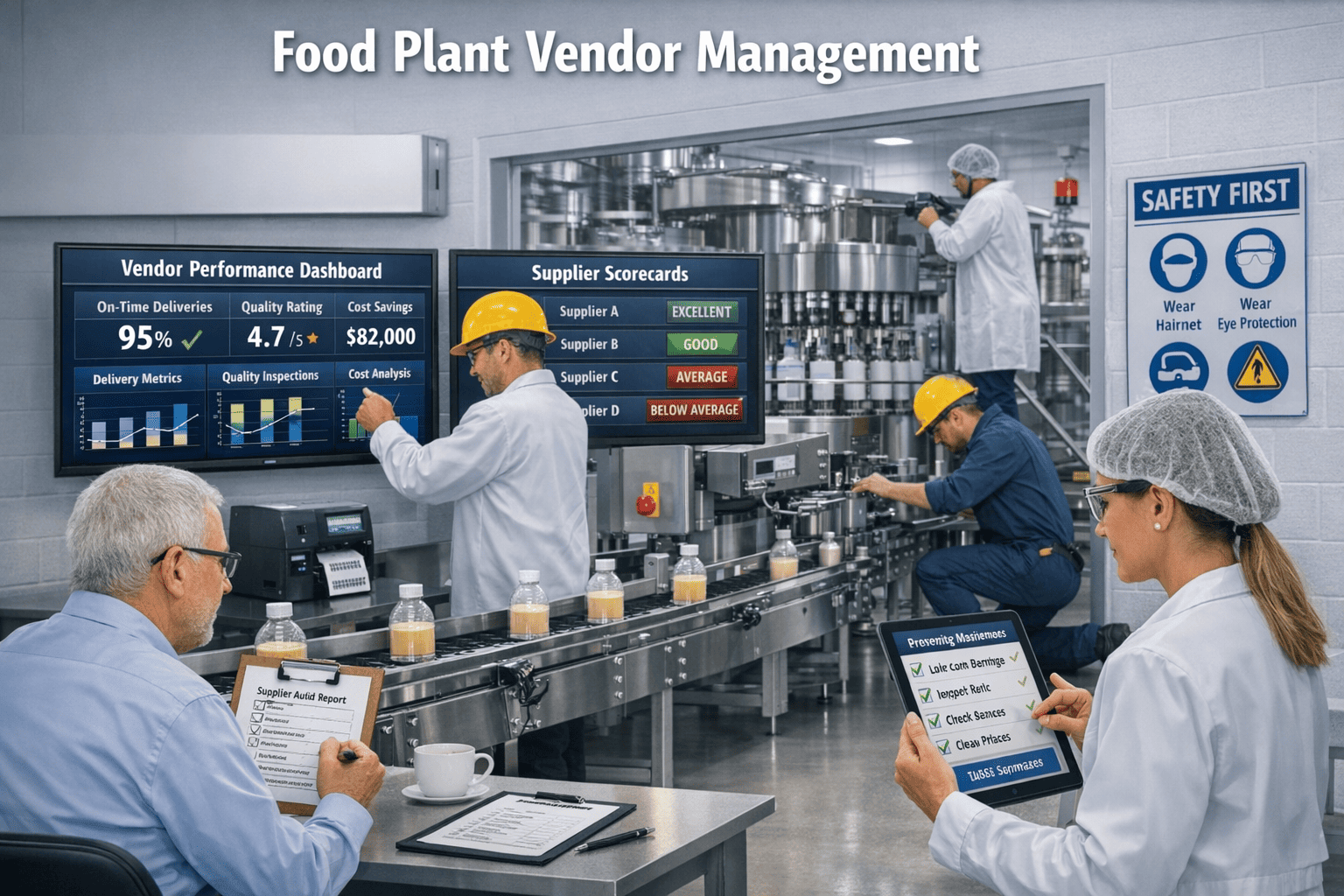
First-time-fix rate, repeat-failure rate, compliance score, cost per WO, rework events — live per vendor. Renewal meetings run from data, not anecdotes.
Allergen & Zone Workflow
Contractor check-in records zone entry, tool changeover, and post-work wash-down. Cross-contact risk documented against every job — not reconstructed during recall investigations.
Audit-Ready Vendor File
SQF, BRCGS, FSMA 204(d) inspector asks for contractor records on a specific line? Export complete vendor history per asset in under 2 minutes — not two days.
See how food manufacturers cut vendor compliance overhead by 60% — book a demo or start a free trial today.
Spreadsheet Vendor Lists vs OxMaint Vendor Control
| Vendor Activity | Spreadsheets & Email | With OxMaint |
|---|---|---|
| Credential tracking | Shared Excel, found expired during audit | Auto-alerts 30 days pre-expiry, WO blocked on lapse |
| Work order assignment | Manual — any contractor, any asset | CCP-aware routing only to qualified vendors |
| SLA monitoring | Not measured — trust the invoice | Response & fix clocks logged per WO |
| Food-grade parts | Verified post-incident | Approved parts list enforced at WO creation |
| Post-maintenance sanitation | Ad hoc, often skipped | Mandatory digital sign-off before WO close |
| Vendor scorecard | Built once a year for renewal | Live, drill-down, per asset and per job |
| Audit retrieval | 2–3 days of folder hunting | Complete vendor history in under 2 minutes |
What Food Plants Achieve With Structured Vendor Management
less time spent chasing contractor compliance documents each month
drop in repeat failures once vendor scorecards drive renewal decisions
faster audit response when vendor records live with the asset, not in binders
more SLA credit recovery once response clocks are logged automatically
SQF / BRCGS observations for contractor credentials in the last 12 months
to pull contractor history for any asset during an FDA inspection
Frequently Asked Questions
How does OxMaint prove contractor compliance during an SQF or BRCGS audit?
OxMaint stores every contractor credential — GMP training, insurance, allergen awareness, background check — linked to the vendor profile, with expiry dates and document previews. Auditors see the credential, the asset touched, the work order, the technician, and the post-maintenance verification in one timeline. You can book a demo to see a real food-plant audit export.
Can OxMaint block a contractor from starting work if a food-safety training lapses?
Yes. Credential expiry rules can be configured per vendor category. Once a document lapses, any new work order assignment to that contractor is blocked until the document is renewed and reloaded — removing the reliance on manual gatekeeping during shift changes.
Does the platform handle food-grade parts enforcement for outside repair crews?
Yes. Each CCP-tagged asset carries an approved parts list with food-grade certifications on file. Work orders for that asset pull from the approved list only, and any deviation requires documented override plus requalification. You can start a free trial to configure this on your own assets.
How are SLA breaches actually measured — not just claimed?
Every vendor WO has a response clock, arrival clock, and time-to-fix clock — triggered at ticket creation and closed by mobile sign-in / completion timestamps. Breaches appear on the vendor scorecard for the next review, making credit recovery a data conversation instead of an invoice dispute.
Put every food-plant contractor on one audit-ready system.
Credentials, SLAs, food-grade parts, allergen workflow, post-maintenance sanitation, performance scorecards — in one CMMS trusted by food manufacturers across the US, UK, Canada, Germany, Australia and the UAE.