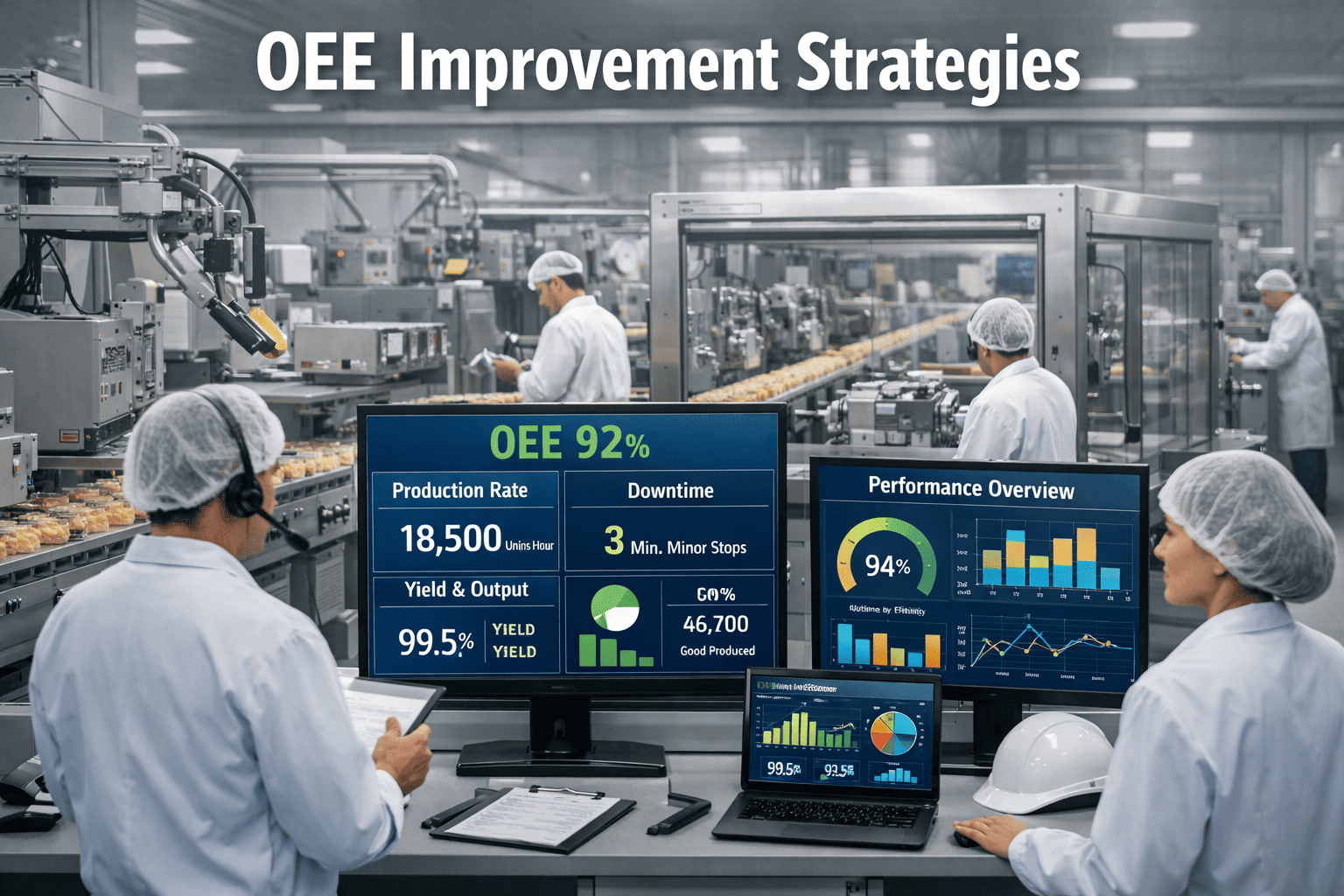
A food line running at 62% OEE feels normal until you realise every 10-point gain is equivalent to buying another packaging line without spending a dollar on steel. The industry average sits between 55% and 65%, world-class is 82–85%, and the difference is almost entirely invisible losses — micro-stops, speed drift, changeover overrun, and quality ramps that never make the shift report. You can book a demo to see how OxMaint surfaces those losses per line per SKU, or start a free trial and plot your first OEE waterfall this week.
OEE Improvement in Food Production: Boost Line Efficiency Fast
TPM, downtime analysis and CMMS dashboards — how food manufacturers move from 62% to 78% OEE within 12 months without capital spend.
OEE Waterfall · Beverage Line 03
F&B industry OEE average — well below world-class
world-class food & beverage OEE benchmark
typical OEE improvement after 12 months of automated tracking
downtime reduction food & beverage plants achieve with predictive maintenance
You cannot fix what you cannot see at 3-second resolution.
Most food plants report OEE numbers that are 10–18 points higher than reality because micro-stops under 5 minutes never make the log. OxMaint surfaces them automatically — and ties each one to the asset, the SKU, and the loss bucket.
What is OEE in Food Production?
Overall Equipment Effectiveness (OEE) is the single composite metric that multiplies Availability × Performance × Quality to reveal how much of your planned production time actually becomes good product. In food manufacturing, every loss carries compound consequence — downtime triggers product holds, speed losses inflate labour per unit, and quality failures generate not just rework but potential HACCP corrective action.
Availability
Actual run time ÷ planned run time
Killed by breakdowns, CIP overrun, changeover drift. Biggest loss bucket in multi-SKU beverage lines.
Performance
Actual output ÷ (run time × rated speed)
Killed by micro-stops under 5 min and chronic under-speeding. Invisible in manual reports, decisive in throughput.
Quality
Good units ÷ total units produced
Killed by startup scrap, fill-weight drift, seal-integrity rejects and metal-detect kick-offs during ramp-up.
OEE = A × P × Q. One weak factor collapses the product — all three must move together.
Where F&B OEE Actually Leaks
Breakdown losses
Unplanned downtime from reactive maintenance — the flagship killer in mechanical packaging lines.
Setup & changeover
A 90-min planned changeover that routinely runs 130 min is a measurable availability loss on every run.
Minor stops (micro-stops)
40 stops × 3 min each = 2 hours of silent lost production per shift that never hits the log.
Reduced speed
Running below rated speed feels safe — and quietly drains Performance from 95% to 80% across a shift.
Startup rejects
200 units lost per changeover × 12 runs/day = 2,400 daily quality losses in high-mix operations.
In-process defects
Seal failures, fill drift, metal-detect kick-offs — each one hits OEE and risks a HACCP corrective action.
Food & Beverage OEE: Where Do You Actually Stand?
| Tier | OEE Range | Typical Signature | Next Move |
|---|---|---|---|
| Below Average | < 50% | Manual logging, reactive maintenance, no micro-stop capture | Measurement before improvement — establish honest baseline |
| Industry Average | 55–65% | Daily OEE reports, some PMs, changeover pain, high CIP variance | SMED on top 3 changeovers + micro-stop tracking |
| Good | 66–75% | TPM in place, CMMS active, condition-based triggers starting | Predictive maintenance on CCPs + standardised CIP recipes |
| World-Class | 76–85% | Real-time OEE per line, autonomous maintenance culture, IoT integrated | Sustain through audits + tackle structural CIP design |
A 62% line lifted to 75% adds the equivalent of 15% more capacity — at zero capital cost.
The Six-Lever Framework to Lift F&B OEE
Measure at 1-second resolution
Machine-connected monitoring. If your OEE relies on operator logs, you are flying with one eye closed — most micro-stops are invisible to humans on a running line.
Separate structural vs recoverable loss
Standard CIP time is planned; CIP overrun is an availability loss. Coding this difference is 80% of the OEE improvement conversation.
SMED the top 3 changeovers
Format changes are often the largest single loss category. A 25% cut in changeover duration typically lifts OEE by 4–7 points on high-mix lines.
Condition-based PM on critical assets
Vibration, temperature, motor current. Shift from calendar PMs on fillers, cappers and pasteurisers to actual condition triggers — breakdowns drop 30–50%.
Root-cause every repeat stop
Three micro-stops on the same conveyor in a week is not a coincidence. CMMS-linked RCA turns repeating losses into one-time fixes.
Tie OEE to work-order data
Every downtime event should link to a failure mode, maintenance history and PM status. That is where opinion stops and statistically clear ROI begins.
See the framework in your own plant — book a demo or start a free trial.
Reactive Line vs CMMS-Driven OEE Line
| Operational Lever | Reactive Plant | OxMaint OEE Plant |
|---|---|---|
| OEE capture | Manual, shift-end, estimated | Real-time from machine data, per SKU and per shift |
| Micro-stops | Unrecorded — "line was running" | Logged in seconds, tagged to asset |
| Downtime root cause | Opinions in a meeting | Linked to failure mode + WO + PM history |
| Changeover time | Plan says 90 min, actual 130 min | SMED-tracked per format, variance visible daily |
| CIP overruns | Treated as structural | Split standard vs overrun — overrun flagged as availability loss |
| Quality losses | Aggregated weekly | Tied to equipment condition in real time |
| OEE improvement | Stalls at 55–60% | Typically +15 pts within 12 months |
What F&B Plants Unlock With OxMaint OEE Tracking
average OEE gain within 12 months of CMMS-driven loss analysis
reduction in unplanned downtime after shifting to predictive triggers
cut in CIP cycle time through standardised recipes without safety compromise
shift downtime once operators see micro-stops in real time
OEE improvement achieved by food ingredients manufacturer with real-time displays
typical payback period for OEE platform deployment
Frequently Asked Questions
Is 85% OEE a realistic target for a food & beverage line?
World-class in F&B is typically 82–85%, achievable on dedicated high-volume lines (beverage, bottling) but structurally harder on high-mix ready-meal operations. The more productive target is honest measurement and +15 points over 12 months — industry average sits at 55–65%. You can book a demo to benchmark your specific line type.
How does OxMaint capture micro-stops that operators miss?
Machine-connected monitoring records every stop, including the sub-5-minute events that never make manual logs. Each stop is tagged to the asset, the SKU, and the loss bucket automatically — giving you the 2+ hours per shift of hidden production that separates a 65% line from a 75% line.
Should CIP cleaning time count against OEE?
Standard CIP duration is planned downtime and should not be an OEE loss — but CIP overrun beyond the validated standard should be flagged as an availability loss. OxMaint splits these automatically so you can drive cleaning-process improvement without compromising food safety. Start a free trial to configure this for your recipes.
How long before OEE numbers actually improve after go-live?
Most food plants see a 5–8 point improvement within 90 days driven purely by visibility — operators self-correct once losses are visible. Structural gains of +15 points typically land between month 6 and month 12 as TPM and condition-based PMs mature.
Move your food line from 62% to 78% OEE — without buying new equipment.
Machine-connected monitoring, micro-stop capture, CIP variance analysis, condition-based PM, and live loss attribution per SKU — in one CMMS trusted by food manufacturers across USA, UK, Canada, Germany, Australia and the UAE.