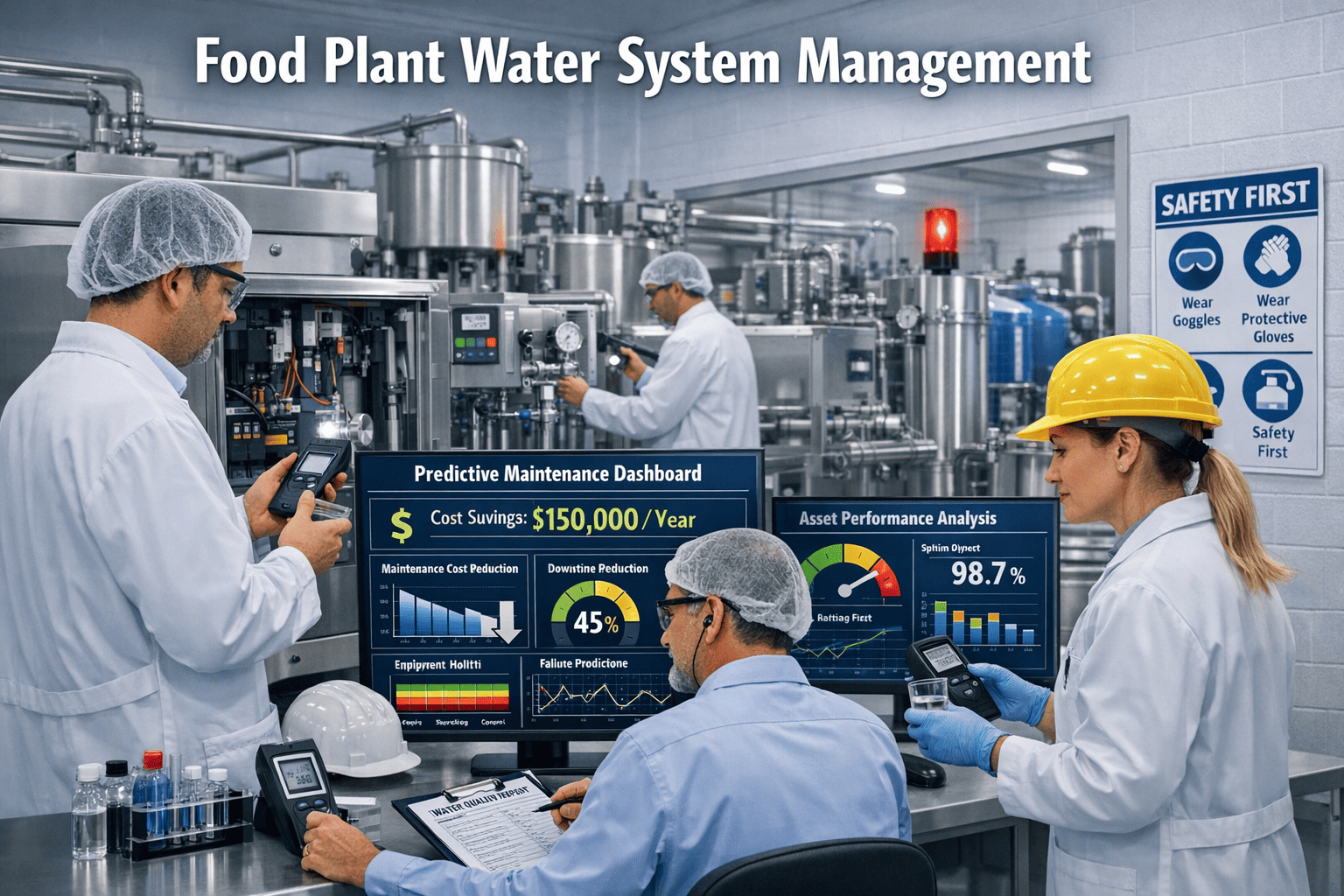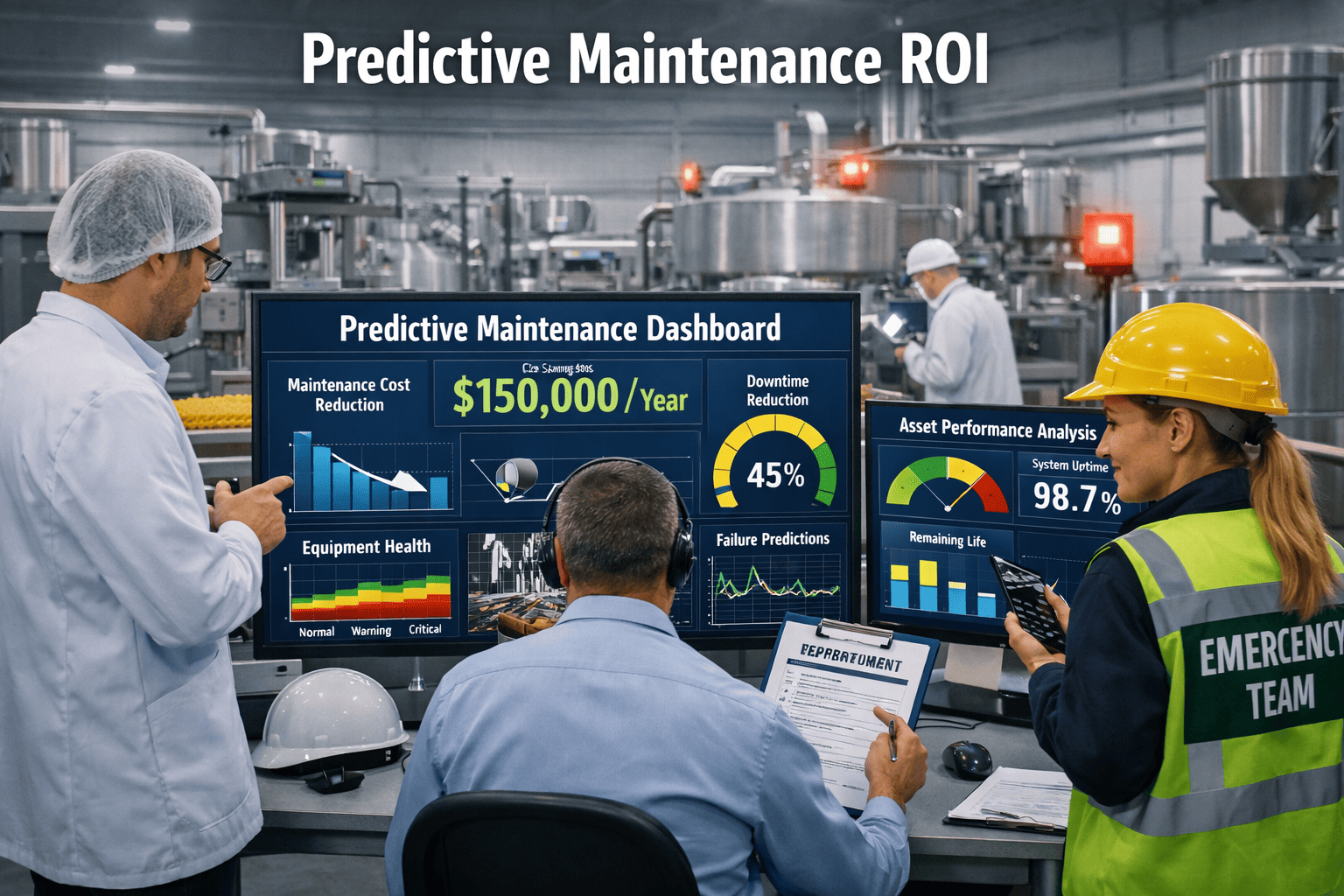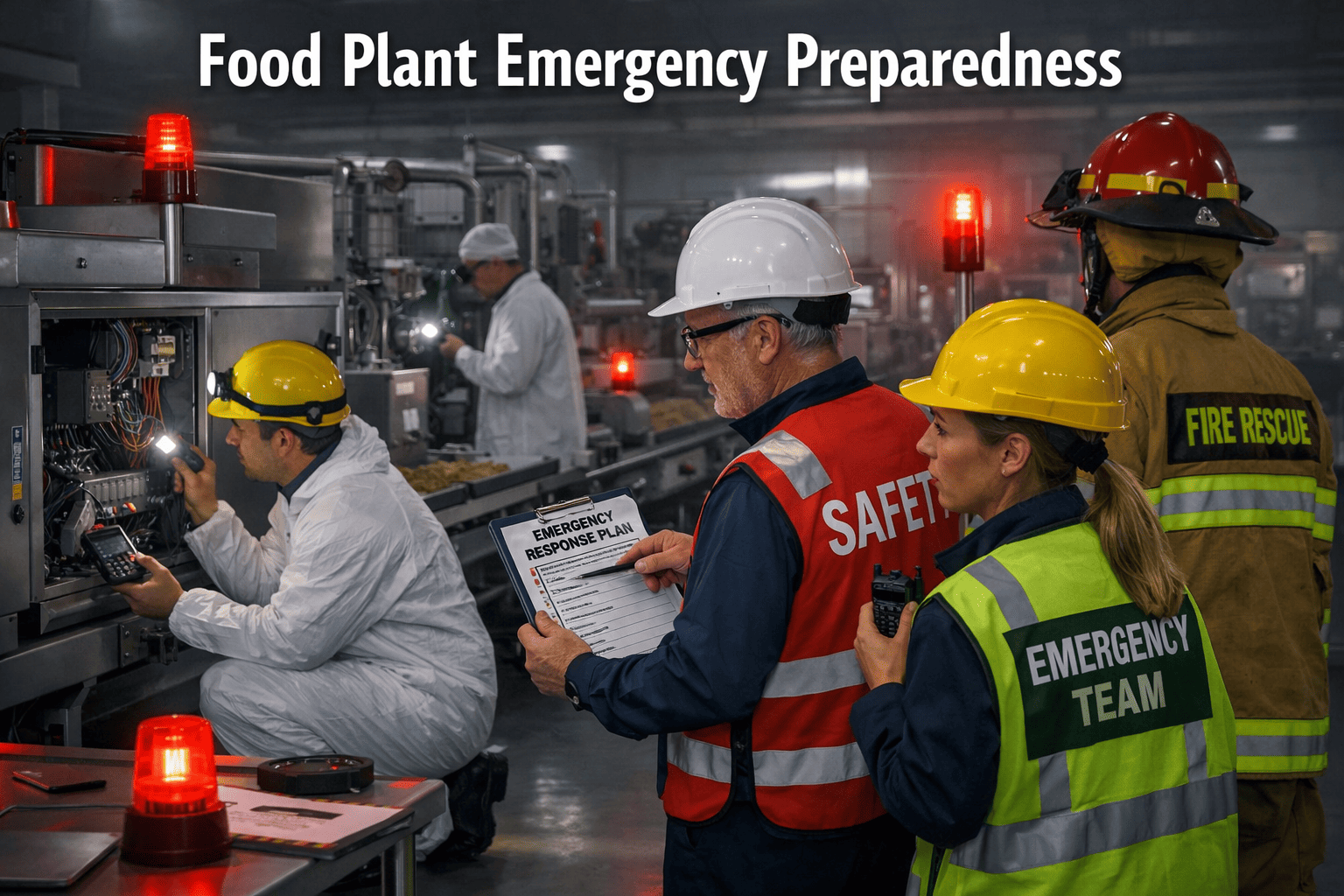
The recall call comes at 2:47 AM. A Listeria positive on environmental swabs. Production kept running while your team was sleeping because the last sanitation verification was "pending" — and nobody knows which 14 hours of product is implicated. Whether your plant absorbs a Class II withdrawal or faces a Class I, FDA-mandatory recall that costs up to $30M now depends entirely on what your CMMS can produce in the next 24 hours. You can book a demo to see full recall-ready equipment history, or start a free trial and build your emergency workflows before the next incident.
Food Plant Emergency Preparedness: Equipment Failures, Recalls & Disasters
Build CMMS-backed response plans for equipment breakdown, FSMA mandatory recalls, power outages and contamination events — with 24-hour FDA traceability ready on demand.
FSMA 204(d) · Traceability Clock
of Class I food recalls cost up to $30M, 23% cost more
annual US cost of foodborne illness across 48M Americans
FDA window to produce traceability spreadsheet on request
median cost of unplanned downtime across manufacturing
A recall plan on paper is the plan you don't have.
21 CFR 117.139 requires a written recall plan tied to every preventive-control hazard. OxMaint tightens that from a binder to a live workflow — traceable, timestamped, and exportable in minutes.
What is Food Plant Emergency Preparedness?
Emergency preparedness in a food plant is the disciplined ability to detect, contain, document and resolve crises — equipment failure, product contamination, recall, fire, power outage, pandemic, cyber incident — without compromising consumer safety or regulatory standing. FSMA gave the FDA mandatory recall authority and a 24-hour traceability window under §204(d); best-practice preparedness turns those obligations into a tested, CMMS-backed workflow rather than a scramble.
The Four Phases of Food Plant Crisis Management
Prevent
HACCP plan, preventive controls, CIP validation, PM adherence, allergen programme, environmental monitoring — the continuous baseline that most incidents never escape.
Detect
Environmental swab triggers, equipment alarms, consumer complaints, supplier FSVP alerts, upstream notifications — moving from symptom to signal in hours, not days.
Respond
Product hold, root-cause investigation, recall classification (I/II/III), FDA notification, communications, retrieval logistics — the 24–72 hour high-stakes window.
Recover
CAPA closure, regulator reporting, insurance claim, customer re-onboarding, mock-recall update, lessons learnt — where brand damage is contained or amplified.
Know the Severity Before the Call
Serious health risk or death
Undeclared allergens, pathogenic contamination (Listeria, Salmonella, E. coli O157). FDA mandatory recall authority applies.
Action window: hours
Temporary or reversible harm
Foreign material, minor labelling issues on sub-clinical doses, low-probability contamination.
Action window: days
Unlikely to cause harm
Mislabelling (non-allergenic), undeclared non-allergenic ingredients, weight variance, regulatory-only deviations.
Action window: standard
Minor violation, no FDA action
Quality defects below the regulatory threshold — still costly but non-reportable.
Action window: internal
Six Emergency Scenarios Every Food Plant Must Rehearse
Critical equipment failure
Pasteuriser drop-out, metal detector offline, CIP pump failure mid-cycle. Product hold + requalification + FDA-facing documentation trail.
Pathogen positive (EMP)
Environmental monitoring finds Listeria in Zone 2. Trace-forward investigation, implicated production windows, corrective deep-clean.
Undeclared allergen
Peanut trace found in a labelled nut-free SKU. Class I recall probability. Changeover records and contractor movement logs become pivotal.
Power outage / utility loss
Refrigeration drop, CCP loss of control, generator PM gap. Cold-chain records and time-temp reconstruction are everything.
Supplier FSVP failure
Ingredient recall cascades upstream. FSMA 204(d) demands traceability in both directions — lot in, lot out — within 24h.
Natural disaster / fire
Flood, hurricane, fire, cyber-attack. Business continuity plus potential product quarantine. FDA registration impact if operations suspended.
CMMS-Backed Emergency Workflows
Live Equipment Genealogy
Every asset carries a timestamped history: PM completed, calibration status, sanitation verification, technician, parts. When an outbreak investigator asks "what was the state of the filler on March 14?" the answer is one click.
Product Hold + Trace Workflow
Incident flag on an asset triggers an automatic hold scope — all batches processed since last verified clean. 24-hour FSMA-ready export in sortable spreadsheet format.
Emergency PM Library
Pre-built checklists for generator runs, post-power-outage restart, flood restoration, sanitation breakdown response — activated in one click, assigned instantly, tracked to closure.
CAPA-Linked Work Orders
Every corrective action bound to the causing incident. Regulator asks for effectiveness verification? Full audit trail visible with digital signatures, no paper chase.
Mock Recall Simulation
Run a mock recall from any past lot. Measure time-to-retrieve, identify record gaps, train the team, satisfy SQF/BRCGS audit mock-recall evidence requirements.
Supplier & Contractor Trace
Every batch links to parts lot, contractor activity, sanitation event, and PM window. FSVP failure traces both upstream and downstream in minutes.
Test-drive a recall simulation on real data — book a demo or start a free trial.
The 24-Hour Response Gap
| Response Task | Paper / Spreadsheet Plant | OxMaint-Backed Plant |
|---|---|---|
| Product hold scope | Reconstructed from shift logs — hours of work | Automatic from last-verified-clean timestamp |
| Equipment maintenance trail | Folder searches, partial records | Full history per asset ID in seconds |
| FSMA 204(d) sortable export | Manual assembly, often missed 24h window | One-click export, fully formatted |
| Contractor movement log | Ad hoc if at all | Every check-in timestamped & zoned |
| CAPA effectiveness verification | Separate folder, weeks later | Linked to incident, digitally signed |
| Mock recall | Annual, painful, partial | On-demand, measurable, complete |
| FDA facility registration risk | High when records are incomplete | Demonstrable compliance on demand |
Measurable Preparedness Outcomes
to complete a full mock-recall export from production data
FSMA §204(d) response met without paper assembly
reduction in product-hold scope through tighter equipment genealogy
CAPA actions traceable to root-cause incident
faster audit response during FDA facility inspection
mandatory recalls issued where voluntary recall was documented and executed on time
Frequently Asked Questions
Does OxMaint satisfy FSMA §204(d) traceability requirements?
OxMaint captures Key Data Elements against Critical Tracking Events and produces a sortable electronic spreadsheet within the 24-hour FDA window. Every equipment interaction, parts lot, sanitation event and contractor check-in is timestamped against the batch. You can book a demo to see the 204(d) export on live demo data.
Can OxMaint run mock recalls on demand?
Yes — select any past lot, trace forward to distribution and backward to ingredient-lot, and produce a timed report showing exactly how fast you can respond. This satisfies SQF and BRCGS mock-recall evidence requirements and trains teams before real incidents. Start a free trial to try one on your own data.
How does the platform help after a power outage or flood?
Pre-built emergency PM libraries cover generator PMs, cold-chain reconstruction, post-outage restart checklists and sanitation requalification. Work orders launch instantly, get assigned to qualified staff, and close with digital signatures — so the regulator-facing documentation is complete before inspectors arrive.
What happens when a supplier issues an ingredient recall?
OxMaint traces the ingredient lot through every batch that used it, identifies implicated finished goods, flags affected equipment for sanitation verification, and produces the customer-notification list. FSVP and HACCP corrective-action documentation is generated automatically in regulator-ready format.
Be ready before the recall call — not after.
Live equipment genealogy, FSMA 204(d) exports, mock-recall simulation, emergency PM libraries, CAPA audit trails — one CMMS trusted by food manufacturers across USA, UK, Canada, Germany, Australia and the UAE.