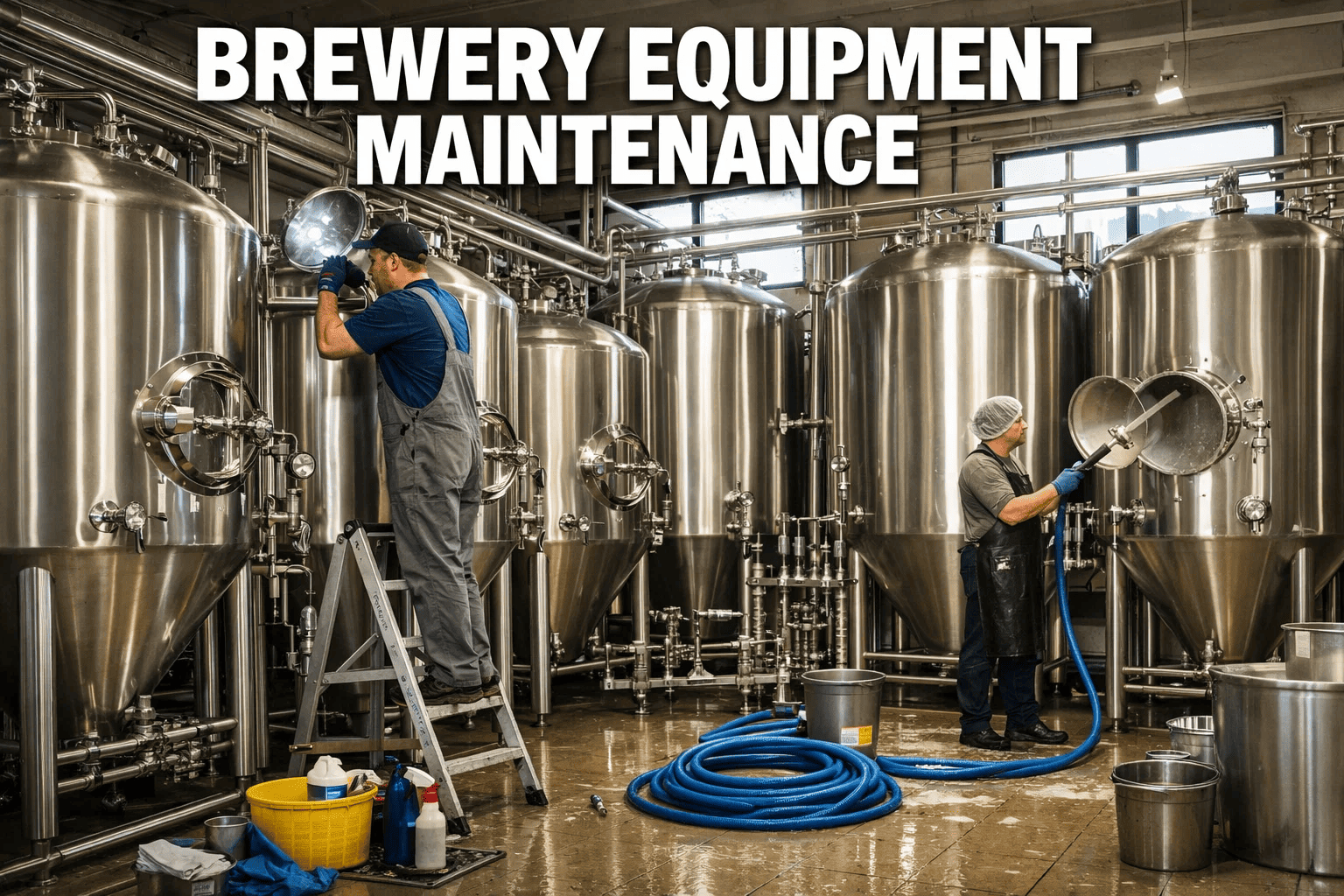
Brewery equipment failures do not just interrupt production — they compromise batch integrity, contaminate fermentation vessels, and in worst cases trigger product recalls that damage brand reputation built over years. Deferred CIP maintenance is the single leading cause of microbial contamination events in breweries, responsible for 34% of brewery quality defects when CIP spray balls, pump seals, and process pipework are not maintained on schedule. A single contaminated batch in a mid-size commercial brewery costs an average of $85,000 in direct loss — before accounting for the investigative downtime, deep sanitation required, and customer confidence impact that follow. This checklist covers every critical maintenance and sanitation task for brewery operations, organized by equipment category and frequency, with particular emphasis on the fermentation, cold-side, CIP, and packaging systems that most directly determine product quality and compliance. Start a free trial to digitize this checklist in Oxmaint and automate your brewery PM schedule, or book a demo to see brewery asset management in action.
Protect Every Batch — Automate Your Brewery PM and Sanitation Schedule in Oxmaint
Oxmaint digitizes every task in this checklist into automated mobile work orders — with CIP validation records, pressure vessel inspection certificates, glycol system tracking, and complete sanitation audit trail built in automatically.
What Is a Brewery Equipment Maintenance and Sanitation Checklist?
A brewery equipment maintenance and sanitation checklist is a structured, frequency-organized reference for every inspection, cleaning, calibration, and preventive maintenance task required to keep brewery equipment operating reliably and producing consistently high-quality, contamination-free beer. In the brewery context, maintenance and sanitation are inseparable disciplines — degraded CIP spray balls, worn butterfly valve seats, and failed gaskets are simultaneously maintenance failures and sanitation failures, because each creates pathways for microbial contamination that compromise product quality and batch integrity.
Brewery PM checklists must cover both the hot side (mash, kettle, whirlpool, heat exchanger) and the cold side (fermenters, bright tanks, glycol chiller, CIP system, kegging and packaging lines). Each system has distinct failure modes, PM intervals, and sanitation requirements. Cylindroconical fermenters require regular seal inspection, pressure relief valve testing, temperature sensor calibration, and CIP validation — with cone valve and racking arm seal wear being the primary contamination risk if maintenance is deferred. Glycol chillers require concentration monitoring, condenser cleaning, and compressor oil level checks — with improper glycol mixtures being the leading cause of chiller failure in field operations.
Critically, fermenters and bright tanks operating above atmospheric pressure are classified as statutory pressure vessels in most jurisdictions — requiring formal inspection under ASME (USA), PED/PSSR (EU/UK), and equivalent Australian, Canadian, and UAE frameworks. These statutory inspection certificates must be current and on file for regulatory compliance. Book a demo to see how Oxmaint manages statutory inspection tracking alongside daily PM operations.
Brewery PM Checklist Framework — Key Task Categories
Fermentation Temperature Log Review
Review temperature logs for all fermentation tanks and cold storage. Investigate deviations from established ranges — temperature excursions stress yeast and generate off-flavor compounds that cannot be corrected after the fact.
Visual Equipment Inspection
Walk-through inspection of all brewing and packaging equipment for leaks, cracks, unusual noises, and anything out of the ordinary. Pay special attention to connections and seals — early detection prevents costly breakdowns.
CIP Spray Ball Verification
Inspect spray balls in fermenters and bright tanks for proper flow, rotation, and full coverage. Degraded or blocked spray balls leave biofilm in vessels — the leading cause of microbial contamination events in brewery operations.
Glycol Reservoir & Concentration Check
Check glycol reservoir level against minimum indicator. Verify glycol/water concentration with refractometer — target 35:65 propylene glycol to water. Lean mix freezes evaporator; rich mix overamps pump. Both cause costly chiller damage.
Fermenter & Bright Tank Seal Inspection
Inspect manway gaskets, butterfly valve seats, racking arm seals, and sample valve seats for wear, cracking, or deformation. Failed seals allow air ingress — creating dissolved oxygen contamination that compromises beer stability and flavor.
Heat Exchanger Inspection & Cleaning
Disassemble and inspect heat exchanger plates for fouling, scale buildup, and damage. Fouled heat exchangers cause slow wort cooling — increasing yeast stress and infection risk. Document flow restriction readings and cleaning records.
Pressure Relief Valve Testing & Calibration
Recalibrate and inspect PRVs on all fermenters and bright tanks. Replace damaged rupture disks. In most jurisdictions, vessels operating above atmospheric pressure require documented PRV testing — maintain records for statutory inspection compliance.
Statutory Pressure Vessel Inspection
Formal inspection by certified inspector under ASME, PED/PSSR, or equivalent jurisdiction framework. Certificates must be current and on file. Oxmaint stores certificates and triggers renewal alerts 60 days before expiry — eliminating lapses during audits.
Equipment-Specific Maintenance and Sanitation Tasks
Fermenters and Bright Tanks
Glycol Chiller System
CIP System
Pain Points: What Deferred Brewery Maintenance Costs You
CIP Biofilm and Batch Contamination
Degraded spray balls leave biofilm in fermenters that survives normal CIP cycles. A single contaminated fermenter produces beer with off-flavors, sour notes, or unstable carbonation — and one infected batch can spread to multiple vessels. The $85,000 average batch loss does not include investigation costs or brand damage.
Glycol Failure and Fermentation Excursion
Improper glycol concentration is the leading cause of chiller failure in the field. A lean mix freezes the evaporator; a rich mix overamps the pump. Either failure during active fermentation causes temperature excursions that stress yeast, generate off-flavor compounds, and can ruin entire batches across multiple tanks.
Worn Valve Seats and Air Ingress
Worn butterfly valve seats and manway gaskets allow air ingress into fermenters and bright tanks — introducing dissolved oxygen that compromises beer stability, accelerates staling, and reduces shelf life. Most oxygen-related quality defects trace back to seal failures, not process errors.
Lapsed Pressure Vessel Certificates
Fermenters and bright tanks operating with expired statutory inspection certificates represent legal and insurance liability in most jurisdictions. Regulatory inspectors can order production halts for non-compliant vessels. Certificate tracking without automation is routinely missed — until the annual audit finds the lapse.
Filler Head Seal Wear and Packaging Oxygen Pickup
Failed filler head seals introduce dissolved oxygen into packaged product — dramatically reducing shelf life and causing premature staling. Packaging line seal wear is a gradual, invisible process that only surfaces in shelf-life testing or customer complaints without systematic PM inspection.
Incomplete CIP Documentation
Most brewery quality incidents require CIP records as the first point of investigation. Facilities using paper-based or informal CIP documentation frequently cannot demonstrate compliance with their own cleaning procedures — creating liability exposure and regulatory risk that CMMS-generated records eliminate entirely.
Breweries that systematically track CIP performance, seal condition, and glycol system health through a digital CMMS eliminate the deferred maintenance that accounts for 34% of all brewery quality defects — start a free trial to build that discipline in Oxmaint, or book a demo to see brewery-specific asset management in action.
How Oxmaint Manages Brewery PM and Sanitation Compliance
Automatic CIP Audit Trail From Every Cleaning Cycle
Every CIP cycle in Oxmaint generates a timestamped record with chemical concentrations, temperature, contact time, spray ball confirmation, and technician ID — the complete evidence set that quality investigations and regulatory audits require. Paper CIP records cannot achieve this level of completeness or reliability.
Statutory Inspection Certificates Tracked and Auto-Alerted
Oxmaint stores ASME, PED, and PSSR inspection certificates for every fermenter and bright tank, with automatic expiry alerts triggered 60 days before the inspection window closes — eliminating the certificate lapses that expose breweries to regulatory action and insurance liability.
Concentration, Level, and Service Records in One Place
Monthly glycol checks, concentration readings, biannual professional service records, and compressor oil logs are all tracked in Oxmaint — with automated reminders ensuring no interval is missed and a complete service history available when troubleshooting performance issues.
Replace Before Failure — Not After a Contaminated Batch
Scheduled seal inspection tasks are delivered monthly to technicians as mobile work orders — with replacement records, parts consumption history, and batch association data that create the documentation trail quality teams need when investigating product deviations.
Gaskets, Seals, and Spray Balls Always in Stock
Critical brewery spare parts — butterfly valve seats, manway gaskets, spray balls, pump seals, and transfer hoses — are tracked with minimum stock levels. Auto-reorder alerts prevent the parts shortages that turn a 30-minute seal replacement into a multi-day contamination response.
Hot Side Through Packaging — One PM System for the Entire Brewery
Oxmaint registers every brewery asset — fermenters, bright tanks, glycol chillers, CIP systems, kegging lines, and packaging equipment — in a single hierarchy, with linked PM schedules, calibration workflows, inspection checklists, and compliance certificate tracking from mash to market.
Reactive vs. Planned Brewery Maintenance
| Maintenance Scenario | Reactive / Deferred Approach | Planned PM Approach |
|---|---|---|
| CIP Spray Ball | Degradation missed — biofilm forms — contaminated batch discovered at QC ($85K+ loss) | Weekly inspection catches damage early — replacement before contamination risk |
| Glycol Concentration | Lean mix freezes evaporator — fermentation excursion ruins batch | Monthly refractometer check — concentration corrected before thermal event |
| Pressure Vessel Certificate | Certificate expires — regulatory action, production halt possible | 60-day auto-alert — inspection booked and completed before expiry |
| Fermenter Seal | Air ingress discovered via off-flavor QC complaint on packaged product | Monthly inspection detects wear — seal replaced before oxygen contamination |
| CIP Documentation | Incomplete paper records — quality investigation has no baseline evidence | Complete digital CIP records auto-generated — investigation baseline always available |
Brewery PM and Sanitation ROI
Frequently Asked Questions
How often should brewery fermenters undergo CIP, and what does proper CIP involve?
Fermenters should undergo a complete CIP cycle after every batch — no exceptions. Proper CIP involves: (1) immediate hot water rinse to remove spent yeast and trub before it dries; (2) alkaline cleaning cycle with caustic cleaner at correct concentration and 30–60 minute contact time with recirculation; (3) phosphate removal rinse for darker beer styles prone to scale; (4) thorough hot water rinse confirming complete caustic removal; (5) sanitizer application with documented dwell time. Spray ball coverage must be verified at every CIP cycle — degraded or blocked spray balls are the leading cause of biofilm formation and the $85,000+ batch losses that follow. Start a free trial to digitize CIP cycle records in Oxmaint.
What glycol concentration should breweries maintain, and how is it checked?
For standard medium-temperature brewery glycol chillers, the recommended concentration is 35% inhibited propylene glycol to 65% water. This mixture provides adequate freeze protection while maintaining proper pump viscosity. Concentration is checked using a refractometer — a simple tool typically included with the chiller that takes seconds to use. A lean mix (too much water) can freeze the evaporator, causing extensive damage. A rich mix (too much glycol) overamps the pump and leads to premature pump failure. Glycol concentration should be checked monthly, with refractometer readings documented. Level should be checked weekly against the minimum indicator on the reservoir. Book a demo to see glycol system tracking in Oxmaint.
Do craft brewery fermenters require statutory pressure vessel inspection?
Yes. Fermenters and bright tanks operating above atmospheric pressure are classified as pressure vessels in most jurisdictions and require statutory inspection regardless of brewery size. In the USA, ASME certification applies. In the UK and EU, vessels fall under PED (Pressure Equipment Directive) and PSSR (Pressure Systems Safety Regulations). Australia, Canada, and UAE have equivalent frameworks. Inspection frequency depends on vessel size and operating pressure — typically annual or biennial. Certificates must be current and on file for insurance coverage and regulatory compliance. A single lapsed certificate can trigger production halt orders during inspections. Oxmaint stores every certificate with auto-expiry alerts 60 days in advance.
How does a CMMS improve brewery sanitation compliance and quality records?
A CMMS improves brewery sanitation compliance by converting informal or paper-based CIP records into systematic, timestamped, technician-identified digital documentation that quality investigations and regulatory audits can interrogate reliably. When a quality deviation occurs, the first question is always "what were the CIP records for this vessel?" — a CMMS answers that question in seconds, with complete chemical concentration, temperature, contact time, and spray ball verification data, rather than requiring a document search through handwritten logs. Beyond reactive investigation, CMMS-automated PM scheduling ensures CIP tasks, seal inspections, and glycol system checks never slip during high-production periods — which is precisely when deferred maintenance most frequently generates contamination events.
Protect Every Batch — Build Your Brewery PM System in Oxmaint
Oxmaint gives brewery operations teams automated PM scheduling, CIP validation records, pressure vessel certificate tracking, glycol system monitoring, and complete sanitation audit trail — from fermenter to packaging line, in a single mobile-first platform.
- CIP cycle records auto-generated with every cleaning event
- Pressure vessel certificate expiry alerts — 60 days advance notice
- Seal, gasket, and spray ball replacement tracked and scheduled
No heavy implementation — live in days. Works across single and multi-site brewery operations.