CMMS vs ERP for Food Manufacturing Maintenance Management

By Johnson on February 26, 2026

cmms-vs-erp-food-manufacturing

Your ERP already manages your finances, procurement, and HR. So why do food plants that rely on it for maintenance keep experiencing the same problems — missed PMs, no real-time work order visibility, technicians hunting for equipment history, and audit prep that takes hours instead of seconds? The answer is simple: ERP was built for business management, not equipment reliability. This guide gives you the honest comparison, the data, and the decision framework to choose what's actually right for your food manufacturing plant in 2026. Try Oxmaint free — purpose-built CMMS for food manufacturers, live in 48 hours.

CMMS Software · Comparison Guide · 2026

CMMS vs ERP for Food Manufacturing:
The Decision That Determines Your Uptime

70% of asset-intensive manufacturers now run both systems — ERP for financials, CMMS for daily maintenance. Understanding why reveals everything about which tool your floor actually needs.

ERP Best for: Business-wide financial control, procurement, HR, supply chain
|
CMMS Best for: Equipment reliability, technician workflows, PM scheduling, compliance docs
|
BOTH Best for: 70% of food manufacturers — integrated for complete operational control
Core Identity

Built for Different Worlds — Understanding the DNA

Both systems manage data. Both live on servers or in the cloud. But they answer completely different questions — and the people who use them daily couldn't be more different.

ERP

Enterprise Resource Planning

"How is the business performing, and where are we spending?"

[ PRIMARY USERS ]
CFOs · Finance teams · Procurement managers · HR directors · Supply chain leads
[ $ ] Financial management & reporting
[ PO ] Procurement & purchase orders
[ HR ] Human resources & payroll
[ SC ] Supply chain & inventory
[ CRM ] Customer relationship mgmt
ERP maintenance modules exist — but they are add-ons designed for broad use, not food plant floor realities.
VS

CMMS

Computerized Maintenance Management

"Is our equipment reliable and how do we keep it running?"

[ PRIMARY USERS ]
Maintenance techs · Reliability engineers · Shift supervisors · Plant managers
[ WO ] Work order creation & dispatch
[ PM ] Preventive maintenance scheduling
[ ASSET ] Asset history & lifecycle
[ MRO ] Spare parts & inventory
[ KPI ] MTBF · MTTR · PM compliance
Purpose-built for the technicians and supervisors who keep food production equipment running 24/7.
Real-World Workflows

The Same 3 Tasks — In ERP vs CMMS

Abstract comparisons are easy. Here is how the two systems handle three tasks that happen every single day in a food plant.

01 A conveyor seal fails mid-shift. Create & dispatch a work order.
[ ERP ]
Open ERP on desktop terminal
Create maintenance notification, convert to order
Manually assign technician, set priority
Tech finds terminal to view assignment & update status
[ TIME ] 15–25 min · Desktop-only · No mobile field access
[ CMMS ]
Operator scans QR on conveyor from phone
Work order auto-created, priority set by asset criticality
Best-matched tech receives mobile alert with SOP & parts list
Tech completes, signs off. Record auto-generated.
[ TIME ] Under 3 min · Mobile-first · Auto-documented
02 FDA auditor asks for 18 months of CIP pump maintenance records.
[ ERP ]
Search across work order history by asset & date
Cross-reference paper binders for missing entries
Manually compile into report format
[ TIME ] 3–4 hours · Possible gaps · Manual compilation
[ CMMS ]
Filter by asset: CIP Pump, date range: 18 months
Export signed PDF with timestamps & technician signatures
[ TIME ] Under 60 seconds · Complete · FDA 21 CFR Part 11 compliant
03 Track your plant's PM compliance rate and MTBF trends this quarter.
[ ERP ]
Query work order counts by cost center
Calculate manually or via custom report
MTBF & failure analysis typically unavailable or needs custom development
[ RESULT ] Basic spend data only · No reliability metrics · Custom dev needed
[ CMMS ]
Live dashboard shows PM compliance %, MTBF, MTTR, overdue tasks, technician wrench time — updated in real time
[ RESULT ] Full reliability KPIs · Failure trend analysis · No custom dev needed
Purpose-Built for Food Manufacturers

Oxmaint Is the CMMS Designed for Your Floor

QR-code scanning, HACCP-linked records, FDA 21 CFR Part 11 compliance, offline mobile access, and ERP integration via API. Live in 48 hours — no disruption to production.

Feature Scorecard

Capability-by-Capability: CMMS vs ERP for Food Plants

Scored across 14 capabilities critical to food manufacturing maintenance operations. Rating: Full = purpose-built capability, Partial = add-on or limited, None = not available.

Capability ERP CMMS (Oxmaint) Winner
Work order creation & dispatch Partial Full CMMS
Preventive maintenance scheduling Partial Full CMMS
Mobile technician access (offline) None Full CMMS
HACCP CCP-linked maintenance records None Full CMMS
FDA 21 CFR Part 11 audit trail Partial Full CMMS
MTBF & MTTR reliability analytics None Full CMMS
QR code asset scanning (mobile) None Full CMMS
Spare parts / MRO inventory Full Full Tie
Financial & cost center reporting Full Partial ERP
Procurement & supplier management Full Partial ERP
PM compliance rate tracking None Full CMMS
SQF / BRC / FSMA documentation None Full CMMS
Technician dispatch & skill matching None Full CMMS
Integration with ERP / SCADA / IoT Native Via API Both
ERP wins 2
vs
CMMS wins 10
across 14 food manufacturing maintenance capabilities
Your Situation

Which Setup Is Right for Your Plant?

Choose ERP Maintenance Module If...
  • You have fewer than 50 assets and basic maintenance needs
  • Your maintenance is primarily facility / property management, not production equipment
  • You are already deep in SAP/Oracle and want unified finance + maintenance
  • You cannot justify a second software platform budget
[ ! ] Warning: ERP maintenance modules typically lack mobile field access, PM automation, food-safety compliance documentation, and reliability analytics. These gaps cost more in downtime than the software savings.
Choose CMMS (Oxmaint) If...
  • You run a food production facility with complex equipment and 24/7 operations
  • You need HACCP-linked maintenance records and FDA audit readiness
  • Your technicians need mobile access in washdown environments
  • You want PM compliance rates above 90% with automated scheduling
  • You need MTBF, MTTR, and reliability analytics built in — no custom dev
[ + ] Best approach: Deploy Oxmaint for maintenance operations, integrate with your ERP via API for financial data flow. 70% of food manufacturers run this exact hybrid model.
Common Questions

What Food Plant Managers Ask About CMMS vs ERP

We already pay for SAP. Why would we add a second system?
Because SAP was designed to manage your business — not your equipment. SAP PM (Plant Maintenance) is a module, not a purpose-built system. It lacks mobile-first technician workflows, food-safety documentation automation, and built-in reliability analytics. The cost of the SAP PM gap — in downtime, missed PMs, and compliance exposure — typically far exceeds the cost of a dedicated CMMS. Most plants run SAP for finance and Oxmaint for maintenance, connected via API, and consider it their most impactful technology investment.
Can a CMMS integrate with our existing ERP system?
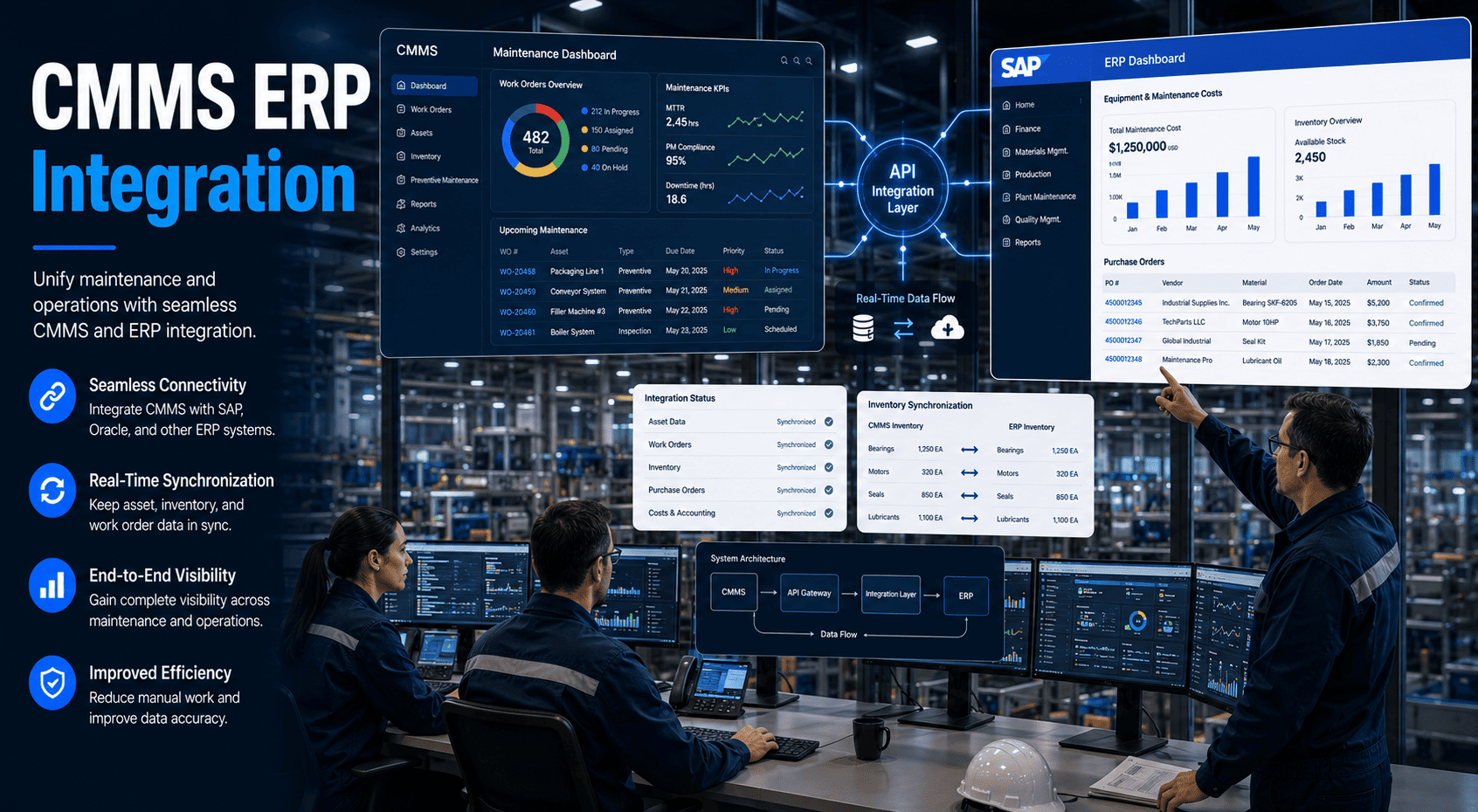
Yes — and this is the standard approach in 2026. Modern CMMS platforms including Oxmaint connect to SAP, Oracle, Microsoft Dynamics, and NetSuite via REST APIs. Work orders, parts usage, and labour hours flow into financial systems automatically. This gives your finance team the cost visibility they need while giving your maintenance team a tool built for their actual daily workflow. Integration typically takes 3–5 weeks and requires no production downtime to implement.
Is a CMMS only for large plants, or is it viable for mid-size operations?
Modern CMMS platforms are designed for operations of all sizes. Early CMMS tools were complex and expensive — leading to the misconception that they only fit large enterprises. Today's cloud-based CMMS platforms including Oxmaint are live in 48 hours, require no IT infrastructure, and scale from 10 assets to 10,000. Mid-size food plants often see the highest ROI because they have enough complexity to benefit from automation but lacked the IT resources to implement heavy ERP modules.
How long does CMMS implementation take compared to adding an ERP maintenance module?
A dedicated CMMS like Oxmaint is operational in 48–72 hours. QR labels printed, assets loaded, technicians trained on mobile app, first work orders flowing — all within days. Implementing or expanding an ERP maintenance module (SAP PM, Oracle CMMS) typically takes 6–18 months and requires significant IT and consulting resources. For food plants that need operational improvement now, the speed difference alone justifies a dedicated CMMS.
The Verdict Is Clear for Food Manufacturing

Your ERP Runs the Business.
Oxmaint Keeps the Equipment Running.

10 out of 14 food manufacturing maintenance capabilities score better in a purpose-built CMMS than an ERP. Deploy Oxmaint alongside your existing ERP and get the best of both worlds — financial control at the top, operational reliability at the floor level.
[ 48 hrs ] Live & running [ API ] Connects to SAP · Oracle · Dynamics [ FDA ] 21 CFR Part 11 compliant [ HACCP ] CCP-linked records [ 94% ] PM compliance achievable

Share This Story, Choose Your Platform!