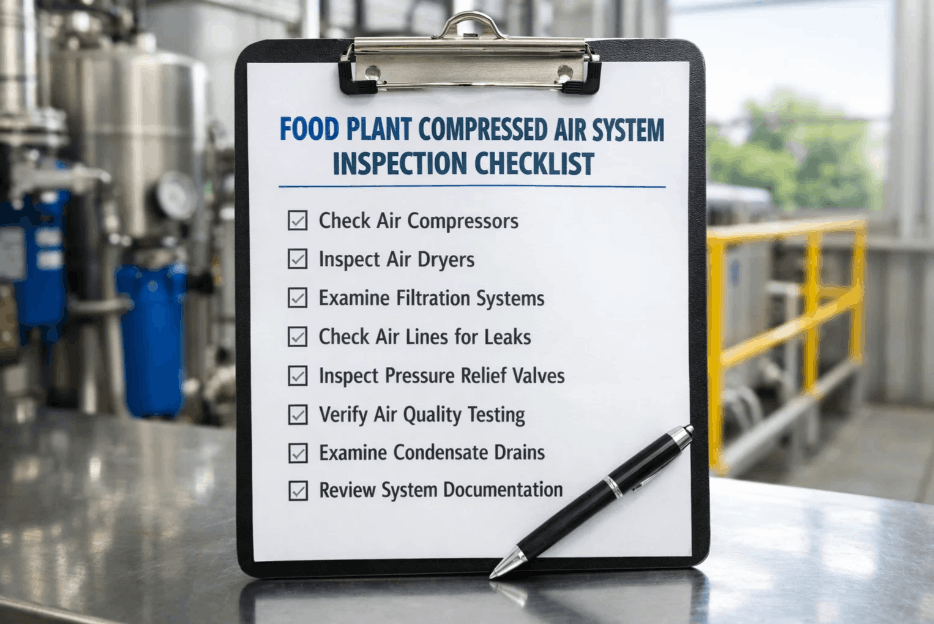
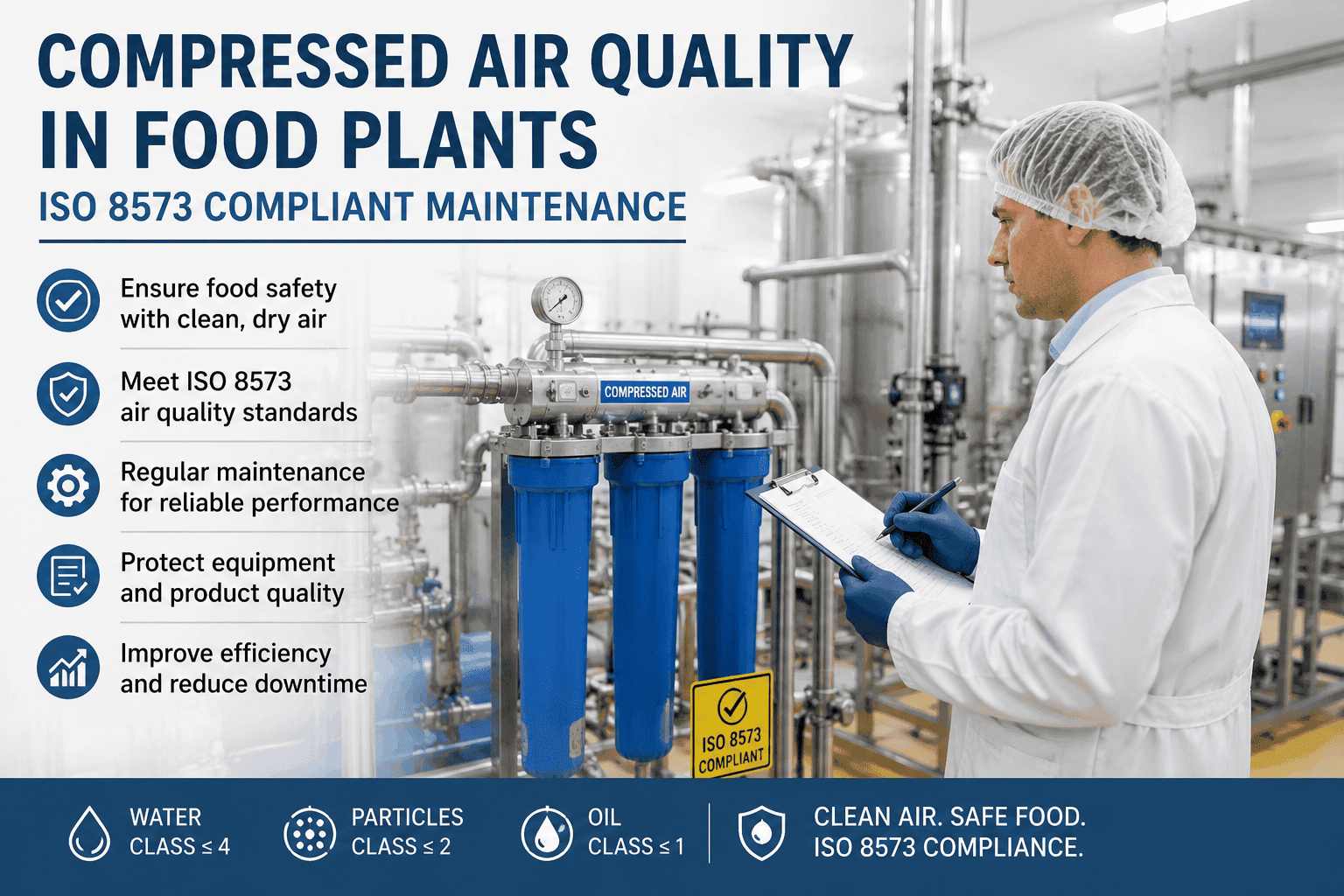
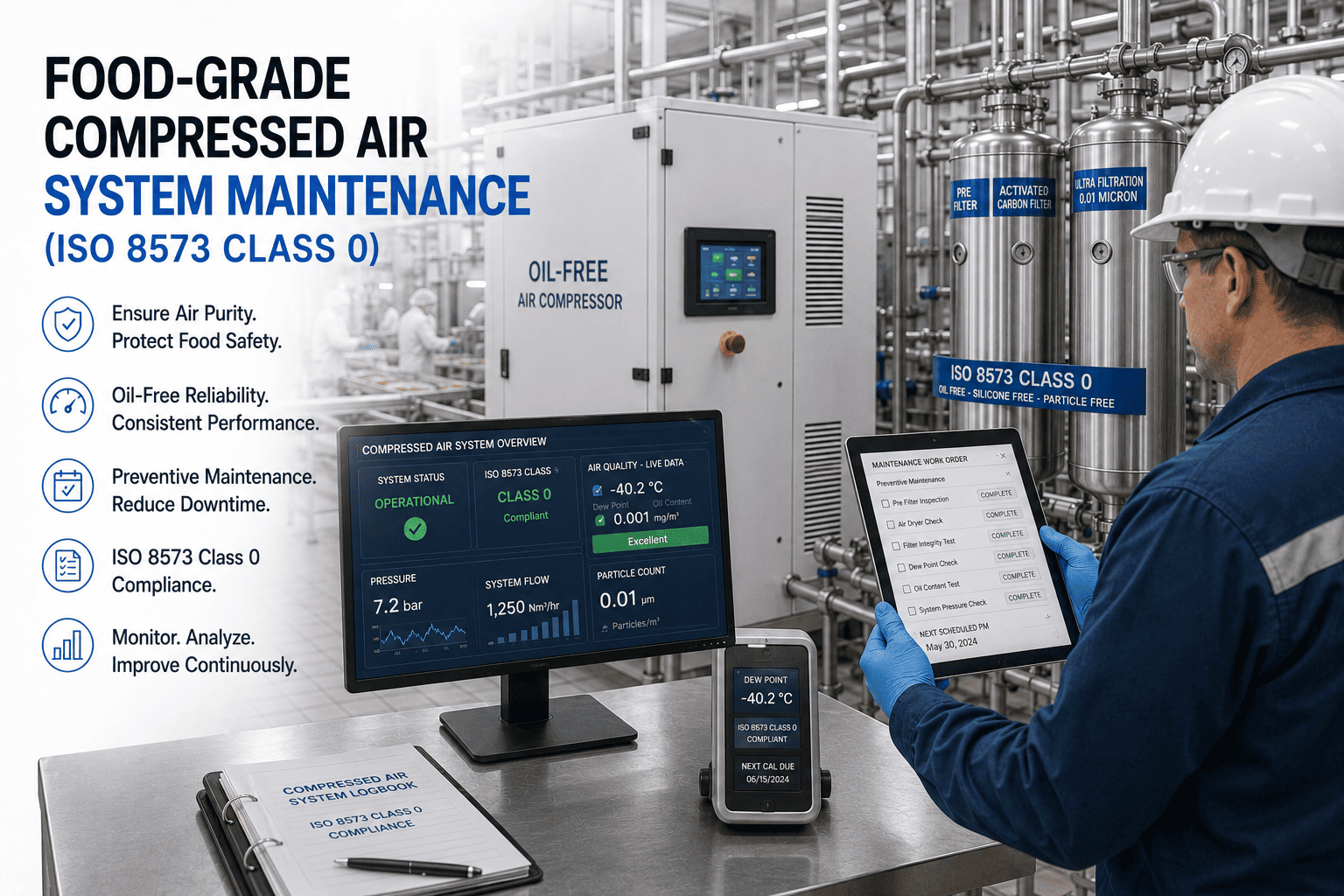
Food manufacturing facilities depend on compressed air as a critical utility — powering pneumatic conveyors, packaging lines, blow-off nozzles, and food-contact instrumentation. Yet compressed air is also one of the most overlooked contamination risks in food production. A rigorous food plant compressed air system inspection checklist gives facilities engineers a structured framework to verify compressor health, validate dryer and filter performance, confirm ISO 8573 purity compliance, and maintain the audit-ready records required by SQF, BRC, and FSSC 22000 certification bodies.
Automate your compressed air inspection program
Schedule PM tasks, track filter replacements, log air quality test results, and generate audit-ready compressed air records — all in one platform.
1. Compressor Unit Preventive Maintenance
Compressor condition directly affects downstream air quality. Verify all scheduled PM tasks are completed, documented, and within tolerance before conducting purity testing.
2. Air Dryer Inspection & Performance Verification
Dryer performance is the primary control for moisture contamination in compressed air. Desiccant and refrigeration dryers require separate inspection protocols to confirm effective moisture removal.
3. Filtration System Inspection & Replacement Schedule
Multi-stage filtration is the primary defense against oil aerosol, particulate, and microbial contamination in food-contact compressed air. Filter condition and replacement intervals must be rigorously maintained.
4. ISO 8573 Air Quality & Purity Testing
ISO 8573 compliance testing provides objective verification that compressed air used in food contact meets defined purity limits for oil, moisture, and particulate. Testing must be conducted at representative use points, not just at the compressor room outlet.
5. Distribution System, Piping & Point-of-Use Integrity
The distribution network is a frequent contamination source in compressed air systems. Leaks, dead legs, and corroded pipework can introduce contaminants even when the treatment train is fully functional.
6. CMMS Integration, Calibration Records & Audit Documentation
Complete, traceable maintenance and testing records are the evidence base for compressed air compliance during food safety audits. All inspection activities must be documented in a retrievable format tied to specific assets and personnel.
Ready to bring your compressed air program into full compliance?
OxMaint auto-schedules compressor PMs, filter replacements, and ISO 8573 air quality tests — and generates timestamped, audit-ready records for every inspection event across your food plant.
Frequently Asked Questions: Food Plant Compressed Air Inspection
1. What ISO 8573 purity class is required for food-contact compressed air?
For direct food-contact applications — including pneumatic conveying of food, packaging line air, and blow-off at open product — facilities typically must meet ISO 8573-1 Class 1 for oil content (≤0.01 mg/m³), Class 1 or 2 for particulate, and Class 2 for moisture (pressure dew point ≤–40°C). Non-contact utility air may be classified at a lower purity class, but this must be formally risk-assessed and documented in the compressed air prerequisite program.
2. How often should compressed air quality testing be performed in a food plant?
Industry guidance such as the BCAS/EIGA food-grade air best practice document recommends testing food-contact compressed air quality at minimum annually, with many food safety certification standards and customer requirements calling for semi-annual or quarterly testing at all critical use points. Testing frequency should also increase after system changes, major maintenance events, or out-of-specification results.
3. What are the most common compressed air contamination risks in food manufacturing?
The four primary contamination risks are: oil aerosol and vapor carry-over from oil-flooded compressors with degraded or bypassed filtration; excess moisture from failed dryers or auto-drain faults enabling microbial growth; particulate contamination from corroded or inappropriate pipework; and microbiological contamination from stagnant dead legs, dirty filter housing seals, or point-of-use hose contamination. A systematic inspection checklist targeting all four vectors is essential for maintaining ISO 8573 compliance.
4. Does activated carbon filter replacement need to follow a time-based schedule?
Yes — activated carbon filter elements must be replaced on a time-based schedule defined by the manufacturer (commonly every 3–6 months) regardless of differential pressure readings. Unlike coalescing filters, carbon elements reach adsorption capacity silently, without a measurable pressure drop increase. Relying on differential pressure alone for carbon filter change-out decisions is a recognized audit non-conformance in food safety certification audits.
5. How does a CMMS support compressed air compliance in food plants?
A CMMS strengthens compressed air compliance by automating PM work order generation for compressors and dryers at the correct intervals, tracking calibration due dates for all air quality measurement instruments, logging filter replacement history with technician ID and timestamps, and flagging overdue tasks before they create audit gaps. Facilities that manage compressed air maintenance through a CMMS can produce complete, searchable asset histories during food safety audits within minutes — which is a significant differentiator compared to paper-based systems.