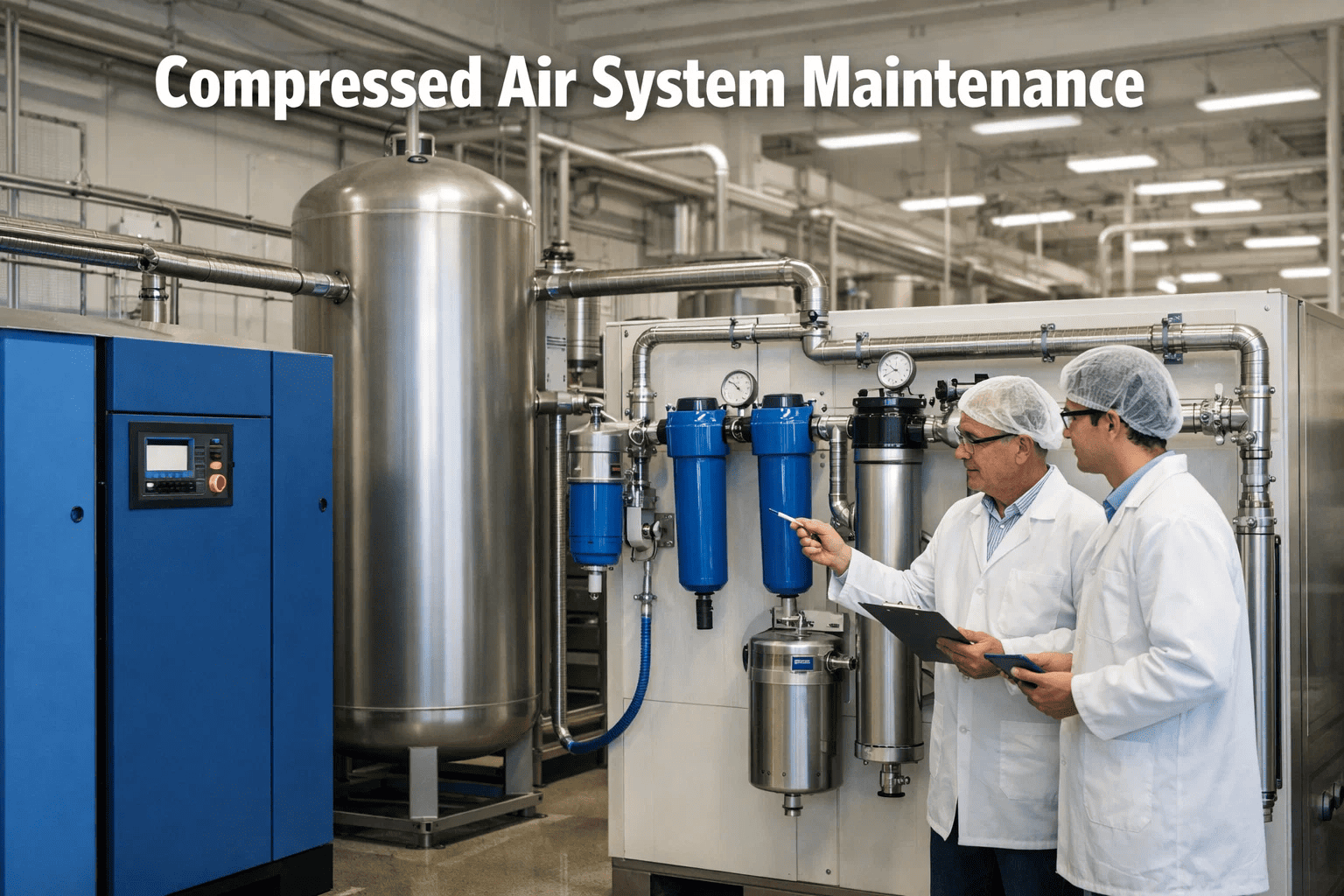
Compressed air is often called the "fourth utility" in food manufacturing — right alongside electricity, gas, and water. Yet unlike those utilities, compressed air quality in food plants receives far less structured maintenance attention until something goes wrong. A failed desiccant dryer, a saturated coil filter, or a lubricated compressor delivering oil-contaminated air into a food-contact zone can trigger product recalls, FDA observations, and customer contract suspensions. For facilities engineers responsible for food-grade compressed air system maintenance, a proactive, ISO 8573-aligned PM strategy is not optional — it is the foundation of safe, compliant production. Sign up for OxMaint to manage your compressed air PM schedules, inspection records, and compliance documentation in one audit-ready platform.
Keep Your Food-Grade Compressed Air System Audit-Ready Year-Round
OxMaint delivers automated PM scheduling, digital inspection logs, and real-time compliance dashboards built for food manufacturing environments.
Why Compressed Air Quality Is a Food Safety Critical Control Point
In food manufacturing, compressed air that contacts product, packaging, or food-contact surfaces is a direct food safety risk. Oil aerosols from lubricated compressors, microbial contamination from untreated moisture, and particulate carryover from degraded filtration can all compromise product integrity in ways that are invisible to production staff but detectable — and reportable — by regulators and quality auditors.
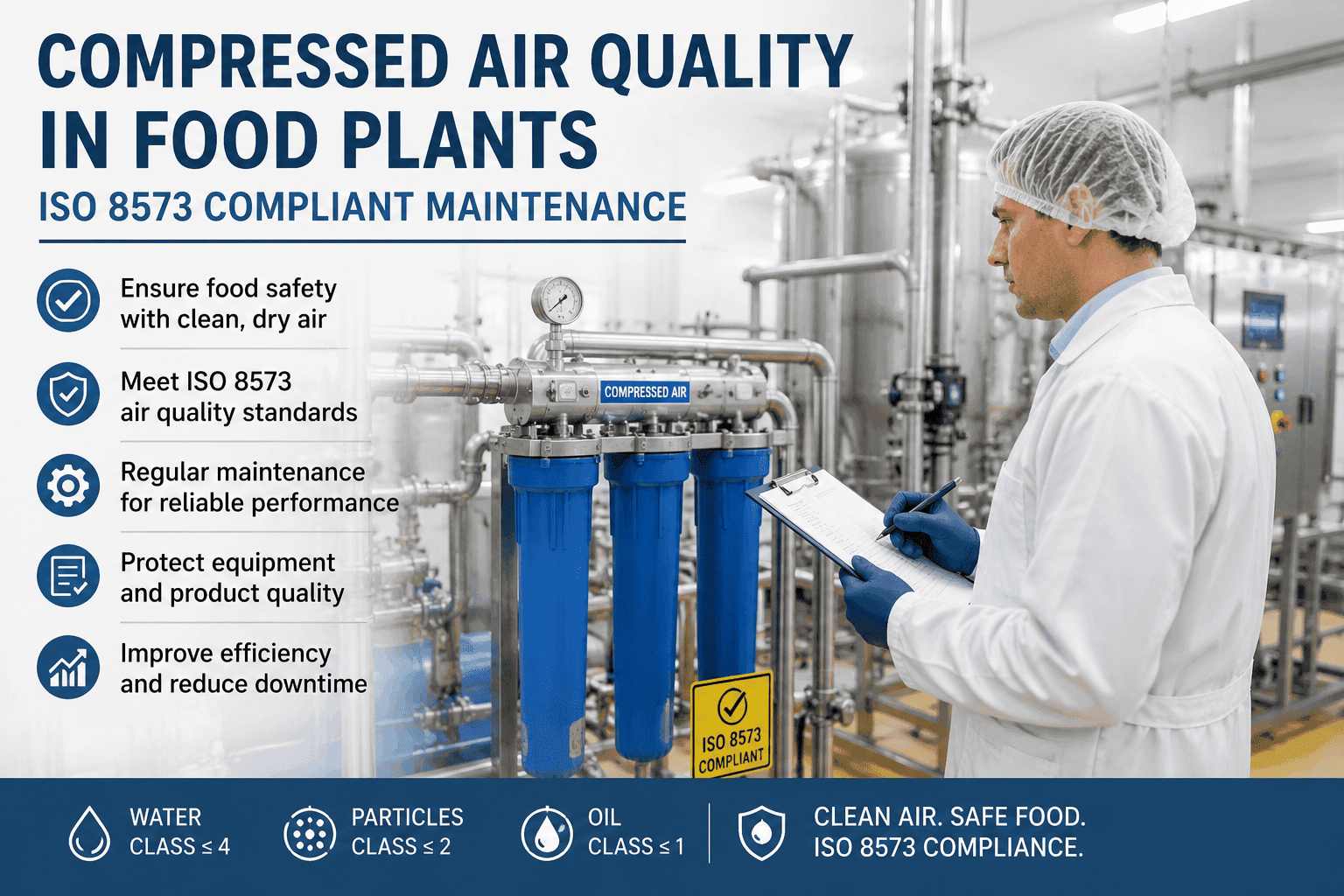
The international benchmark for food-grade compressed air quality is ISO 8573, which defines purity classes for particulate contamination, water content, and oil content. Compliance with ISO 8573-1 is increasingly required by food safety standards including SQF, BRC Global Standards, and FSSC 22000. Facilities engineers must understand which purity class applies to each compressed air use point in their plant — direct product contact, indirect contact, or non-contact — and maintain the filtration, drying, and compressor equipment necessary to consistently deliver that purity class. Sign up free to start managing your compressed air assets and purity class documentation in one place.
ISO 8573 purity class requirements must be matched to the end-use risk. Food-contact applications typically require Class 1 or Class 2 for oil content and moisture — standards that demand oil-free or oil-flooded compressors with multi-stage filtration, plus desiccant or refrigeration drying systems in good working order.
Core Components of a Food Plant Compressed Air PM Program
A structured air compressor preventive maintenance program for food manufacturing covers every element of the compressed air chain — from the compressor inlet to the point-of-use outlet. Each component has distinct maintenance intervals, failure modes, and compliance documentation requirements that facilities engineers must actively manage.
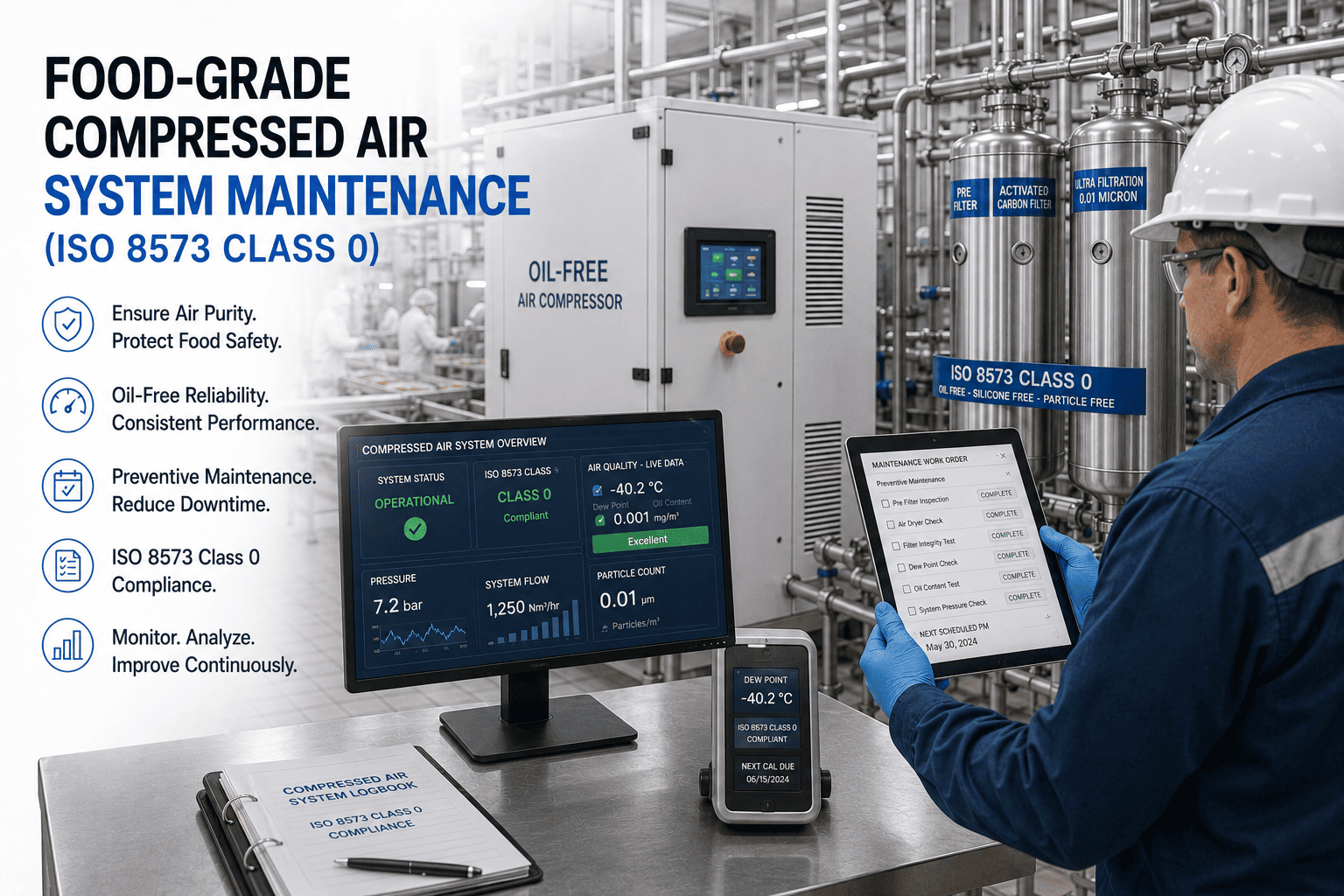
Service oil-free compressors every 4,000–8,000 hours — covering airend inspection, inlet filter replacement, cooling system service, and belt or coupling checks. For oil-flooded units in non-contact zones, add oil, oil separator, and filter replacement. All service events must be documented with date, technician, parts replaced, and operating parameters for GFSI audit compliance.
Refrigerated dryers need quarterly condenser cleaning, refrigerant checks, and drain valve testing — with pressure dewpoint logged against ISO 8573 moisture class. Desiccant dryers require desiccant replacement verification and purge valve inspection. A failed dryer introduces moisture into food-contact lines, creating microbial risk and audit non-conformances.
Replace filters based on differential pressure readings — not calendar time alone. Use a three-stage setup: pre-filter, coalescing filter, and sterile or activated carbon filter at food-contact outlets. Document each stage separately with element replacement records and downstream air quality results. Inspect housings for corrosion and O-ring integrity at every service.
Run ultrasonic leak detection surveys quarterly or semi-annually, tracking all findings through corrective action to verified repair. Inspect piping for corrosion and joint integrity. Test automatic drain valves on receivers, dryers, and filter housings regularly — a failed drain allows moisture accumulation that degrades air quality and damages downstream equipment.
Test at point-of-use locations at least annually — covering particulate (Class 1–5), moisture/dewpoint (Class 1–6), and total oil content (Class 1–4). Trigger additional testing after any compressor service, filter failure, or system change. Document results against the required purity class at each use point. Any non-conformance must halt line production until re-tested and verified.
ISO 8573 Purity Classes: What Facilities Engineers Need to Know
Understanding which ISO 8573 purity class applies to food manufacturing applications is the starting point for designing a compliant compressed air system and maintenance program. The table below summarizes typical class requirements by application type in food plants — facilities engineers should validate specific requirements against their GFSI certification body's technical interpretation and their own HACCP-based risk assessment.
| Application Type | Typical ISO 8573 Particulate Class | Typical Moisture Class | Typical Oil Class | Key PM Priority |
|---|---|---|---|---|
| Direct product contact | Class 1–2 | Class 1–2 | Class 1 | Sterile filtration, oil-free compressor, desiccant drying |
| Food-contact surface blowoff | Class 1–2 | Class 2–3 | Class 1 | Coalescing + sterile filter, dryer performance monitoring |
| Packaging contact | Class 2 | Class 2–4 | Class 1–2 | Multi-stage filtration, drain valve function testing |
| Pneumatic conveying (non-contact) | Class 2–3 | Class 3–4 | Class 2 | Pre-filter and coalescing filter PM, receiver drain maintenance |
| Instrument / control air | Class 2 | Class 2–3 | Class 2 | Refrigerated dryer service, filter differential pressure monitoring |
| General plant (non-food zones) | Class 3–4 | Class 4–6 | Class 2–3 | Compressor service intervals, leak detection surveys |
Compressed Air PM Frequency: Recommended Maintenance Intervals
Establishing the right compressed air maintenance intervals for food plants requires balancing manufacturer recommendations, operating conditions, and the food safety risk level of downstream applications. The following intervals represent industry best practice for food manufacturing environments — actual intervals should be adjusted based on compressor type, runtime hours, ambient conditions, and air quality test results. Book a demo to see how OxMaint automates interval scheduling and sends alerts before tasks go overdue.
- Manual drain valve operation check on receivers and filters
- Automatic drain valve function test
- Compressor operating parameter log (pressure, temperature, amperage)
- Visual inspection of refrigerated dryer discharge temperature
- Filter differential pressure reading and log
- Condensate drain line inspection and flush
- Safety valve function test (compressor and receiver)
- Belt tension and condition inspection (belt-driven compressors)
- Oil level and condition check (oil-flooded units)
- Refrigerated dryer condenser inspection and cleaning if needed
- Coalescing filter element condition assessment
- Ultrasonic leak detection survey and repair tracking
- Desiccant dryer purge cycle timing verification
- Air receiver internal inspection (visual, where accessible)
- Refrigerant system pressure and dewpoint performance log
- Full ISO 8573 air quality test at all critical use points
- Compressor airend service per manufacturer hour interval
- Oil separator element replacement (oil-flooded units)
- Desiccant bed replacement or regeneration evaluation
- Pressure vessel statutory inspection per local regulation
How CMMS Software Strengthens Compressed Air Compliance in Food Plants
Managing a multi-component compressed air system maintenance program across a food manufacturing facility is precisely the type of complex, documentation-intensive operational challenge that a purpose-built CMMS is designed to solve. When compressed air PM is managed through paper logs or spreadsheets, interval gaps accumulate invisibly, filter differential pressure readings go unlogged, and air quality test results live in email attachments disconnected from the equipment records they document. Try OxMaint free and connect your entire compressed air asset chain in a single audit-ready system.
A CMMS connects every compressed air asset — compressors, dryers, filters, receivers, distribution headers — to an automated work order system that generates PM tasks at the correct interval, routes them to the assigned technician, and captures completion evidence including readings, observations, and photographic documentation. When an SQF or BRC auditor asks for the preventive maintenance history of the desiccant dryer serving your primary production line, the complete record trail is retrievable in seconds — not assembled from binders over two days. Explore OxMaint's CMMS for food plants and see how automated compressed air PM management works in practice.
Generate work orders by calendar interval or runtime hours — so compressor airend service at 6,000 hours fires automatically, not when a technician remembers to check the log.
Capture filter differential pressure readings, dewpoint logs, drain valve test results, and compressor parameters in structured digital forms — timestamped, attributed, and stored against the asset record.
Attach ISO 8573 test certificates directly to the relevant equipment and use-point records — creating a traceable link between purity class requirements and the verification evidence that satisfies them.
When a leak survey, dryer performance deviation, or air quality test failure generates a finding, structured CAPA workflows assign ownership, set deadlines, and document root cause through to verified closure.
Real-time visibility into PM completion rates, overdue compressed air inspections, expiring calibration certificates, and open corrective actions — replacing reactive audit scrambles with continuous compliance awareness.
Generate complete maintenance history reports for any compressor, dryer, or filter in minutes — exactly the evidence package SQF, BRC, and FSSC auditors request when evaluating compressed air program compliance.
Manage Your Compressed Air PM Program with Confidence
OxMaint's CMMS gives facilities engineers automated scheduling, digital inspection logs, ISO 8573 documentation, and corrective action tracking — purpose-built for food manufacturing.
Common Compressed Air System Failures in Food Plants — and How to Prevent Them
Understanding the failure modes most likely to compromise food-grade compressed air quality allows facilities engineers to prioritize PM activities and inspection focus areas by risk. The following failure patterns are the most frequently identified in food plant compressed air audits. Book a demo to see how OxMaint tracks these failure patterns through CAPA workflows and prevents repeat non-conformances.
Refrigerated dryer failure or bypass during maintenance allows moisture-laden air into the distribution system. Prevention: dewpoint monitoring at dryer outlet with automated alert on deviation; never bypass dryer without isolating downstream food-contact use points.
Filters operating past service life or at elevated differential pressure allow oil aerosol and particulate carryover. Prevention: differential pressure gauges on all filter housings, with element replacement triggered by pressure drop — not calendar date alone.
A failed-closed automatic drain traps condensate in receivers and filter bowls, eventually discharging moisture pulses downstream. Prevention: weekly function testing of all automatic drains as a formal PM task with documented pass/fail record.
Using oil-flooded rotary screw compressors for food-contact applications, even with downstream filtration, introduces oil carryover risk if filters fail. Prevention: dedicated oil-free compressor for food-contact zones, or documented risk assessment with validated multi-stage filtration and regular oil content testing.
Compressed air leaks at fittings, hose connections, and equipment interfaces can represent 20–30% of compressed air loss in neglected systems — and create pressure fluctuations that affect process equipment performance. Prevention: documented ultrasonic leak detection surveys on a scheduled frequency with tracked corrective action to repair.
Frequently Asked Questions
What ISO 8573 class is required for food-grade compressed air?
ISO 8573 purity class requirements for food manufacturing depend on the application risk level. Direct food contact typically requires Class 1 for oil content (total oil ≤0.01 mg/m³) and Class 1–2 for particulate and moisture. Indirect contact applications may permit Class 2 for oil content. Facilities engineers should conduct a use-point risk assessment aligned to their HACCP plan and GFSI certification requirements to determine the specific purity class needed at each outlet in the plant.
How often should compressed air quality be tested in a food plant?
Best practice for food manufacturing is ISO 8573-compliant air quality testing at all critical use points at least annually. Additional testing is warranted following any compressor maintenance event, filter failure, dryer servicing, system modification, or any indication of air quality deviation (unusual odor, visible moisture at use points, process equipment anomalies). Test results must be documented against the purity class required at each use point and retained as part of the food safety management system records.
Should food plants use oil-free compressors for all applications?
Oil-free compressors are the recommended choice for any compressed air use point that contacts food, food-contact surfaces, or packaging. For non-contact applications such as general plant utilities, pneumatics in non-food areas, or instrument air in utility zones, oil-lubricated rotary screw compressors with appropriate multi-stage filtration are acceptable. A documented risk-based assessment linking compressor type to use-point classification — reviewed as part of the food safety management system — provides the compliance framework needed to justify the equipment configuration chosen.
What documentation do SQF auditors require for compressed air maintenance?
SQF auditors evaluating compressed air programs typically request preventive maintenance records for all compressors, dryers, and filters (including service dates, parts replaced, and technician sign-off), air quality test results with ISO 8573 purity class verification, corrective actions raised following any air quality non-conformance, calibration records for monitoring instrumentation (dewpoint meters, differential pressure gauges), and evidence that the compressed air quality program is defined in the food safety management system with assigned ownership and review frequency.
How can a CMMS help manage compressed air PM compliance in food plants?
A CMMS automates the scheduling, assignment, and documentation of all compressed air PM activities — eliminating the interval gaps that develop in spreadsheet or paper-based systems. Compressed air assets are individually managed in the system with their own PM schedules, inspection forms, and maintenance histories. Air quality test certificates attach directly to use-point records. Corrective actions from dryer failures, filter overloads, or leak survey findings are tracked through structured CAPA workflows to verified closure. The result is a continuously maintained, audit-ready compliance record for the entire compressed air system.