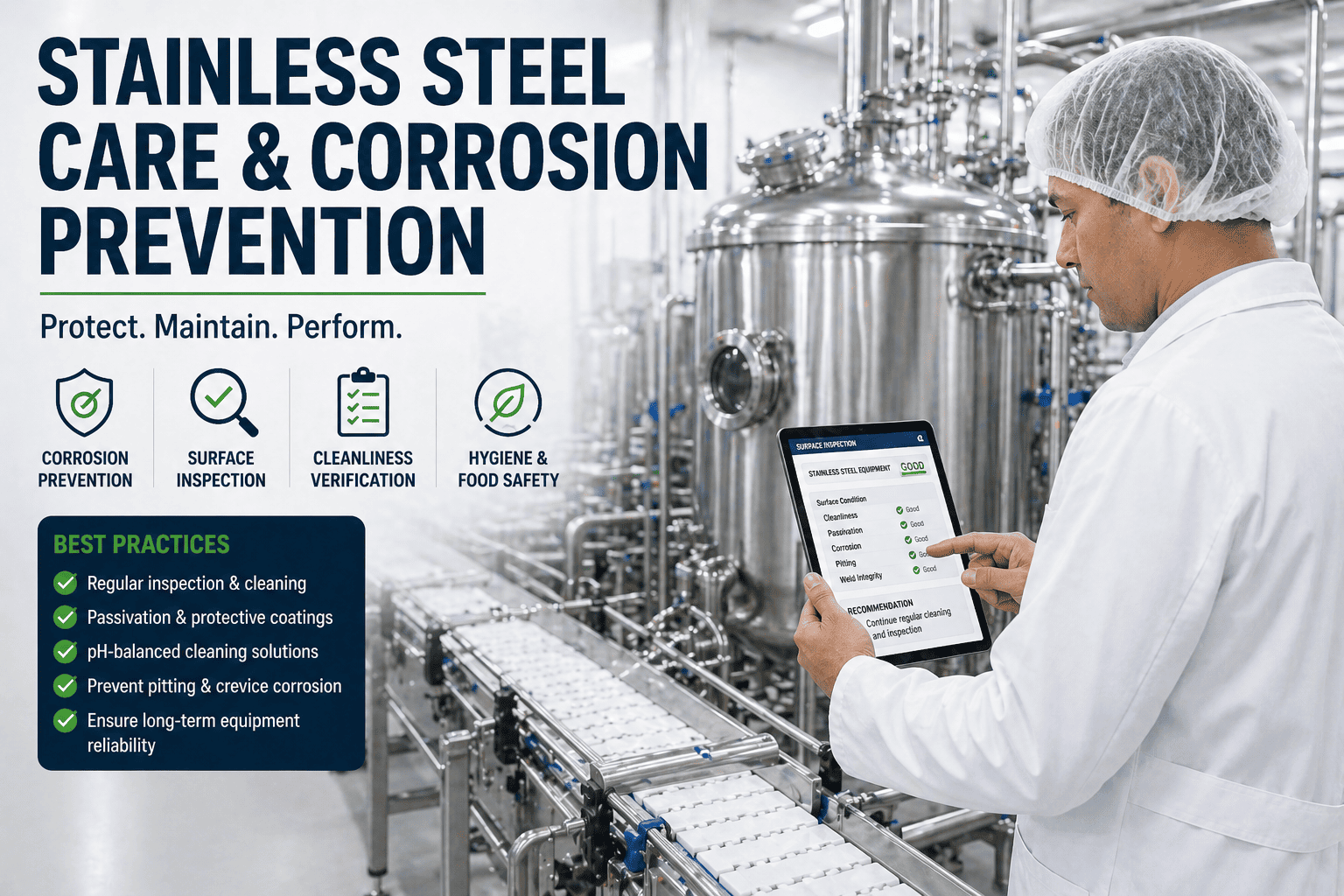
A 220,000 square foot meat processing line in Iowa pulled apart a CIP supply manifold during a Tuesday inspection and found a faint orange film coating the inside of three 316L tees. Class I rouging — the wipeable kind — but the operator had passed visual checks for sixteen consecutive weeks because nothing on the outside changed. The chromium oxide layer had been chemically stripped by a cleaner formulation switched in by procurement seven months earlier. By the time the film became visible, two batches had already been held pending micro re-test, and a third had to be re-cleaned at the cost of an entire production shift. Stainless steel is named for what it resists, not what it cannot fail at — and food-grade equipment fails far more often through the slow corrosion nobody schedules around than through the catastrophic failure that makes the maintenance log. A facility running structured passivation on a 90-day cycle inside its CMMS catches the chemistry shift in week eight, not month seven. Want to see how OxMaint registers every wetted surface as a maintainable asset and triggers passivation work orders before rouge sets in — start a free trial and explore the platform, or book a demo to see it walked through with one of our engineers.
Food-Grade Stainless Steel Equipment Care & Corrosion Prevention
Passivation schedules, surface finish tracking, and structured care for 304L and 316L food-contact surfaces — turn corrosion from a discovery event into a managed maintenance line item before rouge ever reaches your product stream.
Why Food-Grade Stainless Steel Actually Corrodes
"Stainless" is shorthand for stain-resistant, not stain-proof. Every austenitic grade used in food processing — 304, 304L, 316, 316L — relies on a microscopic chromium oxide layer roughly 15 to 25 angstroms thick to keep the iron beneath unreactive. When that layer is depleted faster than it can self-heal, free iron migrates outward, oxidises, and the surface begins to rouge. The depletion rate is a function of cleaning chemistry, temperature, chloride load, and surface finish. Once you understand which one is moving against you, the maintenance schedule writes itself.
The Three Classes of Rouge — and What Each Tells You
Not all rouge is created equal. The visible film tells your maintenance team how far the passive layer has degraded — and dictates whether you can wipe, derouge, or replace. A facility that misclassifies Class II as Class I can spread iron oxide through CIP and contaminate downstream tanks within a single shift.
Loose iron particles that have migrated from gaskets, filters, or upstream carbon-steel components. Removable by mechanical wipe with deionised water and a clean lint-free cloth. Indicates the passive layer is intact but contamination is being introduced from outside.
Chromium oxide has been partially replaced by iron oxide (Fe2O3). No longer wipeable — requires chemical derouging using nitric or citric acid systems. Common in unpassivated or improperly passivated tanks exposed to repeated CIP cycles.
Magnetite (Fe3O4) formed under prolonged high-temperature exposure — typical of steam systems, autoclaves, and CIP supply lines that run above 100°C without adequate maintenance. Often requires mechanical removal followed by aggressive passivation cycle.
Surface gloss reduction visible under inspection light before any colour change. Detected by copper sulphate test or surface Cr/Fe ratio measurement. The window where preventive passivation costs an order of magnitude less than corrective derouging.
304L vs 316L — Which Grade Belongs Where
Specifying the wrong grade for a wetted application is one of the most common — and most expensive — mistakes in food plant capital projects. The 2-3% molybdenum in 316L isn't a luxury; it's the alloy chemistry that resists chloride attack in brine, dairy CIP, and any acidic process. A facility moving from 304L to 316L on the right assets recovers the upgrade cost in 18 to 30 months through reduced derouging cycles alone.
| Property | 304L Stainless | 316L Stainless | Recommended Use |
|---|---|---|---|
| Chromium content | 18-20% | 16-18% | Both meet food contact |
| Molybdenum | None | 2.0-3.0% | 316L for chloride zones |
| Pitting resistance (PREN) | ~19 | ~25 | 316L for brine, dairy CIP |
| Carbon (max) | 0.030% | 0.030% | L grades resist sensitisation |
| Material cost premium | Baseline | +22-30% | Pay back via reduced rework |
| Best application | Dry storage, light service | Wetted surfaces, CIP loops | Match grade to risk zone |
| Rouge incidence (relative) | Higher in chloride loads | Materially lower | Document grade by asset |
If Your Stainless Equipment Isn't in Your CMMS, You're Inspecting Reactively
OxMaint registers every tank, vessel, valve, and pipe segment with grade, finish, and installation date — and triggers passivation work orders by calendar interval, CIP cycle count, or chemistry change event. Engineers see the corrosion timeline before the auditor does.
Surface Finish — The Spec That Predicts Cleanability
Surface roughness, measured as Ra in microinches or micrometres, determines how easily a wetted surface releases soil during CIP and how readily it harbours microbes. The food industry standard for product-contact surfaces is Ra ≤ 32 μin (0.8 μm), but smarter operators are targeting Ra ≤ 20 μin on critical assets through electropolishing — gaining up to 30x the corrosion resistance of standard 2B mill finish.
The Passivation Schedule Most Plants Get Wrong
Passivation is not a one-time event at fabrication. The chromium oxide layer needs renewal whenever cleaning chemistry shifts, after major mechanical work, and on a predictable interval that depends on duty cycle. Plants treating it as ad-hoc maintenance discover rouge late; plants treating it as scheduled work catch the precursor signs and intervene before product is at risk.
| Equipment Type | Recommended Interval | Trigger Type | Method |
|---|---|---|---|
| HTST pasteuriser hold tubes | Every 90 days | Calendar + CIP cycle count | Citric acid, 60-80°C, 30-60 min |
| Buffer / bulk storage tanks | Every 180 days | Calendar + chemistry change | Phosphoric/citric blend, 70°C |
| CIP supply manifolds | Every 120 days | CIP volume threshold | Nitric acid, room temp option |
| Filling and packaging contact | Every 60 days | Production hours | Citric acid, low-temp circulation |
| Brine and curing systems | Every 45 days | Chloride exposure events | Nitric blend, full passivation |
| Welds and HAZ zones | Post-fabrication + annual | Repair work order trigger | Pickle paste + nitric rinse |
How OxMaint Manages Stainless Steel Care End-to-End
A wetted surface registry, automated passivation scheduling, and inspection records tied to the asset itself — so every tee, valve, and tank carries its own corrosion history alongside its PM record.
Reactive Care vs. Programmed Care — The Cost Gap
The arithmetic of stainless steel care is brutal once you compare a programmed approach to the typical reactive baseline. The same plant, the same equipment, the same chemistry — but very different annual outcomes. Want to model your own gap, start a free trial and load your asset list to see the projection.
- $48kAvg. annual derouging cost per major vessel
- 14 daysAvg. unplanned downtime per rouge event
- 3 yrsService life lost vs. design specification
- 2-3Audit observations per facility per year on corrosion
- SurpriseDiscovery cadence — found, not predicted
- ManualDocumentation reconstructed before each audit
- $14kAvg. annual passivation cost per major vessel
- ZeroUnplanned rouge-driven downtime in target year
- FullDesign service life maintained through structured care
- ZeroCorrosion-related audit observations on target plants
- ScheduledPM trigger before passive layer is compromised
- LiveDocumentation built during work, not after
What Plants on a Programmed Care Schedule Report
Frequently Asked Questions
Stop Discovering Rouge. Start Scheduling Around It.
OxMaint registers every wetted asset with grade, finish, and history; automates passivation work orders by interval, cycle count, or chemistry change; and tracks corrosion findings against the asset itself — so your stainless equipment is one less surprise on your reliability report.