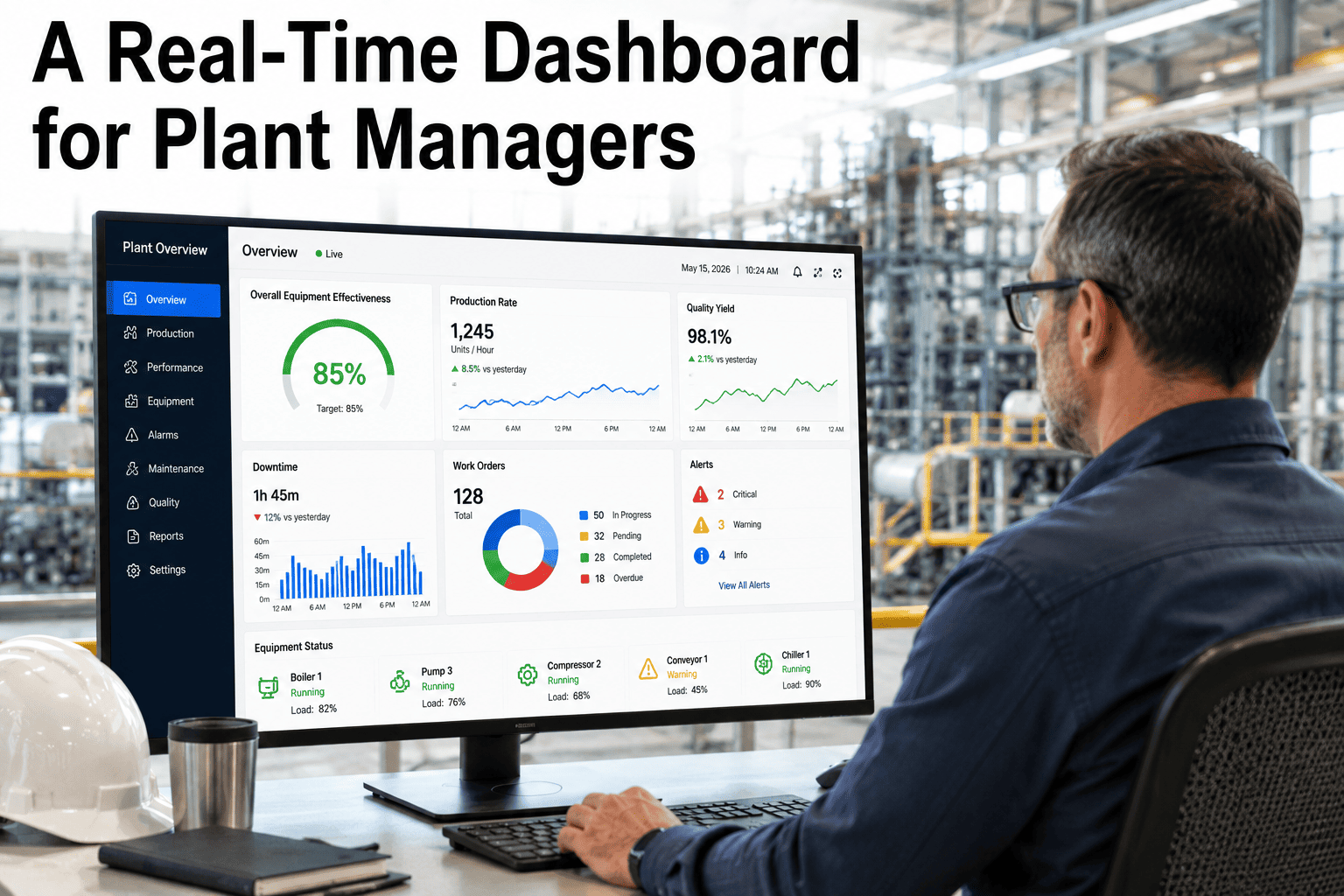
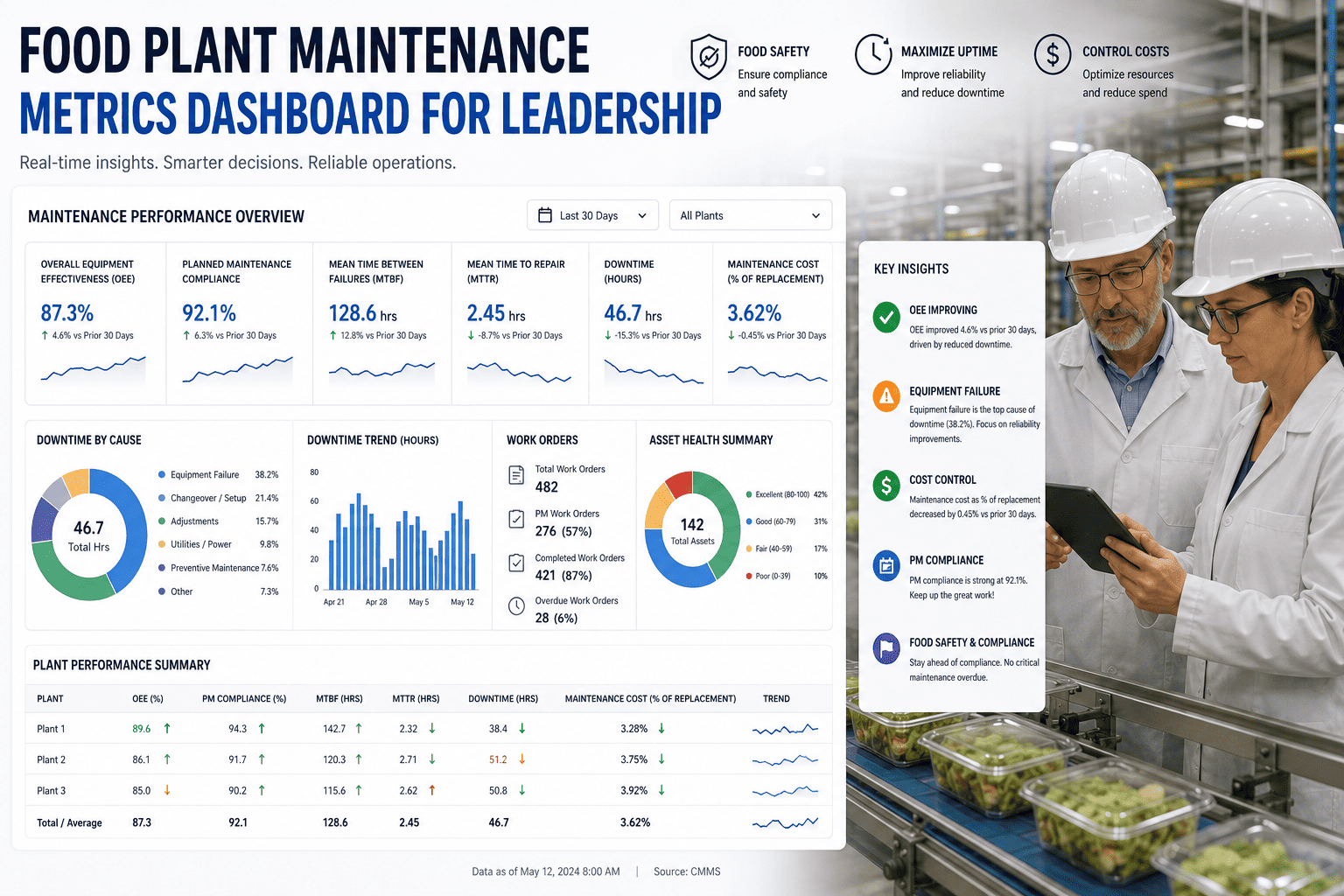
A snack food plant in Georgia was running what they thought was a 74% OEE — good enough, their operations manager said. Their competitor down the road was running 81%. When they finally installed a real-time KPI dashboard and looked at actual line data, they discovered their OEE was 58%. The gap between what felt true and what was true was costing them approximately $1.1 million per year in lost production capacity — on a single line. They had been measuring the wrong things, measuring them manually, and measuring them too late. Sign up for Oxmaint and see what your actual numbers look like — you might be surprised.
The OEE Reality Gap in Food Manufacturing
Based on data from 3,500+ machines across 50+ countries (Evocon, 2024)
Food & Beverage Industry Average
Below Target
Average OEE across food & beverage plants — 32 percentage points below world-class
GAP
+32 pts
≈ $1M+ lost/year per line
World-Class OEE Benchmark
World Class
Target for leading food manufacturers — only ~3% of plants achieve this without dedicated KPI tracking
The 6 KPIs Every Food Plant Dashboard Must Show
Most food facilities track 15–20 metrics but act on none of them. The highest-performing plants focus on a core set of 6–10 KPIs — updated in real time — that every role on the floor can read and respond to. Here is what a well-configured KPI dashboard looks like in practice, and what each metric is telling you. Book a demo to see Oxmaint's live dashboard in a food manufacturing context.
74.1%
Composite of availability, performance, and quality — the single number that tells the full story of your line efficiency.
42min
0 minTarget: <30 min90 min
Time from equipment failure to full return to production. Tracking MTTR by fault type reveals where your maintenance team needs training or spare parts pre-staging.
96.4%
Products manufactured to spec on the first attempt — no rework, no rejects. Each 1% drop in FPY translates directly to wasted ingredients, labor, and energy.
88%
Scheduled PMs completed on time vs. total scheduled. Low PMC scores are the leading indicator of future unplanned downtime — often 6–8 weeks before the failure.
186hrs
0 hrsTarget: 300 hrs500 hrs
Average hours of operation between unplanned failures. Tracking MTBF by asset reveals which machines are draining maintenance resources and which are ready for predictive intervention.
6.8%
Unplanned downtime costs food processors an average of $260,000 per hour. Plants reporting 20%+ lost capacity almost universally lack real-time downtime KPI visibility.
The Real Cost of Not Having a Dashboard
Every Untracked Hour
Is a Measured Loss
The cost of unplanned downtime in food processing sits at $260,000 per hour (Aberdeen Research). With some facilities reporting 800+ hours of downtime per year, the arithmetic is devastating — and most of it is preventable with the right KPI visibility in place.
Start Tracking Free
Annual Downtime Cost Exposure
Low downtime facility
200 hrs/yr
$52M
Typical food plant
400 hrs/yr
$104M
Plants without KPI dashboards
800 hrs/yr
$208M
At $260K/hr (Aberdeen Research). These are potential losses — not guaranteed. But without measurement, you cannot know where you stand.
?
A 15% OEE improvement on one line saved €370,000 in a single year (Mapex case study)
One Platform, Three Perspectives — Role-Based Dashboards
A KPI dashboard only drives performance if the right person sees the right metric at the right time. Oxmaint's Performance Analytics Dashboard surfaces different views for different roles — so production managers, maintenance engineers, and quality leads each get the signal they need without information overload. Book a demo to explore the role-based dashboard experience.
Dashboard shows:
Production vs. schedule (units/hr)
Current shift throughput vs. target
Batch status by production order
→
Can call a line rebalance or expedite maintenance during the shift instead of discovering losses at end-of-day.
Dashboard shows:
PM compliance rate — this week
Open work orders by priority
Failure frequency by fault code
→
Can prioritize the highest-MTTR assets for next PM cycle and justify additional resources with actual failure data.
Dashboard shows:
First Pass Yield — per batch
Defect rate by production line
Open CCP deviations & CAPAs
Compliance task completion rate
→
Can identify which line is generating the most non-conformances and link them to a specific maintenance or process event — not guess.
3×
better KPI improvement in organizations with performance dashboards vs. those without
15%
average OEE improvement in first year of KPI tracking with real-time data
30–60
days in advance that predictive KPI analytics can forecast equipment failure
Your KPI data is being generated right now — on every line, every shift. The question is whether anyone can see it.
Oxmaint Performance Analytics Dashboard: What It Tracks, What It Tells You
Oxmaint's Performance Analytics Dashboard is built specifically for food manufacturing operations — not adapted from a generic manufacturing template. It connects maintenance, production, and quality data into a single live view that grows more predictive as your operation generates more history.
Live OEE Dashboard by Line, Shift, and Asset
Real-time OEE calculated continuously — not reported after the shift ends. See availability, performance, and quality components separately so your team can respond to the specific loss type, not just the combined score.
OEE per line
Shift comparison
Asset-level drill down
Maintenance KPI Tracking — MTTR, MTBF, PM Compliance
Automatically calculates MTTR and MTBF from work order close-out timestamps — no manual entry. PM compliance rates update as scheduled tasks are completed, missed, or rescheduled. Correlate maintenance patterns with downtime events.
MTTR by fault type
MTBF trending
PM schedule adherence
Downtime Pareto — Find Your Biggest Loss in One Click
Every downtime event is categorized by fault type, asset, and duration. The dashboard automatically ranks your top 5 loss causes by total time impact — so maintenance prioritization is data-driven, not based on who complained loudest last week.
Ranked by total hrs lost
Root cause tagging
Week-over-week trend
Quality & Compliance KPI Layer
First Pass Yield, defect rate by line and shift, CCP deviation count, and compliance task completion rate — all tracked on the same dashboard as production and maintenance KPIs. One view for cross-functional performance conversations.
FPY per batch
CCP deviation alerts
Compliance task rate
Shift & Period Comparisons — See the Trend, Not Just the Number
Compare KPI performance across shifts, days, weeks, and months. Identify if Night Shift consistently underperforms Day Shift on a specific line — and drill into the work orders, staffing records, and downtime events from that period to find the reason.
Shift vs. shift
Week-over-week delta
Monthly trend lines
Threshold Alerts — Get Notified Before KPIs Hit Crisis Level
Set warning thresholds for any KPI — OEE dropping below 65%, MTTR exceeding 60 minutes, PM compliance falling below 80%. Alerts go to the right person via mobile push notification before the KPI becomes a production incident.
Custom thresholds
Mobile alerts
Escalation rules
Frequently Asked Questions
Common questions from food manufacturers before implementing a KPI analytics dashboard — answered plainly.
We already track OEE on a spreadsheet. Why do we need a dashboard?
A spreadsheet OEE is a lagging indicator — it tells you what happened after the shift, the day, or the week is over. A live dashboard tells you what is happening right now, which is the only point in time where you can actually intervene. If your OEE drops at 10:15 AM on a Tuesday, a dashboard tells you at 10:15 AM. A spreadsheet tells you on Friday when the weekly report is compiled. The difference is whether your team can respond during the loss or only after it has fully occurred. Additionally, spreadsheet calculations introduce systematic errors through manual data entry — which is why many facilities believe their OEE is higher than it actually is, as in the hook scenario above.
What is a realistic OEE improvement target for a food manufacturer in the first year of KPI tracking?
The industry average for food and beverage OEE is 53%. A realistic first-year target for a facility implementing real-time KPI tracking is reaching 60–65% — a 7 to 12 percentage point improvement. Case study data from Mapex shows a meat industry manufacturer achieved a 15% OEE increase on a single line in 12 months, saving €370,000 in production value. The improvement is not from the dashboard itself — it is from the maintenance and process decisions the dashboard makes possible. Facilities that implement KPI dashboards but don't create accountability structures around them see smaller gains. The combination of real-time visibility and structured team review cycles (daily shift boards, weekly KPI reviews) drives the improvement.
How many KPIs should we actually track on our dashboard?
Research consistently points to 6–10 core KPIs as the optimal range for operational dashboards. Fewer than 6 and you lose visibility into the interlocking factors that drive performance (OEE alone without MTTR and FPY is incomplete). More than 10 and you create information overload where critical signals get lost in noise. The most effective manufacturing dashboards focus on a core set that every role can understand — with deeper drill-down layers available to engineers and managers for root cause analysis. Oxmaint allows you to configure your primary dashboard view with your critical 6–8 KPIs while keeping full analytics accessible one level deeper.
Sign up free to configure your dashboard from day one.
How does a KPI dashboard help with food safety compliance (SQF, BRC, FSMA)?
Food safety standards like SQF Edition 9 and BRC Global Standard require documented evidence that your production and maintenance processes are controlled and monitored over time. A KPI dashboard generates this evidence automatically — maintenance compliance rates, CCP deviation frequencies, corrective action closure times, and production quality trends are all captured and timestamped in real time. During an audit, Oxmaint can export a date-filtered performance history that shows auditors exactly what was happening on the floor over any period. This is significantly more credible than manually assembled spreadsheet reports and eliminates the risk of documentation gaps that cause clause failures.
Do operators on the floor actually engage with KPI dashboards, or do they ignore them?
Engagement depends entirely on what operators see on the dashboard and whether the numbers connect to actions they can take. Abstract OEE percentages on a screen they walk past have low engagement. Real-time production pace vs. target displayed on a digital andon board at the line — with a simple red/green status — drives immediate engagement because the information is about their work right now. Oxmaint's dashboard is configured to show line-level operators their shift progress against target, their pending tasks, and any open quality holds that require their input. This is information that directly affects what they do next — and engagement follows naturally when the data is actionable and relevant.
Performance Analytics Dashboard
Your Line Is Generating KPI Data Right Now.
The only question is whether you can see it — or whether you find out what happened when it's too late to change it. Oxmaint connects maintenance, production, and quality data into one live dashboard built for food manufacturing operations.
⚡ Live dashboard from day 1
✅ No credit card required
? OEE, MTTR, FPY, PM Compliance included
Live Dashboard Preview
3 lines live · Last updated 12 sec ago