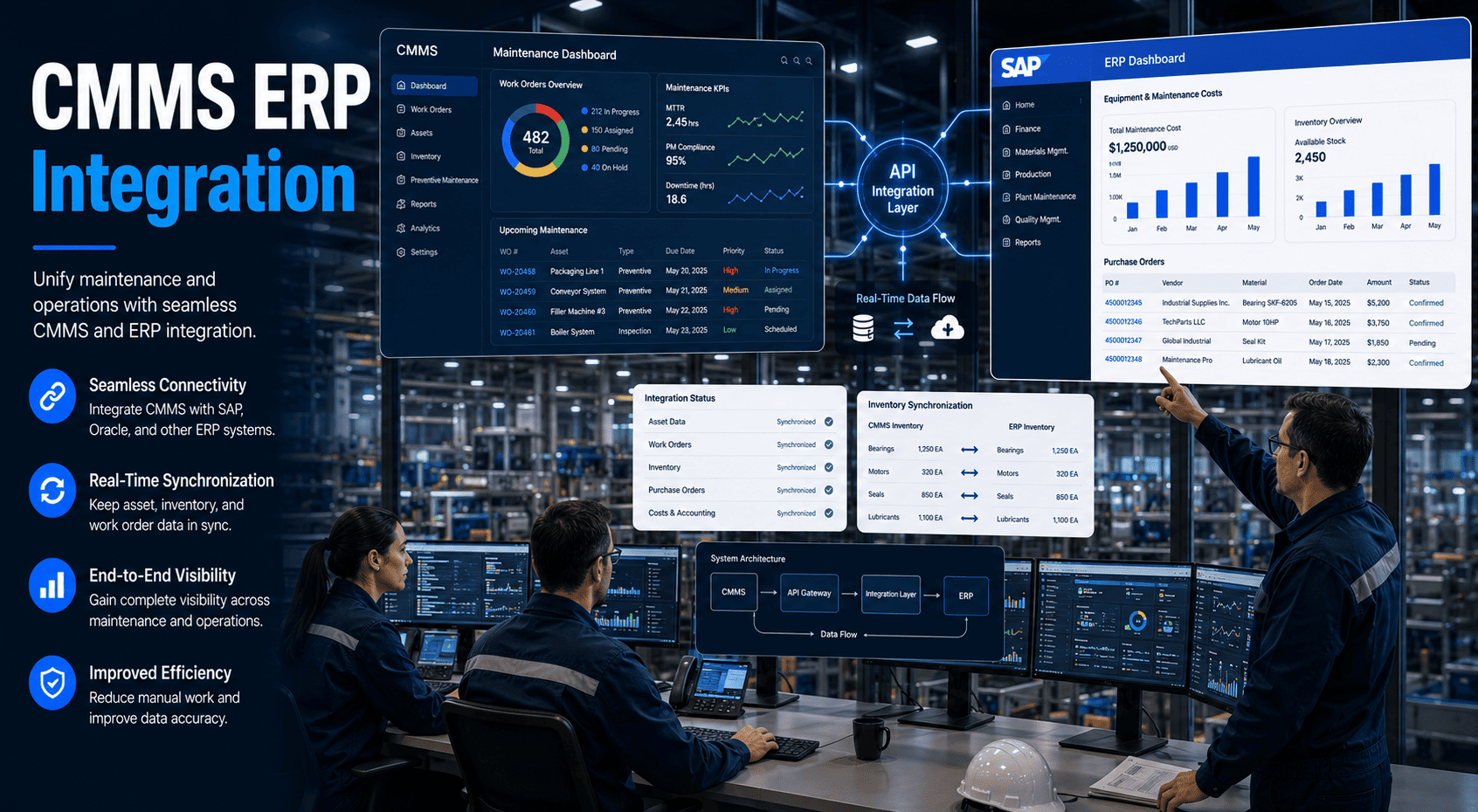
A food plant running SCADA, MES, ERP, and CMMS as four separate islands of data is a plant where a compressor vibration alert stays on a SCADA screen while the maintenance team checks a whiteboard, production planning adjusts schedules in a spreadsheet, and finance discovers the downtime cost three weeks later in a monthly report. Industry 4.0 in food manufacturing is not about buying more technology — it is about connecting the technology you already have so data flows automatically from sensor to work order to production schedule to financial report. Plants that achieve full CMMS-MES-ERP-SCADA integration report 23% less unplanned downtime, 18% higher OEE, and 31% faster root cause analysis. Book a demo to see how OxMaint integrates with your existing MES, ERP, and SCADA systems to close the loop between equipment alerts and maintenance action. Start a free trial and connect your first data source today.
Food Plant Automation and Industry 4.0: CMMS Integration Guide
Connect CMMS with MES, ERP, and SCADA for unified data flow — real-time equipment alerts triggering automated work orders, production-aligned maintenance, and enterprise-wide visibility.
What Is Industry 4.0 in Food Manufacturing?
Industry 4.0 in food manufacturing is the convergence of operational technology (SCADA, PLC, sensors) with information technology (MES, ERP, CMMS) into a unified digital ecosystem where data flows automatically between systems. The goal is not automation for its own sake — it is the elimination of manual data transfer, delayed decision-making, and information silos that cause food plants to operate at 15-25% below their actual capacity. When a SCADA system detects a motor running at elevated temperature and the CMMS automatically creates a work order, assigns a technician, and notifies the MES to adjust production scheduling — that is Industry 4.0 delivering measurable value. See this data flow working live — start a free trial and book a demo to walk through the integration architecture.
The Four Systems and How They Connect
Each system serves a distinct function, but their value multiplies exponentially when connected. The CMMS sits at the centre — receiving equipment data from SCADA, coordinating with MES on production windows for maintenance, and feeding cost data to ERP for financial reporting.
Connect Your Systems. Close the Loop Between Equipment Alert and Maintenance Action.
OxMaint integrates with your existing SCADA, MES, and ERP platforms via API — so sensor alerts become work orders, production schedules inform maintenance windows, and every cost flows to finance automatically.
Siloed vs. Integrated: The Operational Gap
The difference between operating with siloed systems and an integrated Industry 4.0 architecture is not theoretical — it shows up in every downtime event, every missed maintenance window, and every budget variance report.
Integration Benefits by Department
Industry 4.0 integration does not just help maintenance — it delivers measurable value to every department in the food plant. Each stakeholder sees the data they need, automatically, without manual compilation. Explore what this means for your team — start a free trial and book a demo to see role-specific dashboards.
How OxMaint Enables Industry 4.0 Integration
Frequently Asked Questions
Does OxMaint integrate with our existing SCADA system?
OxMaint integrates with SCADA systems via API and webhook connections. When SCADA detects a threshold breach — elevated temperature, abnormal vibration, pressure deviation — the event data is sent to OxMaint, which automatically creates a work order with equipment context, alert severity, sensor readings, and recommended maintenance action. The integration is platform-agnostic and works with major SCADA providers. Book a demo to discuss your specific SCADA integration.
How does production-based maintenance triggering work?
OxMaint supports maintenance triggers based on production volume (units produced), operating hours, cycle counts, and calendar time — whichever threshold is reached first. When integrated with MES, production counters update automatically, and maintenance work orders fire when the asset reaches its service interval based on actual usage rather than arbitrary time schedules. Start a free trial to configure production-based PM triggers.
What ERP systems does OxMaint connect with?
OxMaint provides API-based integration with major ERP platforms including SAP, Oracle, Microsoft Dynamics, and NetSuite. The integration enables automatic flow of maintenance costs, spare parts consumption, purchase requisitions, and asset financial data — eliminating double-entry and ensuring real-time budget visibility for finance teams. Book a demo to discuss your ERP integration requirements.
How long does Industry 4.0 integration typically take to implement?
OxMaint is designed for rapid deployment — basic CMMS functionality is live within days, and SCADA/MES/ERP integrations are typically configured within 2-4 weeks depending on the complexity of your existing technology stack. There are no heavy implementation fees or multi-month onboarding projects. The platform is designed to deliver value incrementally as each integration comes online. Start a free trial to begin your integration journey.
Your Systems Already Generate Data. OxMaint Makes It Work Together.
SCADA alerts become work orders. Production schedules inform maintenance windows. Costs flow to finance automatically. One integration platform connecting your entire food manufacturing operation.