
Food Safety Modernization Act compliance is no longer optional — it is the baseline standard every food manufacturer must meet to operate legally in the United States. As FDA enforcement intensifies in 2026 and the FSMA Section 204 traceability rule reaches full implementation, manufacturers who have not built a systematic compliance infrastructure face mounting risks: warning letters, import alerts, facility shutdowns, and irreparable brand damage. This guide breaks down exactly what food manufacturers need to know about FSMA compliance requirements in 2026 — and how to build audit-ready systems that protect your operation year-round.
Build Audit-Ready FSMA Compliance — Without the Guesswork
Oxmaint helps food manufacturers automate preventive controls, traceability records, and CGMP documentation in one platform.
What Is FSMA and Why It Matters More Than Ever in 2026
The Food Safety Modernization Act, signed into law in 2011, fundamentally shifted U.S. food safety regulation from reactive to preventive. Rather than responding to outbreaks after they occur, FSMA requires food manufacturers to identify hazards, implement preventive controls, and document everything in a way that FDA inspectors can verify. In 2026, the enforcement landscape has tightened significantly — particularly around the Food Traceability Rule under FSMA Section 204 and the updated Current Good Manufacturing Practice (CGMP) expectations for high-risk food categories.
For food manufacturers, this means that paper-based compliance systems and fragmented records are no longer sufficient. FDA investigators arrive with digital tools, cross-reference supply chain data in real time, and expect corrective action documentation that traces directly back to your Food Safety Plan. Manufacturers without a digital food safety management system are at a structural disadvantage before an inspection even begins. Schedule a demo to see how Oxmaint closes these gaps in your current setup.
The 7 Core FSMA Rules Every Food Manufacturer Must Comply With
FSMA is not a single rule — it is a framework of seven interlocking regulations that collectively govern how food is grown, processed, transported, and sold in the U.S. Understanding which rules apply to your facility is the first step toward building a defensible compliance program.
Preventive Controls for Human Food
Requires a written Food Safety Plan with hazard analysis, preventive controls, monitoring procedures, corrective actions, and a recall plan. This is the cornerstone of FSMA compliance for most manufacturers.
Preventive Controls for Animal Food
Mirrors the human food rule but applies to animal feed and pet food manufacturers. Includes CGMP requirements specific to animal food production environments.
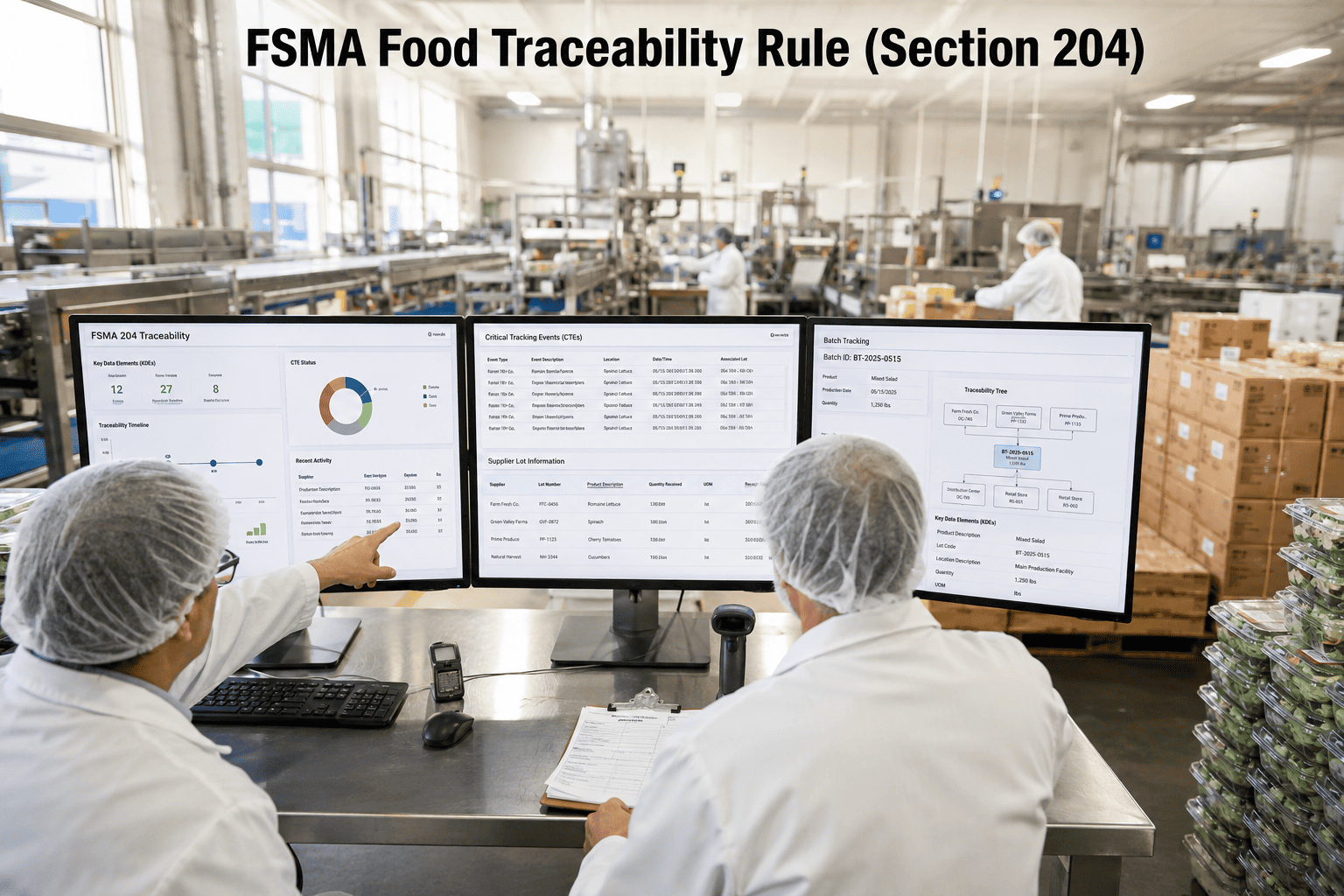
Food Traceability Rule (Section 204)
Mandates enhanced traceability records for high-risk foods on the FDA Food Traceability List. Manufacturers must capture Key Data Elements at Critical Tracking Events throughout the supply chain.
Foreign Supplier Verification Program
Importers must verify that foreign suppliers produce food under standards that provide the same level of public health protection as FSMA requires of domestic facilities.
Produce Safety Rule
Establishes science-based minimum standards for growing, harvesting, packing, and holding produce. Applies to farms above specified revenue thresholds.
Accredited Third-Party Certification
Establishes a voluntary program for FDA-accredited third parties to conduct food safety audits of foreign food facilities. Used to support FSVP programs and expedited import entry.
Sanitary Transportation Rule
Sets requirements for shippers, loaders, carriers, and receivers to ensure food is not contaminated during transportation operations across the supply chain.
Intentional Adulteration Rule
Requires vulnerability assessments and mitigation strategies at actionable process steps where intentional adulteration could cause wide-scale public health harm.
FSMA Preventive Controls Plan: Building a Compliant Food Safety Plan
For the majority of registered food facilities, the Preventive Controls for Human Food rule is the single most operationally demanding element of FSMA compliance. A fully compliant Food Safety Plan is not a static document — it is a living system that must be reviewed, updated, and validated regularly. Here is what every FSMA preventive controls plan must contain:
FSMA Section 204: Food Traceability Rule Requirements and Deadlines
FSMA Section 204 — the Food Traceability Rule — is the most significant new compliance burden for food manufacturers processing products on the FDA Food Traceability List (FTL). The rule requires firms to establish and maintain records containing Key Data Elements (KDEs) associated with Critical Tracking Events (CTEs) and to provide those records to FDA within 24 hours of a request.
| Critical Tracking Event (CTE) | Who It Applies To | Key Data Elements Required |
|---|---|---|
| Growing (for farms) | Farms harvesting FTL produce | Traceability lot code, commodity, location, harvest date |
| Receiving | All facilities receiving FTL foods | Traceability lot code, quantity, unit, location, date received |
| Transformation | Manufacturers processing FTL ingredients | New lot code, input lot codes, location, date of transformation |
| Creating (packing/labeling) | Packers and labelers of FTL foods | Lot code, commodity, location identifier, date of activity |
| Shipping | All entities shipping FTL foods | Lot code, quantity, unit, recipient location, departure date |
The 24-hour records submission requirement is the single most operationally challenging element of Section 204. Facilities that manage traceability in spreadsheets or paper logs routinely fail mock recall exercises under this timeline. Implementing FSMA traceability rule software that captures KDEs electronically at each CTE is the only reliable way to meet this standard at scale.
CGMP Compliance in Food Manufacturing: 2026 Requirements
Current Good Manufacturing Practice regulations under 21 CFR Part 117 establish the baseline sanitary and operational standards every registered food facility must maintain. CGMP compliance in food manufacturing covers personnel hygiene, plant design, equipment maintenance, sanitation controls, and production process controls. FDA investigators evaluate CGMP compliance both as a standalone requirement and as evidence of whether your preventive controls are effectively implemented. Explore Oxmaint's CGMP tracking tools to see how leading food manufacturers stay ahead of these requirements.
Personnel and Hygiene Requirements
All employees involved in food manufacturing must receive food hygiene training commensurate with their duties. Supervisors must be trained or have equivalent experience. Training records must be maintained and available for inspection. New in 2026 enforcement focus: contamination from ill employees and inadequate handwashing documentation.
Equipment and Maintenance Controls
All food contact surfaces must be constructed of non-toxic materials, maintained in good repair, and cleaned at appropriate intervals. Preventive maintenance schedules for processing equipment, temperature monitoring systems, and sanitation equipment must be documented. Equipment calibration records are a frequent source of 483 observations.
Sanitation Controls
Facilities must implement and monitor sanitation controls for food contact surfaces, allergen cross-contact prevention, and environmental pathogen monitoring. Sanitation records must document what was cleaned, when, by whom, and using which procedures and chemicals.
Production Process Controls
Time and temperature controls for food safety must be actively monitored and documented. Rework procedures, coding and labeling operations, and storage conditions all require written procedures and records demonstrating compliance at the point of operation.
How FDA Compliance Software Transforms Food Manufacturing Audit Readiness
The operational gap between food manufacturers who pass FDA inspections without observations and those who accumulate 483 citations largely comes down to documentation infrastructure. Facilities with integrated food manufacturing compliance software can retrieve any record, traceability data point, or corrective action log within minutes. Facilities managing compliance manually cannot. See how Oxmaint works and understand why hundreds of food facilities have made the switch.
HACCP vs. FSMA: Understanding the Relationship for 2026 Compliance
Many food manufacturers already operate under HACCP programs and wonder how FSMA preventive controls relate to what they already have in place. HACCP compliance does not automatically satisfy FSMA preventive controls requirements, but a well-designed HACCP program provides a strong foundation to build from.
| Element | HACCP | FSMA Preventive Controls |
|---|---|---|
| Scope | Process hazards at CCPs | Process + allergen + sanitation + supply chain hazards |
| Mandatory for U.S. facilities | Selected sectors (meat, seafood, juice) | All registered human food facilities |
| Allergen Controls | Not specifically required | Explicitly required as a preventive control type |
| Supply Chain Program | Not included | Required when supply chain hazard is identified |
| Qualified Individual Requirement | Not required | PCQI (Preventive Controls Qualified Individual) required |
| Reanalysis Requirement | Facility discretion | At least every 3 years or upon significant change |
Facilities with existing HACCP plans should conduct a gap analysis against FSMA Preventive Controls requirements. The most common gaps are missing allergen control documentation, absent supply chain programs, and no formal PCQI designation. A combined HACCP and FSMA compliance tool can manage both frameworks within a single recordkeeping system.
5 FSMA Compliance Mistakes That Trigger FDA Warning Letters
Incomplete or outdated Food Safety Plans
The most cited FSMA violation: Food Safety Plans that have not been reanalyzed after process changes, new ingredient additions, or equipment modifications. A static plan is not a compliant plan.
Monitoring records with gaps or alterations
Missing time-temperature records, incomplete CCP logs, or records that show uniform readings across multiple shifts raise immediate credibility concerns with FDA investigators and often trigger broader records requests.
No documented corrective actions for deviations
When a monitoring record shows a deviation from a critical limit with no corresponding corrective action record, FDA views this as evidence that the preventive control system is not functioning as designed.
Failing to qualify the PCQI
FSMA requires that the Food Safety Plan be prepared by or under the oversight of a Preventive Controls Qualified Individual. Facilities without a certified PCQI have a foundational compliance gap that invalidates the entire plan.
Section 204 traceability records that cannot be assembled in 24 hours
Manufacturers processing FTL products who cannot demonstrate a credible 24-hour records retrieval process are non-compliant regardless of whether the underlying records exist. The speed and format of retrieval is itself a compliance requirement.
Building a Year-Round FSMA Compliance Program: A Practical Roadmap
Passing a single FDA inspection is not the goal — operating with continuous compliance readiness is. The following roadmap helps food manufacturers build a systematic program that holds up regardless of when an inspection occurs or when a recall situation demands rapid records access. Book a free consultation with our team to map this roadmap directly to your facility's current compliance gaps.
FSMA compliance in 2026 demands systematic documentation, real-time traceability, and proactive audit readiness that paper-based systems cannot deliver. Oxmaint gives food manufacturers the infrastructure to manage preventive controls, CGMP maintenance records, and Section 204 traceability requirements in one connected platform — so every inspection finds you ready.
Ready to Make FSMA Compliance a Competitive Advantage?
Automate your preventive controls, traceability records, and CGMP documentation with a platform purpose-built for food manufacturing compliance.
Frequently Asked Questions About FSMA Compliance
Which food manufacturers are required to comply with FSMA Preventive Controls?
All facilities required to register with FDA under the Federal Food, Drug, and Cosmetic Act must comply with FSMA Preventive Controls for Human Food (21 CFR Part 117). Qualified facilities with average annual sales under $1 million may qualify for modified requirements. All registered facilities are now subject to full requirements in 2026.
What foods are covered by the FSMA Section 204 Food Traceability Rule?
Section 204 applies to foods on the FDA Food Traceability List, which includes fresh leafy greens, fresh herbs, tomatoes, peppers, sprouts, melons, tropical tree fruits, shell eggs, nut butters, and certain ready-to-eat deli salads. Manufacturers processing these ingredients as components of other products are also covered for the transformation CTE.
How does FSMA compliance software help during an FDA inspection?
FDA compliance software centralizes all Food Safety Plan documentation, monitoring records, corrective action logs, calibration certificates, and traceability records in a single searchable system. During inspections, facilities can retrieve any requested record in minutes — demonstrating operational control and reducing the likelihood of 483 observations tied to documentation delays.
Do we need a PCQI on staff full-time?
FSMA requires that the Food Safety Plan be prepared by or under the oversight of a PCQI, but the regulation does not specify full-time employment. Many smaller manufacturers contract PCQI services or train a qualified staff member through the FSPCA's standardized curriculum. The PCQI must be available to oversee reanalyses and respond to significant changes that trigger plan updates.
How long must FSMA records be retained?
FSMA requires most records to be retained for at least 2 years. Records supporting the Food Safety Plan — including the written plan itself, hazard analyses, and validation studies — must be retained for the life of the plan plus 2 years. For Section 204 traceability records, the retention period is 2 years from the date the record was created.



-what-food-manufacturers-must-do-now.png)


