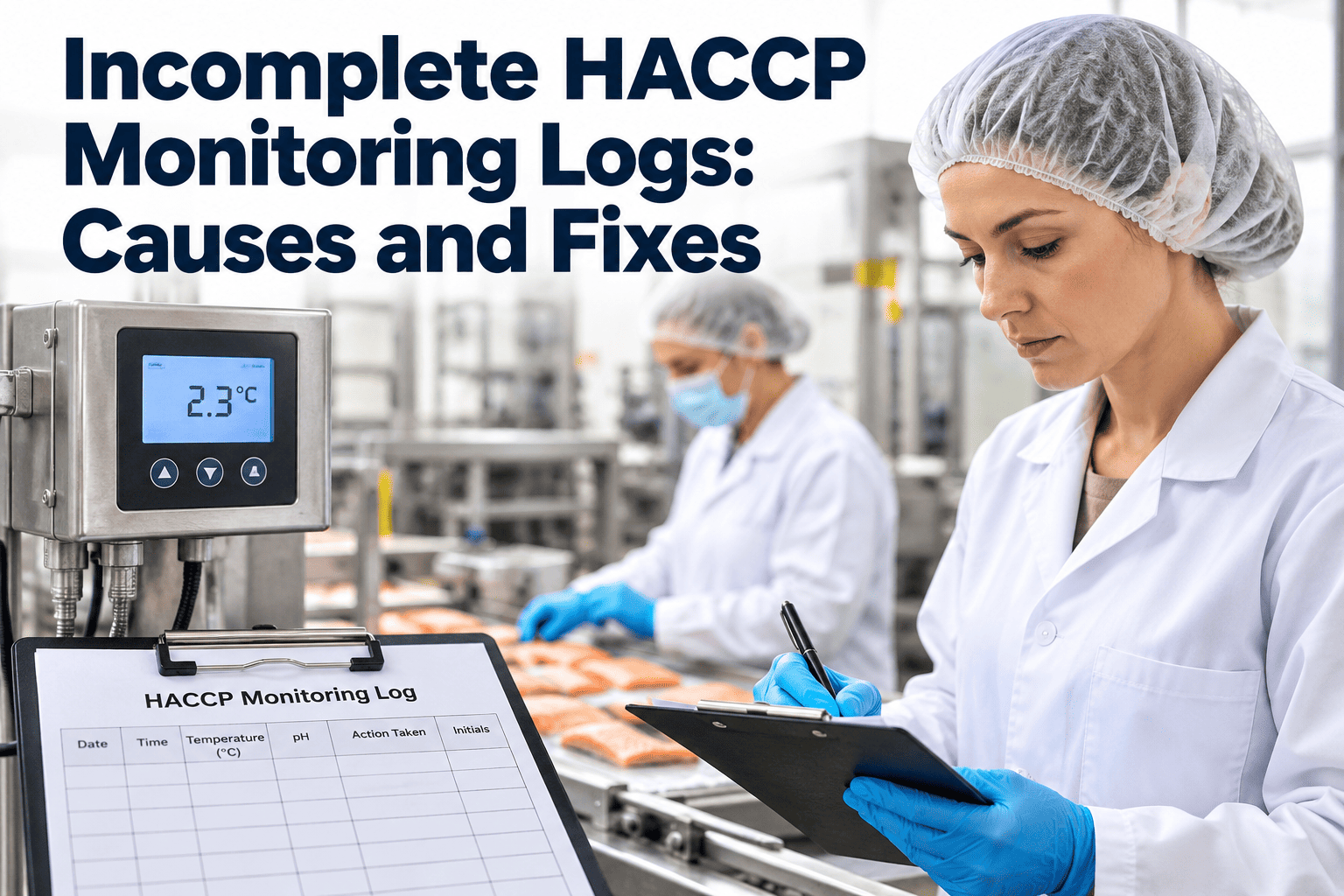
An incomplete HACCP monitoring log is rarely a sign that people ignored the plan. More often the check happened, the product was safe, and the record simply never caught up with the work. Blank time slots, missing initials, unreadable temperatures and entries written at the end of the shift all weaken the evidence that a critical control point was under control. Auditors and regulators judge the record, not your memory of the day. Closing these gaps takes better design of how checks are prompted, captured and reviewed, and maintenance management software can help carry that routine.
Incomplete HACCP monitoring logs: find the gaps, fix the causes
Missing entries, late entries and unsigned records put your CCP evidence at risk. Build a monitoring routine where every scheduled check is prompted, recorded on time and reviewed before the shift ends.
Six ways a monitoring log ends up incomplete
Before changing the form, identify which kind of gap you actually have. Each type has a different cause and a different fix, and most plants find two or three of them running at the same time.
The blank slot
A scheduled check has no value at all. Either it was missed, or it was done and never written down. The log cannot tell the two apart, so you must assume the worst.
The batch entry
Several readings are written together at the end of the shift, often with suspiciously round numbers. This is a contemporaneous record failure even if every value is plausible.
The missing signature
The reading exists but nobody is attributed to it. Without a name or user ID, you cannot show that a trained person performed the check.
The value without a decision
A reading sits outside the critical limit, but no corrective action, product disposition or verification is attached. The monitoring was done, the response was not recorded.
The unreadable or corrected entry
Overwritten numbers, correction fluid, smudged ink or untraceable changes raise doubts about whether the original value was altered.
The wrong-frequency record
The plan says every 30 minutes, the log shows hourly checks. The record is complete, but it does not match the HACCP plan it is meant to prove.
What the auditor sees and what actually happened
Gaps rarely cause a safety event on their own. They cause something almost as costly: product that cannot be released with confidence, and findings that repeat audit after audit.
On the production floor
- Operators check the product, find it in range and carry on.
- The clipboard is at the other end of the line, so the entry is postponed.
- A changeover or a breakdown pulls attention away from the form.
- At shift end, someone reconstructs the missing values from memory.
In the audit room
- Blank slots look like unmonitored production time.
- Identical handwriting across hours suggests pre-filling or backfilling.
- Missing corrective actions suggest the system does not respond to deviations.
- Product made during a gap may need hold, reassessment or additional testing.
The cost shows up as extra holds, repeated verification testing, rework of paperwork, longer audits and weaker confidence from customers who review your records.
Why logs go incomplete: symptoms, causes and fixes
Treat missing entries as a process problem. Retraining alone rarely works if the layout of the plant or the form itself makes the entry hard to complete.
| Symptom | Likely root cause | Practical fix |
|---|---|---|
| Blank slots clustered at shift change | No clear owner for the check during handover | Assign each check to a role, not a person, and include open checks in the handover |
| Blank slots during changeovers or breakdowns | Monitoring competes with urgent work | Define who covers monitoring when the primary person is pulled away |
| Backfilled entries | Forms are away from the point of use | Capture readings where the check is done, on a mobile device or a station at the CCP |
| Illegible values | Wet, greasy or cold conditions, gloves, poor forms | Use structured entry fields with units and validation instead of free handwriting |
| Out-of-limit values with no action | Operators are unsure of the limit or the next step | Show the critical limit beside the field and force a corrective action prompt when a value fails |
| Missing signatures | Shared pens, shared logins, rushed review | Attribute each entry to an individual login and timestamp it automatically |
| Review done days later | Supervisor review depends on free time | Make same-shift review a scheduled task with its own due time |
What changes when the log is built into the workflow
Moving a form from paper to a screen does not fix anything on its own. The gain comes from prompts, validation and visibility that a clipboard cannot provide.
- Nothing prompts the check when it is due
- Gaps are discovered at the end of the shift or the audit
- Time of entry is whatever the person writes
- Out-of-limit values depend on the operator remembering the next step
- Searching records means opening boxes of binders
- Scheduled tasks appear on the right device at the right time
- Overdue checks are visible to supervisors while production is running
- Entries carry a system timestamp and user identity
- Failed values trigger a required corrective action entry
- Records can be filtered by date, line, product or CCP in seconds
A five-step monitoring loop that leaves no slot blank
A reliable log is the output of a routine, not of good intentions. Each step below removes one of the gap types described earlier.
Schedule
Convert each CCP and prerequisite check into a recurring task with frequency, owner and location.
Prompt
Notify the assigned role before the check is due, not after it is missed.
Record
Capture the value, unit, time and user at the point of the check, with limits displayed.
Review
A supervisor verifies the entries within the shift and signs off or returns them.
Escalate
Overdue checks and failed limits go to the quality lead with a clear response record.
Stop discovering missing entries at audit time
Set up scheduled checks, prompts and same-shift review in Oxmaint, and see overdue monitoring tasks while there is still time to act.
Walk through your own log layout in the demo
A same-shift review checklist that catches problems early
Verification is where gaps are caught while they can still be explained. Keep the review short enough that it actually happens before people go home.
Align the details of this checklist with your own HACCP plan, customer requirements and the scheme you are certified to.
Late entries and corrections: handle them honestly
Some gaps will happen. A power cut, a probe failure or a short-staffed shift is real. What matters is that the record tells the truth about it.
Attributable
Every entry shows who did the check.
Contemporaneous
The entry is made when the check is done, not later.
Original
The first recorded value is kept, even after a correction.
Accurate
The value is read from calibrated equipment and entered as read.
Explained
Late or missed entries carry a reason and a reviewer note.
- Mark a late entry as late, with both the check time and the entry time visible.
- If a check was missed, record that it was missed and what was done about product made in that window.
- Never overwrite a value. Add a correction that references the original and the reason.
Fixes that look good on paper but backfire on the floor
Plants under audit pressure often respond with measures that add paperwork without improving the evidence. Watch for these patterns before rolling out any change.
- Adding more fields to the form. Longer forms take longer to complete, so operators skip them or batch them at the end. Keep each check to the data the HACCP plan actually needs: value, unit, time, person and, when required, action taken.
- Blaming individuals. If the same slot is blank on every shift, the cause is the process. Look at staffing, location of the form, competing tasks and unclear ownership before looking at attitude.
- Relying on retraining alone. Training explains why records matter, but it cannot add a reminder, move a clipboard or cover a changeover. Pair training with a change in how the check is prompted and captured.
- Pre-filling or copying previous values. Some systems and some habits carry yesterday's reading forward. This hides gaps and creates a record that looks complete while proving nothing.
- Reviewing only at month end. A gap found three weeks later cannot be explained or corrected. Same-shift review is what turns a record failure into a manageable event.
- Ignoring monitoring equipment. A complete log filled with readings from an uncalibrated probe is still weak evidence. Include probe and scale verification in the same routine.
KPIs that show whether your logs are getting better
You cannot improve what you only sample at audit time. Track a small set of measures weekly and review them with production and quality together.
| Measure | How to calculate | What it tells you |
|---|---|---|
| On-time completion rate | Checks recorded within the allowed window divided by checks scheduled | Whether prompts and ownership are working |
| Missed check count by CCP and shift | Scheduled checks with no entry, grouped by location and shift | Where the process breaks, such as handover or changeover |
| Late entry rate | Entries made outside the window divided by total entries | Whether forms are available at the point of use |
| Deviation response time | Time from out-of-limit value to recorded corrective action | How quickly the plant reacts to a failed limit |
| Review lag | Time from entry to supervisor sign-off | Whether verification happens in the same shift |
| Repeat finding count | Audit or internal findings on the same record issue | Whether corrective actions address root causes |
Using Oxmaint to run the monitoring routine
Oxmaint is maintenance management software. It is not a replacement for your HACCP plan, but its scheduling and records features suit the recurring, evidence-heavy tasks around it.
Confirm with your quality team how monitoring forms, limits and sign-offs should be configured to match your own plan.
A practical rollout that fits a working plant
You do not need to digitize every record at once. Start where gaps hurt most and expand after the team trusts the routine.
Audit the gaps
Pull recent logs for one or two CCPs and classify every gap by the six types above. Note which shifts and lines they cluster on.
Build the schedule
Create the recurring tasks, assign roles, set critical limits on the form and agree who covers monitoring during changeovers.
Run in parallel
Operators use the new routine on one line while the old form stays as a backup. Collect feedback on wording and timing.
Review and expand
Compare on-time completion and missed checks with the baseline, then extend to the next CCP or line.
Incomplete HACCP monitoring logs: common questions
Is a missing entry always a nonconformance?
It is a record failure, and you should assess product made in that period. Document what you found and what was done, then fix the cause so it does not repeat.
Can I fill in a missed entry afterwards?
Only if the value was genuinely observed, and it must be marked as a late entry with the reason. Never invent a value to fill a blank.
Do digital logs satisfy auditors?
They can, provided entries are attributable, timestamped and protected from silent changes. Check your scheme and customer requirements, or book a demo to see the workflow.
Who should review monitoring logs?
A trained supervisor or quality person who did not make the entries, ideally within the same shift. Daily or weekly reviews by management then check the pattern.
Where should we start if logs are poor everywhere?
Pick the CCP with the highest risk and the most gaps, and fix that routine first. You can get started with one line and grow from there.
Make every scheduled check count
Give your team prompts, clear limits and same-shift review, so your HACCP monitoring logs are complete before the audit asks.
Start with a single CCP and expand from there