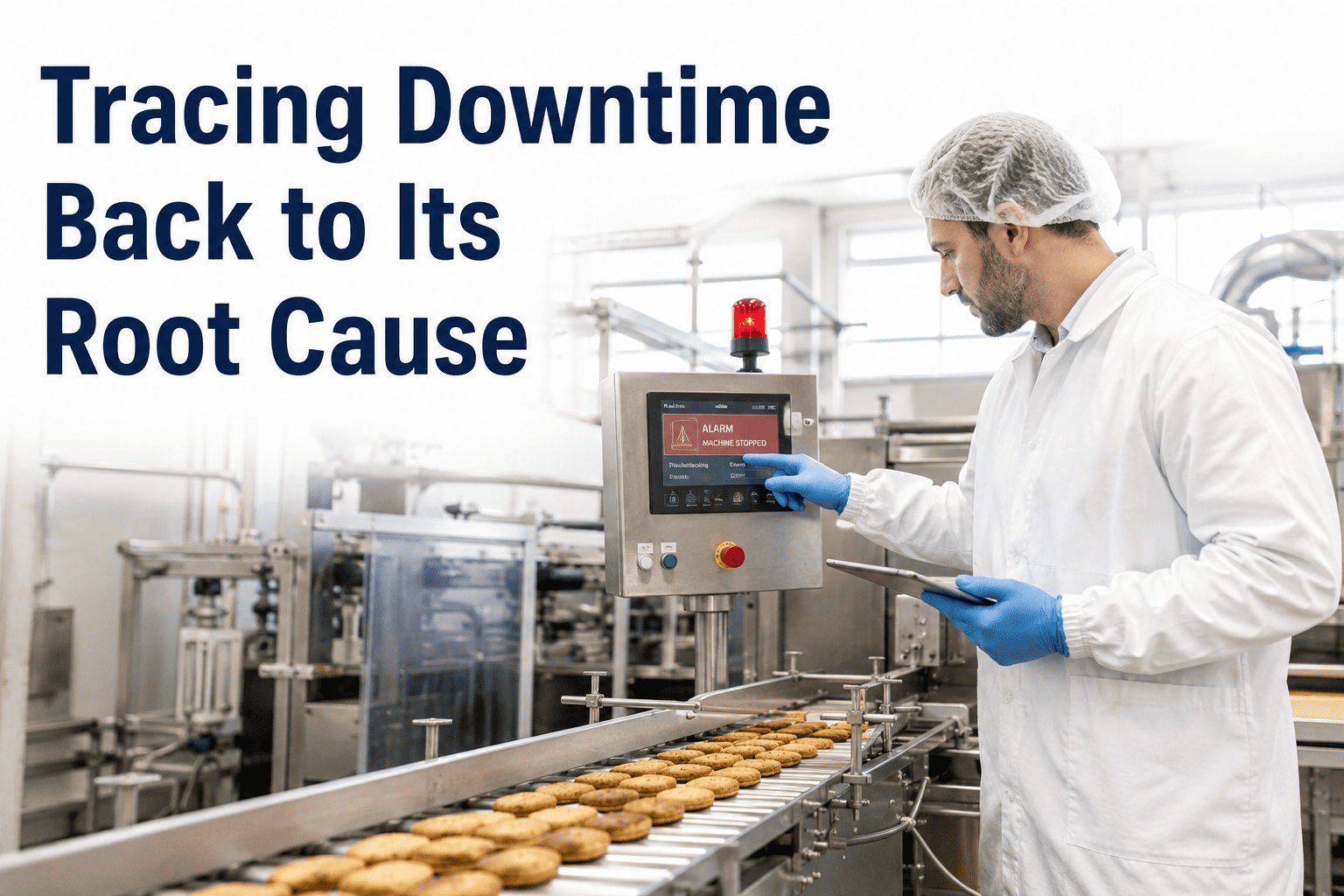
Last March, a snack food manufacturer in Ohio watched their 500-gallon ribbon blender seize during a critical production run. The gearbox had been making subtle grinding sounds for six weeks. Operators noted increased vibration three weeks prior. The motor drew 18% more current than baseline for eleven days. Every indicator pointed to imminent failure, yet the mixer ran until catastrophic gearbox destruction halted production for four days, contaminated an entire batch with metal particulates, and generated $156,000 in losses. Industrial mixer failure root cause analysis transforms these scattered warning signs into predictable patterns, enabling food plants to intervene before failures cascade into food safety incidents and production disasters.
Sign up or book a demo to see how systematic RCA prevents recurring breakdowns.
Root Cause Analysis
Industrial Mixer Failure Root Cause Analysis in Food Plants
Stop treating symptoms. Eliminate the underlying causes that create 73% of recurring mixer failures.
Of Mixer Failures Are Recurring Issues
Caused by Gearbox Problems
Preventable with Proper RCA
$47K
average
Cost Per Major Mixer Failure
The Anatomy of Industrial Mixer Failures in Food Manufacturing
Industrial mixers in food plants face a unique convergence of mechanical stress, sanitary requirements, and operational demands that create failure patterns distinct from other industrial applications. Understanding these patterns requires moving beyond simple component replacement toward systematic analysis of why failures develop and how they interconnect.
Food-grade mixers, including ribbon blenders, paddle mixers, planetary mixers, and high-shear homogenizers share common failure mechanisms but express them differently based on design and application. A ribbon blender processing dry seasonings experiences seal wear from abrasive particles, while the same seal design in a planetary mixer handling viscous dough fails from thermal stress during extended mixing cycles. Effective root cause analysis accounts for these application-specific variables.
73%
of mixer failures in food plants are repeat occurrences of previously experienced problems. Without proper root cause analysis, plants fix the same failures an average of 4.2 times before accidentally discovering the true cause.
The financial impact extends far beyond repair costs. A single mixer failure during production generates average losses of $47,000 when accounting for downtime, lost product, emergency labor, expedited parts, sanitation requirements before restart, and potential quality holds on adjacent batches. Plants implementing structured RCA programs reduce these incidents by 67% within the first year.
Sign up for Oxmaint to document failure patterns and build institutional knowledge that prevents recurring problems.
Primary Failure Modes Requiring Root Cause Analysis
Understanding the seven most common mixer failure modes provides the foundation for effective root cause analysis. Each mode presents characteristic warning signs, typical root causes, and specific prevention strategies that systematic analysis can identify and address.
Gearbox and Drive System Failure
Warning Signs
Grinding or whining sounds during operation, excessive heat at gearbox housing, oil discoloration or metal particles in lubricant, increased vibration amplitude, motor current fluctuations exceeding 15% of baseline.
Root Causes
Inadequate lubrication intervals, wrong lubricant viscosity for operating temperature, misalignment between motor and gearbox, overloading from incorrect batch sizes, thermal cycling from CIP procedures without proper cool-down.
Prevention Focus
Oil analysis every 500 operating hours, thermal imaging monthly, vibration trending weekly, alignment verification after any motor work, load monitoring during startup.
Impact: Average repair cost $12,000-$35,000. Typical downtime 2-5 days. Risk of contamination from lubricant leakage into product zone.
Seal and Bearing Assembly Failure
Warning Signs
Product leakage at shaft penetrations, visible wear on seal faces, temperature rise at bearing housings, squealing or chirping sounds, lubricant contamination with product residue.
Root Causes
Aggressive CIP chemical attack on elastomers, thermal shock from hot wash followed by cold product, shaft runout exceeding seal tolerance, improper seal installation orientation, inadequate flush water pressure or flow.
Prevention Focus
Weekly seal face inspection, quarterly shaft runout measurement, CIP temperature ramp protocols, seal material compatibility verification for all chemicals used, flush system flow verification daily.
Impact: Product contamination risk requiring batch hold. Repair cost $3,000-$8,000. Sanitation verification before restart adds 4-8 hours.
Mixing Element Wear and Damage
Warning Signs
Increased mixing time to achieve specification, uneven product consistency, visible blade edge erosion, unusual scraping sounds, material buildup in dead zones that previously cleared.
Root Causes
Abrasive ingredients accelerating wear, improper blade-to-wall clearance adjustment, corrosion from acidic products or sanitizers, fatigue cracking from repeated start-stop cycles, foreign object damage from upstream contamination.
Prevention Focus
Monthly blade thickness measurement, clearance verification after CIP, visual inspection of weld joints weekly, magnetic separation upstream verification, blade rotation schedule for even wear.
Impact: Quality issues before failure detection. Metal contamination risk from worn elements. Replacement cost $5,000-$15,000 for complete agitator assembly.
Motor and Electrical System Failure
Warning Signs
Motor running hot to touch, current imbalance between phases, insulation resistance declining over time, VFD fault codes recurring, starting current spikes exceeding nameplate values.
Root Causes
Moisture ingress from washdown procedures, voltage imbalance from facility power quality issues, cooling fan obstruction or failure, excessive duty cycle without adequate rest periods, VFD parameter drift from power events.
Prevention Focus
Quarterly insulation resistance testing, monthly thermal scan during operation, power quality monitoring, motor enclosure seal verification before and after washdown, VFD parameter backup and verification.
Impact: Complete production stoppage. Motor replacement 1-3 days depending on inventory. Cost $8,000-$25,000 including installation.
Vessel and Structure Integrity Failure
Warning Signs
Visible cracks at weld joints, pitting corrosion on interior surfaces, distortion of vessel walls, discharge valve wear or leakage, jacket integrity issues causing heat transfer decline.
Root Causes
Chloride stress corrosion from sanitizers, fatigue from pressure cycling in jacketed vessels, thermal stress from rapid temperature changes, improper weld repairs creating stress concentrations, erosion from abrasive products.
Prevention Focus
Annual internal inspection with documented photography, wall thickness measurement at wear points, weld joint dye penetrant testing every two years, jacket pressure testing annually, discharge component inspection monthly.
Impact: Catastrophic vessel failure poses safety risk. Repair typically requires extended shutdown of 1-4 weeks. Replacement cost $50,000-$200,000+ for large mixers.
Control System and Instrumentation Failure
Warning Signs
Erratic speed control, temperature readings drifting from verification checks, batch timing inconsistencies, safety interlock nuisance trips, communication faults between PLC and HMI.
Root Causes
Sensor drift from product buildup, wiring degradation from chemical exposure, EMI interference from nearby equipment, software corruption from power events, calibration drift over time.
Prevention Focus
Quarterly sensor calibration verification, annual wiring inspection in junction boxes, PLC battery replacement schedule, software backup before any changes, independent verification of safety interlocks.
Impact: Quality variation before detection. False safety trips waste production time. Diagnostic troubleshooting can extend downtime significantly.
Auxiliary System Failure
Warning Signs
Heating or cooling system response time increasing, vacuum pump performance declining, discharge conveyor synchronization issues, dust collection effectiveness decreasing, CIP spray coverage becoming uneven.
Root Causes
Scale buildup in heat transfer systems, vacuum pump oil contamination, conveyor belt wear or tracking issues, filter loading in dust systems, spray nozzle erosion or clogging.
Prevention Focus
Heat transfer efficiency monitoring, vacuum level trending, conveyor inspection during CIP, differential pressure monitoring on filters, spray pattern verification during validation.
Impact: Quality issues from temperature or mixing variations. Extended cycle times reduce throughput. Often overlooked until causing primary system failure.
Track Failure Patterns. Find Root Causes. Prevent Recurrence.
Oxmaint transforms scattered maintenance data into actionable root cause insights. Document failures systematically, identify recurring patterns, and build the institutional knowledge that prevents problems from repeating.
Symptom-Based RCA Troubleshooting Guide
Effective root cause analysis begins with accurate symptom identification. This troubleshooting guide connects observable symptoms to probable causes, enabling maintenance teams to investigate systematically rather than replacing components randomly until the problem disappears.
Sound
Unusual Noise During Operation
Grinding or gnashing sound
Investigate gearbox: Check lubricant level and condition, inspect for metal particles, verify gear mesh clearances. Root cause often traced to lubricant degradation or contamination.
High-pitched whine or squeal
Investigate bearings: Check bearing temperature, listen for variation with load, verify lubrication. Often indicates bearing fatigue or inadequate lubrication reaching bearing surfaces.
Rhythmic knocking or thumping
Investigate mixing elements: Check blade clearance to wall, inspect for loose bolts, verify balance. May indicate blade contact, loose components, or imbalance from wear.
Electrical humming or buzzing
Investigate motor and VFD: Check phase balance, verify VFD parameters, inspect motor mounts. Often related to electrical issues or resonance from mounting problems.
Vibration
Excessive Vibration Detected
1x running speed vibration
Investigate imbalance: Check agitator for product buildup, verify blade integrity, measure runout. Primary cause is mass imbalance from wear or accumulation.
2x running speed vibration
Investigate alignment: Check motor-to-gearbox coupling alignment, inspect coupling for wear, verify mounting bolt torque. Misalignment creates characteristic 2x signature.
Random or broadband vibration
Investigate looseness: Check all mounting points, verify structural integrity, inspect for cracks. Mechanical looseness creates erratic vibration patterns.
High-frequency vibration
Investigate bearings and gears: Perform detailed vibration analysis, check for bearing defect frequencies, verify gear mesh frequencies. Indicates component-level defects.
Heat
Abnormal Temperature Conditions
Gearbox running hot
Investigate lubrication and load: Check oil level and condition, verify proper viscosity grade, evaluate operating load versus rating. Insufficient lubrication or overloading generates excess heat.
Motor overheating
Investigate electrical and mechanical: Check current draw, verify voltage balance, inspect cooling fan, confirm duty cycle. Overloading, electrical issues, or cooling problems cause motor heat.
Bearing housing hot
Investigate lubrication and fit: Verify grease type and quantity, check for over-greasing, confirm proper bearing fit. Both under and over-lubrication cause bearing heat.
Seal area running hot
Investigate flush and alignment: Check flush water flow and temperature, verify shaft concentricity, inspect seal faces. Dry running or misalignment generates seal friction heat.
Quality
Product Quality Variations
Inconsistent mix uniformity
Investigate mixing elements: Measure blade clearances, check for wear patterns, verify mixing time and speed parameters. Worn elements or incorrect settings cause poor mixing.
Extended mixing time required
Investigate blade condition: Inspect edge sharpness on cutting elements, measure blade angle, check for material buildup. Degraded mixing elements reduce efficiency progressively.
Foreign particles in product
Investigate wear points: Inspect blade edges for metal loss, check seal wear, examine all product contact surfaces. Metal contamination indicates active component degradation.
Temperature variations in batch
Investigate heat transfer: Check jacket flow rates, verify temperature sensor accuracy, inspect for scale buildup. Heat transfer degradation or control issues affect product temperature.
Leakage
Leakage and Contamination Issues
Product leaking at shaft seal
Investigate seal condition: Inspect seal faces for wear or damage, check shaft sleeve condition, verify flush system operation. Worn seals or inadequate flushing allows product escape.
Oil leaking from gearbox
Investigate gearbox seals: Check output shaft seal, inspect breather for blockage, verify oil level is not overfilled. Pressure buildup or worn seals cause lubricant leakage.
Water in product from jacket
Investigate vessel integrity: Pressure test jacket system, inspect weld joints at jacket connections, check for corrosion. Jacket leaks indicate vessel integrity issues requiring immediate attention.
Air leaking into vacuum system
Investigate seals and gaskets: Check lid gasket condition, inspect valve seals, test all penetration seals. Vacuum leaks often occur at gaskets degraded by CIP chemicals.
Food Manufacturing-Specific Failure Considerations
Industrial mixer maintenance in food plants requires understanding how sanitary requirements, regulatory compliance, and food-specific operating conditions influence failure patterns and root cause analysis approaches.
CIP and Sanitation Stress Factors
Clean-in-place procedures impose thermal, chemical, and mechanical stresses that accelerate component degradation. Caustic solutions attack aluminum components and certain elastomers. Acid sanitizers pit stainless steel if concentrations or contact times exceed specifications. Thermal cycling between hot CIP solution and cold rinse water creates expansion stress at dissimilar metal joints.
RCA Focus: When analyzing seal or gasket failures, always examine CIP chemical concentrations and temperatures as potential root causes. Document actual versus specified parameters.
Viscous Product Handling Challenges
High-viscosity products like doughs, batters, and thick sauces create torque demands that stress drive systems beyond design margins. Cold startup with viscous product generates peak loads that damage gearbox components. Product adhesion to mixing elements creates imbalance and increases power consumption progressively through the batch cycle.
RCA Focus: Gearbox failures in viscous product applications often trace to inadequate soft-start programming or cold product introduction without temperature conditioning.
Abrasive Ingredient Impact
Sugar, salt, spices, and other crystalline ingredients create abrasive conditions that accelerate wear on seals, blades, and vessel surfaces. Fine particles migrate into seal faces and bearing areas despite protective systems. Erosion patterns develop at high-velocity impact zones where product flow concentrates.
RCA Focus: Accelerated seal wear in dry mixing applications typically traces to inadequate seal flushing or incorrect seal material selection for abrasive environments.
Allergen Changeover Requirements
Allergen control programs require complete cleaning between product runs, increasing CIP frequency and associated wear. Some facilities disassemble and manually clean mixers for allergen changeovers, creating opportunities for improper reassembly. Rushed changeovers to meet production schedules often skip verification steps.
RCA Focus: Failures occurring shortly after allergen changeovers suggest investigating reassembly procedures and verification protocols as potential root causes.
Temperature-Sensitive Product Demands
Many food products require precise temperature control during mixing. Chocolate tempering, dough conditioning, and emulsion stability all depend on jacket system performance. Heat transfer degradation from scale buildup or jacket fouling affects product quality before obvious mechanical failure occurs.
RCA Focus: Quality issues traced to temperature should investigate heat transfer system efficiency trends, not just temperature sensor accuracy.
Regulatory Documentation Requirements
FDA, FSMA, and customer audit requirements demand documented maintenance and corrective action records. Root cause analysis must produce documentation suitable for regulatory review. Verbal troubleshooting without documentation fails to satisfy compliance requirements and prevents institutional learning.
RCA Focus: Effective food plant RCA generates documented evidence linking identified causes to implemented corrective actions with verification of effectiveness.
Book a demo to see how Oxmaint creates audit-ready RCA documentation that satisfies FDA and customer requirements.
5-Why Root Cause Analysis Framework
The 5-Why method provides a structured approach to moving beyond symptoms to identify true root causes. This example demonstrates proper application to a recurring industrial mixer failure scenario common in food manufacturing environments.
1
Why did the gearbox fail?
The output shaft bearing seized due to inadequate lubrication reaching the bearing surfaces.
2
Why was lubrication inadequate?
Oil viscosity had degraded below specification, reducing film strength and flow to bearings.
3
Why had oil viscosity degraded?
Operating temperature consistently exceeded 180F during summer months, breaking down the oil faster than the change interval accounted for.
4
Why were temperatures exceeding 180F?
Production scheduling increased to 18 hours daily during summer season without rest periods for gearbox cooling. Additionally, the cooling fan shroud had been removed and not replaced after motor work.
5
Why was the cooling fan shroud not replaced?
ROOT CAUSE: No post-maintenance verification checklist exists. The work order system does not include verification steps confirming all removed components are reinstalled. The shroud removal was not documented, so the technician completing the motor work was unaware it needed reinstallation.
Corrective Actions Implemented
Immediate: Replace gearbox, reinstall cooling fan shroud, change to high-temperature synthetic lubricant rated to 220F.
Root Cause Fix: Create post-maintenance verification checklist requiring sign-off that all removed components are reinstalled. Add to CMMS as mandatory completion step before work order closure.
Systemic Fix: Audit all mixer gearboxes for proper shroud installation. Reduce oil change interval from 2000 hours to 1000 hours for summer operation. Add gearbox temperature to daily operator checklist with 175F action threshold.
Verification: Monitor gearbox temperature weekly for three months. Confirm new checklist completion rate. Review next oil analysis at 500 hours for viscosity confirmation.
Build Institutional Knowledge That Prevents Recurring Failures
Every documented RCA adds to your plant's reliability knowledge base. Oxmaint captures failure patterns, root causes, and corrective actions in searchable records that inform future troubleshooting and training.
Frequently Asked Questions: Industrial Mixer RCA
How long should a proper root cause analysis take for an industrial mixer failure?
Most mixer RCA investigations complete within 2-4 hours for straightforward failures. Complex failures involving multiple contributing factors may require 1-2 days including evidence gathering and verification. The key is not rushing to conclusions. A thorough RCA that takes 4 hours prevents recurrence and saves the 40+ hours of repeated repairs that incomplete analysis causes.
What data should we collect immediately after an industrial mixer failure?
Preserve physical evidence before cleaning or repairs begin. Photograph the failure area from multiple angles. Record operating parameters at time of failure including motor current, temperatures, and pressures. Interview operators about conditions before failure and any unusual observations. Retain failed components for examination rather than discarding immediately. This evidence window closes quickly once repairs begin.
How do we distinguish between symptoms and root causes in mixer troubleshooting?
Symptoms are what you observe: noise, vibration, leakage, heat. Root causes explain why the symptom exists and can be acted upon to prevent recurrence. If fixing the identified cause would not prevent the same failure from happening again, you have found a symptom, not a root cause. Continue asking why until you reach an actionable cause, typically a procedure gap, training deficiency, or system weakness.
Sign up for Oxmaint to document and track the relationship between symptoms and root causes across your equipment.
Should we conduct RCA on every mixer failure or only major breakdowns?
Conduct formal RCA on every unplanned failure that causes production impact or safety concern. Quick failures that maintenance resolves in under 30 minutes may not need full formal analysis but should still be documented. The pattern of minor failures often reveals systemic issues that cause major failures. Plants that only analyze catastrophic events miss the warning signs that thorough documentation would reveal.
How do we verify that corrective actions from RCA actually work?
Schedule follow-up reviews at 30, 60, and 90 days after implementing corrective actions. Define specific metrics that indicate success, such as time between failures, condition monitoring trends, or elimination of specific symptoms. If the same failure mode recurs, the corrective action either was not implemented correctly or did not address the true root cause. Verification is where most RCA programs fail because plants move on to the next crisis without confirming effectiveness.
Transform Reactive Repairs into Proactive Reliability
Oxmaint provides the structured documentation, failure tracking, and corrective action management that effective RCA requires. Stop losing production to recurring failures and start building the reliability program your food plant deserves.