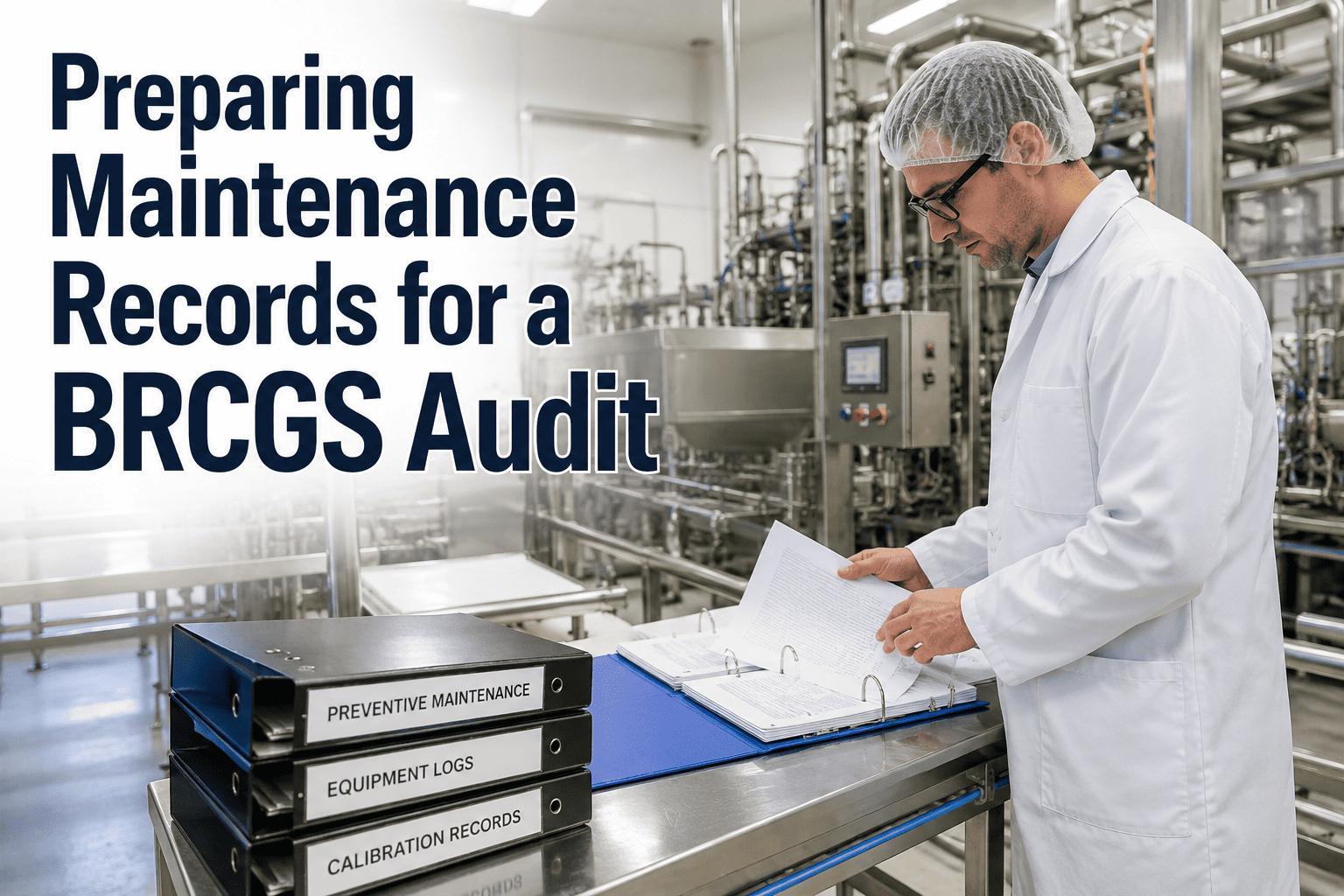
Food safety certification audits do not fail because of a single catastrophic event. They fail because of documentation gaps — missing calibration records, incomplete PM logs, corrective actions closed on paper but absent from any traceable system. Under BRCGS Issue 9 alone, facilities averaged nearly five non-conformance findings per audit in 2024, with 59% of those findings rooted in site standards and maintenance documentation deficiencies. For plant managers and quality directors preparing for SQF, BRC, or FSSC 22000 certification, the single most high-leverage investment is a CMMS that generates audit-ready records automatically — not a document binder compiled the week before the auditor arrives. Start a free trial and build your audit evidence trail from day one, or book a demo to see how Oxmaint generates GFSI-ready compliance reports in minutes.
67%
Of GFSI audit non-conformances involve incomplete or missing maintenance documentation
5 avg
Non-conformance findings per facility in BRCGS Issue 9 audits conducted in 2024
60–75%
Reduction in audit preparation time reported by facilities using automated CMMS systems
95%+
PM completion rate target auditors look for across all GFSI-benchmarked schemes
Build Your Audit-Ready Evidence Trail Today
Oxmaint centralizes PM records, calibration logs, corrective actions, and inspection history in one system — so audit preparation takes hours, not weeks.
What Is GFSI Audit Readiness — and Why Does Maintenance Make or Break It?
GFSI-benchmarked schemes — SQF, BRC (BRCGS), and FSSC 22000 — all require documented, traceable, and consistently executed maintenance programs. Calibration records, preventive maintenance schedules, breakdown logs, corrective action reports, return-to-service verifications, and food-grade lubricant records are not optional supplements to your food safety management system. They are core evidence requirements that auditors examine in detail. A facility with excellent production hygiene but incomplete maintenance records will still receive major non-conformances. Start a free trial and see how Oxmaint organizes every maintenance record by asset, date, and technician automatically.
SQF Edition 9
SQF Maintenance Documentation
Documented preventive maintenance schedule for all equipment
Breakdown event records with corrective action sign-off
Calibration logs traceable to reference standards
Return-to-service verification before production restarts
Food-grade lubricant usage documented per asset
Maintenance segregation from food handling during repairs
BRCGS Issue 9
BRC Maintenance Documentation
Planned maintenance schedule with completion evidence
Equipment register with full maintenance history per asset
Cleaning and reinspection records after every maintenance job
Contractor food safety induction records on file
Building fabric condition logs — floors, ceilings, drains
Hygienic maintenance procedures for food-contact equipment
FSSC 22000 V6
FSSC 22000 Maintenance PRPs
ISO/TS 22002-1 Section 8: Maintenance and Repair compliance
Temporary repair records with defined maximum duration
Lubricant management — type, location, food-grade status
Tool control procedures during food production
Maintenance-related contamination risk documentation
Scheduled PRP execution verified and timestamped
All Schemes
Universal Compliance Requirements
Critical Control Point instrument calibration records
Internal audit completion evidence with follow-up records
Closed-loop corrective action records for every finding
Management review minutes with maintenance trend data
Pest control contractor records with access logs
Digital signatures and technician ID on all records
The Five Most Common Audit Failures — and How CMMS Prevents Them
Audit non-conformances follow predictable patterns. These are the five recurring documentation failures that GFSI auditors cite across SQF, BRC, and FSSC 22000 inspections — and how a connected CMMS eliminates each one before the auditor arrives. Book a demo to see how Oxmaint closes each of these audit risk gaps automatically.
01
No Calibration Due-Date Tracking
Expired calibration certificates on CCP instruments — an automatic major non-conformance under all three schemes.
Oxmaint Fix: Auto-generates calibration work orders 30 and 60 days before due date. Certificate expiry visible on every asset record.
02
Incomplete PM Completion Records
Preventive maintenance scheduled but not executed, or executed without documented verification — PM completion rate below 95% triggers findings.
Oxmaint Fix: Mandatory checklist completion before WO closure. PM completion rate dashboard visible to managers in real time.
03
Missing Return-to-Service Records
Equipment returned to production after repair without documented hygiene reinspection and sign-off — SQF and BRC both require this verification.
Oxmaint Fix: Return-to-service checklist embedded in every corrective maintenance work order. Cannot close WO without supervisor digital sign-off.
04
Open Corrective Actions With No Closure
Breakdown logged, repair done verbally, no corrective action follow-up in writing. Auditors look for closed-loop CAPA on every maintenance event.
Oxmaint Fix: Every work order links to a corrective action record. Managers see all open CAPAs on a single dashboard with days-open tracking.
05
Undocumented Contractor Activities
External maintenance contractors entering food production areas without documented food safety induction, site rules, or work activity records.
Oxmaint Fix: Contractor work orders include induction confirmation field, activity log, and sign-off — all stored against the asset in the audit trail.
06
Food-Grade Lubricant Records Missing
Maintenance using correct lubricants but with no documentation that confirms food-grade status — creates CCP integrity risk findings under FSSC 22000.
Oxmaint Fix: Spare parts inventory tracks lubricant type and food-grade certification against each asset's PM task — automatically logged on every application.
Reactive Audit Preparation vs. CMMS-Driven Continuous Readiness
| Documentation Area |
Manual / Reactive Approach |
Oxmaint CMMS Approach |
| PM Completion Records |
Paper logs, often incomplete or unsigned |
Digital, mandatory sign-off, 100% traceable |
| Calibration Due-Date |
Spreadsheet — updates missed, certificates expire |
Auto-alert 60/30 days before expiry per asset |
| Corrective Actions |
Verbal repairs, no written closure record |
Every WO has linked CAPA — open CAPAs flagged |
| Audit Report Generation |
2–4 weeks of manual record gathering |
Generated in under 2 minutes from the dashboard |
| Return-to-Service Proof |
Rarely documented — major NC risk |
Required checklist item before WO closes |
| Contractor Records |
Paper sign-in, no activity log |
Digital induction + work record per visit |
| Spare Parts Traceability |
Parts used unknown — no asset linkage |
Every part linked to WO, asset, technician, date |
How Oxmaint Builds Your GFSI Audit Package — Automatically
Continuous audit readiness is not about doing more work. It is about doing the same work your team already does — but with a system that captures, organizes, and presents that work in the format auditors require. Start a free trial and run your first audit preparation report before your next internal review.
Asset Registry
Full Equipment Register with History
Every asset has a full maintenance and calibration history, condition score, and linked inspection records — exactly what BRCGS and SQF auditors request first.
PM Scheduling
Automated Preventive Maintenance Triggers
PM tasks trigger on calendar, production cycles, or hours — ensuring no equipment exceeds its service interval. Completion rates tracked and reportable instantly.
Calibration
Calibration Due-Date Tracking
Calibration schedules managed per instrument with automatic alerts at 60 and 30 days before expiry. Certificates stored and linked to CCP asset records.
Work Orders
Digital Work Orders with Digital Signatures
Every repair, PM, and inspection generates a timestamped, signed work order linked to the asset. No work is undocumented — no verbal repairs, no paper gaps.
GMP Compliance
Digital Equipment Inspections
Mobile inspection checklists enforce GMP compliance at the point of task execution — with photo capture, forced responses, and supervisor sign-off built in.
Reporting
One-Click Audit-Ready Report Generation
Generate PM completion rates, open CAPA reports, calibration status, and asset history reports in under 2 minutes — formatted for SQF, BRC, and FSSC auditors.
60–75%
Audit Prep Time Saved
CMMS-equipped facilities spend 60–75% less time gathering records before certification audits
59%
BRC Findings in Site Standards
More than half of all BRCGS non-conformances target premises condition and maintenance documentation
2 min
To Pull Full Asset Audit Trail
Auditors expect instant access to asset history — Oxmaint delivers a full record in under 2 minutes
100%
Work Order Traceability
Every task linked to technician, asset, parts, and timestamp — closed-loop CAPA evidence for every auditor request
Stop Preparing for Audits. Start Being Audit-Ready.
Oxmaint turns your daily maintenance operations into a continuous compliance system. Every PM completed, every calibration logged, every corrective action closed — all in one platform, all ready for SQF, BRC, or FSSC 22000 auditors on demand.
Frequently Asked Questions
What maintenance records do SQF, BRC, and FSSC 22000 auditors specifically request?
Auditors across all three schemes consistently request: preventive maintenance completion records with technician signatures, calibration certificates with traceability to reference standards and due-date tracking, breakdown and corrective maintenance records with closed-loop CAPA evidence, return-to-service verification before production restart, food-grade lubricant records per asset, and building fabric inspection logs. In BRCGS and FSSC 22000, contractor food safety records and hygienic maintenance procedure documentation are also reviewed.
How does a CMMS help with GFSI calibration requirements?
A CMMS manages calibration as a scheduled maintenance task — automatically triggering work orders at defined intervals, alerting managers 30–60 days before certificates expire, and storing calibration records against each instrument in the asset registry. This eliminates the spreadsheet errors and missed due-dates that generate CCP instrument calibration non-conformances — one of the highest-severity finding types in food safety audits across all GFSI schemes.
Does Oxmaint generate the specific reports that food safety auditors request?
Yes. Oxmaint generates PM completion rate reports, open corrective action reports, calibration status reports, full maintenance history per asset, contractor work records, and inspection completion logs — all with timestamp and digital signature. These reports are formatted to be presented directly to SQF, BRCGS, FSSC 22000, and IFS auditors without additional formatting work. Most clients generate a complete audit evidence package in under 2 minutes using the reporting dashboard.
How quickly can a food manufacturing facility get audit-ready using Oxmaint?
Most facilities establish baseline asset records, PM schedules, and calibration tracking within the first 2–4 weeks of deployment, with no heavy implementation fees or IT dependency. Once the system is live, every maintenance task executed automatically builds the audit evidence trail. Facilities transitioning from paper-based systems typically report having a complete, auditor-ready record set within 90 days — and a dramatically lower audit preparation burden from the first certification cycle onward.