A leading snack foods manufacturer in Pennsylvania was losing $47,000 per hour when their delta robot palletizer experienced gripper failures mid-shift. The culprit? Inadequate lubrication schedules and missing sanitation documentation that failed FDA audit requirements. After implementing automated work order tracking by Signing Up to Oxmaint for their packaging line robots, they achieved 99.4% uptime while maintaining full FSMA compliance—documenting every cleaning cycle, parts replacement, and preventive maintenance task in real-time.
Top Packaging Line Robotics Maintenance Tips for Food Manufacturers
Proven strategies to maximize OEE, reduce unplanned downtime, and maintain FDA/FSMA compliance for delta robots, SCARA systems, collaborative robots, and automated palletizers in food production environments
Packaging Line Performance Dashboard
Real-world OEE metrics from 18 food manufacturing facilities operating 240+ packaging line robots with CMMS-managed maintenance programs (Q4 2025 data):
Why Packaging Line Robots Demand Specialized Maintenance Protocols
Food-grade robotics operate in uniquely harsh conditions that accelerate component wear while demanding absolute cleanliness. Delta robots on primary packaging lines execute 200-300 picks per minute in environments with temperature fluctuations, humidity exposure, and mandatory daily washdowns using caustic cleaning agents.
Traditional industrial maintenance schedules designed for automotive or electronics assembly don't account for these factors. A delta robot gripper that would last 18 months in dry ambient conditions degrades in 4-6 months when exposed to high-moisture food environments and aggressive sanitation chemicals. See how CMMS platforms by Signing Up and adapt maintenance cycles to packaging line realities.
Issued to food manufacturers in 2025 cited inadequate maintenance documentation for automated packaging equipment—specifically missing sanitation logs, incomplete preventive maintenance records, and undocumented component replacements (FDA Warning Letters Database)
Essential Maintenance Practices for Packaging Line Robotics
These protocols address the specific failure modes and compliance requirements unique to food production automation:
Robots operating in direct food contact zones (Zone 1) or splash zones (Zone 2) require NSF H1-rated lubricants that won't contaminate products. Standard industrial greases cause automatic FSMA violations if used in these areas.
End-effectors contact product packaging directly and experience the highest failure rates—accounting for 41% of unplanned packaging line stoppages. Proactive replacement prevents mid-shift breakdowns.
Food production robots must withstand daily high-pressure washdowns with hot water (60-80°C) and caustic detergents. Seal degradation is the leading cause of controller failures and motor burnouts.
Vision-guided robots rely on camera clarity for accurate pick-and-place operations. Optical contamination from airborne flour, sugar dust, or packaging debris causes misreads that trigger line stops and product rejects.
Packaging robots use pneumatic actuators for grippers, product pushers, and conveyor gates. Contaminated or moisture-laden compressed air destroys valve seals and causes erratic actuator behavior.
FDA requires documented evidence that robots contacting food or packaging materials receive proper sanitation. Missing documentation triggers warning letters even when equipment is physically clean.
Ready to eliminate packaging line downtime and streamline compliance documentation? See how food manufacturers use automated work order management to track every maintenance task, sanitation cycle, and parts replacement.
OEE Optimization Through CMMS-Driven Maintenance
Overall Equipment Effectiveness combines availability, performance, and quality metrics. Here's how systematic maintenance tracking improves each component:
- Preventive maintenance scheduling: CMMS prevents 73% of breakdowns by triggering PM tasks before failures occur
- Parts inventory management: Stock critical spares (gripper cups, seals, filters) based on CMMS usage forecasts—reduces repair time 68%
- Mobile work orders: Technicians receive immediate notifications of robot faults via smartphone app, cutting response time from 47 min to 8 min
- Calibration tracking: Automated reminders ensure vision systems and gripper force sensors remain within spec—eliminates speed reductions from misalignment
- Lubrication compliance: Proper greasing schedules prevent friction-induced slowdowns that reduce robot cycle speeds by 12-18%
- Trend analysis: CMMS analytics identify performance degradation patterns—robots operating 15% below target trigger root cause investigations
- End-effector maintenance: Scheduled gripper replacements prevent product damage from worn vacuum cups (crushed packages, dropped items)
- Vision system upkeep: Clean optics and calibrated cameras reduce misplaced labels, incorrect barcode orientation, improper package orientation
- Sanitation verification: Documented cleaning prevents contamination rejects and product holds that destroy quality metrics and brand reputation
World-class OEE benchmark for food packaging lines: 85%. Facilities using CMMS maintenance management average 82.4% compared to 61.7% industry average for manual tracking systems (PMMI report, 2025).
Maintenance Strategies by Robot Type
Different packaging line configurations require tailored maintenance approaches based on robot kinematics, speed, and food contact exposure:
High-Speed Pick & Place (Primary Packaging)
Delta robots with 3-4 parallel arms excel at rapid product transfer from conveyors to tray packs, blisters, or cartons. Operating speeds: 150-300 picks/minute.
Selective Compliance Assembly (Secondary Packaging)
SCARA robots with rigid Z-axis and compliant X-Y plane handle tray loading, case packing, and cartoning operations. Operating speeds: 60-120 cycles/minute.
6-Axis Palletizers (End-of-Line)
Multi-joint robots stack cases onto pallets with complex motion paths. Payload capacity: 20-200 kg. Operating speeds: 10-15 cases/minute.
Cobots for Flexible Pack Stations
Collaborative robots work alongside personnel in variable product packaging tasks. Inherent force-limiting safety features. Operating speeds: 0.25-1.5 m/s.
Automated Work Order Management for Packaging Robots
Manual maintenance scheduling fails when managing 20+ robots across multiple packaging lines. CMMS automation eliminates missed PMs and ensures audit-ready documentation:
Runtime-Based Trigger System
Instead of calendar schedules that ignore actual usage, connect robot PLCs to CMMS via OPC-UA or Modbus. System generates PM work orders automatically when cumulative runtime reaches maintenance thresholds—250 hours for lubrication, 1,000 hours for belt inspection, 2,000 hours for major service.
Predictive Failure Alerts from Sensor Data
Modern packaging robots report diagnostic data (motor currents, vibration levels, cycle times) to controllers. Advanced CMMS platforms by Signing Up to Oxmaint and analyze this telemetry to detect developing failures before they cause downtime.
Compliance Documentation Auto-Generation
FDA audits require proof that maintenance occurred as scheduled with documented evidence. CMMS platforms compile work order histories into audit reports showing 100% PM compliance, technician certifications, and parts traceability.
Spare Parts Consumption Tracking & Forecasting
Every work order completion records which parts were consumed (gripper cups, seals, filters, belts). CMMS analytics calculate average usage rates and predict reorder points to prevent stockouts during critical repairs.
"Before implementing CMMS work order automation, we were flying blind on robot maintenance. Technicians would forget lubrication cycles, sanitation documentation was incomplete, and we had three FDA observations in one year. Now every task is tracked, every cleaning is verified with photos, and we haven't had a single audit finding in 18 months. The system paid for itself in the first quarter just from eliminated downtime."
— Director of Engineering, frozen foods manufacturer, 47,000 units/day packaging capacity
90-Day CMMS Implementation Roadmap for Packaging Lines
Follow this phased approach to deploy automated maintenance management without disrupting production:
Asset Registry & Baseline Documentation
- Inventory all packaging line robots with manufacturer, model, serial number, installation date, zone classification
- Upload robot manuals, electrical schematics, pneumatic diagrams to CMMS document library
- Create asset hierarchy: Production Line → Robot Cell → Individual Robot → Components (motors, grippers, controllers)
- Define criticality scores (A/B/C) based on production impact—palletizers are typically A-critical as single points of failure
- Import existing maintenance records from spreadsheets or paper logs into CMMS work order history
PM Schedule Creation & Work Order Templates
- Build preventive maintenance templates for each robot type with detailed checklists, required tools, estimated duration
- Configure recurring work orders on runtime or calendar triggers (lubrication 250 hrs, vision calibration weekly, major service annually)
- Create sanitation work order templates with FDA-required documentation fields (chemical concentration, contact time, ATP results)
- Set up mobile app access by Signing Up for technicians to receive notifications and log completions from factory floor
- Define approval workflows for high-cost repairs (>$5,000 requires maintenance manager sign-off before proceeding)
Go-Live, Training & Optimization
- Conduct hands-on training sessions for maintenance technicians, sanitation crew, production supervisors on CMMS usage
- Run parallel operations for 2 weeks—maintain existing paper system while building confidence in CMMS accuracy
- Monitor KPIs: PM schedule compliance (target 95%+), work order close rate (target 90%+ within SLA), documentation completeness
- Integrate robot PLC runtime counters via OPC-UA or manual entry to enable hour-based PM triggers
- Generate first compliance audit report and review with quality assurance team—address any documentation gaps immediately
Maximize Packaging Line OEE with Automated Maintenance Management
Stop losing production hours to preventable robot failures. See how food manufacturers track every PM task, sanitation cycle, and compliance requirement in one unified platform.
Frequently Asked Questions
How do you track robot runtime hours without manual entry from operators?
Most modern robot controllers expose runtime data via OPC-UA, Modbus TCP, or proprietary APIs. CMMS platforms can poll this data every 15-60 minutes and automatically increment cumulative runtime counters. For older robots without connectivity, install low-cost runtime meters (Hobbs meters) on main power supplies—technicians enter readings weekly during routine checks. This eliminates reliance on operator logs which have 30-40% error rates.
What's the typical ROI timeline for CMMS implementation in food packaging?
Most facilities achieve payback within 6-9 months through three sources: (1) Reduced downtime—preventing just 2-3 major robot failures per year saves $150-300k in lost production, (2) Labor efficiency—technicians spend 25% less time searching for manuals, tracking down parts, documenting work when CMMS centralizes information, (3) Compliance cost avoidance—eliminating FDA warning letters prevents remediation costs averaging $200k+ per incident. Request ROI calculator by Signing Up to Oxmaint for specific to your operation.
Can CMMS integrate with our existing ERP system for parts ordering?
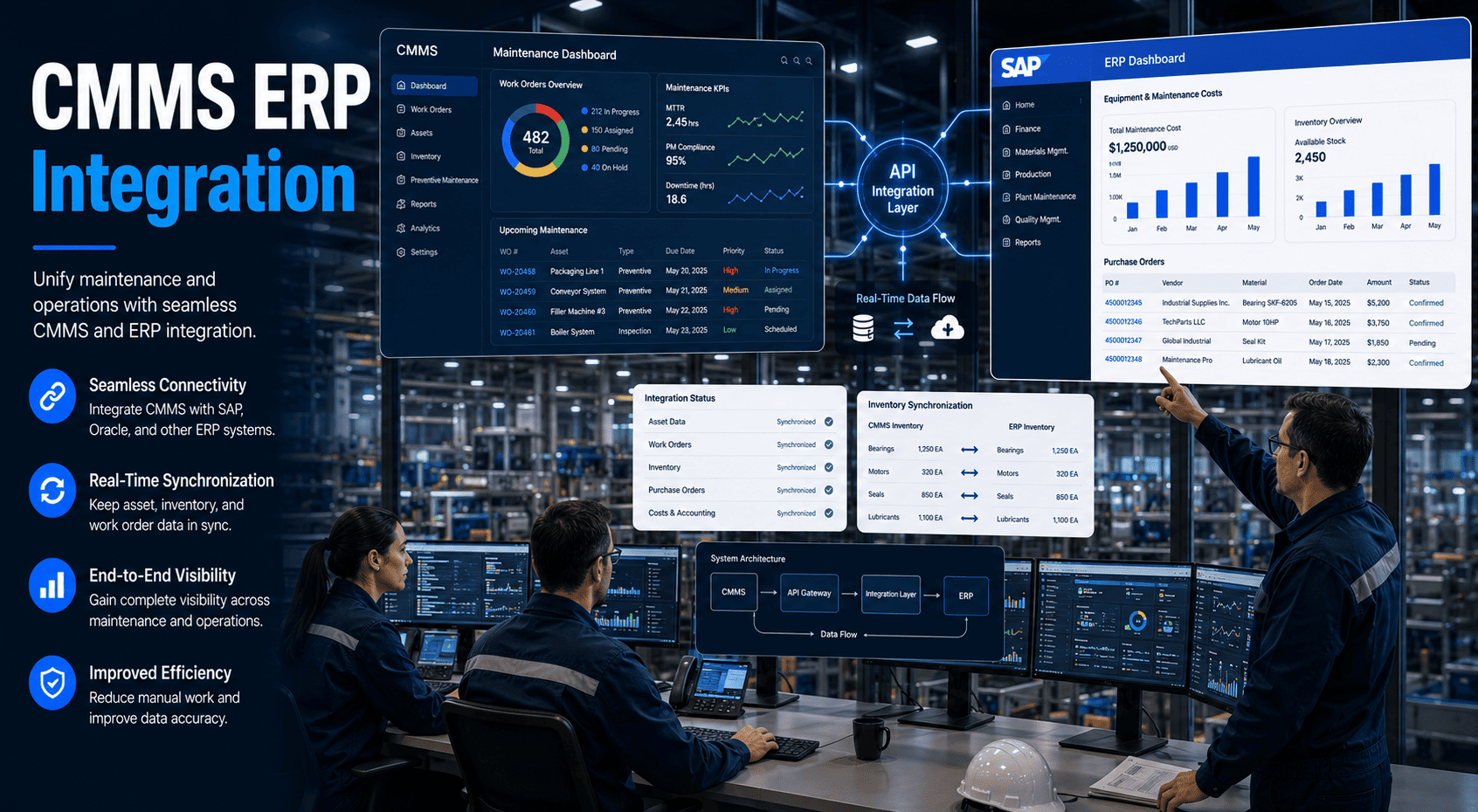
Yes—modern CMMS platforms offer REST APIs and pre-built connectors for major ERP systems (SAP, Oracle, Microsoft Dynamics). When a work order identifies needed parts, CMMS can automatically create purchase requisitions in your ERP, check inventory availability, and even trigger reorder points when spare parts inventories drop below minimum thresholds. This eliminates duplicate data entry and prevents stockouts that delay repairs.
How do you handle sanitation documentation for robots that get daily washdowns?
Create recurring daily work orders titled "Robot Washdown - [Robot ID]" assigned to sanitation crew. Work order template includes checklist items (exterior surfaces cleaned, cable trays flushed, drain holes verified clear) plus custom fields for chemical concentration, water temperature, and ATP swab results. Technicians complete via mobile app in 90 seconds by Signing Up, attach photos showing cleanliness, and e-sign completion. System generates compliance reports showing 100% washdown completion for FDA audits.
What happens when a robot breaks down unexpectedly between scheduled PMs?
Operators or technicians create corrective maintenance work orders immediately when failures occur—either via mobile app or by calling maintenance office. CMMS logs failure date/time, production impact (line down vs reduced speed), root cause analysis, and corrective actions taken. This data feeds into analytics that identify recurring failure patterns. For example, if gripper cups fail every 4 months instead of expected 6 months, CMMS flags the trend and recommends shortening replacement interval.
How do you maintain food-safe certification for lubricants and spare parts?
Store digital copies of NSF H1 certificates, material safety data sheets (SDS), and allergen declarations in CMMS document library linked to each part number. When creating work orders, system displays only approved products for each robot zone classification—prevents technicians from accidentally using non-food-grade materials in Zone 1/2 areas. Purchase orders automatically include "NSF H1 certified" requirement, and receiving inspection verifies certification before accepting delivery.