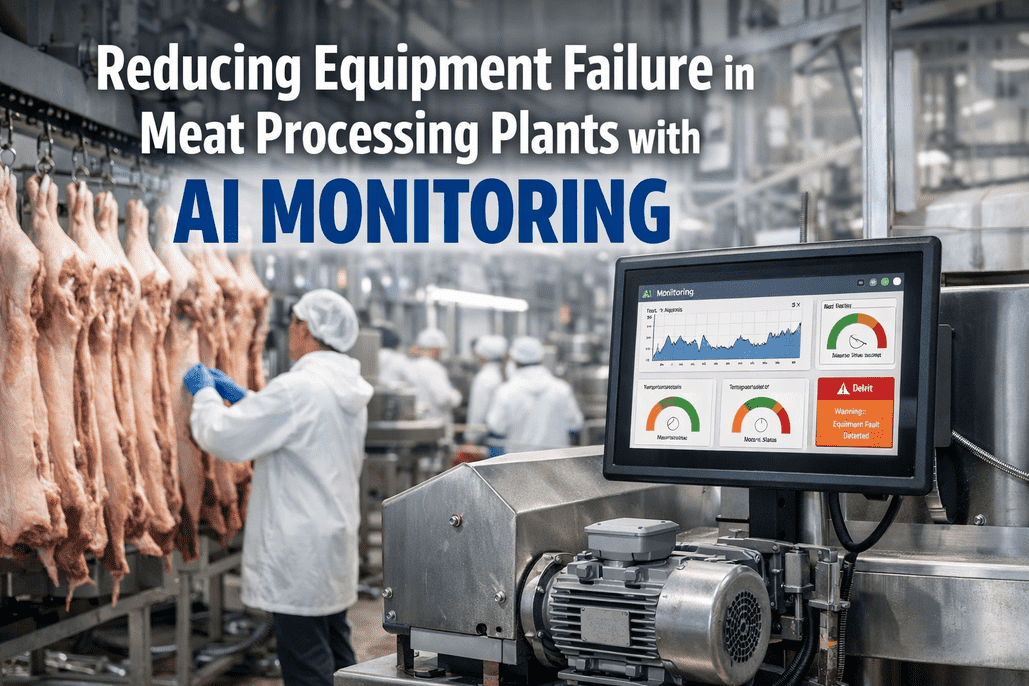
A fresh produce distributor in California lost 14 tonnes of leafy greens in a single weekend when a blast chiller compressor developed a bearing fault that went undetected for 72 hours. The temperature excursion was slow — half a degree per hour — and the manual monitoring log was only checked at shift start. By the time the failure was confirmed, the product was unsalvageable and the facility faced a $218,000 write-off on a single compressor bearing that cost $340 to replace. Predictive maintenance with IoT monitoring on OxMaint catches bearing temperature trends before a bearing failure becomes a cold chain failure — triggering a work order when the trend starts, not when the product is lost. In food manufacturing, equipment failures do not only cost repair time. They cost inventory, waste, and in many cases, customer relationships. Book a demo to see how OxMaint uses predictive maintenance to protect your food product.
Predictive Maintenance / Food Waste Reduction
Reducing Food Waste Through Predictive Equipment Maintenance and IoT Monitoring
One equipment failure in food processing does not just create downtime. It destroys perishable inventory, contaminates product in process, and triggers food safety holds that cascade through the supply chain. Predictive maintenance stops the equipment failure before the food waste begins.
$161B
Annual food waste value attributed to supply chain failures in the US
23%
Of food waste in manufacturing directly linked to equipment failures
78%
Cold chain failures are preceded by detectable sensor signals 48+ hours before
6.4x
Cost of food waste from a cold chain failure vs. preventive repair cost
The Equipment-to-Waste Chain in Food Manufacturing
Food waste from equipment failures follows a predictable pattern. The failure mechanism begins days or weeks before product is affected — but without monitoring, the first visible signal is often the food loss itself.
Phase 1 — Days 1–7
Early Degradation Signals
Vibration slightly elevated. Bearing temperature 3–4°C above baseline. Current draw marginally higher. Compressor discharge temperature trending up. No alarms triggered — all within broad normal range.
Detectable by IoT monitoring
Phase 2 — Days 7–14
Accelerating Degradation
Vibration trending higher. Bearing temperature now 8–12°C above baseline. Oil analysis showing elevated metal particles. Refrigeration capacity beginning to decline — product temperatures drifting 0.3–0.5°C above setpoint. Still no hard alarm.
Predictive threshold trigger point
Phase 3 — Hours Before Failure
Imminent Failure
Vibration spike. Bearing temperature 20°C+ above baseline. Motor overload protection may trip. If compressor fails, cold room temperature rises at 0.5–2°C per hour depending on thermal mass. Product clock starts immediately.
Reactive-only response starts here
Phase 4 — After Failure
Product Loss Event
Cold room reaches unsafe temperatures. Perishables exceed 4°C critical threshold. Depending on product type and dwell time, food safety hold or write-off is required. Average food waste event from a cold chain failure: $80,000–$250,000.
Food waste event — $80K–$250K average
Equipment Failure Types That Drive Food Waste — and Their Predictive Signals
Refrigeration Compressor
Avg. waste event: $180,000
Predictive signals to monitor:
Suction and discharge pressure trends
Bearing temperature (motor and compressor end)
Motor current draw trending
Discharge superheat deviation
Blast Chiller / Blast Freezer
Avg. waste event: $95,000
Predictive signals to monitor:
Pull-down time trend (increasing = declining capacity)
Evaporator fan current
Defrost cycle duration and frequency
Product zone air temperature deviation
CIP System Pump
Avg. loss event: $42,000
Predictive signals to monitor:
Flow rate trend below specification
Pump vibration and cavitation signature
CIP cycle time extension
Sanitisation log pass rate trend
Pasteuriser / Heat Treatment System
Avg. regulatory hold cost: $310,000
Predictive signals to monitor:
Hold tube temperature deviation frequency
Flow diversion valve actuation history
HTST recorder calibration drift
Steam supply pressure fluctuation
How OxMaint Connects IoT Signals to Food Waste Prevention
OxMaint closes the gap between sensor data and maintenance action — turning predictive signals into work orders before equipment failures become food waste events.
1
IoT Sensor Integration
Temperature, vibration, current, pressure, and flow sensors connect to OxMaint via MQTT, REST API, or direct integration with existing SCADA and BMS platforms. Sensor data streams continuously against asset-specific threshold baselines.
2
Predictive Threshold Monitoring
OxMaint monitors not just hard alarm limits but trend deviation thresholds. A bearing temperature that is 4°C above a 30-day baseline but below the alarm threshold triggers a predictive work order — before the alarm fires, before the failure occurs.
3
Automatic Work Order Generation
Threshold violations create work orders automatically — pre-populated with asset ID, fault description, sensor reading, recommended action, and required parts from the asset's spare parts register. The technician receives the job before the supervisor asks for it.
4
Cold Chain Asset Priority Escalation
Assets tagged as cold chain critical receive priority escalation — supervisor and QA notifications go out simultaneously with the technician work order. Any cold chain asset with an open predictive work order is flagged on the production dashboard until closed.
Predictive vs. Reactive Maintenance: Cost and Waste Impact
Reactive Maintenance
Failure discovered at equipment breakdown or manual check
Cold chain interrupted before corrective action begins
Emergency repair: 4.8x cost of planned repair
Product loss event: $80K–$310K depending on asset type
Food safety hold possible; regulatory documentation required
Root cause investigation adds 2–5 days of management time
Predictive Maintenance with OxMaint
Degradation trend detected 48–96 hours before failure
Work order generated automatically — parts pre-staged before job
Planned repair: full cost visibility, scheduled downtime window
Zero product loss: cold chain never interrupted
No food safety hold; no regulatory deviation required
Trend data available immediately for root cause documentation
ROI of Predictive Maintenance in Food Manufacturing
35%
Reduction in Food Waste
Average food waste reduction at facilities implementing predictive monitoring on cold chain assets
4.8x
Emergency vs. Planned Repair Cost
Every unplanned refrigeration repair costs 4.8x more than the equivalent planned intervention
48 hr
Average Predictive Lead Time
Sensor trend monitoring provides an average 48-hour warning before refrigeration compressor failure
94%
Cold Chain Uptime
Predictive maintenance facilities maintain cold chain uptime above 94% vs. 81% reactive baseline
Frequently Asked Questions
What IoT sensors are most critical for food waste prevention in a cold storage facility?
The highest-impact sensors for food waste prevention are compressor bearing temperature, compressor suction/discharge pressure, evaporator fan current, and product zone air temperature. These four sensor types together provide early warning of refrigeration system degradation at the compressor level before any product temperature excursion occurs. OxMaint integrates with standard industrial temperature, pressure, current, and vibration sensors — and with BMS/SCADA systems that already collect this data.
Start a free trial to configure cold chain predictive monitoring.
How does OxMaint distinguish between normal temperature variation and an early failure signal?
OxMaint establishes baseline profiles per asset using historical sensor data — typically 30 to 90 days of normal operating readings. Predictive alerts trigger on deviation from the asset's own baseline, not a generic threshold. This means a compressor that normally runs at 52°C bearing temperature will trigger an alert at 56–57°C, while a different compressor with a normal operating temperature of 60°C will not. Baseline profiling eliminates nuisance alerts while catching genuine degradation trends early.
Book a demo to see baseline profiling in the OxMaint platform.
Can OxMaint integrate with existing SCADA or BMS systems in a food plant?
OxMaint integrates with SCADA, BMS, and industrial IoT platforms via REST API and MQTT. If your facility already collects refrigeration sensor data through an existing building automation or process control system, OxMaint can receive that data without deploying new hardware. The platform also supports direct integration with common industrial sensor platforms including Advantech, Siemens, and Rockwell Automation controllers.
How quickly do predictive maintenance improvements affect food waste KPIs?
The reduction in food waste from equipment failures is typically visible within the first quarter of predictive monitoring deployment. Facilities report the first prevented cold chain failure — and its associated food waste event — within 4 to 12 weeks of go-live. Because the cost of a single prevented cold chain failure often exceeds the annual cost of the OxMaint deployment, ROI calculation is straightforward: one prevented event pays for the first year.
Protect Your Inventory with Predictive Maintenance
Your Next Cold Chain Failure Has a Detectable Signal Right Now. OxMaint Finds It Before the Product Does.
OxMaint connects your refrigeration, processing, and cold chain equipment to IoT sensor monitoring — establishing baseline profiles per asset, triggering predictive work orders on trend deviation, prioritising cold chain critical assets, and providing the food waste cost data your finance team needs to justify the maintenance budget.