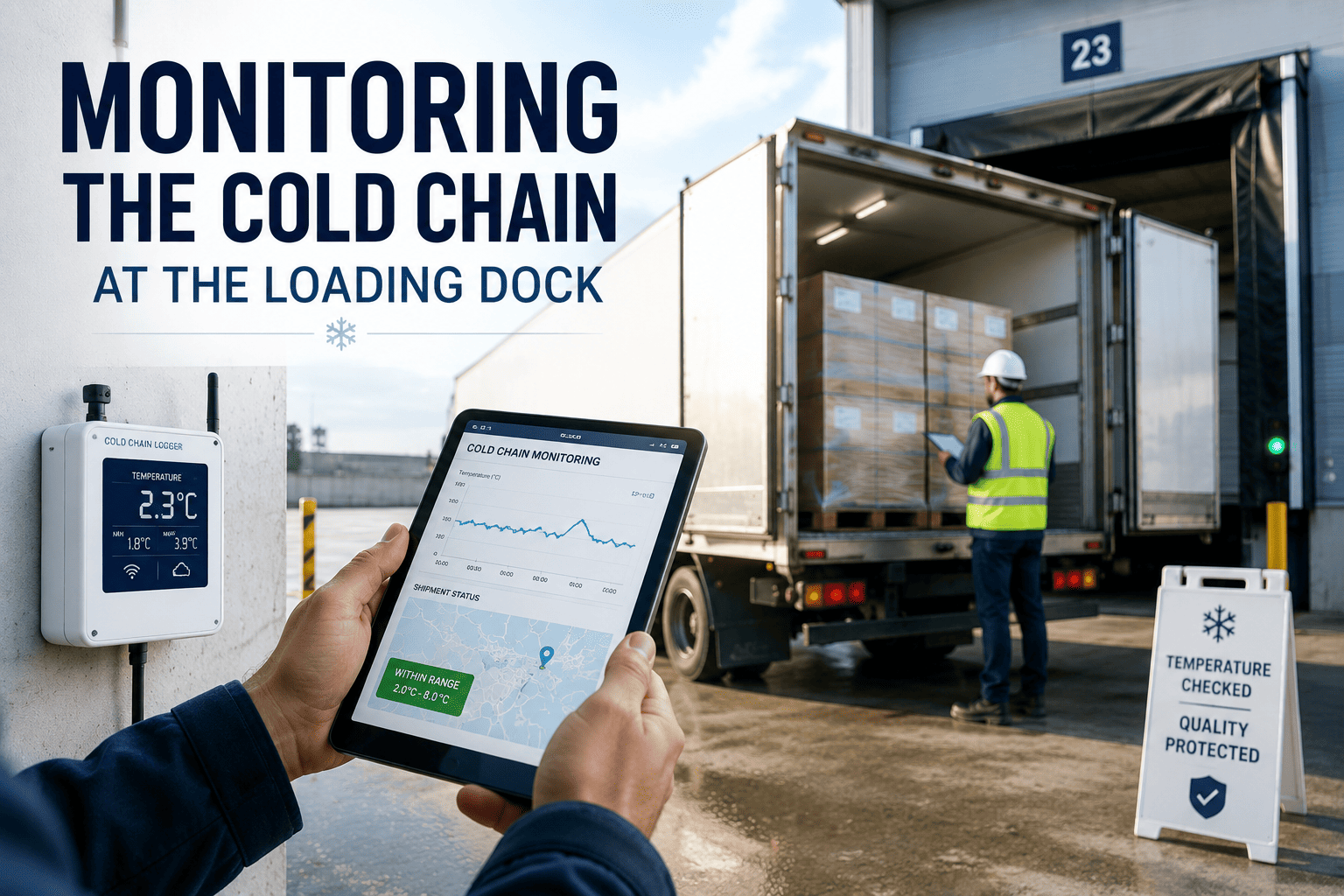
Most cold-chain failures aren't traced to a faulty reefer unit — they're traced to the twelve minutes a pallet sits on a loading dock between cold storage and trailer. Dock temperature excursions during load-out are documented recall-risk events under FSMA, HACCP, and EU 852/2004, and a single breach above 5°C for produce or above -15°C for frozen goods can trigger a Class I recall costing an average of $10M. The loading dock is the single most vulnerable handoff in the entire cold chain because it sits at the seam between two climate-controlled systems that were never designed to talk to each other. This guide walks through dock temperature monitoring, seal condition management, load-out protocol, and the CMMS-integrated dock monitoring program that keeps cold chain continuity intact from cold storage to truck. You can deploy the full workflow in a free Start Free Trial of OxMaint.
Is the last 90 seconds of your cold chain the 90 seconds that trigger a recall?
A single dock temperature excursion above the FDA's 5°C threshold for more than 12 minutes turns a compliant load into a recall-risk event. CMMS-integrated dock monitoring closes the gap between cold storage and trailer — capturing temperature, seal integrity, and reefer verification in one auditable record.
Why the loading dock is where cold chain integrity breaks
Cold storage holds at 2–4°C. Reefer trailers hold at 2–4°C. The dock between them is a 14–22°C ambient zone with no active refrigeration — and every minute a door stands open, that warm air migrates into the load.
A reefer trailer running perfectly at 2°C cannot undo a pallet that spent 14 minutes at 18°C on the dock. By the time the trailer thermometer settles, the damage is already in the product.
Pre-load dock verification checklist
Run this 14-point check before any refrigerated load enters the dock zone. Each item maps to a CMMS work-order field so the verification becomes a permanent audit record under FSMA 204 traceability rules.
Dock zone temperature
Confirm dock ambient sensor reads between 2–6°C for at least 10 minutes before load-in. Log the reading into the CMMS dock-record field with timestamp and sensor ID.
Reefer unit pre-cool verification
Trailer must be pre-cooled to the set-point for minimum 30 minutes. Capture reefer discharge-air temperature; reject trailer if > 1°C above set-point.
Dock seal & shelter condition
Inspect foam pad compression, curtain tears, and shelter-hood alignment. A 2-inch gap around a trailer edge equals a 6°C dock-zone rise in 8 minutes.
Door-curtain & air-lock integrity
Verify strip-curtain overlap (minimum 50%) and that the air curtain activates on door-open. Both barriers engaged cuts warm-air infiltration by 70%.
Pallet core temp sampling
Probe 3 random pallets per load at core; reject batch if any reading exceeds the product's max receiving temperature per HACCP critical limit.
Load-out time window
Total dock-door-open time must stay under the product-specific excursion limit — typically 15 min for chilled, 8 min for frozen. CMMS auto-flags overruns.
| Product class | Storage set-point | Max dock-zone temp | Door-open excursion limit | CMMS alert threshold |
|---|---|---|---|---|
| Frozen (ice cream, seafood) | −25°C | −12°C | 8 min | 6 min |
| Deep-chill (meat, poultry) | −2°C | 4°C | 12 min | 10 min |
| Chilled (dairy, produce) | 2–4°C | 7°C | 15 min | 12 min |
| Pharma (vaccines, biologics) | 2–8°C | 8°C | 10 min | 8 min |
| Beverage (cold-fill) | 4°C | 10°C | 20 min | 16 min |
The 6-stage CMMS load-out workflow
From trailer arrival to departure, each stage generates a timestamped record in the CMMS dock-monitoring module. Miss any stage and the audit trail breaks — which under FSMA 204 means the load is untraceable.
Trailer check-in & reefer verification
Driver checks in at the gate; CMMS auto-pulls the reefer unit's last 24-hour temperature log via telematics. Discharge-air temp must match set-point within ±1°C for the previous 30 minutes or the trailer is flagged for re-pre-cool.
Bay assignment & dock pre-conditioning
CMMS assigns a bay matched to the load's temperature class and activates the dock-zone climate system to the target set-point. Door remains closed until dock sensor confirms target range for 10 consecutive minutes.
Seal engagement & trailer dock
Driver backs into the bay; dock seal compresses against the trailer face. Operator confirms seal gap is zero on all four sides and logs the seal-condition checklist into the CMMS dock record before any door opens.
Active load-out & continuous monitoring
Dock and trailer doors open simultaneously. Dock-zone sensor samples every 15 seconds; CMMS displays a live temp curve and counts down the excursion clock. If temp crosses the alert threshold, the system sends an SMS to the dock supervisor within 30 seconds.
Door close & trailer seal
Doors close immediately after the last pallet. Trailer is sealed with a numbered tamper-evident seal; seal number, seal condition, and close-time are entered into the CMMS shipment record. Reefer unit continues running throughout.
Release & chain-of-custody transfer
CMMS generates the full dock-monitoring report — temperature log, seal record, load-out time, pallet core temps — and attaches it to the shipment's electronic bill of lading. Chain of custody transfers to the carrier with a complete, auditable trail.
A 14-bay DC: what CMMS dock monitoring saves in year one
A regional grocery distribution center runs 14 dock bays, averaging 38 refrigerated loads per day across chilled, frozen, and pharma classes. Before CMMS dock monitoring, manual clipboard logs produced 2–3 unrecorded excursions per week.
Recall probability per documented excursion event averages 4.1% across chilled and frozen categories per FDA recall data.
Plus $14,200/yr in rejected loads from unverifiable temperature histories at receiving.
| Cost / savings line | Before CMMS | With CMMS dock monitoring | Annual delta |
|---|---|---|---|
| Unrecorded dock excursions | 2.5 / week | 0.2 / week | −92% |
| Recalled-load risk exposure | $256,080 | $20,486 | −$235,594 |
| Rejected loads at receiving | $14,200 | $1,800 | −$12,400 |
| Manual logging labor (supervisor hrs) | $9,600 | $1,200 | −$8,400 |
| FSMA 204 audit prep time | $7,500 | $900 | −$6,600 |
| CMMS subscription & sensors | $0 | −$18,000 | −$18,000 |
| Total annual impact | — | — | +$262,994 |
Stop guessing about the 12 minutes that matter most.
Deploy CMMS-integrated dock monitoring in under 48 hours. Sensor pairing, FSMA 204-ready audit logs, and live excursion alerts — all in one workflow.
Cold chain dock monitoring — answered
How does a CMMS verify reefer trailer pre-cool without a manual check?
Modern reefer units broadcast discharge-air temperature via carrier telematics (ThermoKing, Carrier, etc.). The CMMS pulls the last 30 minutes of telemetry at gate check-in and flags the trailer if discharge air is more than 1°C above set-point. If telematics aren't available, the dock operator probes the trailer interior and enters the reading into the CMMS mobile app — the system still enforces the 30-minute pre-cool rule before bay assignment.
What temperature thresholds trigger a CMMS excursion alert at the dock?
Alerts are product-class specific: dock-zone temp above 7°C for chilled goods, above 4°C for deep-chill, above −12°C for frozen, and above 8°C for pharma triggers an immediate SMS to the dock supervisor. The system also fires a countdown alert when door-open time reaches 80% of the product's excursion limit, giving operators a 2–3 minute window to close before a breach is logged.
Can a CMMS dock-monitoring program satisfy FSMA 204 traceability requirements?
Yes — the dock record (temperature log, seal number, load-out timestamps, pallet core temps, bay ID, operator ID) becomes a Key Data Element in the traceability plan. You can set this up in a Start Free Trial and export the records in the FSMA-required format. The CMMS attaches the full dock report to the electronic bill of lading, so the handoff from cold storage to carrier is fully traceable.
What hardware is required beyond the CMMS software?
Each dock bay needs one ambient temperature sensor (wired or wireless, sampling every 15 seconds), a door-open sensor, and optionally an infrared pallet-core probe. Existing reefer telematics integrate via API. Total hardware cost per bay ranges from $800–$1,400 depending on sensor class, with a typical 14-bay DC spending under $18,000 fully deployed.
How long does deployment take for a multi-bay distribution center?
A 14-bay DC is typically fully operational in 36–48 hours: sensor mounting and pairing on day one, CMMS workflow configuration and staff training on day two. The fastest way to scope your specific bays, product classes, and reefer integration is to Book a Demo with the OxMaint team for a tailored deployment plan.
Every dock door is a recall risk — until it's monitored.
Join the distribution centers that cut dock excursions by 92% in year one. Full CMMS dock-monitoring workflow, FSMA 204-ready records, live alerts — live in 48 hours.
Free 14-day trial · No credit card