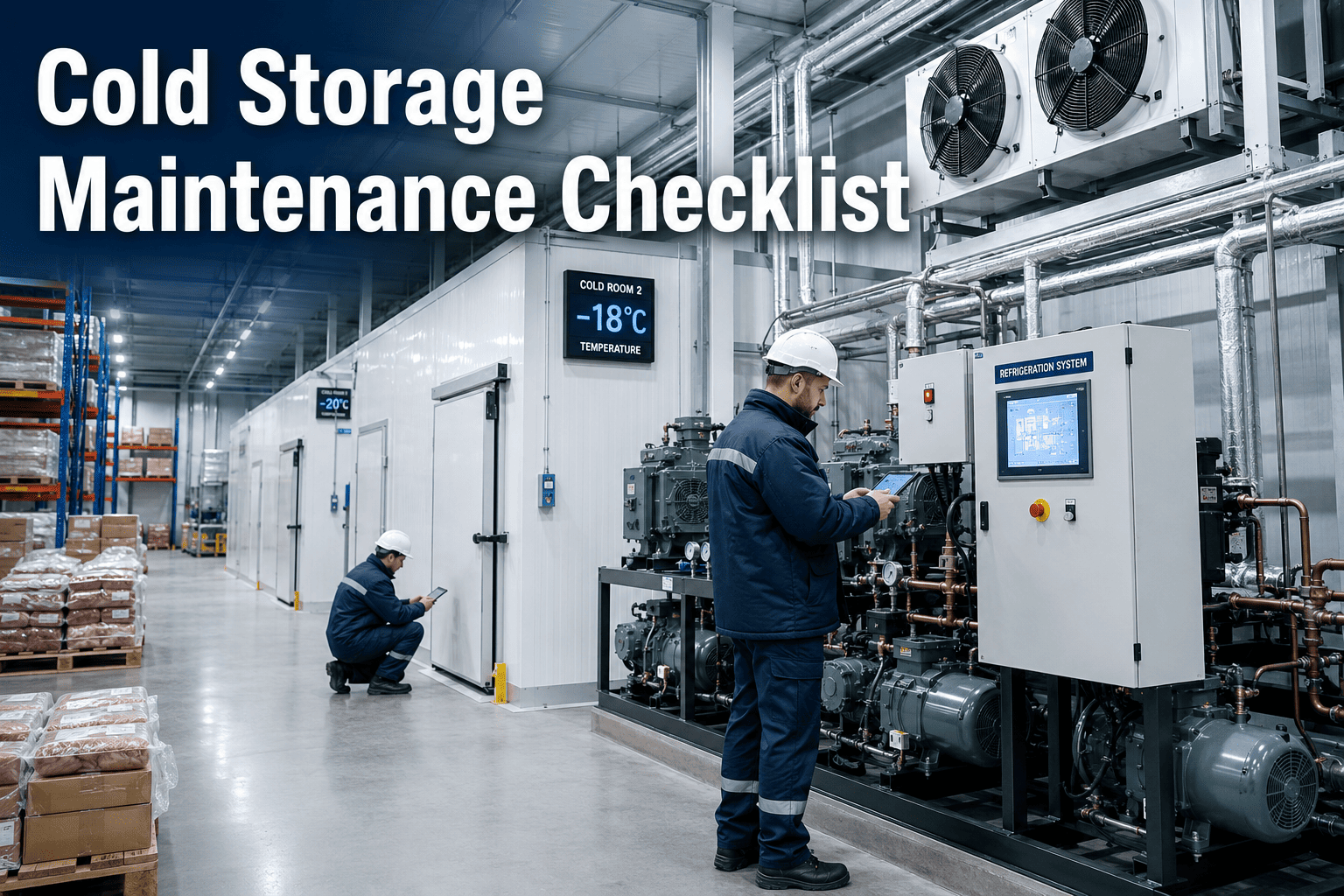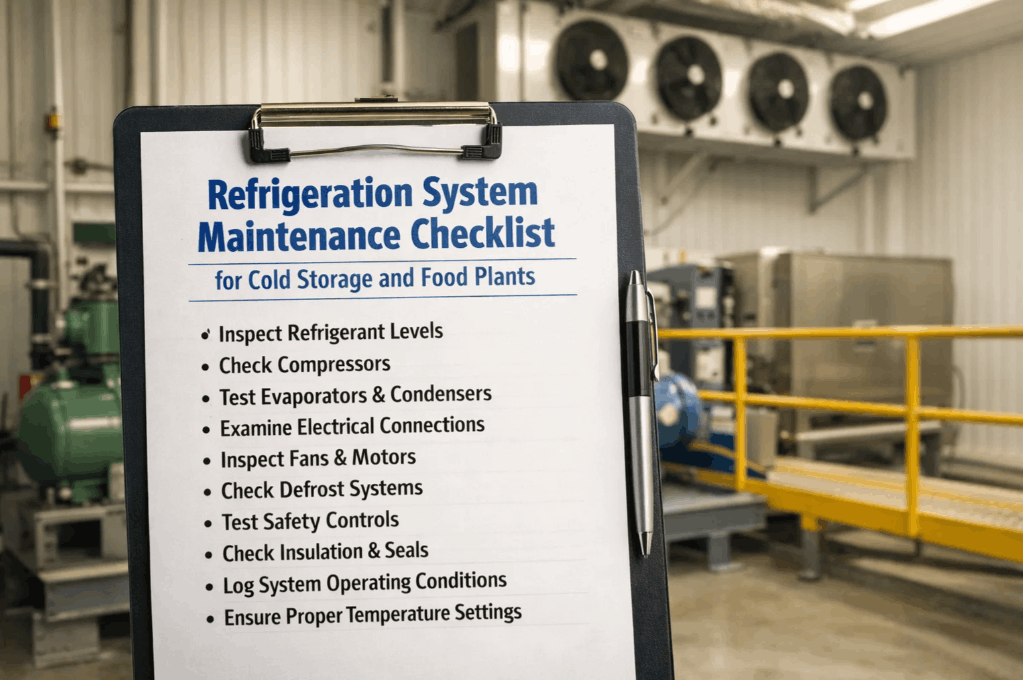
Industrial refrigeration systems in food plants and cold storage facilities operate under extreme demands — continuous duty cycles, temperature-critical loads, and zero tolerance for unplanned downtime. A compressor failure at 2 AM or a condenser coil blocked with grease isn't just a maintenance event; it's a food safety incident, a product loss, and a regulatory exposure rolled into one. This refrigeration system maintenance checklist gives refrigeration technicians and facility engineers a structured, frequency-based framework covering compressors, condensers, evaporators, ammonia systems, glycol loops, expansion valves, and controls — every critical subsystem from oil management to leak detection, aligned to the PM intervals that protect cold chain integrity and keep your facility audit-ready.
1. Compressor Maintenance Checklist
Compressors are the mechanical heart of any industrial refrigeration system. Reciprocating, screw, and centrifugal compressors each have distinct PM requirements, but all share a common vulnerability to lubrication failure, valve wear, and vibration-induced loosening that accelerates when scheduled maintenance lapses. Track compressor PM intervals with OxMaint.
Daily: Check Suction and Discharge Pressures
Log suction and discharge pressures at each operating compressor and compare against design operating conditions. Abnormal pressure ratios indicate refrigerant shortage, condenser fouling, or valve inefficiency requiring investigation before the next shift.
Daily: Verify Oil Level and Oil Pressure Differential
Confirm crankcase or oil reservoir levels are within operating range and that oil pressure differential meets manufacturer specifications. Oil pressure below the minimum setpoint trips the lube oil safety — investigate the root cause rather than simply resetting the control.
Weekly: Inspect for Abnormal Vibration and Noise
Use a vibration pen or handheld analyzer to check bearing housings, coupling guards, and compressor body for vibration readings outside baseline. Unusual knocking, valve chatter, or liquid slugging noise requires immediate shutdown assessment to prevent catastrophic internal damage.
Monthly: Sample Compressor Oil for Analysis
Draw oil samples from operating compressors and submit to a laboratory for viscosity, acid number, moisture content, and metallic wear particle analysis. Oil analysis trending over multiple intervals is the most reliable early warning of bearing wear, seal deterioration, or refrigerant migration into the oil circuit.
Annually: Inspect Valves, Pistons, and Cylinder Liners
On reciprocating compressors, open valve covers and inspect suction and discharge valves for breakage, carbon deposits, and spring fatigue. Measure cylinder liner wear and piston ring gap against OEM tolerances. On screw compressors, inspect rotor timing, slide valve operation, and shaft seal condition.
Annually: Test All Compressor Safety Controls
Manually test the operation of high-pressure cutout, low-pressure cutout, high-temperature cutout, and oil pressure differential safety. Document setpoints and trip values against design specifications. Safety controls that fail to trip within tolerance must be replaced before the compressor is returned to service.
2. Condenser Maintenance Checklist
Condenser fouling is the single largest contributor to elevated condensing pressure and compressor discharge temperature in food plant refrigeration systems. Evaporative condensers, air-cooled condensers, and shell-and-tube water-cooled condensers each accumulate scale, biological growth, and airborne contamination at different rates — all of which compress operating margins and increase energy consumption predictably.
Weekly: Monitor Condensing Pressure and Approach Temperature
Log condensing pressure and calculate the approach temperature (condensing temperature minus ambient wet-bulb for evaporative, or leaving water temperature minus condensing temperature for water-cooled). Rising approach temperature is the earliest measurable indicator of fouling requiring cleaning intervention.
Monthly: Clean Evaporative Condenser Fill Media and Basin
Flush the sump basin, inspect and clean drift eliminators, and visually assess fill media for biological growth or scale accumulation. Test water chemistry for conductivity, pH, and biocide residual. Evaporative condenser basins in food plant environments require Legionella-compliant water treatment management.
Quarterly: High-Pressure Wash Condenser Coil Surfaces
Clean condenser coils using manufacturer-approved descaling solution and high-pressure water rinse. On air-cooled condensers, clean from the discharge face inward to avoid packing debris into the coil. On evaporative condensers, descale tube bundles with chemical circulation when scale deposits are confirmed by approach temperature trending.
Annually: Inspect Fan Blades, Bearings, and Drive Components
Inspect condenser fan blades for erosion, pitch angle uniformity, and blade tip clearance. Lubricate or replace bearings per OEM schedule. Check belt tension and sheave alignment on belt-driven units. Document motor amperage at full speed against nameplate rating to detect winding degradation.
Want to automate condenser PM scheduling and track cleaning records in one place? Book a free OxMaint demo and see how refrigeration teams manage condenser maintenance digitally.
3. Evaporator Maintenance Checklist
Evaporators in blast freezers, cold rooms, and process refrigeration circuits accumulate frost, ice, and in food plant environments, airborne grease and organic contamination that degrade heat transfer efficiency and create sanitation risks. Defrost cycle management and coil cleaning frequency directly determine how close to design capacity your evaporators operate day to day.
Daily: Verify Defrost Cycle Completion and Drain Operation
Confirm that all defrost cycles completed within the scheduled time window and that drain pans and drain lines are clear of ice bridging or blockage. Incomplete defrost cycles in walk-in coolers and freezers are the leading cause of progressive coil icing that eventually requires emergency manual defrost.
Weekly: Inspect Evaporator Fans and Motor Mounts
Check evaporator fan blade condition for ice accumulation, cracks, or tip erosion. Verify motor mounts are secure and that fan guards are in place. Measure motor amperage on units with accessible current testing points. Fan motors in freezer applications operating with failed blade seals ice up rapidly and fail prematurely.
Quarterly: Chemical Clean Evaporator Coils in Food Areas
Apply food-safe alkaline coil cleaner to evaporator surfaces in processing and packaging areas where grease and organic particulates accumulate. Rinse thoroughly before returning to service. Document cleaning dates, chemical used, and contact time to satisfy food safety audit requirements and HACCP documentation.
Annually: Pressure Test Evaporator Coils and Inspect Headers
Pressure test evaporator coil sections with dry nitrogen to confirm refrigerant tightness. Inspect distributor tubes, headers, and return bends for corrosion, particularly in high-humidity or ammonia-compatible environments. Document any sections showing pitting or wall thinning for engineering evaluation.
4. Ammonia System Maintenance Checklist
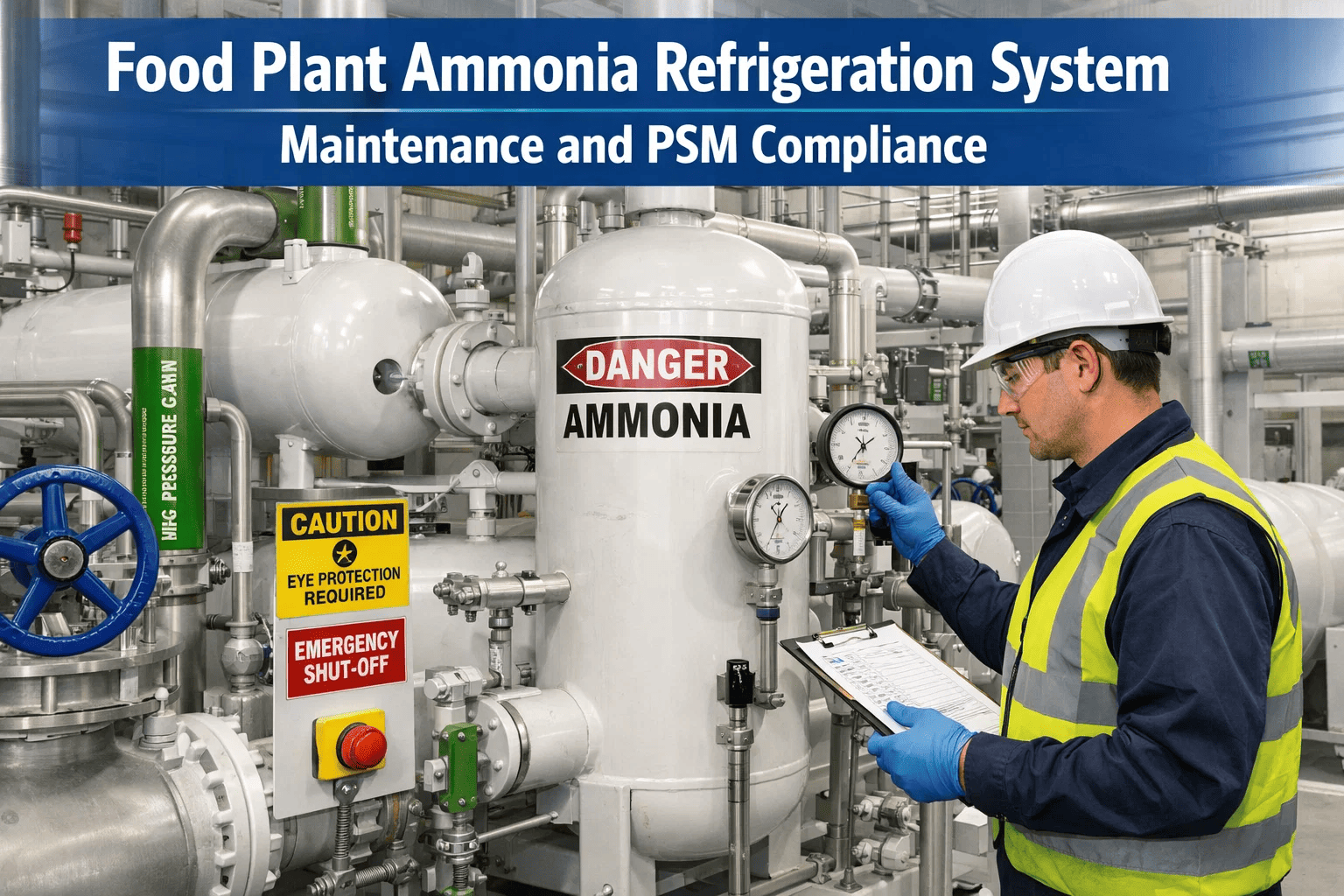
Ammonia refrigeration systems are subject to PSM (Process Safety Management) and RMP (Risk Management Program) requirements in facilities above regulatory threshold quantities. Maintenance of ammonia systems carries regulatory obligations that extend beyond mechanical reliability — leak detection, relief valve management, and emergency shutdown system integrity are compliance requirements, not optional PM items. Manage ammonia system compliance records with OxMaint.
Daily: Inspect Ammonia Detection System Calibration and Alarm Status
Verify that all fixed ammonia detectors are online, that alarm outputs are active, and that detector heads in machinery rooms, freezer spaces, and control rooms are within calibration validity. Electrochemical sensor cells in ammonia detectors degrade over time — calibration logs must be current to satisfy PSM mechanical integrity records.
Weekly: Conduct Visual Leak Survey of Ammonia Piping and Valves
Walk all accessible ammonia piping, valve stations, pump seals, and relief valve outlets with a sulfur stick or portable detector to identify any developing leak points. Log any indications in the PSM mechanical integrity log. All ammonia leaks must be investigated and repaired; none should be recorded as "monitor and recheck."
Annually: Test and Document Relief Valve Condition
Remove and bench test all pressure relief valves on vessels, compressors, and high-side piping per IIAR 9 and manufacturer requirements. Replace any valve that fails to open at the rated set pressure or that shows evidence of weeping, corrosion, or seat damage. Maintain a relief valve registry with test dates and replacement history.
Annually: Inspect Ammonia Vessels for Corrosion and Wall Thickness
Conduct external visual inspection of all pressure vessels (high-pressure receivers, low-pressure receivers, intercoolers, oil pots) for corrosion under insulation (CUI), paint breakdown, and support saddle condition. Schedule ultrasonic thickness testing at corrosion-prone locations per the PSM mechanical integrity program schedule.
Annually: Test Emergency Shutdown System and Ventilation Interlocks
Simulate ammonia detection events to verify that emergency shutdown valves close, that machinery room ventilation activates at design capacity, and that audio-visual alarms activate within specified time delays. Test emergency stop circuits independently of the detection system to confirm wiring integrity and actuator response.
5. Glycol System Maintenance Checklist
Secondary glycol refrigeration loops are used extensively in food processing, dairy, and beverage plants where indirect refrigeration reduces ammonia inventory and system complexity in production areas. Glycol system maintenance focuses on concentration management, corrosion inhibitor replenishment, and pump and heat exchanger integrity — all of which degrade quietly until a heat transfer or freeze protection failure makes the problem visible.
Monthly: Test Glycol Concentration and Freeze Point
Draw glycol samples from the system return header and test concentration using a calibrated refractometer. Calculate the freeze point protection margin relative to the lowest expected operating temperature. Systems operating with less than a 10°F freeze point safety margin require glycol addition before the next cooling season.
Quarterly: Analyze Glycol for pH, Inhibitor Level, and Contamination
Submit glycol samples for laboratory analysis of pH, corrosion inhibitor concentration, chloride contamination, and microbiological activity. Propylene glycol systems in food plant applications require food-grade inhibitor packages maintained at the manufacturer's recommended concentration to prevent iron, copper, and aluminum corrosion.
Quarterly: Inspect Circulation Pump Seals and Bearing Condition
Check glycol pump mechanical seal faces for weeping, seal flush line flow, and bearing housing temperature. Glycol leaks at pump seals in food production environments are contamination risks. Document seal condition and schedule replacement at the first indication of dripping rather than allowing progressive leakage to develop.
Annually: Clean and Inspect Plate Heat Exchanger or Shell-and-Tube Chiller
Disassemble plate heat exchanger packs or open shell-and-tube heads to inspect for fouling, gasket condition, and plate erosion. Clean fouled surfaces with appropriate chemical cleaners and pressure-test after reassembly. Document heat exchanger approach temperatures before and after cleaning to quantify fouling impact and establish future cleaning trigger points.
Need a smarter way to track glycol chemistry logs and pump maintenance intervals? Book a free OxMaint demo and see how cold storage facilities manage secondary refrigeration PM records with ease.
6. Expansion Valves and Controls Maintenance Checklist
Expansion devices and refrigeration control systems determine how efficiently refrigerant is metered to evaporators and how precisely operating setpoints are maintained across the system. Thermostatic expansion valve (TXV) hunting, electronic expansion valve (EEV) calibration drift, and control sensor failures are among the most common causes of evaporator capacity loss in cold storage facilities.
Monthly: Verify Superheat Setpoints at Suction Line
Measure suction line superheat at each evaporator circuit using a calibrated clamp-type thermometer and pressure/temperature chart. Superheat values outside the 8–12°F target range indicate TXV bulb charge loss, valve seat fouling, or improper sensing bulb contact requiring field adjustment or valve replacement.
Quarterly: Calibrate Temperature and Pressure Sensors
Verify calibration accuracy of all refrigeration control temperature sensors, pressure transducers, and humidity sensors using calibrated reference instruments. Sensors with drift exceeding 1°F or 2 psi from the reference must be recalibrated or replaced. Sensor calibration records are a required component of HACCP critical control point documentation in food facilities.
Annually: Test Electronic Expansion Valve Response and Hunting Behavior
Simulate load changes in the refrigeration controller and observe EEV response for excessive hunting, sluggish response, or failure to achieve stable superheat within design response time. Log EEV step position data from the controller and compare to baseline commissioning data to detect motor gear wear or control loop parameter drift.
Annually: Inspect Solenoid Valves for Coil Condition and Seat Wear
Test liquid line, hot gas, and suction solenoid valves for complete open and close operation. Measure coil resistance and compare to nameplate specifications to detect winding degradation. Inspect valve seats on solenoids showing slow temperature recovery after energization — seat wear allows refrigerant bypass that degrades system efficiency and space temperature control.
Annually: Review and Update Refrigeration Control Setpoints
Review all PLC or refrigeration controller setpoints against current operating conditions and design documentation. Verify that defrost initiation and termination setpoints, safety alarm setpoints, and temperature alarm notification thresholds remain appropriate for current production schedules. Document any setpoint changes with authorization signatures per the PSM Management of Change procedure where applicable.
Frequently Asked Questions
The most common questions from refrigeration technicians and facility engineers about industrial refrigeration maintenance frequencies, compliance requirements, and cold storage PM best practices.
Oil change intervals depend on oil type, system cleanliness, and oil analysis results — not fixed calendar intervals. Mineral oil in ammonia systems typically requires annual changes, while synthetic alkylbenzene oils can extend to 2–3 years with clean oil analysis. Oil analysis trending is the most reliable indicator of when a change is actually required.
OSHA 29 CFR 1910.119 PSM requires written procedures for all maintenance tasks on covered process equipment, documentation of each inspection and test with date, name of inspector, and results, and records of deficiencies and corrective actions. Relief valve testing, leak inspection logs, safety control tests, and vessel inspection records must all be maintained and retrievable during OSHA audits.
For a 28°F operating temperature, propylene glycol concentration should be maintained to provide a freeze point of at least 18°F — typically 30–35% by volume depending on the specific glycol product. Always verify with the glycol manufacturer's concentration chart and maintain at least a 10°F safety margin below the lowest expected operating temperature.
A CMMS like OxMaint automates PM work order issuance at required frequencies, stores calibration records, oil analysis reports, and relief valve test documentation in a single retrievable system, and generates compliance reports for PSM audits, FDA inspections, and third-party food safety certifications — eliminating the paper log gaps that create audit findings.
Fouled condenser coils are the most common cause, followed by non-condensable gas (air or nitrogen) trapped in the high side, condenser fan failure, and elevated ambient or wet-bulb temperatures. Tracking approach temperature trend data over time distinguishes fouling (gradual rise) from non-condensable contamination (sudden step increase) and guides the correct corrective action.