The United States has approximately 180 million utility poles in service — the majority of them aging wood structures that require periodic inspection to prevent failures that cause outages, fires, and public safety hazards. Traditional ground-based manual inspection of utility poles is labor-intensive, slow, and limited in what a field inspector can actually see and measure from a standing position. AI-powered vision inspection systems mounted on drones, vehicles, or handheld devices are now capable of detecting rot, cracking, woodpecker damage, insulator defects, attachment hardware corrosion, and structural lean with far greater accuracy and consistency than manual methods — and at a fraction of the time and cost. This article covers how municipal utilities and public works agencies are implementing AI vision inspection programs for utility pole networks, and how OxMaint connects inspection findings directly to prioritized maintenance work orders.
Electric Utilities · AI Vision Inspection
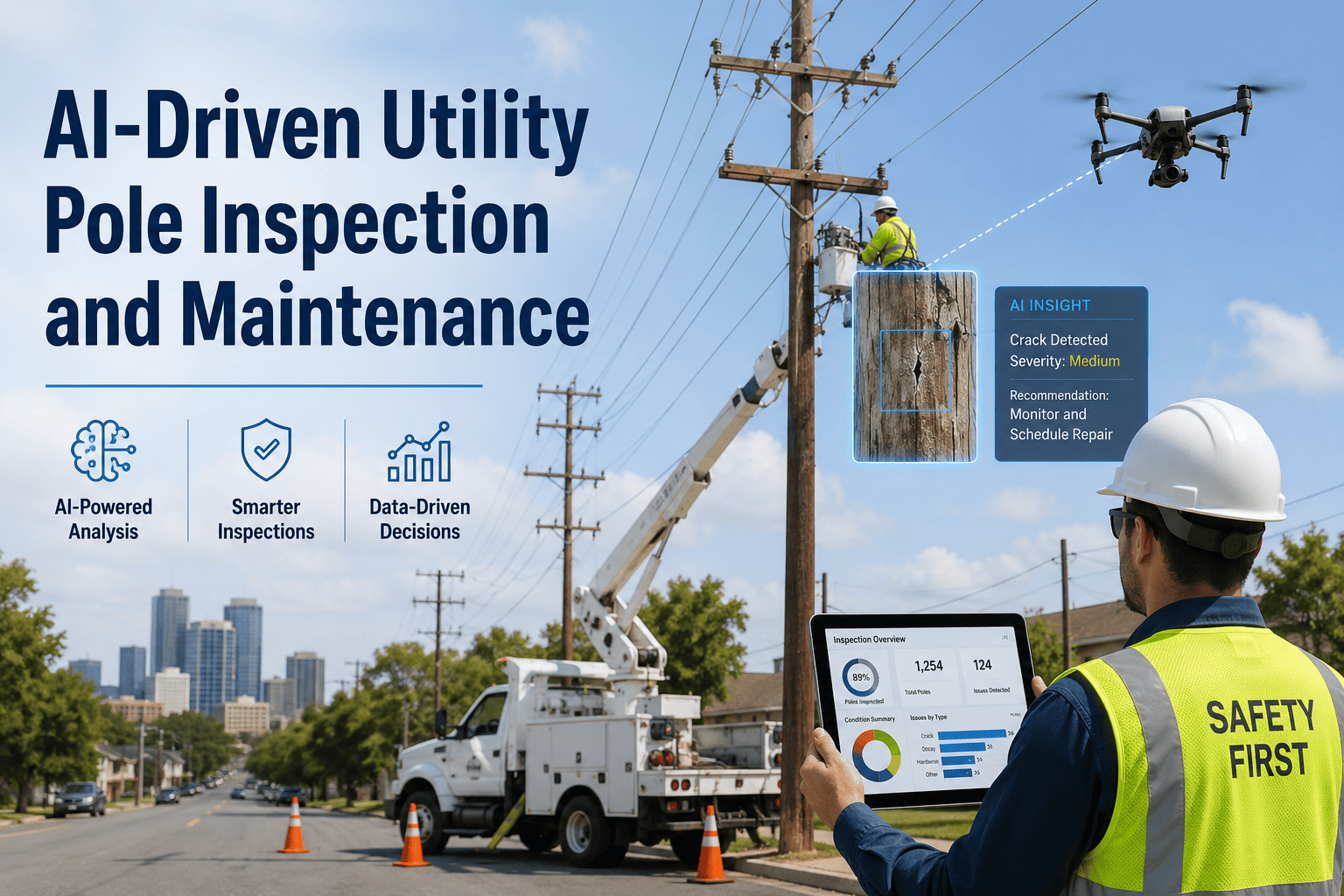
AI-Driven Utility Pole Inspection and Maintenance
How AI vision systems are replacing manual inspection for utility pole networks — detecting structural defects, hardware failures, and safety hazards that traditional methods miss, and connecting every finding to a maintenance work order automatically.
180M
Utility poles in service across the US
25%
Of poles exceed recommended replacement age
60%
Defect detection improvement with AI vs manual inspection
3x
Faster inspection speed with drone + AI vision systems
What AI Vision Inspection Detects That Manual Methods Miss
Ground-based manual inspection of utility poles is constrained by what an inspector can see with binoculars from the base of the pole. Structural defects at the groundline — the highest-risk zone for wood pole failure — are largely invisible without probing, and hardware defects at height require a climber. AI vision systems operating from drones or pole-mounted cameras capture the entire pole surface in high resolution, with defect detection models trained on thousands of labeled failure images covering every major failure mode in utility pole infrastructure.
Groundline Zone
Internal rot and shell rot at soil interface
Checking and splitting at base
Fungal decay indicators
Soil contact moisture damage
Highest failure risk zone
Mid-Pole Body
Woodpecker damage and cavity formation
Longitudinal checking severity
Physical impact damage (vehicle strikes)
Structural lean measurement
Safety and stability indicators
Upper Pole and Hardware
Insulator cracking and glazing failure
Crossarm splitting and hardware corrosion
Guy wire tension and anchor condition
Transformer mounting hardware integrity
Outage and fire risk zone
Manual vs AI-Assisted Utility Pole Inspection: Performance Comparison
The business case for AI vision inspection in utility pole programs is not just about defect detection accuracy — it is about the scale and speed at which a jurisdiction can complete its inspection cycle relative to its pole population. Most municipal utilities with aging pole infrastructure cannot complete a full manual inspection cycle within their budget cycle. AI-assisted inspection changes the economics fundamentally.
| Metric |
Manual Ground Inspection |
AI Vision + Drone Inspection |
| Inspection rate |
50–80 poles per crew per day |
200–400 poles per crew per day |
| Groundline defect detection |
Requires physical probing — often skipped |
Thermal and visual AI models detect below-grade indicators |
| Hardware defect accuracy |
Limited — binocular inspection at distance |
High-resolution imagery with AI classification per defect type |
| Structural lean measurement |
Estimated visually — inconsistent |
LiDAR measurement accurate to 0.5 degrees |
| Inspection documentation |
Paper forms, manual data entry, photo if remembered |
Automated per-pole report with geotagged images, defect classifications, severity ratings |
| Work order integration |
Separate entry into CMMS — hours to days lag |
Direct API push to OxMaint — work orders generated immediately |
Connect Your AI Inspection Findings to Maintenance Work Orders Automatically
OxMaint receives defect findings from AI vision inspection systems via API and converts them into prioritized maintenance work orders assigned to field crews — within minutes of inspection completion. No manual data entry, no lag between finding and action.
The Defect-to-Work-Order Workflow in OxMaint
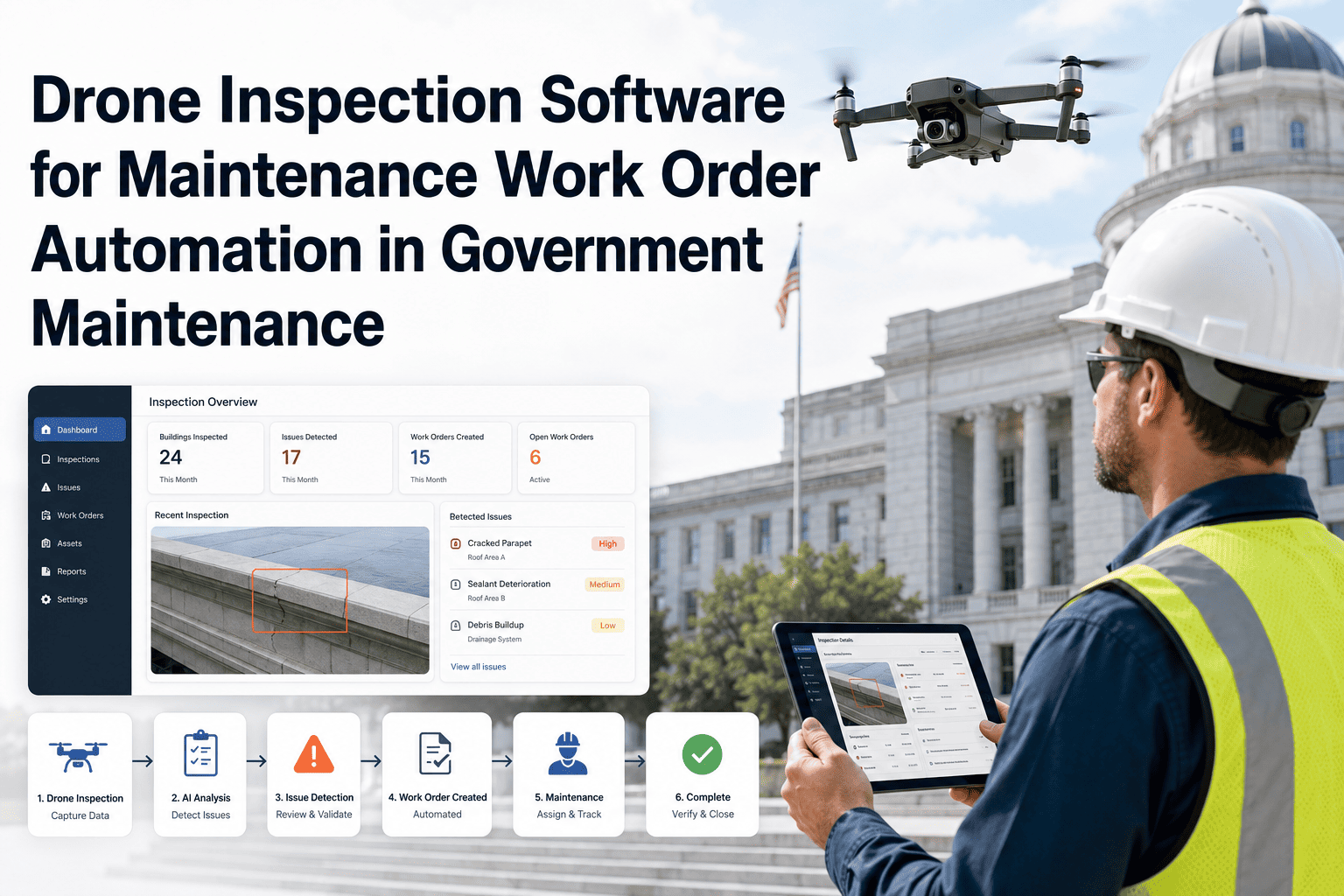
The value of AI vision inspection is only fully realized when inspection findings immediately trigger the right maintenance response. OxMaint's integration with AI inspection platforms creates a continuous workflow loop — from drone pass to field crew dispatch — with every defect finding recorded against the pole asset's permanent maintenance history.
Step 1
AI Inspection Completed
Drone or vehicle-mounted AI vision system completes inspection run. Defect classifications, severity ratings, and geotagged images are generated per pole.
Step 2
Findings Pushed to OxMaint
AI inspection platform sends defect data via API to OxMaint. Each finding is matched to the pole asset record by GPS coordinates or pole ID.
Step 3
Priority Work Orders Generated
OxMaint creates maintenance work orders with priority ranking based on defect severity, regulatory replacement thresholds, and asset criticality in the network.
Step 4
Crew Assignment and Routing
Field crews receive mobile work orders with pole location, defect summary, required materials, and access instructions. Crew routing is optimized by geographic cluster.
Step 5
Field Completion and Documentation
Technicians document completion with photos, parts used, and outcome notes. Work order closes against the pole asset record with full timestamp and technician identity.
Step 6
Compliance Report Generation
OxMaint generates NESC, state PUC, and internal compliance reports from the completed inspection and maintenance records — exportable for regulatory submissions.
Utility Pole Inspection Compliance Standards
| Standard |
Governing Body |
Inspection Requirement |
OxMaint Documentation Support |
| NESC (IEEE C2) |
IEEE |
Inspection at 10-year maximum intervals; immediate inspection after storm or impact events |
Inspection cycle tracking, event-triggered work orders, interval compliance reports |
| ANSI O5.1 |
ANSI |
Wood pole performance requirements and reject criteria by species and class |
Asset class tracking, reject threshold alerts, replacement work order generation |
| State PUC Rules |
State Commissions |
Varies by state — typically annual or biennial inspection requirements for distribution |
State-specific compliance report templates, inspection completion evidence by jurisdiction |
| NERC CIP (Transmission) |
NERC |
Transmission structure inspection and maintenance for bulk electric system assets |
CIP-014 physical security documentation, transmission asset maintenance evidence |
Expert Review
The practical barrier to effective utility pole maintenance has never been a lack of inspection standards — it is the gap between what inspection programs find and what maintenance programs act on. A utility that completes a thorough AI inspection of 50,000 poles and produces a ranked defect list has accomplished half the job. If those findings take three weeks to reach the crew dispatch system, if they're entered manually and lose context, or if the work orders generated don't reflect the actual defect severity and material requirements, the inspection investment is partially wasted. The integration between inspection intelligence and maintenance execution is where the ROI of AI inspection programs is actually captured. That integration is what makes the difference between knowing your infrastructure is degrading and actually fixing it before it fails.
Frequently Asked Questions
Which AI vision inspection platforms does OxMaint integrate with for utility pole programs?
OxMaint integrates with AI inspection platforms through standard REST API connections that accept inspection findings in structured data formats. The integration workflow maps inspection defect records to existing pole asset records in OxMaint by GPS coordinates, pole ID, or other location identifiers — and converts each finding into a maintenance work order with the correct priority, crew assignment logic, and documentation requirements. Specific platform integrations can be configured based on your program's existing inspection technology.
Book a demo with our utilities team to discuss your specific inspection platform and how the integration workflow would function for your pole network.
Explore OxMaint to see the asset management structure that supports utility pole maintenance programs.
How does OxMaint handle the prioritization of utility pole maintenance work orders from large inspection batches?
When AI inspection systems complete a large inspection run and push findings to OxMaint, the platform applies configurable prioritization logic to generate work orders in the correct action sequence. Priority factors include defect severity (reject vs action-required vs monitor), pole criticality in the network (transmission vs distribution vs service lateral), geographic clustering for crew routing efficiency, and regulatory replacement thresholds that trigger mandatory timelines under NESC or state PUC rules. This prioritization logic prevents operations teams from being overwhelmed by a large finding list and ensures that the highest-risk poles receive maintenance response first.
OxMaint also allows manual override of generated priorities when field supervisors have additional context.
Talk to our team about configuring priority rules for your specific program.
Can OxMaint manage the complete pole asset lifecycle — from installation records through inspection history to decommissioning?
Yes — OxMaint maintains a persistent asset record for each utility pole that accumulates the complete maintenance and inspection history from initial installation through the pole's full service life. The asset record includes installation date, pole class and species, manufacturer, initial inspection at installation, all subsequent inspection records with defect findings and photos, all maintenance work orders and completion records, and treatment or reinforcement history. When a pole reaches reject condition and a replacement work order is completed, the decommissioned pole record is retained in the system with its complete history — relevant for regulatory compliance audits and for analyzing failure patterns across the pole population.
Start exploring the asset management capabilities or
book a walkthrough with our utilities team.
How does AI-assisted inspection change the economics of utility pole programs for smaller municipal utilities?
Smaller municipal utilities with limited inspection budgets often face the most acute pole aging challenges because their inspection cycles have historically been the longest. A municipal utility with 20,000 poles and a two-person inspection team might complete a full manual inspection cycle every 8–10 years — well beyond NESC and most state PUC requirements. AI vision inspection using contracted drone services can complete the same network in a fraction of the time, with significantly higher defect detection accuracy, for a comparable or lower cost than the extended manual cycle. The key economic factor for smaller utilities is that AI inspection also generates the structured, prioritized maintenance backlog that OxMaint can then execute systematically — turning an overwhelming asset condition problem into a manageable, sequenced maintenance program.
Talk to our team about how other municipal utilities have structured their AI inspection and maintenance programs.
From AI Inspection Finding to Field Crew Action in Minutes
OxMaint closes the loop between AI vision inspection and utility pole maintenance execution — so every defect finding becomes a prioritized work order, and every work order becomes a compliance-ready maintenance record. Talk to our electric utilities team about your pole network and inspection program.