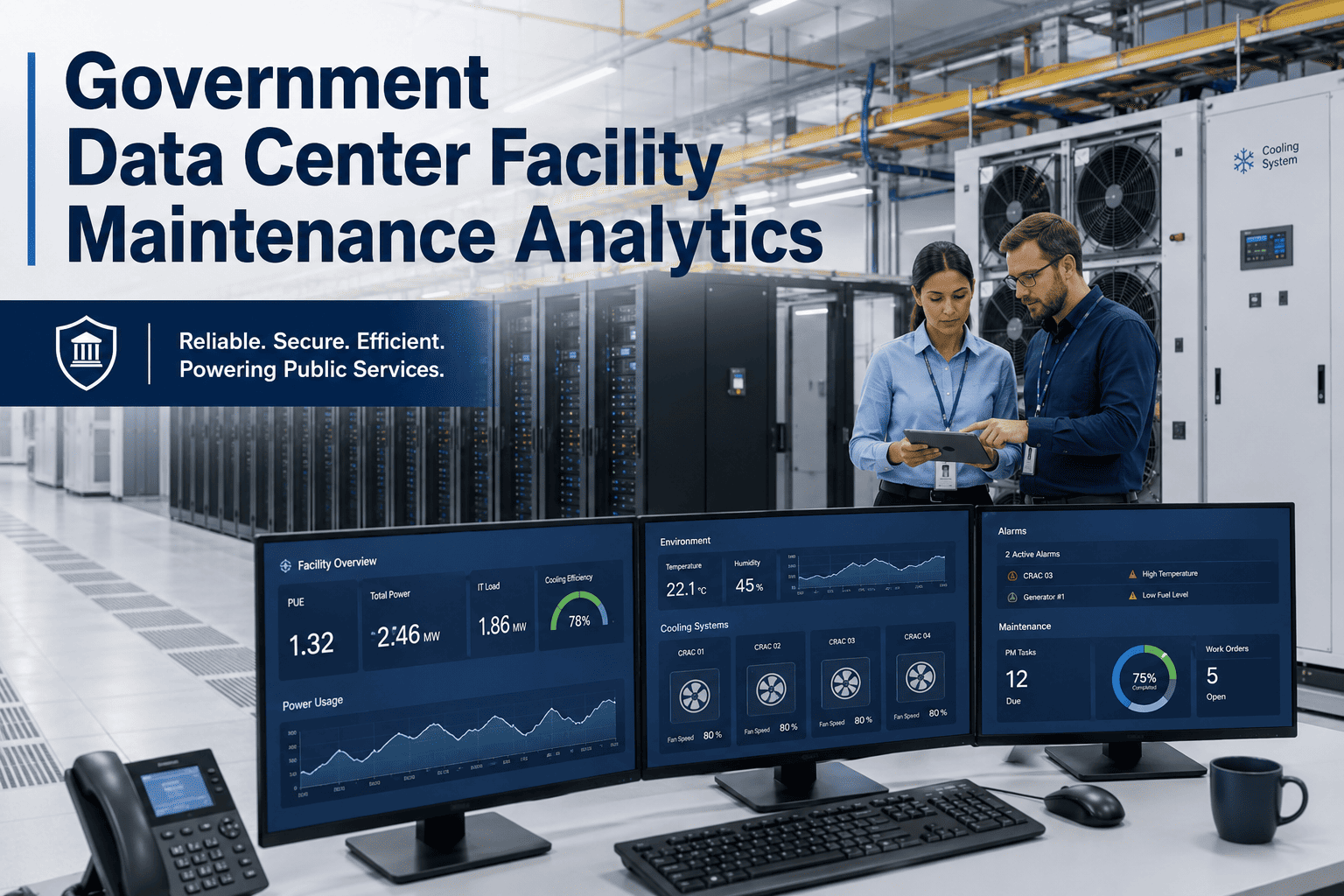
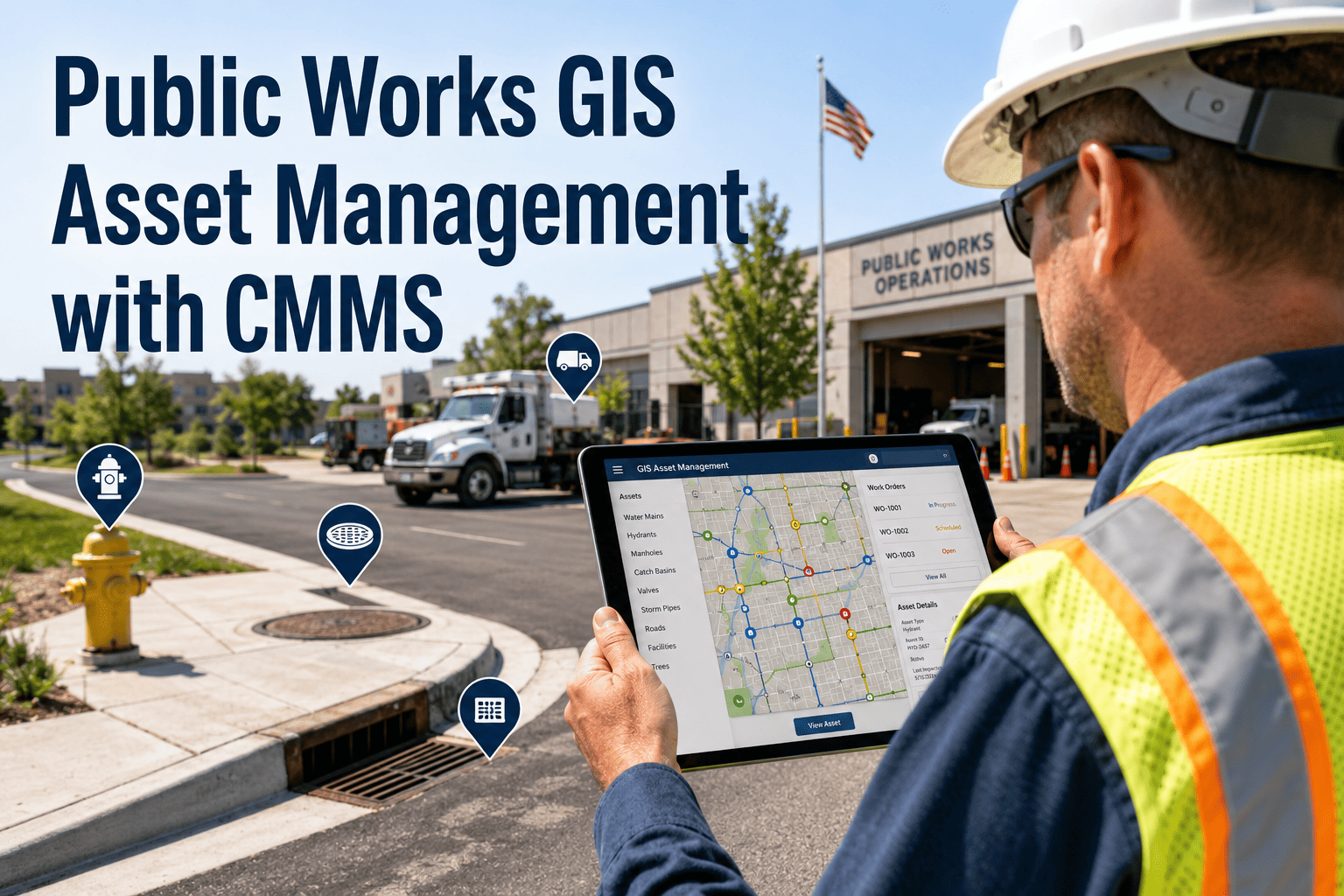
Government data centers run citizen-facing services around the clock — tax processing, benefits administration, emergency dispatch systems, and public records databases that cannot afford unplanned downtime. Yet most public sector facilities maintenance teams still manage HVAC, UPS systems, cooling infrastructure, and generator assets with reactive maintenance practices and paper-based inspection records. When the average hourly cost of government data center downtime exceeds $5 million, and public sector organizations report $73 million in annual downtime damage-control costs, the gap between reactive and predictive maintenance is not a technology preference — it is a fiscal and operational risk management decision. This article covers how predictive maintenance analytics applied to government data center facilities reduces unplanned downtime, extends asset life, and builds the audit trails that public agencies require for FedRAMP, FISMA, and government facility compliance programs.
Government IT Facilities · Predictive Maintenance AI
Government Data Center Facility Maintenance Analytics
How public sector data center facility teams use predictive maintenance intelligence to prevent infrastructure failures before they become service outages — with full compliance documentation built in.
$5M+
Hourly cost of government data center downtime
$73M
Avg annual downtime damage-control costs for public sector
93%
Of organizations that experience data center failure go bankrupt within 1 year
25–30%
Maintenance cost reduction achievable with predictive analytics
The Four Critical Systems That Predictive Maintenance Protects
Government data centers depend on interconnected mechanical and electrical systems where a single component failure can cascade into a full facility event. Predictive maintenance analytics focuses monitoring attention on the four system categories responsible for the majority of unplanned data center outages. Understanding the failure modes and early warning signals for each system is the foundation of an effective maintenance analytics program.
HVAC & Cooling
40% of data center failures
Compressor vibration trending upward
Chiller approach temperature increasing
CRAC unit filter differential pressure
Cooling capacity vs IT load ratio
UPS Systems
25% of data center failures
Battery cell voltage deviation
Internal resistance trending high
Capacitor degradation indicators
Load bank test result trending
Generator & Power
20% of data center failures
Generator start failure history
Transfer switch operation time
Fuel system contamination indicators
Engine oil analysis results
Fire Suppression
15% compliance-related risk
Agent cylinder pressure trending
Detection circuit integrity status
Suppression system test history
NFPA 75 inspection compliance
From Reactive to Predictive: The Maintenance Maturity Model
Government data center facilities typically operate at one of four maintenance maturity levels. Most public sector facilities enter a predictive maintenance program from Level 1 or Level 2, where maintenance is triggered by failure or fixed calendar schedules rather than actual equipment condition. Understanding where your facility sits on this scale determines the fastest path to measurable downtime reduction and compliance improvement.
| Level |
Approach |
Trigger |
Risk Profile |
Typical Annual Cost Impact |
| Level 1 |
Reactive |
Equipment fails |
Very High |
Highest — unplanned labor, emergency parts, downtime |
| Level 2 |
Preventive |
Calendar schedule |
High |
Over-maintenance on healthy assets; under-maintenance on degrading ones |
| Level 3 |
Condition-Based |
Sensor threshold breach |
Moderate |
Reduced emergency events; work orders still manually reviewed |
| Level 4 |
Predictive (AI) |
Trend pattern analysis |
Low |
25–30% maintenance cost reduction; near-elimination of unplanned outages |
How OxMaint Predictive Maintenance Analytics Works for Data Centers
OxMaint's predictive maintenance AI analyzes equipment telemetry data, historical work order patterns, and asset condition trends to identify failure risk before threshold breaches occur. For government data center facilities, this means maintenance work orders are generated based on equipment behavior trajectory — not just current readings — giving facility teams days or weeks of advance notice rather than minutes of alarm response time.
1
Sensor Data Ingestion
OxMaint ingests real-time telemetry from BMS, DCIM platforms, and IoT sensor networks — temperature, power, vibration, pressure, and runtime metrics — mapped to individual asset records in the CMMS.
2
Trend Analysis and Anomaly Detection
AI models analyze rolling performance trends against historical baselines for each asset. Anomalies — even subtle ones that don't trigger threshold alerts — are flagged for review based on rate-of-change patterns that precede known failure modes.
3
Risk-Ranked Maintenance Work Orders
When predictive analysis identifies an at-risk asset, OxMaint automatically generates a maintenance work order with priority ranking, recommended action type, and supporting trend data — assigned to the responsible technician or contractor.
4
Compliance-Ready Documentation
Every inspection, maintenance action, and predictive alert is logged with timestamp, technician identity, and outcome — generating audit-ready records for FedRAMP, FISMA, NFPA 75, and government facility compliance documentation requirements.
Turn Your Data Center's Equipment Telemetry Into Predictive Work Orders
Most government data centers already collect the sensor data needed for predictive maintenance — it just isn't connected to a maintenance execution platform. OxMaint closes that gap in weeks, not months. Book a 30-minute demo to see how it works for your facility.
Compliance Requirements Driving Government Data Center Maintenance Programs
Government data centers operate under a complex stack of facility maintenance compliance obligations that go beyond standard commercial data center requirements. Each compliance framework mandates specific maintenance documentation, inspection cadences, and audit trail requirements that a modern CMMS must support to satisfy both internal audit and external regulatory review.
| Compliance Framework |
Maintenance Relevance |
Documentation Required |
| FedRAMP |
Physical & environmental protection (PE controls) |
Facility maintenance logs, access records, environmental monitoring history |
| FISMA / NIST SP 800-53 |
MA (Maintenance) control family — 6 specific controls |
Maintenance schedules, controlled tools, off-site maintenance records, timely maintenance evidence |
| NFPA 75 |
Fire suppression system inspection and testing |
Quarterly/annual inspection records, suppression test logs, deficiency resolution documentation |
| ASHRAE 90.1 |
HVAC and cooling system energy performance |
Equipment calibration records, efficiency measurement logs, commissioning documentation |
| State CIP standards |
Critical infrastructure protection — varies by state |
Asset inventory, maintenance history, incident response documentation |
Expert Review
Government Data Center Facilities Expert
Critical Infrastructure Operations, Federal Contractor, 18 Years
Government data center facility teams are chronically under-resourced relative to the compliance and uptime requirements placed on them. The facilities staff managing the mechanical and electrical infrastructure supporting a Tier III government data center often has the same headcount as a commercial office building team — but ten times the compliance documentation burden. Predictive maintenance AI addresses both sides of that equation: it reduces the volume of reactive work that consumes field technician time, and it generates the structured documentation trail that auditors require automatically. The facilities that have implemented this approach stop treating compliance documentation as a separate administrative workload and start treating it as a byproduct of doing maintenance well.
Frequently Asked Questions
How does OxMaint predictive maintenance integrate with existing government data center BMS and DCIM systems?
OxMaint integrates with building management systems and data center infrastructure management platforms through standard API connections and MQTT/REST data feeds. The platform ingests telemetry data from existing BMS and DCIM investments without replacing them — OxMaint functions as the maintenance execution layer that turns monitoring alerts and trend data into structured work orders, crew assignments, and compliance documentation. For government facilities using legacy BMS systems, OxMaint also supports integration via IoT gateway devices that can be deployed at the equipment level.
Book a demo to review your specific systems architecture with our government infrastructure team, and
explore the platform to see how data flows from sensor to work order.
What evidence does OxMaint generate to satisfy FISMA MA control family documentation requirements?
FISMA's maintenance control family (MA-1 through MA-6) requires evidence of controlled maintenance scheduling, authorized personnel records, maintenance tools tracking, timely completion documentation, and off-site maintenance records. OxMaint generates all of these natively through its work order management system — every work order carries technician identity, authorization status, task completion timestamp, and parts or tools used. The platform maintains a persistent, timestamped maintenance history per asset that can be exported in standard formats for FISMA audit packages.
The platform also supports maintenance personnel authorization tracking, which satisfies the MA-5 control requirement for personnel authorization records. Talk to our team about specific FISMA documentation workflows during a
live demo.
How long does it take to see measurable results from a predictive maintenance analytics implementation?
Government data center facilities typically see three distinct phases of value delivery from a predictive maintenance implementation. In the first 30–60 days, teams gain immediate visibility into asset health status and eliminate the blind spots that exist in spreadsheet or paper-based maintenance tracking — this alone often surfaces deferred maintenance items that represent active risk. Between 60–180 days, trend data accumulates and the AI baseline models for each asset class develop sufficient history to generate predictive alerts with meaningful lead time. By the 6–12 month mark, facilities are typically measuring reduction in unplanned maintenance events, improvement in planned maintenance completion rates, and a quantifiable decline in emergency work orders per quarter.
Our team can share specific timelines from comparable government facility implementations during a demo.
Can OxMaint manage maintenance for contractor-operated equipment alongside government-operated assets?
Yes — OxMaint supports multi-party maintenance management, including work orders assigned to government facility staff, third-party maintenance contractors, and OEM service providers. Each work order carries the assigned party's identity, and the platform maintains full visibility into open, in-progress, and completed work regardless of whether the performing party is internal staff or an external contractor. For government data centers where critical mechanical and electrical systems are often maintained under separate service contracts, this unified view is essential for uptime management and compliance documentation.
The platform also supports contractor qualification documentation and work order approval workflows that satisfy government procurement and security requirements.
Government Data Centers Cannot Afford Reactive Maintenance
OxMaint gives government facility teams the predictive analytics, automated work orders, and compliance documentation to manage critical infrastructure at the level public agencies require. Talk to our team about your data center's current maintenance program and how predictive AI changes the risk equation.