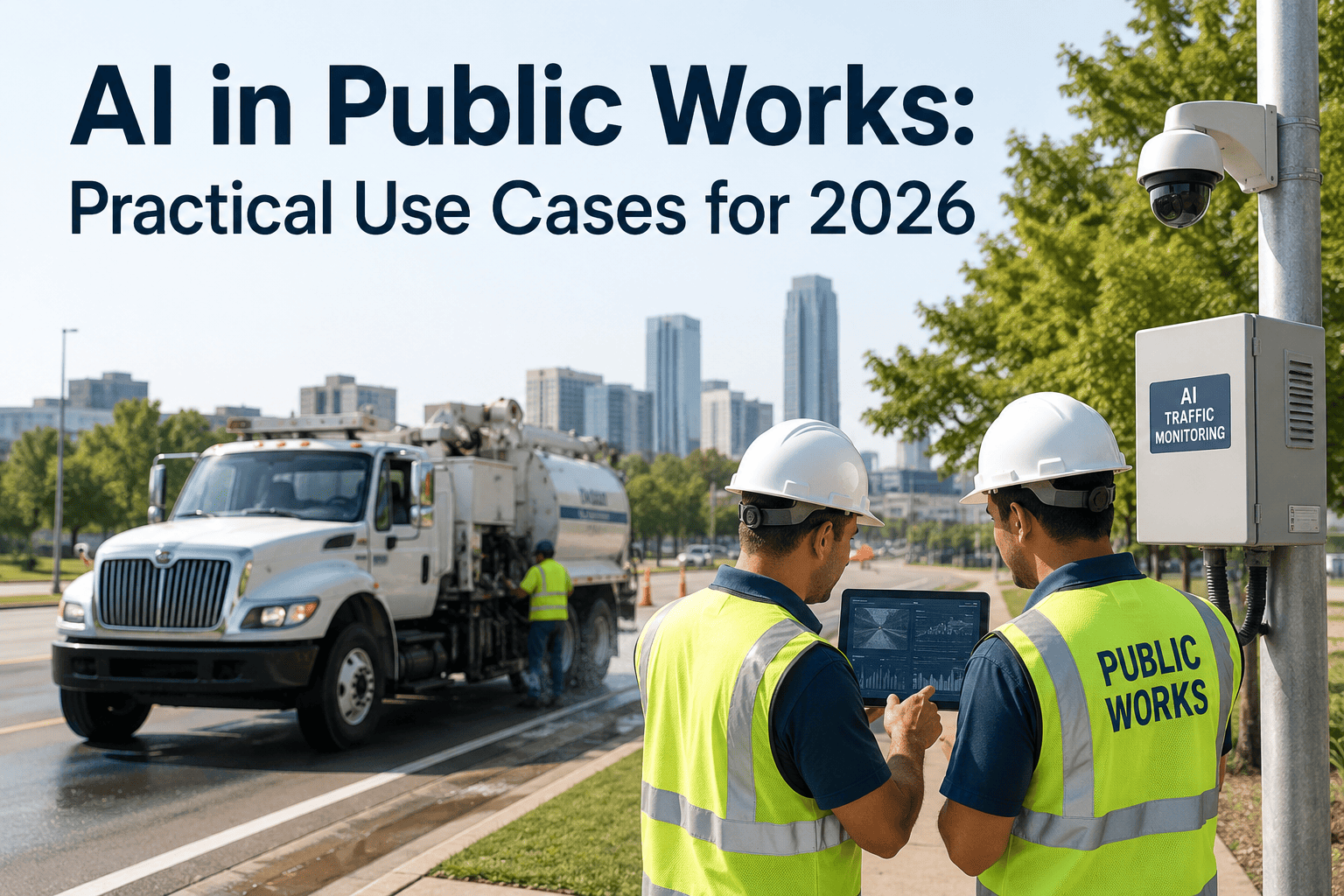
AI in public works has moved from concept to practical operational tool in 2026, with asset prioritization, work order categorization, and predictive analytics all delivering measurable value for municipal governments. From condition prediction to 311 request routing, artificial intelligence in public sector operations is no longer experimental — it is a budget tool that cuts downtime, extends asset life, and lets lean crews do more with less. This guide covers the high-ROI AI public works use cases, the deployment approach, data readiness requirements, and the adoption strategy that consistently produces operational value for municipalities. Ready to see it on your assets? Start Free Trial or read on for the practical roadmap.
From Reactive Repairs to Predictive Public Works
Public works departments managing 10,000+ assets lose $1.2M–$3.8M annually to reactive maintenance, emergency callouts, and premature replacements. AI shifts that curve — prioritizing work, predicting failures, and routing requests automatically.
Where AI Delivers Measurable ROI in Municipal Operations
Not every AI initiative survives contact with a public works budget. The use cases below consistently produce positive ROI within 6–9 months because they target the three biggest cost centers: asset failure, labor allocation, and parts inventory.
Condition-Based Asset Prioritization
AI models trained on inspection history, age, usage, and environmental data score every asset's failure risk in real time. A mid-size city managing 8,500 assets can focus PM cycles on the top 15% at risk — cutting emergency repairs by 30–45% without adding headcount.
Automated Work Order Categorization
Natural language processing reads incoming 311 requests, classifies them by asset type and urgency, and auto-routes to the right crew. Average dispatch time drops from 4–6 hours to under 30 minutes, with 89% categorization accuracy on day one.
Predictive Failure Analytics
Machine learning detects failure signatures in sensor data, vibration logs, and maintenance history — flagging pumps, HVAC units, and fleet components 7–21 days before breakdown. One public works fleet cut towed-vehicle costs by 38% in year one.
Dynamic Preventive Maintenance Scheduling
Instead of fixed-calendar PMs, AI schedules maintenance based on actual condition and usage data. Municipalities eliminate 20–30% of unnecessary PMs while catching critical issues calendar-based schedules miss — extending asset life by 15–25%.
Smart Spare Parts Forecasting
AI predicts parts demand based on asset condition, seasonality, and failure patterns — reducing stockouts by 60% and cutting inventory holding costs by 18–22%. Critical spares are pre-positioned before peak failure seasons.
Crew Routing & Dispatch Optimization
AI clusters work orders geographically and matches them to crew skills, equipment, and parts availability — reducing windshield time by 25–35%. A 40-person field team gains roughly 120 productive hours per week without overtime.
How to Deploy AI in Public Works: A 6-Month Roadmap
Municipalities that succeed with AI don't boil the ocean. They start with one asset class, prove ROI in 90 days, then scale. Here's the phased approach that consistently works for public sector teams managing 500–50,000 assets.
Data Readiness & Asset Registry Cleanup
Consolidate asset data from spreadsheets, legacy CMMS, and paper records into a single source of truth. Tag every asset with criticality, location, and condition. AI models are only as good as the data feeding them — 70% of deployment time is spent here, but it pays off in every subsequent phase.
Pilot: Predictive Maintenance on One Asset Class
Pick the asset class with the highest repair cost and most failure history — typically fleet vehicles, pumps, or HVAC. Deploy AI failure-prediction models on 50–200 assets. Baseline KPIs: mean time between failures, emergency repair costs, and PM compliance rate.
Automate Work Order Intake & Categorization
Connect AI to 311 channels, citizen apps, and inspection forms. NLP auto-categorizes and routes requests; supervisors review exceptions only. Expect 80–90% reduction in manual triage time within the first 30 days.
Roll Out Dynamic PM Scheduling
Replace fixed-interval PMs with condition-based schedules across all asset classes. Monitor PM compliance, asset availability, and labor utilization. This is where municipalities see the 15–25% asset life extension and 20–30% reduction in unnecessary maintenance hours.
Full Analytics & Continuous Improvement
Deploy maintenance analytics dashboards for directors and operations managers. KPIs — OEE, MTBF, MTTR, cost per asset — update in real time. Models retrain monthly. This is the phase where AI shifts from a project to a permanent operational advantage.
The Real Cost of Reactive Maintenance in Municipal Government
A 180-asset public works department spending $42,000/year on reactive repairs typically pays 2.5–4x more per asset than a predictive peer. The table below breaks down where the money goes — and where AI recovers it.
For a typical 180-asset municipal operation running reactive maintenance. AI-enabled predictive maintenance reduces this to $38K–$52K — a 50–64% reduction.
| Cost Category | Reactive (Status Quo) | AI-Powered Predictive | Annual Savings |
|---|---|---|---|
| Emergency Repair Labor | $38,000 | $14,200 | $23,800 |
| Expedited Parts & Freight | $12,500 | $3,100 | $9,400 |
| Overtime & After-Hours Callouts | $22,000 | $8,400 | $13,600 |
| Premature Asset Replacement | $24,000 | $9,800 | $14,200 |
| Service Disruption & Complaints | $8,500 | $2,500 | $6,000 |
| Total Annual Cost | $105,000 | $38,000 | $67,000 |
OxMaint: The AI-Powered CMMS Built for Public Works
OxMaint combines computerized maintenance management, enterprise asset management, and AI analytics in one platform — designed for municipal teams moving off spreadsheets and legacy CMMS. Here's how it maps to the use cases above.
AI Failure Prediction
Machine learning models analyze asset history, condition data, and usage patterns to flag failures 7–21 days in advance. Outcome: cut unplanned downtime 30–50% and emergency repair costs by up to 64%.
Smart Work Order Automation
NLP auto-categorizes 311 requests, generates work orders, and routes them to the right crew with parts and instructions attached. Outcome: eliminate 80–90% of manual triage; dispatch in under 30 minutes.
Dynamic PM Scheduling Engine
Condition-based preventive maintenance replaces rigid calendar schedules — PMs trigger on actual asset need. Outcome: eliminate 20–30% of unnecessary PMs and extend asset life 15–25%.
Predictive Parts Inventory
AI forecasts spare parts demand based on asset condition and failure predictions — auto-generates purchase orders at reorder thresholds. Outcome: reduce stockouts 60% and cut holding costs 18–22%.
Data Readiness Checklist: Is Your Public Works Team Ready for AI?
AI models need clean, structured data to deliver ROI. Use this checklist to gauge readiness — most municipalities score 4/8 on day one and reach 8/8 within 6–8 weeks using OxMaint's onboarding tools.
Centralized Asset Registry
Every asset has a unique ID, location, criticality rating, and install date in a single system — not spread across 12 spreadsheets and 3 legacy databases.
12+ Months of Maintenance History
Work order records with dates, asset IDs, failure codes, labor hours, and parts used — enough data for AI models to identify failure patterns and seasonality.
Standardized Failure Coding
Consistent failure codes (e.g., ISO 14224 or a custom hierarchy) applied across all assets — so AI can distinguish a seal failure from a bearing failure across 10,000 records.
Digital Work Order Intake
311 requests, inspections, and citizen reports flow into a digital system — not paper forms that sit in a truck for a week before data entry.
Condition Data Collection
Inspection data, sensor readings, meter data, or vibration analysis feeding into the CMMS — the raw material AI uses to predict failures before they happen.
Parts Inventory Linked to Assets
Spare parts tracked by SKU, quantity, and assigned asset — enabling AI to forecast demand and pre-position critical spares before failure seasons.
Crew Skills & Availability Tracked
Technician certifications, skills, and shift schedules in the system — so AI can match the right crew to each work order and optimize daily routing.
Defined KPIs & Baselines
You know your current MTBF, MTTR, PM compliance rate, and cost per asset — so AI improvements are measurable, not anecdotal.
We moved 12,000 assets from spreadsheets to OxMaint's AI platform in 8 weeks. Within the first quarter, emergency repairs dropped 38% and our crew gained 100+ productive hours per week. The 311 auto-routing alone saved us two full-time dispatch positions.
AI in Public Works: Frequently Asked Questions
How are municipalities using AI in public works today?
Municipalities use AI for condition-based asset prioritization, automated 311 work order routing, predictive failure analytics, dynamic PM scheduling, parts demand forecasting, and crew dispatch optimization. The highest-ROI use cases are predictive maintenance on fleet and pumps, and NLP-based request categorization — both deliver measurable savings within 6–9 months. Book a demo to see these workflows on a live public works environment.
What data does a public works department need before deploying AI?
You need a centralized asset registry with unique IDs and locations, 12+ months of structured work order history with failure codes, digital intake for 311 requests, and at least basic condition or inspection data. Most municipalities reach AI readiness in 6–8 weeks with the right CMMS onboarding tools — OxMaint includes data migration and cleanup as part of deployment.
How much does AI-powered CMMS cost for a public works department?
AI-powered CMMS platforms like OxMaint typically cost $3–$8 per asset per month, depending on module selection and user count. For a 1,000-asset municipality, that's $36K–$96K annually — against $67K+ in reactive maintenance savings alone. Most public works teams achieve full payback in 4–7 months. Start a free 14-day trial to evaluate fit before committing.
Can AI work with our existing 311 system and legacy CMMS?
Yes. Modern AI-powered CMMS platforms integrate with 311 systems via REST APIs, ingest data from legacy CMMS exports, and connect to IoT sensors via standard protocols (MQTT, OPC-UA). NLP models can read unstructured 311 comments and auto-categorize them — no need to replace your citizen-facing systems. OxMaint supports integrations with common municipal platforms including 311 CRM, GIS, and ERP systems.
Is AI in government operations secure and compliant with procurement rules?
Reputable AI-powered CMMS platforms are SOC 2 Type II certified, offer role-based access control, and host data in encrypted, FedRAMP-aligned or government-compliant cloud environments. Most support standard municipal procurement processes including RFP responses, security questionnaires, and data processing agreements. OxMaint provides full documentation for IT security review and complies with standard government data residency requirements.
Stop Reacting. Start Predicting.
Join the public works departments using OxMaint's AI-powered CMMS to cut downtime 30–50%, eliminate paper work orders, and extend asset life — all within the first quarter.
Free 14-day trial · No credit card