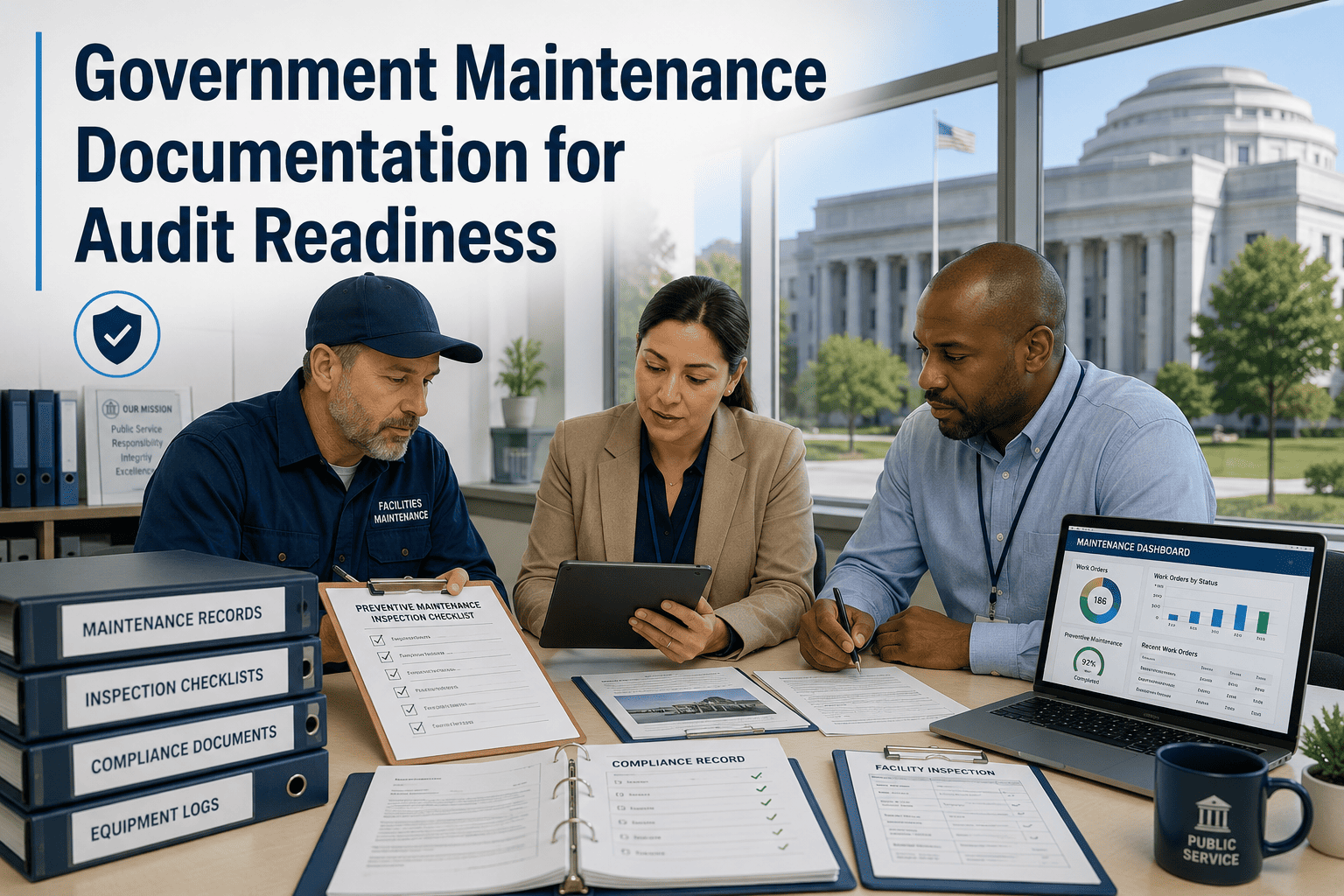
Every year at your agency, two staff members disappear from their regular duties for three weeks — not to fix pumps or replace filters, but to reconstruct maintenance records from paper logs, four different spreadsheets, and the memory of a technician who left last quarter. The auditor is coming. The records exist somewhere. The scramble begins. Agencies that stay audit-ready year-round don't work harder before inspections; they build records as automatic byproducts of daily operations. This is what Oxmaint's audit-ready CMMS does — every calibration, work order, and inspection lands in one searchable, timestamped, defensible register.
Government Agencies · Audit Readiness · 2026
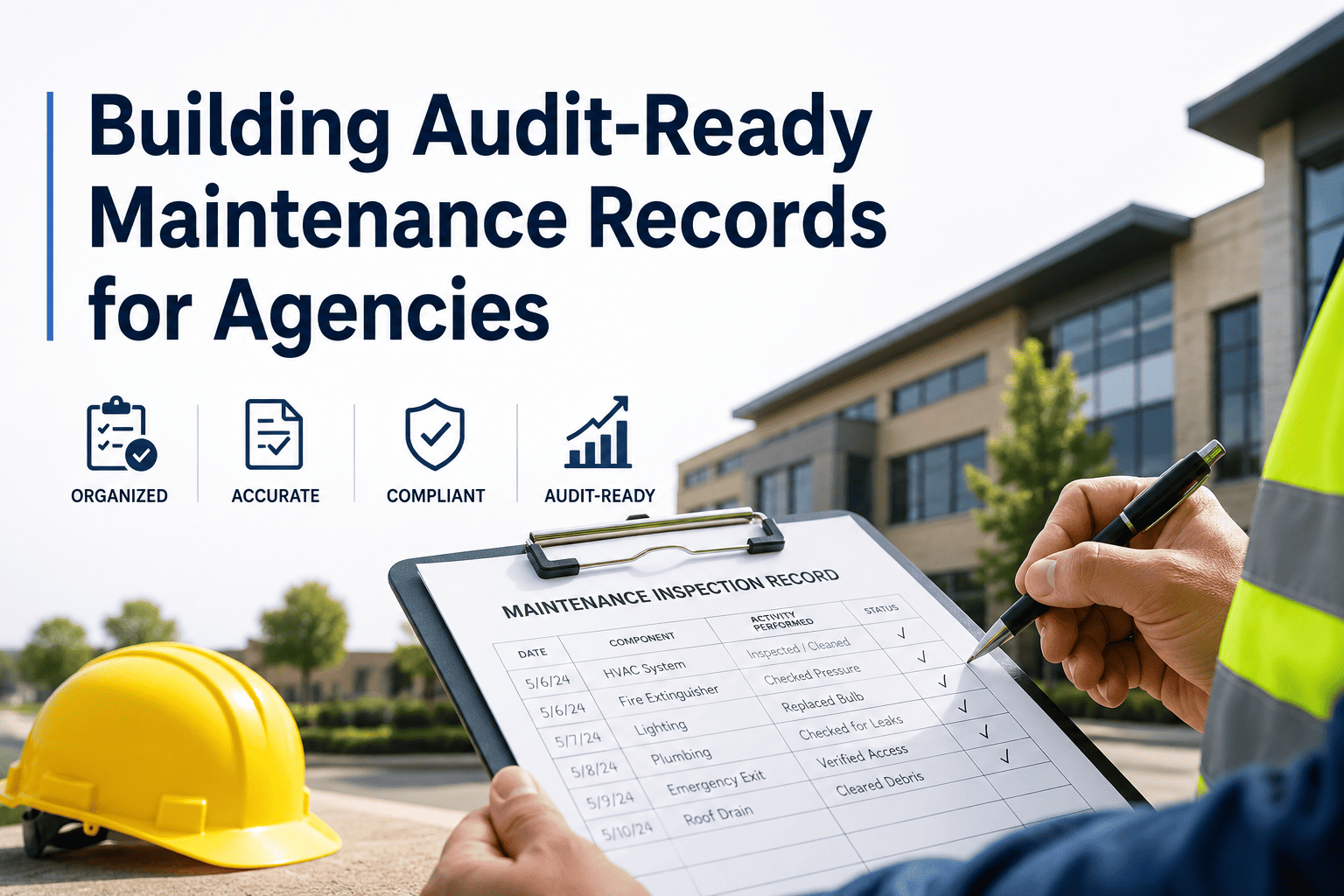
Building Audit-Ready Maintenance Records for Government Agencies
Stop rebuilding your compliance story every audit cycle. Capture defensible records the moment work happens — so when oversight arrives, every question has an answer already on the screen.
3 wks
Average time two staff spend reconstructing records before each audit cycle
70–85%
Reduction in audit prep time when records live in a structured digital register
6 types
Of auditors that arrive at a typical government agency in any 24-month window
Every 3 yrs
GASB 34 minimum infrastructure condition assessment interval — documented and dated
Who Actually Audits Your Agency? Six Reviewers, Six Standards
Government agencies don't face one audit — they face six overlapping ones, each with different expectations, sampling methods, and record demands. Missing records for any single reviewer creates cascading exposure across the others.
Auditor 01
Inspector General
Reviews fraud, waste, abuse. Samples work orders and maintenance spending against actual asset condition and completion evidence.
Auditor 02
State Comptroller / Controller
Verifies capital asset ledgers, useful life reporting, and depreciation schedules against physical inventory and condition scores.
Auditor 03
Federal Grant Auditor
Under 2 CFR Part 200 Uniform Guidance, samples grant-funded assets and maintenance records to confirm allowable use and cost documentation.
Auditor 04
GASB 34 Reviewer
Verifies condition assessments every 3 years under the modified approach — proving continuous maintenance instead of depreciation.
Auditor 05
Insurance / Actuarial Auditor
Reviews PM completion and inspection history to price risk. Missing records translate directly into higher premiums or coverage denials.
Auditor 06
Council / Oversight Committee
Public officials asking why costs are rising, why an asset failed, or how deferred maintenance became a capital emergency. Records are the answer.
The 3 Layers of an Audit-Proof Maintenance Record
An audit-proof record is not a single document — it is three stacked evidence layers. Missing any single layer creates a gap that any of the six auditor types will find and question. This is the architecture that separates records from defensible records.
Layer 3 — Top
Provenance Layer
Proof of the specific parts installed (lot numbers, vendor invoices), the certified technician who did the work, and the verification step confirming the repair held. This is the layer plaintiff attorneys request first.
Layer 2 — Middle
Repair & Corrective Action Layer
Proof the identified defect became a work order, was assigned, executed, and closed. Includes root cause, response steps, and completion timestamp — linked back to the original inspection record.
Layer 1 — Base
Inspection & Detection Layer
Proof the check happened at the required frequency, with quantitative readings (not just pass/fail), visual evidence attached, and a technician identity captured at the moment of the inspection.
Chain of Custody — One Defect, One Audit-Ready File
Auditors trace records the same way investigators trace evidence: from detection to resolution, without breaks in the chain. Here is how a single vibration reading becomes a defensible audit record inside Oxmaint.
A
Detection Captured
Technician records a vibration reading of 0.6 ips on a pump during PM. Quantitative value, timestamp, technician ID, and photo attach to the inspection record automatically.
B
Threshold Exceeded — Corrective Work Order Auto-Created
Oxmaint recognizes 0.6 ips exceeds the 0.5 ips alert threshold. A corrective work order generates instantly, hyperlinked to the source inspection — no manual data entry, no lost handoff.
C
Repair Executed with Provenance
Certified technician receives the work order on mobile. Parts consumed are logged with lot numbers. Labor time captures automatically. Photos of the repair attach before closeout.
D
Verification & Closeout
Post-repair vibration reading of 0.2 ips is recorded and attached. The complete chain — inspection → alert → work order → repair → verification — sits in one indexed file, exportable in one click.
Turn Audit Prep from Fire Drill to Default State
When every action creates a defensible record automatically, audit season stops being a season. Your agency lives audit-ready by default — and staff stop losing weeks to reconstruction.
Score Your Agency's Audit Readiness — 6 Questions
A quick honest self-assessment. Every "no" is an audit finding waiting to happen. Every "not sure" is a red flag your next auditor will find first.
Q1
Can you produce a 36-month PM history for any asset in under 10 minutes?
Chain of Custody Test
Q2
Is every inspection record timestamped, technician-attributed, and photo-supported?
Layer 1 Evidence Test
Q3
Is every defect detected linked to the specific work order that resolved it?
Layer 2 Continuity Test
Q4
Can you trace parts installed 18 months ago back to lot number and vendor?
Layer 3 Provenance Test
Q5
Do you have a documented condition assessment for every infrastructure asset in the last 3 years?
GASB 34 Modified Approach Test
Q6
Can grant-funded assets be filtered and exported for a federal single audit sample request?
2 CFR Part 200 Test
If any answer is "no" or "not sure"
Your agency is operating with audit exposure right now. Oxmaint closes each of these six gaps automatically — starting the day you deploy. No consultants. No 12-month rollouts. Just records that build themselves as work happens.
How Oxmaint Delivers Audit Readiness — The Building Blocks
01
Unified Asset Register
Every building, vehicle, HVAC unit, pump, and generator sits in one hierarchical register — District to Property to System to Asset to Component. Auditors see the structure they expect.
02
Immutable Timestamped Logs
Every action — from logging a fault to closing a work order — records user identity, date, and time in tamper-proof entries. Auditors need this. Insurers need this. Investigators need this.
03
Condition Scoring for GASB 34
Built-in 1–5 condition rating with per-asset-class definitions. Modified approach infrastructure reporting becomes an export, not a project. Assessment dates track automatically.
04
Fund & Grant Tagging
Tag each asset with the grant, bond, or fund that paid for it. When a federal single audit samples a specific grant, the maintenance trail is one filter click away — not one week of reconstruction.
05
Photo & Evidence Capture
Every mobile work order supports photo attachments — wear patterns, leaks, before-and-after repair shots. A picture attached to a timestamp is the strongest defense against a negligence claim.
06
One-Click Audit Package Export
When any of the six auditor types requests records, Oxmaint exports a filtered package — by asset, fund, date range, or auditor scope — in the format each reviewer accepts.
2–4 wks
Deployment window — no heavy IT integration required
70–85%
Reduction in audit prep hours per cycle
Zero
Reconstructed records — everything lives in the register from day one
1 click
To export the exact package any auditor requests
Frequently Asked Questions
What makes a maintenance record "audit-ready" for a government agency?
An audit-ready record contains three layers — inspection evidence, corrective action linkage, and provenance of parts and technicians. It must be timestamped, tamper-proof, and exportable in the format each auditor accepts.
Oxmaint builds all three layers as work happens.
How long must government agencies retain maintenance records?
Retention varies by regulation — federal grant records under 2 CFR Part 200 require 3 years post-close, GASB 34 infrastructure records span the asset lifecycle, and many state statutes require 7–10 years. Oxmaint retains records indefinitely so retention windows are never a risk.
How does Oxmaint support GASB 34 modified-approach reporting?
Every infrastructure asset carries a 1–5 condition score with defined criteria per class. Assessment dates track automatically to satisfy the 3-year interval requirement. Continuous maintenance evidence exports directly for the modified approach reconciliation.
Can Oxmaint filter records by grant or funding source for federal audits?
Yes — every asset is tag-able with the grant, bond, or fund that financed it. When a federal single audit samples a specific grant, one filter surfaces every associated maintenance record — no cross-system reconciliation required.
How fast can a government agency deploy Oxmaint and reach audit readiness?
Most agencies go live in 2–4 weeks with no heavy IT rollout. New records are audit-ready from day one. Historical asset lists import directly and are enriched with condition scoring and grant tagging as staff work through the register.
Book a demo to see the deployment path.
Never Lose Another Three Weeks to Audit Prep
Oxmaint turns your maintenance operations into a defensible record engine. Inspector General, state comptroller, federal grant auditor, GASB reviewer, insurer, council committee — no matter who arrives, the answer is already on the screen. Deploy in weeks. Stay audit-ready forever.