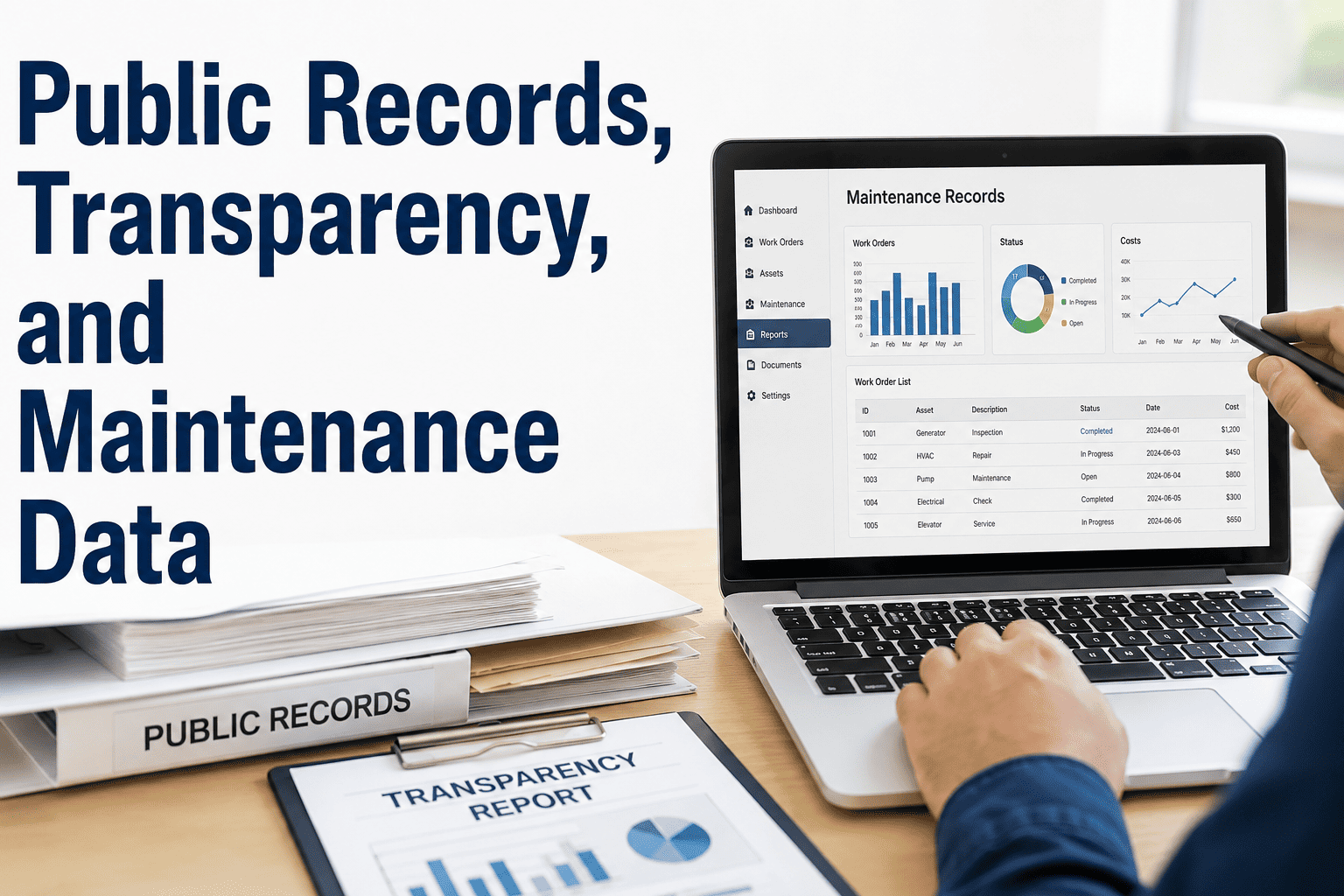
Public records maintenance data has become one of the most scrutinized categories in government transparency, and agencies that cannot produce defensible maintenance histories risk legal exposure, political fallout, and eroded public trust. When a citizen, journalist, or auditor files a public records request for government maintenance logs, work orders, or asset repair histories, the clock starts ticking — and teams relying on paper files or scattered spreadsheets often spend weeks scrambling to assemble a response. Modern FOIA maintenance records demands require a structured, time-stamped, and fully searchable system that turns public works data transparency from a liability into a routine administrative task. OxMaint provides exactly that kind of CMMS-driven documentation, ensuring every maintenance record is audit-ready the moment it is created — you can Start Free Trial to see how it works on your assets.
Government Transparency & Public Records
Can your maintenance records survive a public records request?
Every public dollar spent on infrastructure, fleet, and facilities is subject to scrutiny. Agencies that lack a structured CMMS for public records compliance spend an average of 40+ hours assembling a single FOIA response — while risking incomplete, defensible maintenance data and political consequences.
The Transparency Gap
Why public records maintenance data is now a defensible obligation
Federal FOIA requests have risen over 30% in the past decade, and state-level public records laws — from California's CPRA to Texas's PIA — now routinely target maintenance data, asset repair logs, and preventive maintenance schedules as core public works transparency records.
When a citizen or watchdog group submits a public records request for government maintenance activities, they are asking a fundamental question: how are our tax dollars being used to maintain public infrastructure? If your maintenance team cannot immediately produce work order histories, preventive maintenance completion rates, spare-parts consumption, and asset downtime logs, you are not just failing a bureaucratic test — you are undermining government data transparency. OxMaint captures every maintenance event in a centralized, time-stamped, and tamper-evident database, so FOIA maintenance records can be exported in minutes, not weeks.
Workflow
How to structure maintenance data for public records compliance
Defensible maintenance transparency requires four layers: data capture, retention, retrievability, and response workflow. Here is what each layer demands in a government context.
Capture — time-stamped, immutable work orders
Every work order must be created with a digital time stamp, assigned technician, asset ID, labor hours, parts used, and completion signature. Paper logs and disconnected spreadsheets fail here because they can be back-dated or altered without audit trails. A CMMS like OxMaint locks every field change in a history log.
Retain — meet statutory and regulatory records schedules
Most state records retention laws require public works maintenance data to be kept for 3 to 7 years; federal grant-funded infrastructure may require longer. Your system must enforce retention policies automatically — archiving completed work orders, asset histories, and inventory transactions without manual filing.
Retrieve — searchable by asset, date, cost, and technician
A public records request for public works might ask for "all maintenance performed on Pump Station 4 between January and June." If your data is in filing cabinets, that query takes days. In OxMaint, it is a filtered search that returns results in seconds — with exportable CSV/PDF reports that are defensible in any audit.
Respond — produce redacted, formatted records fast
Some maintenance records contain exempt information (employee personal data, security-sensitive infrastructure details). Your workflow must allow redaction without destroying the integrity of the original record. OxMaint's reporting engine lets you generate public-facing versions while preserving the complete internal record.
Comparison
Spreadsheets vs. CMMS-driven maintenance transparency
The gap between manual records management and a CMMS-powered approach is not just about efficiency — it is about defensibility, accuracy, and the ability to prove that maintenance was performed correctly and on time.
| Capability | Spreadsheets & Paper | OxMaint CMMS |
|---|---|---|
| Time to fulfill a records request | 5–15 days, manual sorting | Minutes — filtered export |
| Audit trail integrity | Editable cells, no history | Tamper-evident, time-stamped log |
| Asset-level maintenance history | Scattered across files | One-click full asset lifecycle view |
| Preventive maintenance proof | Hard to verify completion | Digital signatures & photo evidence |
| Cost tracking per asset | Manual aggregation, error-prone | Automatic labor + parts cost rollup |
| Redaction for public release | Manual, risks original record | Public-facing report templates |
| Records retention compliance | Manual purging, risky | Automated retention policies |
How OxMaint Helps
How OxMaint makes maintenance data transparent and FOIA-ready
OxMaint was built for maintenance and reliability teams — and every feature that helps your team reduce downtime also creates a defensible, transparent record that satisfies public works data transparency requirements.
Immutable work order history
Every work order — from creation to completion — is logged with time stamps, technician assignments, labor hours, parts consumed, and digital signatures. When a public records request arrives, you export the full history in one click. No reconstruction, no gaps, no disputes.
Automated records retention
Configure retention schedules by record type — 3 years for routine work orders, 7 years for capital asset repairs, 10+ years for federally funded infrastructure. OxMaint archives and indexes records automatically, so nothing is lost and nothing is purged prematurely.
One-click FOIA-ready reporting
Filter by asset, date range, technician, work type, or cost — then export to PDF or CSV. Public-facing report templates strip exempt fields automatically, so you produce redacted, formatted records in minutes instead of days. Cut response time by up to 90%.
Audit-grade asset lifecycle tracking
From installation to decommissioning, every maintenance event, inspection, failure, and cost is tied to a single asset record. When an auditor asks "show me everything done on this pump over the last 5 years," the answer is one click — backed by photo evidence and technician signatures.
Real-World Scenario
A mid-sized public works department and the records request that changed everything
A public works department managing 180 assets — pumps, HVAC units, fleet vehicles, and facility equipment — was hit with a public records request asking for three years of maintenance records on a specific pump station. Their data was split across Excel spreadsheets, paper work orders in three different filing cabinets, and a legacy access database no one fully understood.
It took two staff members 11 working days to assemble the response — pulling files, cross-referencing dates, manually redacting employee information, and reformatting everything into a presentable report. The total labor cost: over $4,800 in staff time for a single request. Worse, they could not confidently confirm whether all preventive maintenance had actually been completed on schedule, opening the door to follow-up scrutiny.
After implementing OxMaint: The same request took 22 minutes. A filtered search by asset ID and date range produced a complete, formatted report with photo evidence, technician signatures, parts costs, and labor hours. The department now responds to any public records request for maintenance data in under an hour — and they have eliminated the $25K/year in hidden labor costs associated with manual records management.
See OxMaint on your assets — book a 30-minute demo
Discover how government maintenance teams use OxMaint to cut FOIA response times by 90%, eliminate manual records scrambling, and build defensible maintenance histories that stand up to any audit or public records request.
FAQ
Public records and maintenance data — what government teams ask
Are maintenance work orders subject to public records requests?
Yes. In nearly every U.S. state, maintenance work orders, asset repair logs, and preventive maintenance records created by a government agency are considered public records under FOIA, state public records acts, or sunshine laws. This includes records held by public works departments, water utilities, transit authorities, and school districts. Agencies must produce these records upon request unless a specific statutory exemption applies.
How long must government maintenance records be retained?
Retention periods vary by jurisdiction and record type, but most states require 3 to 7 years for routine maintenance records and longer for capital asset or federally funded infrastructure projects. Some federal grant requirements mandate 10+ years. Agencies should consult their state records retention schedule and configure their CMMS — OxMaint supports automated retention policies — to ensure compliance. Book a Demo to see retention configuration in action.
What maintenance data is typically exempt from public disclosure?
Common exemptions include employee personal information (Social Security numbers, home addresses, medical data), security-sensitive infrastructure details (e.g., utility control system schematics, camera locations), and certain law enforcement facility maintenance records. However, the core maintenance data — what was repaired, when, at what cost — is generally disclosable. OxMaint's public-facing report templates help agencies produce redacted records without compromising the original data.
How can a CMMS improve government data transparency?
A CMMS improves transparency by creating structured, time-stamped, and searchable maintenance records at the point of work. Instead of reconstructing histories from paper files, every work order, inspection, and parts transaction is captured digitally — with audit trails that prove when and by whom each action was taken. This makes public records responses faster, more complete, and more defensible, while also giving agency leadership real-time visibility into maintenance performance.
How quickly can a public works department respond to a FOIA request with OxMaint?
With OxMaint, most maintenance data requests can be fulfilled in under an hour. Technicians filter by asset, date range, work type, or cost, then export formatted reports with one click. Agencies that previously spent 5 to 15 days assembling manual responses typically see a 90% reduction in response time after implementing OxMaint — and the records they produce are more complete, accurate, and defensible than anything assembled from spreadsheets. Start Free Trial to test it yourself.
Make every maintenance record defensible, transparent, and ready on demand
Join government maintenance teams using OxMaint to cut records-request response times by 90%, eliminate manual filing, and build audit-grade asset histories that satisfy any FOIA or transparency requirement.
Free 14-day trial · No credit card