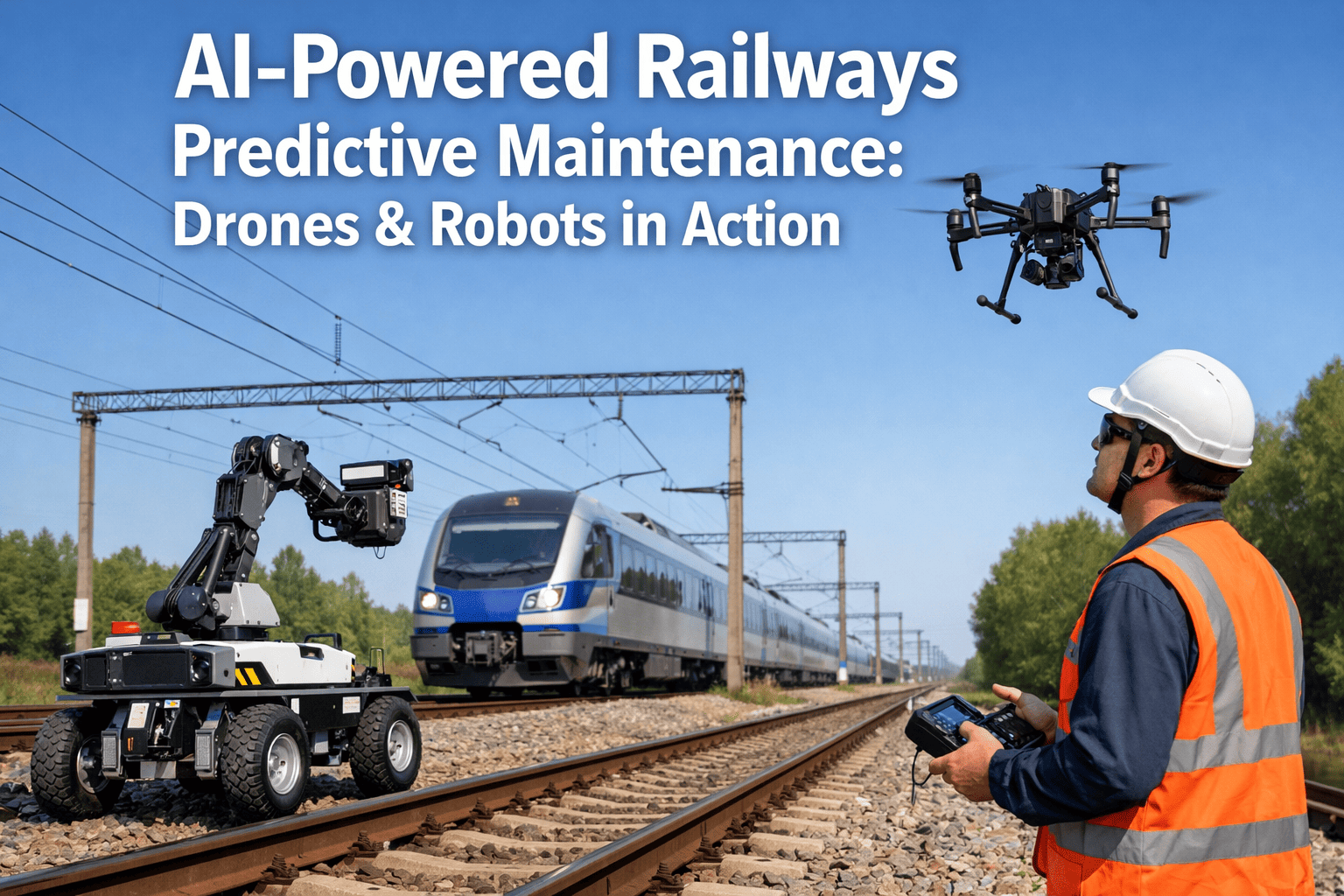
Autonomous Robot Inspections for Railways Infrastructure
By Taylor on March 14, 2026
Railway infrastructure inspection is one of the most demanding, dangerous, and resource-intensive activities in public transport operations. Inspectors working on live or recently closed track face significant personal safety risk while attempting to assess the condition of hundreds of kilometres of rail, sleepers, ballast, switches, overhead line equipment, and tunnel structures under time pressure imposed by narrow possession windows. The result is inspection programs that are simultaneously too costly, too infrequent, and still not comprehensive enough to catch every developing defect before it causes a failure or a service disruption. Autonomous robotic inspection systems are fundamentally changing this equation. Ground-based rail inspection robots, drone-equipped tunnel survey systems, overhead line inspection vehicles, and multi-sensor autonomous platforms are now operating in revenue railway environments across Europe, Asia, and North America — delivering inspection data that is more comprehensive, more consistent, and more frequent than any human-driven program can achieve within the same budget. For government railway operators, the question is no longer whether autonomous inspection technology is mature enough to deploy — it is how to integrate it with existing maintenance workflows to maximise the return on public infrastructure investment. Schedule a free railway inspection technology assessment with our team and find out where robotic inspection can deliver the fastest returns in your network.
Why Human-Only Inspection Is No Longer Adequate for Modern Railway Networks
The limitations of conventional railway inspection are structural, not a reflection of the quality or commitment of inspection teams. They are inherent in the constraints of human observation, physical access, available possession time, and the scale of the infrastructure problem.
15%
Of all railway track km inspected per year in most national networks by foot-patrol inspection
4 hrs
Maximum typical overnight possession window for inspection and maintenance — shared between multiple teams
68%
Of inspection-related railway incidents attributed to defects present but undetected at the most recent manual inspection
Inspector Safety Risk
Track workers are among the highest-risk occupational groups in any country. Walking inspection on or near live infrastructure, working in confined tunnel environments, and operating during night possessions with reduced alertness all create genuine safety hazards that autonomous systems eliminate entirely.
Incomplete Coverage
A walking inspector covers 2–4 km per hour under ideal conditions. Tunnels, bridges, and elevated structures require specialist access equipment that limits coverage further. Large portions of most networks are inspected on multi-year cycles simply because there are not enough inspectors or possession hours to achieve full annual coverage.
Subjective and Inconsistent Data
Manual inspection severity ratings depend on the individual inspector's experience, the lighting conditions, the time pressure of the possession window, and the quality of measurement tools available. The same defect classified differently by two inspectors produces trend data that cannot be reliably analysed — undermining the predictive value of inspection history.
Invisible Sub-Surface Defects
Rail head defects, internal sleeper cracking, ballast voiding, and sub-base deformation are invisible to visual inspection until they reach advanced stages. The most dangerous defects in railway infrastructure — those that initiate and propagate before becoming visible at the surface — require sensor-based detection that cannot be replicated by human observation alone.
The Robotic Inspection Technology Landscape
Autonomous railway inspection is not a single technology — it is a portfolio of platform types and sensor combinations, each optimised for specific asset classes, infrastructure configurations, and operational constraints. Understanding the full landscape enables railway authorities to deploy the right technology against the right inspection problem.
Most Widely Deployed
Rail-Bound Inspection Vehicles
Autonomous and semi-autonomous vehicles operating on the rail network
Track-guided autonomous vehicles carry multi-sensor payloads along the rail corridor at 20–80 km/h during possession or in specialist track inspection vehicle slots. They collect continuous georeferenced data on rail geometry, track gauge, rail profile, ballast condition, overhead line position, and visual surface defects — replacing the need for inspection personnel on the track while achieving 10–20× the coverage rate of walking inspection teams.
Speed20–80 km/h
Coverage50–300 km/shift
Sensors8–24 per platform
PossessionStandard or possession-free modes
Sensor Payload
LiDAR track geometryUltrasonic rail flaw detectionCamera visual AIEddy current rail headInertial measurement unitGround-penetrating radarOverhead line geometry
Tunnel Inspection Drones
Autonomous UAVs for confined underground structures
Tunnel-specific drones navigate the bore using simultaneous localisation and mapping (SLAM) without GPS, carrying high-resolution cameras, LiDAR, and thermal sensors. A single drone covers an entire tunnel bore in one deployment, capturing sub-millimetre crack imagery on the lining, mapping deformation, and identifying water infiltration zones that would take weeks to survey by rope-access inspection.
Coverage2–8 km tunnel/shift
Crack detection≥ 0.1 mm
SLAM navigation360° photogrammetryThermal imagingLining crack AI
Overhead Line Inspection Robots
Robots traversing OLE structures and catenary wires
Specialised robots grip and traverse overhead line equipment — catenary wires, contact wires, registration arms, and stitch wires — inspecting wear, corrosion, clamp condition, and geometry while suspended above the track without requiring the line to be de-energised or possessions to be taken. Contact wire wear measurement to ±0.1mm accuracy is achieved across the full OLE network.
Quadruped platforms for complex structures and yards
Four-legged robots such as Boston Dynamics Spot traverse complex railway environments — bridges, yards, and station structures — that cannot be accessed by wheeled or tracked vehicles. They carry sensor payloads for visual inspection, thermal anomaly detection, and ultrasonic testing, and can navigate obstacles, steps, and uneven surfaces autonomously under remote supervisor oversight.
Climbing robots and drone arrays for structural elements
Magnetic climbing robots traverse steel bridge girders and abutments, carrying thickness gauges and visual inspection cameras. Drone arrays photograph concrete and masonry elements with photogrammetric precision, generating 3D models with sub-millimetre crack detection capability. Deployment takes hours rather than the weeks required to erect access scaffold on major railway bridges.
Access timeHours vs weeks (scaffold)
CoverageFull structure per deployment
Magnetic surface climbingUT thickness gauging3D photogrammetry
Connect Robotic Inspection Data to Maintenance Action
Autonomous robots generate inspection data. Oxmaint turns that data into structured defect records, prioritised work orders, and the complete audit trail that railway safety regulators require — closing the gap between what robots find and what maintenance teams fix.
What Autonomous Robots Inspect: Asset-by-Asset Capabilities
The value of autonomous inspection is specific to the asset type and defect category. Matching inspection technology to the highest-consequence, highest-frequency defect modes for each asset class maximises the safety and financial return on robotic inspection investment.
Eliminates scaffold and lane closures; full 3D structural model per deployment; safe access to high-risk locations
Hours/structure
AI Data Processing: From Raw Sensor Output to Actionable Defect Records
Autonomous inspection robots generate data volumes that would be impossible to process manually at the inspection frequencies that make continuous monitoring valuable. The AI processing pipeline that converts raw sensor output into structured, prioritised, actionable defect records is as important as the robot platform itself.
01
Real-Time Data Capture
Multi-sensor platforms capture georeferenced data streams simultaneously — camera images, LiDAR point clouds, ultrasonic A-scans, GPR B-scans, and IMU readings at sampling rates of 1,000–100,000 Hz. A single inspection shift generates 50–500 GB of raw sensor data spanning hundreds of kilometres of network, tagged with GPS coordinates and track chainage.
→
02
AI Defect Detection
Deep learning models trained on labelled defect datasets process each sensor stream independently. Computer vision models detect and classify visual defects; signal processing algorithms interpret ultrasonic and GPR data for sub-surface anomalies; LiDAR models identify geometric deviations from design tolerances. Models trained on 500,000+ labelled examples achieve 88–96% detection accuracy on validation datasets.
→
03
Severity Classification and Trending
Detected defects are automatically classified by type, measured for dimensions, assigned a severity grade per the railway's standard defect classification system, and compared against the defect database from previous inspection cycles. New defects are flagged for engineer review; existing defects are tracked for dimensional change, with rate-of-change calculations that predict when each defect will reach its intervention threshold.
→
04
Maintenance Work Order Generation
Risk-scored defects automatically generate maintenance work orders in the asset management system with supporting evidence — images, measurements, chainage location, trend data, and recommended intervention type. Urgent defects generate immediate notifications to the maintenance controller; lower-priority defects are batched into planned maintenance windows. The complete defect-to-action chain is documented for regulatory compliance.
The Full Pipeline — From Robot Detection to Closed Work Order
Oxmaint integrates with robotic inspection platforms to receive defect outputs, structure them as work orders with full evidence chains, assign them to maintenance teams, track them to closure, and maintain the permanent defect history that railway safety management systems require.
Government railway operators require a rigorous, evidenced business case before committing to autonomous inspection technology investment. The financial case is well-established from deployments in national railway networks, and the benefit categories are consistent regardless of network type or geography.
Zero
Inspector Injuries on Inspected Assets
The most immediate and unambiguous benefit of autonomous inspection. Every shift where a robot replaces a track worker on live or recently energised infrastructure eliminates a personal safety risk. In national networks where track worker fatalities and injuries remain a persistent safety challenge, this benefit alone justifies the investment case independent of any financial return.
Mechanism: Workers kept off the track entirely during robotic inspection operations
10–20×
Increase in Network Coverage per Inspection Pound Spent
A track inspection robot operating at 40 km/h covers the same network distance in one hour that a walking inspection team covers in 10–20 hours — with more sensors active simultaneously and no fatigue-related quality degradation. For government operators with large networks and constrained inspection budgets, this coverage multiplier translates directly into more frequent inspections across the entire priority network.
Mechanism: Higher speed, 24/7 capability, no fatigue — fundamentally different economics
30–50%
Reduction in Emergency Maintenance Events
More frequent inspection with earlier defect detection prevents the transition from manageable defect to emergency engineering response. Each prevented emergency possession saves 3–5× the cost of the equivalent planned intervention and avoids the service disruption costs — delay minutes, compensation payments, passenger confidence — that accompany unplanned track closures. First-year emergency maintenance reduction of 30–50% is consistently documented in operator deployments.
Mechanism: Earlier detection means intervention before emergency threshold is breached
15–25%
Extension of Rail and Switch Asset Life
Rail renewed at exactly the right time — when wear reaches the optimal intervention point rather than when failure forces emergency replacement — lasts significantly longer per tonne than reactively replaced rail. Robotic inspection enables the data-driven asset life optimisation that maximises the capital return on rail, switches, sleepers, and OLE components across the network. The capital deferral value of extended asset life frequently exceeds the direct cost savings from inspection efficiency alone.
Mechanism: Optimal intervention timing prevents both early replacement waste and accelerated-damage failure
Implementation Roadmap for Government Railway Operators
Deploying autonomous robotic inspection across a government railway network requires a phased approach that validates technology performance, builds operational capability, and satisfies public procurement requirements at each stage before committing to network-wide rollout.
Phase 1
Months 1–4
Network Risk Assessment and Technology Selection
Identify the highest-priority inspection problem on the network — the asset-defect combination causing the most emergency maintenance events, the most service disruption, or the greatest safety risk. Match available robotic inspection technology to this specific problem. Define the performance specification and pilot success metrics before procurement.
Risk-ranked inspection prioritiesTechnology selection reportPilot scope and success criteria
Phase 2
Months 4–10
Pilot Deployment and Performance Validation
Deploy the selected robotic inspection system on the pilot corridor or asset class. Conduct parallel inspections alongside conventional methods during the first 8–12 weeks to validate detection accuracy. Establish the AI model performance baseline — detection rate, false positive rate, measurement accuracy — against independent ground-truth data before relying on robotic outputs for maintenance decisions.
Validated detection performance dataCost comparison vs manualBusiness case for expansion
Phase 3
Months 8–14
Maintenance Workflow Integration
Integrate robotic inspection outputs with the maintenance management system, work order generation, and planning workflows. Train maintenance planners on interpreting AI-derived defect reports. Establish governance protocols for how autonomous inspection recommendations are reviewed by qualified engineers before driving maintenance decisions. This phase determines whether the investment delivers operational value or just data.
Scale the validated inspection capability across the full priority network. Expand to additional asset classes and robot platform types as each pilot demonstrates performance. Build the long-term inspection database that enables multi-year trend analysis, capital investment prioritisation based on actual condition data, and the predictive maintenance programmes that deliver the maximum lifetime return on network infrastructure investment.
Full network coverage planMulti-asset inspection programmeCapital planning data integration
Key Performance Indicators for Robotic Inspection Programmes
Government railway operators require KPIs that demonstrate both the technical performance of robotic inspection systems and the operational and safety outcomes they are delivering against baseline conventional inspection programmes.
10–20×
Network Coverage Multiplier
Kilometres inspected per inspector-shift with robotic systems versus conventional walking patrol — the primary productivity metric demonstrating cost-efficiency to Treasury and oversight bodies.
> 90%
Defect Detection Rate
Percentage of known defects above threshold size correctly identified on independent validation runs — the technical quality metric that must be demonstrated before robotic outputs drive maintenance decisions.
Zero
Track Worker Injuries — Inspected Assets
The safety outcome metric — zero injuries on assets inspected autonomously. Any injury during a robotic inspection operation represents a programme governance failure, not a technology failure.
False Positive Rate
< 15%
AI alerts not confirmed as genuine defects — above 25% erodes maintenance planner trust in robotic outputs
Emergency Events Reduction
30–50%
Reduction in emergency possessions on robotic-inspected assets vs baseline three-year average
Inspection Cycle Completion
100%
All scheduled robotic inspection cycles completed on time — no backlogs accumulating as in manual programmes
Defect-to-Action Lead Time
≥ 4 weeks avg
Average time between defect detection and intervention threshold being reached — the planning window robotic inspection creates
Turn Robotic Inspection Data Into a Safer, Better-Maintained Railway
Oxmaint provides government railway teams with the maintenance management platform that makes autonomous inspection programmes operationally effective — structuring defect outputs, driving maintenance workflows, tracking interventions, and producing the compliance records that railway safety regulators require.
Can autonomous robotic inspection legally replace formal track inspections required by railway safety regulations?
This depends entirely on the specific regulatory framework of the national railway safety authority. In most developed-world railway safety regimes, formal inspection requirements specify outcomes — what must be assessed and at what frequency — rather than the method by which the assessment is carried out. Regulators in the United Kingdom (ORR), European Union (ERA), Australia (ONRSR), and Japan (MLIT) have all accepted or are in active consultation processes regarding robotic inspection outputs as satisfying formal inspection requirements, provided the inspection platform and its sensor suite are validated against defined performance standards and the outputs are reviewed and certified by a competent person. The trend is towards acceptance as deployment track records accumulate. Government operators should engage their safety regulator early in the procurement process to establish the approval pathway specific to their jurisdiction and the technology being procured.
02
How accurate are robotic inspection systems compared to traditional manual methods?
On specific defect types where both methods can be meaningfully compared, robotic systems consistently outperform manual inspection on detection rate and measurement consistency. For surface crack detection, validated AI systems achieve detection rates of 88–96% for cracks above 0.1mm at consistent lighting conditions, compared to studies showing trained inspectors detect 60–75% of visible defects during walking inspection. For sub-surface defects — ballast voiding, rail foot corrosion, internal rail defects — robotic sensor-based methods are the only practical option; manual inspection has a detection rate close to zero for these categories. For track geometry, laser-based robotic measurement achieves ±0.5mm accuracy on all parameters simultaneously and continuously, compared to manual measurement that takes spot readings at intervals and varies in accuracy based on the competence of the individual measurer. The meaningful performance comparison is not robotic versus manual — it is the combined robotic-plus-human-review system versus manual-only, and on that basis robotic inspection consistently demonstrates superior performance.
03
What are the procurement and governance considerations for government railway operators?
Government procurement frameworks require technology-neutral specifications that describe inspection outcomes rather than specific robotic platforms or proprietary AI systems, enabling genuine competitive tendering. Performance specifications should define minimum detection rates, measurement accuracy thresholds, data format standards, and geographic coverage requirements — not specific sensor configurations or vendor platforms. Data ownership provisions must vest all inspection data in the railway operator, not the technology provider, to prevent vendor lock-in that creates long-term budget dependency. Open data format requirements ensure that inspection outputs can be ingested into the operator's asset management system and analysed independently. Safety cases for autonomous inspection systems must comply with applicable railway safety management system standards, and the approval process should be initiated with the safety regulator before procurement commences, not after contract award. Governance frameworks must define the competent person review process that sits between AI output and maintenance decision — regulators universally require qualified human oversight of autonomous inspection outputs for safety-critical maintenance decisions.
04
How does a CMMS platform support autonomous railway inspection programmes?
A maintenance management system is the operational foundation that transforms autonomous inspection from a data collection exercise into a maintenance improvement programme. It receives structured defect outputs from the robotic inspection platform — with location, severity classification, measurement data, and supporting imagery — and converts them automatically into work orders assigned to the relevant maintenance team or contractor with appropriate priority and response timeline. It maintains the permanent defect history for every inspected asset, enabling the multi-year trend analysis that demonstrates programme effectiveness to railway safety regulators and government oversight bodies. It schedules and tracks inspection cycles, ensuring that no corridor falls outside its required inspection interval regardless of resource pressures. It integrates robotic-inspection-generated planned maintenance with scheduled preventive maintenance programmes, ensuring that inspection-triggered interventions are coordinated within planned possession windows to minimise operational disruption. And it generates the compliance reporting that railway safety management systems require — demonstrating that every identified defect has been assessed, actioned, and tracked to closure within the timeframes the safety regulator expects.