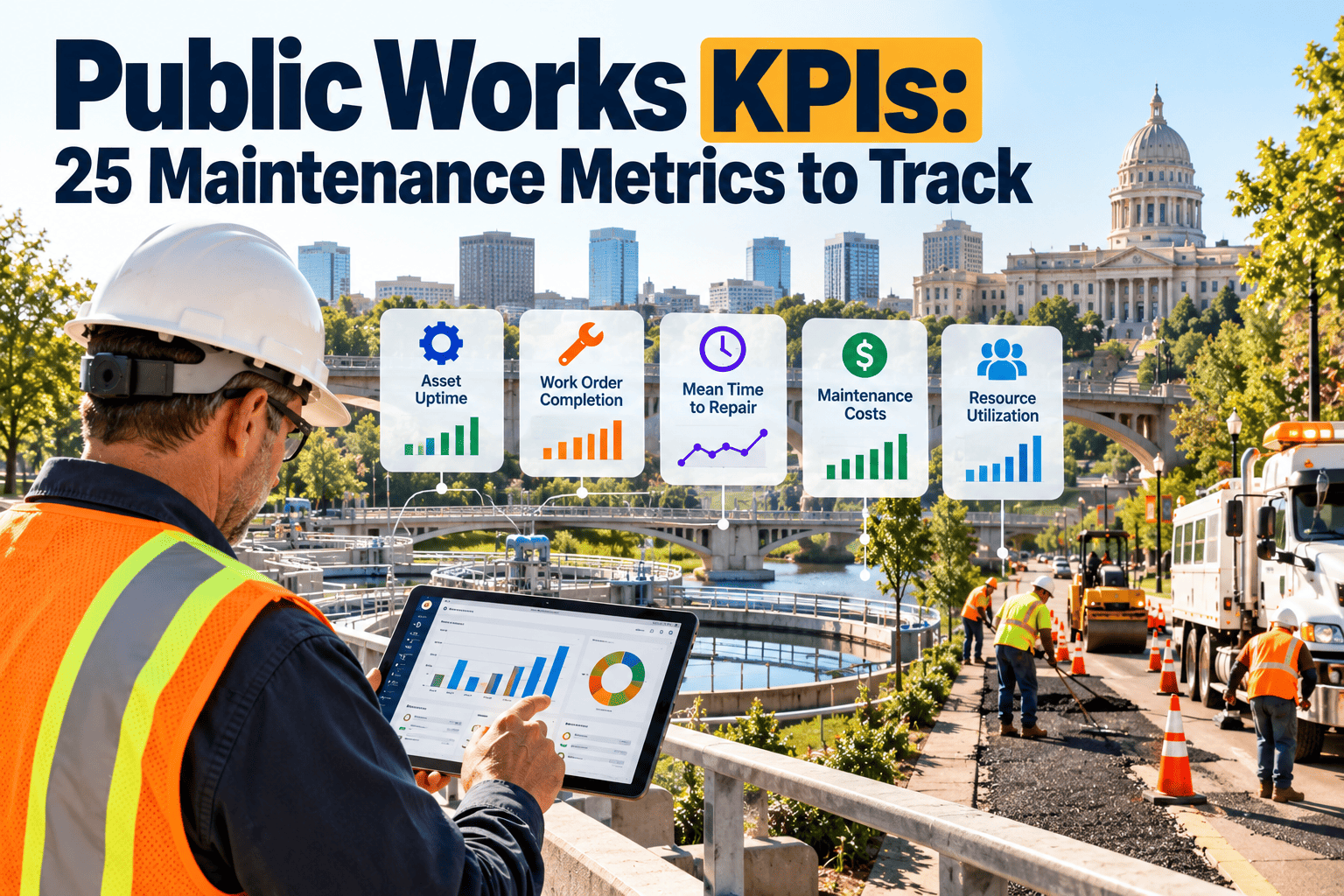
Government asset management runs on two parallel obligations — keeping infrastructure serviceable for the public, and justifying every dollar spent to elected officials, auditors, and grant agencies. KPIs are the bridge between those obligations. Without tracked metrics, capital budget requests are opinion. Deferred maintenance backlogs are invisible until they become crises. Compliance gaps show up as audit findings rather than calendar reminders. This guide covers the eight KPIs that public sector asset managers need to track, how each one is calculated, and the benchmarks that separate high-performing agencies from those perpetually explaining budget overruns.
Automate Every KPI in This Guide with OxMaint
OxMaint calculates FCI, PM compliance, emergency repair ratio, deferred maintenance backlog, and work order response time in real time — with council-ready exports and audit documentation generated automatically from daily operations.
Why KPI Tracking Is a Governance Requirement, Not a Reporting Exercise
Bond rating agencies including Moody's and S&P evaluate a municipality's asset management practices when assigning credit ratings. Demonstrated ability to track metrics like FCI and Maintenance Backlog signals fiscal discipline — and can lower interest rates on municipal bonds, saving millions in debt service. Federal auditors most commonly request PM completion rate, inspection compliance, emergency repair ratio, and deferred maintenance backlog during review. Agencies unable to produce these records within 72 hours of an audit notice face compliance findings and OSHA citations averaging $15,625 per violation. Meanwhile, capital requests backed by FCI data achieve 88% approval versus 47% for estimate-based submissions. Sign up free to start tracking these metrics automatically in OxMaint.
The 8 KPIs Every Government Asset Manager Must Track
Organize your KPI programme across four categories — Condition, Work Efficiency, Cost, and Service Delivery. Every metric below belongs to one category and feeds a specific governance or operational decision. Book a demo to see how OxMaint calculates and dashboards all eight in real time.
How to Build a KPI Dashboard That Actually Gets Used
The failure mode for government KPI programmes is not bad data — it is data that exists in one system, requires manual compilation, and arrives too late to influence decisions. A council presentation built from spreadsheets assembled over three days is not a live management tool. Sign up free to see how OxMaint builds a real-time KPI dashboard from the work order and PM data your team already captures daily.
Frequently Asked Questions
The Facility Condition Index (FCI) is the most widely used asset condition metric in federal and municipal facilities management. It is calculated by dividing the total deferred maintenance cost by the current replacement value of the asset or portfolio. An FCI of 0.00 to 0.05 indicates good condition. FCI of 0.05 to 0.10 is fair and warrants planned investment. FCI above 0.10 is considered poor condition requiring priority capital action. FCI is recognized by APPA, GSA, and most federal grant programmes as the standard metric for capital investment justification. Sign up free to see OxMaint's real-time FCI dashboard configured for your portfolio.
Federal reviews most frequently request PM completion rate, inspection compliance currency, emergency repair ratio, and deferred maintenance backlog by facility. Agencies that cannot produce these records within 72 hours of an audit notice face compliance findings and OSHA citations averaging $15,625 per violation. The documentation must include timestamps, technician attribution, and photo evidence for each completed work order and inspection — formats that manual spreadsheet systems cannot reliably produce. Book a demo to see OxMaint's audit export module in action.
PM compliance rate is the leading indicator for emergency repair ratio — and emergency repair ratio is the primary driver of budget overruns. Every scheduled PM missed increases the probability of an unplanned failure that costs 3 to 5 times more to repair reactively than on a planned basis. A department operating at 70% PM compliance on a $3M maintenance budget is effectively adding $480K or more in avoidable premium labour and contractor costs annually. Raising PM compliance to 95% through automated scheduling and mobile task management eliminates most of that premium and stabilizes budget variance below 12%.
Best-practice government maintenance programmes target an emergency repair ratio below 10% — meaning at least 90% of work is planned and scheduled in advance. Most municipal operations starting a structured KPI programme begin at 30 to 50% emergency ratio. Reducing this ratio by 20 percentage points on a $3M maintenance budget eliminates approximately $300K in reactive cost premiums annually. The reduction is achieved by shifting maintenance from calendar-based and complaint-driven to condition-based and PM-scheduled — a transition that requires digital work order tracking to sustain at scale. Sign up free to start tracking your emergency repair ratio in OxMaint today.
OxMaint calculates FCI, PM compliance rate, emergency repair ratio, work order response time, deferred maintenance backlog, cost per square foot, inspection compliance currency, and citizen satisfaction rate in real time — as a byproduct of the work orders and PM tasks your team already completes. No manual data assembly. No separate reporting system. Directors see the cross-department KPI summary; field crews see their own queue. Council-ready performance reports export in under four hours for any oversight or grant application requirement. Book a demo to see the full KPI dashboard configured for your agency's asset classes and reporting requirements.
Every KPI in This Guide, Calculated Automatically
OxMaint tracks FCI, PM compliance, emergency ratio, deferred backlog, and work order response time in real time — with audit-ready exports and council-formatted reports generated from your team's daily operations. No manual compilation. No separate reporting tools.