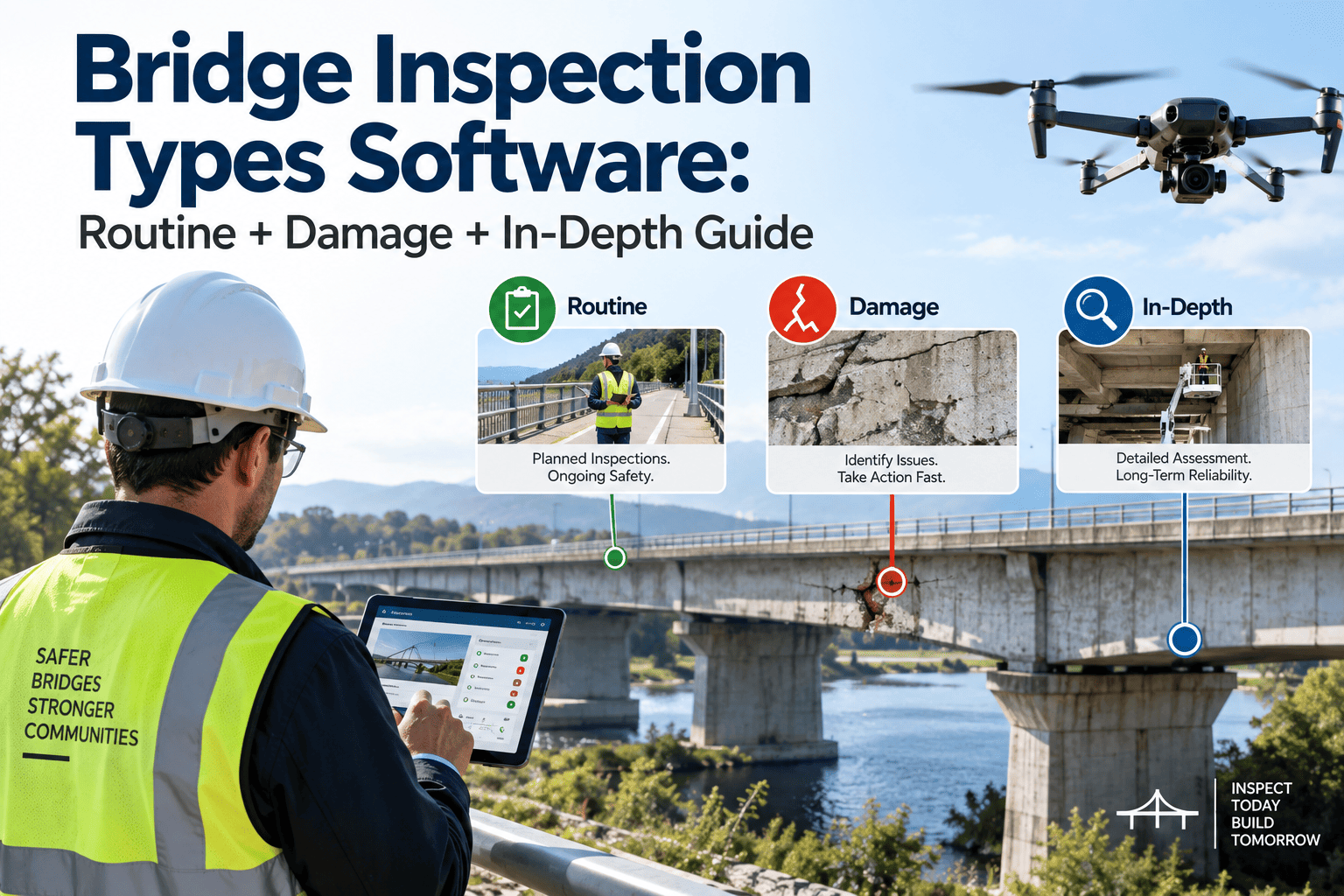
A state transportation department faced a crisis when its annual bridge inspection report revealed a backlog of 342 critical repairs, with an average resolution time of 8 months. The bottleneck wasn't a lack of inspectors; it was data paralysis. Inspectors were filing reports into a legacy system that didn't talk to the maintenance scheduling platform. Critical structural defects identified in June weren't even seen by maintenance planners until October due to manual data entry lags. The tipping point was a partial deck failure on a high-traffic overpass that had been flagged as "urgent" six months prior but buried in a PDF report. By integrating their bridge inspection data directly into a CMMS with automated workflows, the department cut repair turnaround time to 3 weeks, eliminated the backlog, and ensured 100% compliance with federal NBIS standards. Bridge safety relies on data velocity as much as structural integrity. Start Free Trial.
Bridge inspections are rigorous, data-heavy processes mandated by the National Bridge Inspection Standards (NBIS). Inspectors document everything from hairline cracks in concrete to scour around piers. However, the value of this data is lost if it sits in a static report. The challenge for Public Works departments is converting inspection findings into maintenance actions.
This guide outlines a seamless workflow where inspection data triggers automated maintenance responses. It covers condition rating (interpreting NBI codes), symptom diagnosis (identifying root causes like chloride intrusion), and repair prioritization (automating work orders based on risk).
Common Bridge Defects: Causes, Symptoms & Fixes
Understanding bridge deterioration mechanisms is key to selecting the right repair strategy. Is the concrete spalling due to freeze-thaw cycles or rebar corrosion? Is the bearing frozen or misaligned? Correct diagnosis prevents repeat failures.
Cause: Rebar corrosion (rust expansion) or freeze-thaw cycles.
Fix: Remove loose concrete, clean/coat rebar, apply patch material. Seal surface.
Cause: High water flow velocity, turbulence, or channel migration.
Fix: Install riprap (armoring), underpinning, or structural countermeasures.
Cause: Corrosion, debris accumulation, or lack of lubrication.
Fix: Clean and lubricate, jack bridge to reset/replace bearing assembly.
Cause: Seal damage, heavy traffic impact, thermal movement exceeding design.
Fix: Replace gland seal, reconstruction of joint headers, or install trough.
A CMMS enables inspectors to tag these specific defects with photos and NBI condition ratings directly in the field. This triggers logic: "If Rating ≤ 4 (Poor), auto-create High Priority Work Order."
Departments can download NBIS-compliant digital inspection forms to streamline this process.
Inspect, Rate, Repair — a government & public works action plan with mobile apps
Field mobility is the linchpin of modern bridge management. Inspectors climbing scaffolding or wading in streams cannot efficiently juggle paper forms and cameras. Mobile apps consolidate the entire toolkit.
Key mobile capabilities for bridge teams:
Visual History: Tap a bridge element on the tablet to see photos from the last 5 inspections. "Is that crack growing?" Compare instantly with the 2021 photo.
One-Tap Logic: flagging a "Critical Finding" immediately notifies the Bridge Engineer via SMS/Email, bypassing administrative delays.
This workflow closes the gap between "seeing" a problem and "solving" it. It creates a digital thread from the inspector's tablet to the maintenance crew's work order.
Ready to digitize your bridge inspections? Schedule a demo to see how mobile forms enforce data standards.
The 90-Day Inspection-to-Action Roadmap
Moving from siloed reports to an integrated maintenance system requires a structured approach. Here is a 90-day implementation plan for DOTs and Public Works.
This roadmap ensures that inspection data isn't just filed away—it actively drives the maintenance strategy. Book a strategy session to align this timeline with your inspection cycle.
Before & After: Static Reports vs. Dynamic Maintenance
| Capability | Static (Legacy) | Dynamic (Integrated CMMS) | Impact |
|---|---|---|---|
| Defect Reporting | PDF Report (filed weeks later) | Real-time mobile upload | Instant visibility |
| Work Order Creation | Manual transcription | Auto-generated from NBI rating | Zero administrative lag |
| Repair History | Scattered spreadsheets | Linked to Bridge ID timeline | Defensible legal record |
| Critical Findings | Phone chain/Email | Automated SMS/Push alerts | Immediate safety response |
| Resolution Time | 6-12 Months | 3-6 Weeks | Improved public safety |
| Compliance | Reactive/Panic-driven | Proactive/Dashboard-driven | 100% FHWA compliance |
The shift to dynamic maintenance provides a single source of truth. Engineers, inspectors, and maintenance superintendents all see the same real-time data, eliminating communication gaps.
ROI Validation: Justifying the Investment
Investing in integrated bridge management software yields substantial returns by extending asset life and reducing emergency repair costs.
Administrative Efficiency: Automating the report-to-work order process saves engineers 10-20 hours per week of data entry and coordination.
Emergency Avoidance: Catching and fixing a defect at NBI Rating 5 (Fair) costs significantly less than emergency shoring at Rating 3 (Serious).
Federal Funding: Accurate, up-to-date data supports successful grant applications and ensures eligibility for federal repair funds.
Need to build a business case? Schedule a Demo tailored to your bridge inventory and condition profile.