An EPA compliance officer arrives at your utility on a Tuesday morning — unannounced — and asks for 36 months of chlorine residual logs, every corrective action tied to a permit exceedance, and calibration records for each chemical feed pump on site. If those records sit in filing cabinets, spreadsheets, and someone's email inbox, the auditor doesn't see effort — they see gaps. And gaps become Notices of Violation with per-day penalties that add up faster than any budget line can absorb. Public utilities that survive EPA scrutiny don't work harder during inspections; they document continuously through Oxmaint's compliance-configured CMMS so every record is one search away from the auditor's screen.
EPA Compliance · Public Utilities · 2026
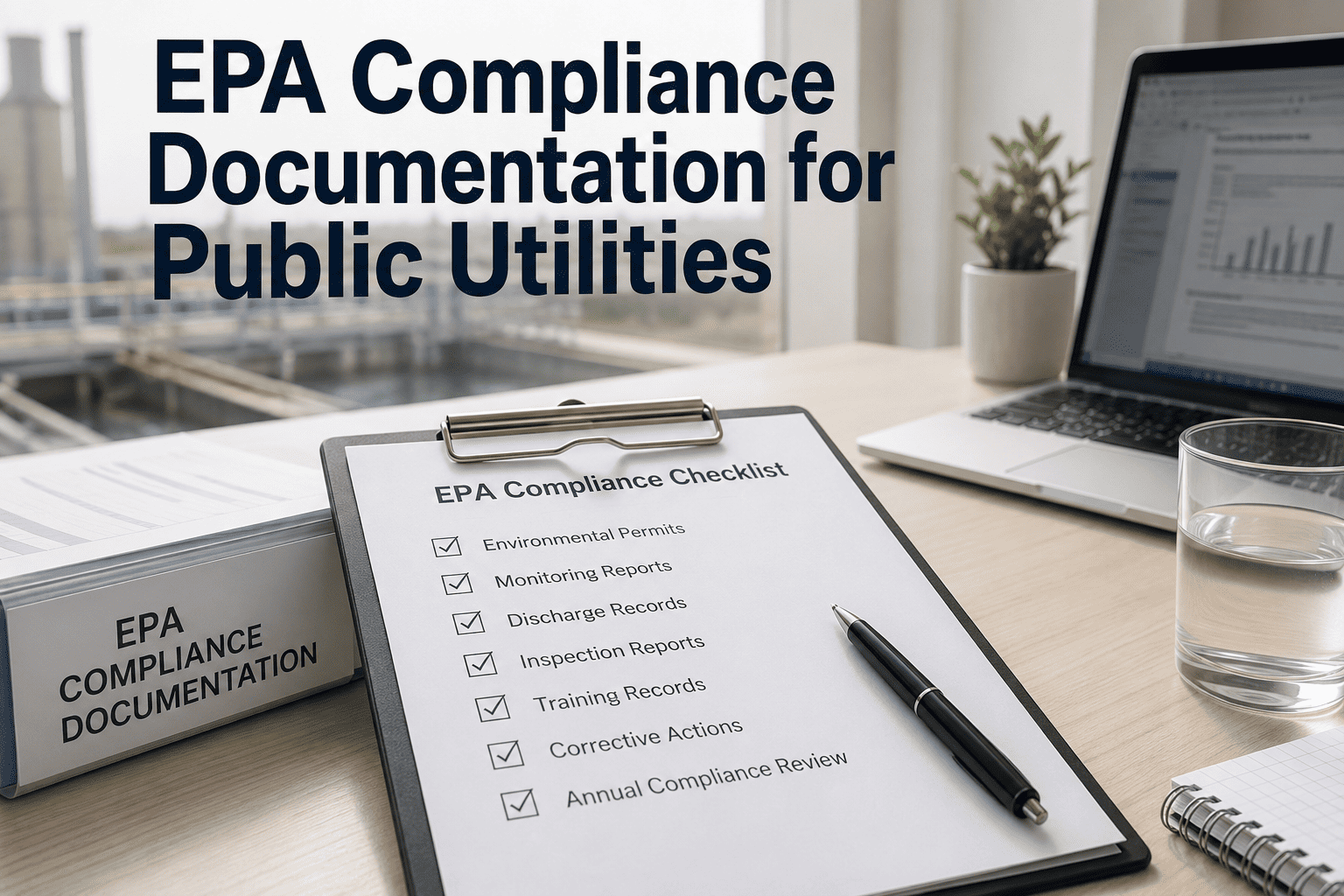
EPA Compliance Documentation for Public Utilities
The maintenance records that stand between your utility and a six-figure Notice of Violation — automated, timestamped, and audit-ready from the day you deploy.
$25K
Per-day EPA penalty for significant SDWA and CWA violations at public utilities
73%
EPA Notices of Violation caused by missing records — not actual treatment failures
3–6 wks
Average time utilities spend compiling audit packages from paper logs before inspections
10 yrs
Mandatory SDWA record retention window — every calibration, sample, and corrective action
Anatomy of a Documentation Failure — What Actually Happens
EPA enforcement actions against public utilities almost never start with a treatment breakdown. They start with a documentation gap that sits invisible for months, then surfaces at the worst possible moment. Here is the sequence that has cost utilities millions.
Day 1
The Deviation No One Logs
A chlorine residual reading drops below the permit floor for two hours at 3 AM. Operator adjusts feed, notes it on a clipboard, moves on. No timestamped record enters a system. The event exists only in one person's memory.
Day 30
The Missing Corrective Action
A DMR is submitted. The exceedance is disclosed as required. But the corrective action documentation — root cause, response steps, verification of resolution — was never formalized. The regulator flags it as an open item.
Day 90
The Unannounced Inspection
EPA arrives. Auditor requests 36 months of continuous monitoring data, calibration certificates for two specific analyzers, and corrective action files for every parameter deviation. Team spends four days pulling paper.
Day 120
The Notice of Violation
NOV cites documentation deficiencies across five parameters — not the original 2 AM incident. Consent order requires 18 months of enhanced monitoring, third-party audit fees, and a public notification the local paper picks up.
The 5 Document Categories EPA Auditors Always Request
Every EPA compliance inspection at a public utility ultimately reduces to the same five demand categories. If your utility cannot produce all five within minutes — indexed by date, parameter, and asset — you are already exposed.
01
Discharge Monitoring Reports
36 months of DMRs showing every permit parameter result, calculation method, submission date, and any exceedance explanation. Gaps in submission dates read as reporting violations.
02
Laboratory & Sampling Records
Chain of custody forms, EPA-approved analytical methods used, QA/QC data, technician sign-offs, and equipment calibration certificates. Inconsistent formats trigger deeper record review.
03
Corrective Action Files
Every exceedance requires documented root cause, response steps, implementation date, and verification of effectiveness. Email trails and hallway conversations do not satisfy the standard.
04
Equipment PM Records
Preventive maintenance logs for treatment-critical assets — blowers, pumps, disinfection systems, clarifiers, chemical feed. Missing PM records suggest the equipment protecting compliance was neglected.
05
Calibration & Certification Logs
Timestamped calibration records for every instrument in the compliance chain, plus current operator certifications with issuing state and expiration dates on file for each shift.
Regulatory Framework Matrix — What Each Rule Demands
The True Cost of One Missing Record
A single documentation gap does not stay small. It escalates through a predictable penalty ladder — and the ladder rungs are expensive.
Rung 1
Informal Warning
$0 direct cost — but on regulator radar
Auditor notes documentation gap during routine inspection. Utility receives written observation. No penalty, but the utility is now flagged for follow-up review.
Rung 2
Notice of Violation
$50K–$200K civil penalty range
Formal NOV issued citing specific missing records. Utility must respond in writing, propose corrective action, and accept a fine calculated per violation day.
Rung 3
Administrative Consent Order
12–24 months enhanced monitoring at $8K–$15K per month
Utility signs enforceable consent order — mandatory third-party audits, enhanced sampling, quarterly progress reports to EPA Region office.
Rung 4
Public Notification & Media Exposure
Ratepayer confidence collapse — political fallout
Tier 1 public notification triggers local news coverage. City council calls hearings. Trust with the community — the hardest asset to rebuild — is damaged for years.
Rung 5
Criminal Referral
Personal liability for compliance officers and operators
Willful noncompliance or falsified records escalate to criminal referral. Individuals — not just the utility — can face prosecution and incarceration under environmental statutes.
Stop Preparing for Audits — Live Audit-Ready Every Day
Oxmaint captures every calibration, PM, corrective action, and inspection as timestamped digital records — so when an EPA officer walks in, your compliance file is already on the screen.
How Oxmaint Builds Your Audit Trail — Automatically
1
Regulation-Mapped Templates Loaded on Day One
SDWA, NPDES, SWTR, and LCRI checklists come pre-built — mapped to your permit conditions during deployment. Every recurring task is a work order with the required documentation fields already in place.
2
Every Action Captured with Timestamp, Operator, and Asset ID
Calibrations, PM completions, corrective actions, and inspections all record who did what, when, and to which asset. Photos, sensor readings, and sign-offs attach automatically to the work order.
3
Permit Calendar Alerts Prevent Missed Deadlines
DMR submission dates, CCR delivery windows, and sanitary survey deadlines all track inside the CMMS. Alerts fire at 7-day, 3-day, and same-day intervals — no compliance requirement falls off the calendar.
4
Audit Package Exports in Under 4 Hours
When EPA requests records, one click exports the compliance package — filtered by regulation, date range, or parameter — in the format state primacy agencies and EPA Region offices accept.
Manual Compliance vs. Oxmaint-Automated Compliance
Manual Process
Records live in paper logs, spreadsheets, and personal email inboxes
Audit prep starts 3–6 weeks before the inspection window
Corrective action files are drafted retroactively — after the fact
Calibration certificates get lost between technician shifts
DMR submission dates depend on one person remembering the calendar
Every NOV becomes a scramble to reconstruct history
With Oxmaint
Every action digitally captured, indexed, and instantly searchable
Audit packages generated on demand — under 4 hours end to end
Corrective actions logged in real time with photo evidence attached
Calibration records tied to asset ID and retained for the regulatory window
Permit calendar alerts fire automatically at multiple intervals
Continuous audit readiness — no scrambling, no gaps, no memory relied on
Compliance Metrics — What Utilities Achieve on Oxmaint
91%
Average PM compliance rate reached within 90 days of deployment
4 hrs
Time to produce a complete EPA audit package — versus 3–6 weeks manually
14 days
Deployment window — no hardware replacement, no consultant fees required
Zero
Documentation-based NOVs among Oxmaint utility customers post-deployment
Frequently Asked Questions
What EPA documentation does a public utility legally need to retain?
Under SDWA, public water systems must keep monitoring results, treatment records, and operator certifications for at least 10 years. NPDES holders retain DMRs and calibration logs for 3 years minimum.
Oxmaint stores every record indefinitely so retention windows are never a risk factor.
How quickly can Oxmaint produce an audit package for an EPA inspection?
Under 4 hours end to end — versus the 3–6 weeks most utilities spend compiling paper records manually. One click filters by regulation, date range, parameter, or asset, and exports the file in the format EPA Region offices and state primacy agencies accept.
Does Oxmaint handle both water and wastewater utility compliance?
Yes — SDWA and CWA NPDES frameworks are both built into the platform. Water treatment, wastewater, booster stations, and pump stations run under one compliance dashboard while each facility maintains its own permit calendar and asset register.
How does Oxmaint prevent missed permit deadlines?
Every DMR submission date, CCR delivery window, and sanitary survey deadline tracks inside the compliance calendar. Automated alerts fire at 7-day, 3-day, and same-day intervals — so no requirement depends on one person remembering.
Is Oxmaint affordable for small and mid-size public utilities?
Yes — deployment happens in 14 days with no hardware replacement and no consultant fees. Utilities of 45,000 connections and smaller run Oxmaint successfully.
Book a demo to see pricing scaled to your utility size.
Make Every EPA Audit a Non-Event
Oxmaint turns your compliance obligations into automatic byproducts of daily operations. Every calibration, every PM, every corrective action becomes a timestamped record — indexed, retained, and instantly retrievable when EPA asks. Stop preparing for audits. Start living audit-ready.