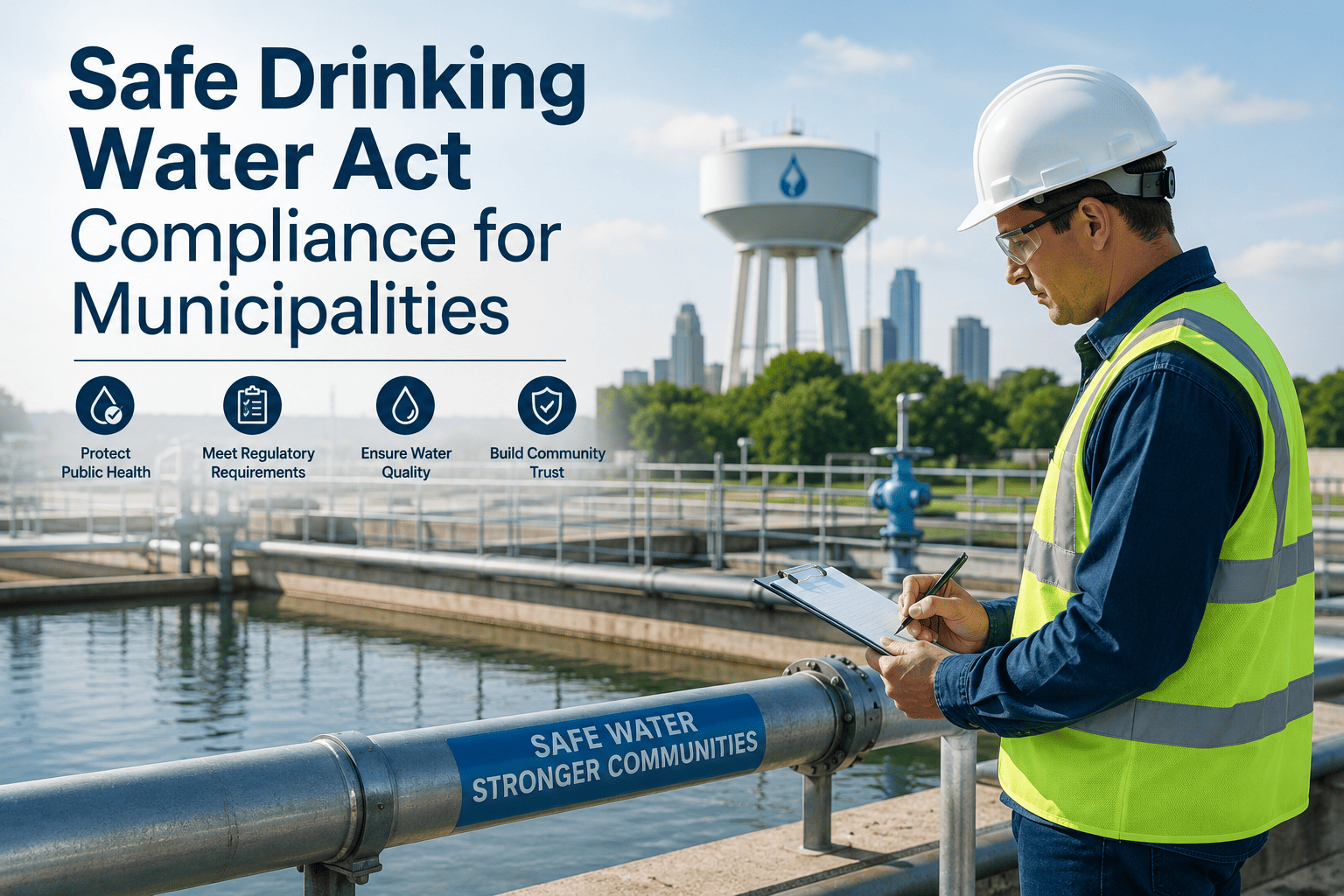
A single missed monitoring deadline or a late Consumer Confidence Report can turn a routine inspection into a state enforcement action. The Safe Drinking Water Act governs how roughly 49,600 community water systems across the country monitor, treat, and report on the water served to more than 312 million people, and most of these systems are small operations running with limited staff. Compliance depends on documentation as much as water quality itself, since incomplete sampling records or unclear justification for reduced monitoring can trigger findings even when contaminant levels sit within limits. As lead service line rules and new PFAS treatment deadlines reshape what utilities must track, keeping every monitoring and maintenance record organized in one place has become the difference between passing an audit and receiving a violation notice, which is why utilities are moving their compliance recordkeeping onto a connected maintenance platform.
The Compliance Load Municipal Systems Are Carrying
Federal drinking water rules do not scale down for small utilities. A system serving a few thousand residents carries the same monitoring, reporting, and notification obligations as one serving a major city, with far fewer hands to manage it.
Where Municipal Systems Fall Out Of Compliance
Regulators are looking past pass or fail contaminant results. Inspectors now weigh how monitoring is documented, not just what it found, which means paperwork gaps can create violations on their own.
Late or skipped sampling events remain one of the most commonly cited issues for community water systems working off manual schedules.
Holding times, approved lab methods, and the justification for reduced monitoring are now reviewed as closely as the contaminant results themselves.
Systems are shifting from the Lead and Copper Rule Revisions to the newer Lead and Copper Rule Improvements, adding service line inventory work.
Utilities are tracking proposed PFOA and PFOS compliance timelines that could move treatment and reporting deadlines with little notice.
See Your Compliance Status Before The State Does
Oxmaint keeps monitoring schedules, lab records, and service line inventories in one system so nothing slips past a deadline, giving your team the documentation an inspector wants to see, ready before they ask for it.
Reactive Compliance vs Documented Compliance
The gap between a clean inspection and a violation notice usually is not water quality, it is whether the paperwork can prove what happened and when.
| Question | Reactive Approach | Documented Approach |
|---|---|---|
| Are samples taken on schedule? | Tracked across spreadsheets, easy to miss a window | Automated reminders tied to each monitoring point |
| Can reduced monitoring be justified? | Relies on one person's memory of past results | Logged history attached to every sample record |
| How fast can a public notice go out? | Drafted only after a violation is confirmed | Template ready and triggered the moment a result flags |
| Where do lead service line records live? | Scattered across paper files and old maps | Centralized inventory linked to active work orders |
| Is the Consumer Confidence Report on time? | Assembled by hand every spring under deadline pressure | Pulled directly from ongoing maintenance and test logs |
Five Stages Every Community Water System Repeats
SDWA compliance is not a single filing, it is a cycle that starts at the source and ends with the public, then starts again the following year.
Following the state source water assessment to limit contamination risk before treatment ever begins.
Collecting samples on the schedule set for each contaminant group and comparing results against maximum contaminant levels.
Filing results with the state primacy agency and keeping holding times and method records defensible for audit.
Notifying customers and the state on the required timeline whenever a violation or treatment technique failure occurs.
Publishing the yearly water quality report that closes one compliance cycle and opens the next.
Turn Every Stage Into A Tracked Work Order
From source water checks to the annual report, Oxmaint links each compliance stage to a maintenance record your team can pull up the moment a regulator asks for it.
Frequently Asked Questions
What counts as a public water system under the SDWA?
Does the EPA or the state enforce compliance?
What happens if a system misses a monitoring deadline?
How is the Lead and Copper Rule changing right now?
Can maintenance software actually support SDWA compliance?
Stop Chasing Deadlines, Start Documenting Them
Every monitoring window, lab result, and public notice your utility handles this year can live in one auditable system instead of a dozen spreadsheets. See what documented compliance looks like for your community water system.