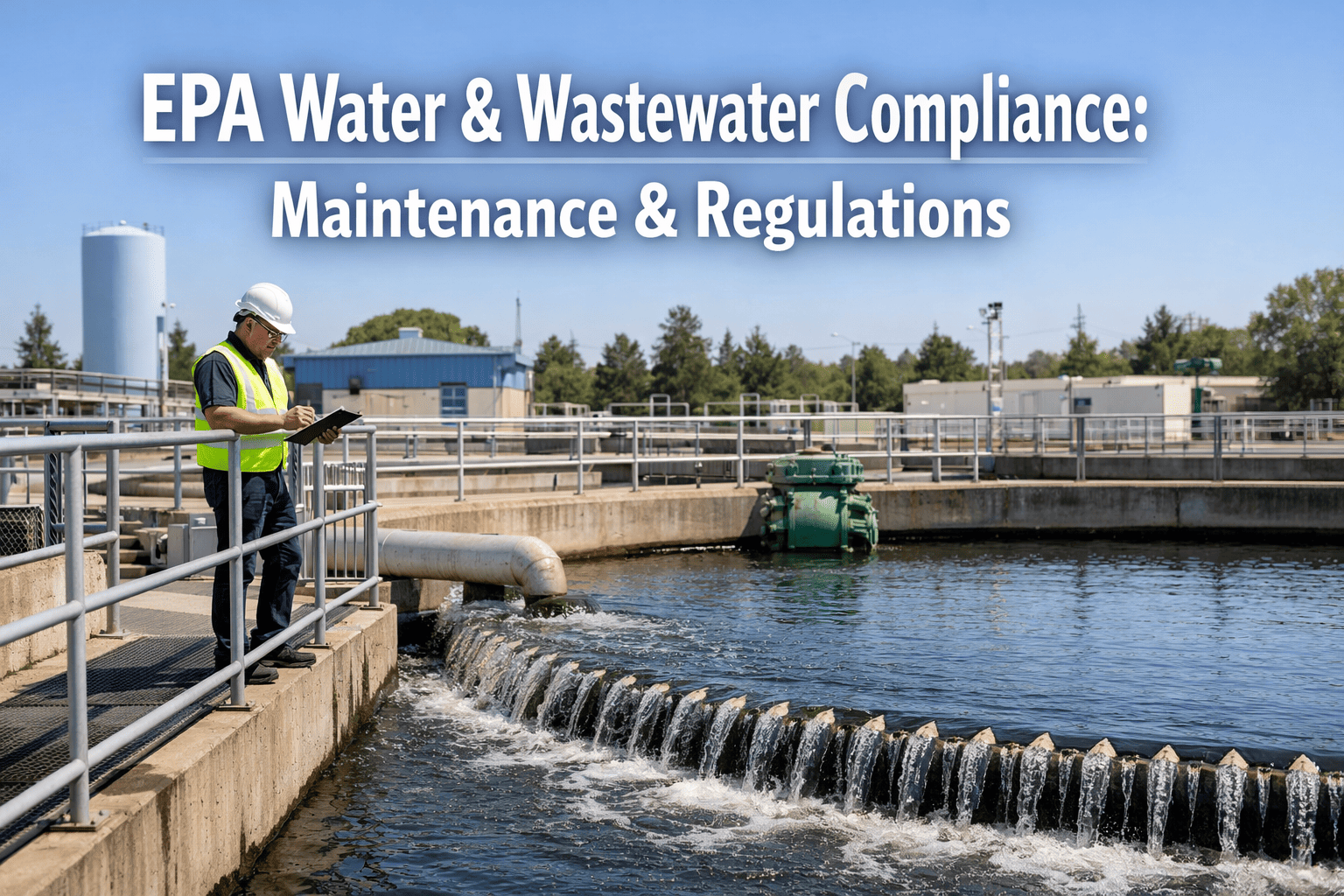
How to Pass EPA Compliance Audits for Municipal Utilities
By Taylor on February 8, 2026
When the EPA compliance officer arrived unannounced at the water treatment plant on a Tuesday morning and asked for the last 36 months of chlorine residual monitoring data, turbidity exceedance reports, and documented corrective actions for every permit parameter deviation, the plant superintendent couldn't produce them. Maintenance logs were in a filing cabinet—unsorted. Lab results existed on three different spreadsheets with inconsistent date formats. Corrective action records? Those were in the supervisor's email inbox. The result? A Notice of Violation carrying $187,000 in penalties, a consent order requiring 18 months of enhanced monitoring at $12,000/month, and a public notification requirement that made the evening news and destroyed ratepayer confidence. A CMMS-driven compliance management system would have generated every requested document in under 10 minutes—because the data was already being captured as part of daily operations.
This scenario repeats at municipal utilities nationwide. EPA enforcement data shows that 40% of NPDES permit holders receive violations in any given compliance cycle, and the majority stem not from treatment failures but from documentation gaps—missed reporting deadlines, incomplete monitoring records, and undocumented corrective actions. Forward-thinking utilities are deploying CMMS-integrated compliance programs that automate documentation, track every permit parameter, and maintain audit-ready records as a natural byproduct of daily operations. Utilities ready to achieve 100% compliance can start building their audit-ready compliance system today.
Compliance Reality: Audit-Ready vs. Scrambling
CMMS-Managed CompliancePaper-Based / Reactive
40%
Of NPDES permit holders receive violations per cycle
100%
Audit-ready documentation achievable with CMMS
$187K
Average penalty for serious compliance violations
The Real Cost of "We'll Pull It Together When They Ask"
Most municipal utilities don't lack compliance effort—they lack compliance systems. Without a formal digital framework, operators log data in notebooks, supervisors track corrective actions via email, and lab results live on disconnected spreadsheets. When an auditor requests three years of records organized by permit parameter, the scramble begins. EPA doesn't accept "we were doing the work but didn't document it" as a defense, and neither do state DEQ auditors who have heard that excuse from every facility that receives a Notice of Violation.
Anatomy of an EPA Audit Failure
How documentation gaps escalate to enforcement actions
A CMMS-driven compliance program prevents this cascade at every step. Automated monitoring schedules ensure no sampling event is missed, digital lab data capture eliminates transcription errors, permit parameter dashboards flag deviations before they become violations, and every corrective action is timestamped and documented. Utilities that implement comprehensive compliance systems don't just avoid fines—they build organizations where auditors find nothing to cite because the documentation tells a story of continuous, systematic compliance.
The Six Pillars of EPA Audit Readiness
EPA compliance audits evaluate six core areas where municipal utilities must demonstrate documented, systematic programs. For water and wastewater utilities managing NPDES permits, Safe Drinking Water Act requirements, and state-specific regulations, each pillar requires specific documentation, monitoring protocols, and corrective action workflows tailored to permit conditions.
Process equipment maintenance protecting permit limits
Prevention
Each pillar builds on the previous—permit tracking drives monitoring, monitoring generates corrective actions, PM prevents the equipment failures that cause violations
From Scrambling to Systematic: The Compliance Roadmap
The goal of a phased compliance implementation is to deliver immediate audit protection while building the long-term documentation framework. When the first permit parameter gets digital tracking with automated threshold alerts, operators see immediate value. Agencies ready to see this transformation can schedule a demo to watch the compliance workflow firsthand.
The EPA Compliance Readiness Roadmap
From documentation gaps to continuous audit readiness
Map Permits
Document all parameters
Digitize Records
Centralize monitoring data
Set Alerts
Threshold notifications
Link PM
Equipment → permit params
Automate DMRs
Report generation
Audit-Ready
Continuous compliance
Build Your Audit-Ready Compliance System
Watch how Oxmaint helps municipal utilities achieve 100% EPA compliance. Our 30-minute demo shows you the complete workflow—from permit parameter tracking to automated DMR generation and instant audit documentation.
Paper Records vs. Digital Compliance: The Audit Comparison
EPA compliance isn't about doing more work—it's about capturing the work you're already doing in a format that satisfies auditors. Most utility operators perform the required monitoring and maintenance daily. The gap is documentation: paper logs get lost, spreadsheets have version conflicts, and email threads can't be searched by permit parameter. Understanding where your compliance system sits determines audit outcomes.
Compliance Documentation Maturity Comparison
Swipe to compare compliance levels
Audit Function
Paper / Binders
Spreadsheets
CMMS-Integrated
Monitoring Records
Handwritten logs, gaps common
Digital but disconnected
Auto-captured, timestamped, linked
Permit Limit Tracking
Manual comparison, after-the-fact
Formula-based, error-prone
Real-time dashboards with alerts
Corrective Actions
Email chains, undocumented
Tracked but no closure verification
Workflow with root cause & sign-off
DMR Preparation
Days of manual compilation
Hours with copy-paste errors
Auto-generated, review-and-submit
Audit Response Time
Days to weeks; records missing
Hours; gaps discovered under pressure
Minutes; complete audit trail instant
40%Of permit holders receive violations each cycle
<10 minAudit record retrieval with CMMS
Expert Perspective: Why Documentation Is the Real Compliance Test
In 25 years of EPA compliance work, I've seen far more enforcement actions triggered by documentation failures than treatment failures. Most utility operators do good work—they monitor, they adjust, they respond to upsets. But if you can't prove it happened, it didn't happen. An auditor sees a gap in your chlorine residual log and assumes the worst. A missing corrective action record becomes evidence of negligence. A CMMS eliminates these gaps by making documentation an automatic byproduct of daily operations, not an afterthought that depends on whether someone remembered to write it down.
Document Everything
Every monitoring result, calibration, corrective action, and operational decision must be timestamped and retrievable. Auditors judge your program by what they can verify, not what you remember.
Alert Before Violations
Set threshold alerts at 80% of permit limits—not 100%. Early warnings give operators time to adjust treatment before exceedances occur, turning potential violations into documented proactive responses.
Close the Loop
Every deviation needs a documented corrective action with root cause analysis, implementation verification, and effectiveness confirmation. Open corrective actions are audit red flags that invite deeper scrutiny.
The utilities passing every EPA audit share common characteristics: digital systems that capture compliance data as part of daily operations, threshold alerts that prevent violations before they occur, and corrective action workflows that close the loop with documented evidence. If you're ready to explore what this looks like for your utility, our team can help build the roadmap. Schedule a consultation to design your compliance program architecture.
Your First 90 Days to Audit Readiness
Achieving EPA audit readiness starts with three parallel workstreams: mapping every permit parameter to monitoring requirements, digitizing historical compliance records into a centralized system, and establishing automated alert thresholds that prevent violations before they occur. Use the first 90 days to build the documentation framework, close existing gaps, and demonstrate to auditors that your utility operates a systematic compliance program.
For utilities ready to move from scrambling during audits to welcoming them as opportunities to demonstrate excellence, the path is clear: digitize permit tracking first, automate monitoring documentation second, and build corrective action workflows third. Book a consultation to discuss how to structure your compliance program for 100% audit readiness.
Join municipal utilities using Oxmaint to automate permit tracking, eliminate documentation gaps, and build instant audit trails. See exactly how digital compliance workflows protect your utility from violations and penalties.
What documents do EPA auditors request most frequently?
EPA auditors typically request five categories of documentation in every compliance inspection: (1) Discharge Monitoring Reports (DMRs) for the past 36 months showing all permit parameter results, calculations, and submission dates. (2) Laboratory records including sampling chain-of-custody, analytical methods, QA/QC data, and equipment calibration logs. (3) Corrective action records for every permit exceedance showing root cause analysis, corrective measures taken, implementation dates, and effectiveness verification. (4) Equipment maintenance records for process-critical systems—blowers, pumps, disinfection, and clarifiers—proving that treatment systems are maintained to prevent violations. (5) Operator certification records and training documentation. A CMMS generates all five categories as a natural byproduct of daily operations, eliminating the multi-day scramble that paper-based utilities face when auditors arrive.
How does a CMMS help prevent NPDES permit violations?
A CMMS prevents violations through three mechanisms: First, automated monitoring schedules ensure no required sampling event is missed—the system generates work orders for every monitoring requirement with deadline alerts at 7-day, 3-day, and same-day intervals. Second, real-time permit parameter dashboards track results against limits with threshold alerts at 80% of permit values, giving operators early warning to adjust treatment before exceedances occur. Third, equipment PM schedules linked to specific permit parameters ensure that the process equipment protecting water quality (aeration blowers, chemical feed systems, UV disinfection, clarifier drives) receives timely maintenance. When a blower vibration trend triggers a predictive work order 60 days before failure, the violation that would have resulted from an unplanned outage never occurs.
What are the most common EPA audit findings for municipal utilities?
The five most common audit findings are: (1) Incomplete or late DMR submissions—even one late filing can trigger Significant Non-Compliance (SNC) designation. (2) Missing monitoring data—gaps in required sampling frequency are treated as violations regardless of reason. (3) Undocumented corrective actions—every permit exceedance requires documented response; oral corrections without records are treated as non-responsive. (4) Equipment calibration gaps—analyzers and monitoring equipment must have current calibration records traceable to NIST standards. (5) Inadequate process equipment maintenance—auditors review maintenance records for permit-critical equipment to assess whether the utility has a systematic program preventing treatment failures. A CMMS eliminates all five findings by automating scheduling, capturing documentation, and creating the audit trail that proves systematic compliance management.
How should we prepare for an unannounced EPA inspection?
The best preparation for unannounced inspections is continuous audit readiness—not scrambling when the auditor arrives. Maintain a permanently organized compliance file (digital, not binders) containing current permits, recent DMRs, lab certifications, operator licenses, and corrective action summaries. Conduct quarterly internal audits using the same checklist EPA auditors use—identify and close gaps before the regulator finds them. Ensure every operator knows where compliance records are stored and can retrieve them independently. With a CMMS, every record is searchable by date, permit parameter, asset, or work order—any authorized user can pull any compliance document within minutes regardless of who originally created it.
Can small utilities afford a digital compliance management system?
Small utilities face the same EPA requirements with fewer staff—making digital compliance even more critical. A single operator managing a 0.5 MGD plant benefits enormously from automated DMR reminders preventing missed deadlines, digital monitoring logs eliminating handwritten record gaps, and threshold alerts catching potential violations before they occur. Cloud-based CMMS platforms cost $3,000-$12,000 annually for small utilities—preventing one EPA violation penalty of $50,000+ recovers 4-15 years of platform investment. State revolving fund programs and USDA Rural Development grants can subsidize technology costs for communities under 10,000 population. The question isn't whether you can afford digital compliance—it's whether you can afford the next violation penalty without it.