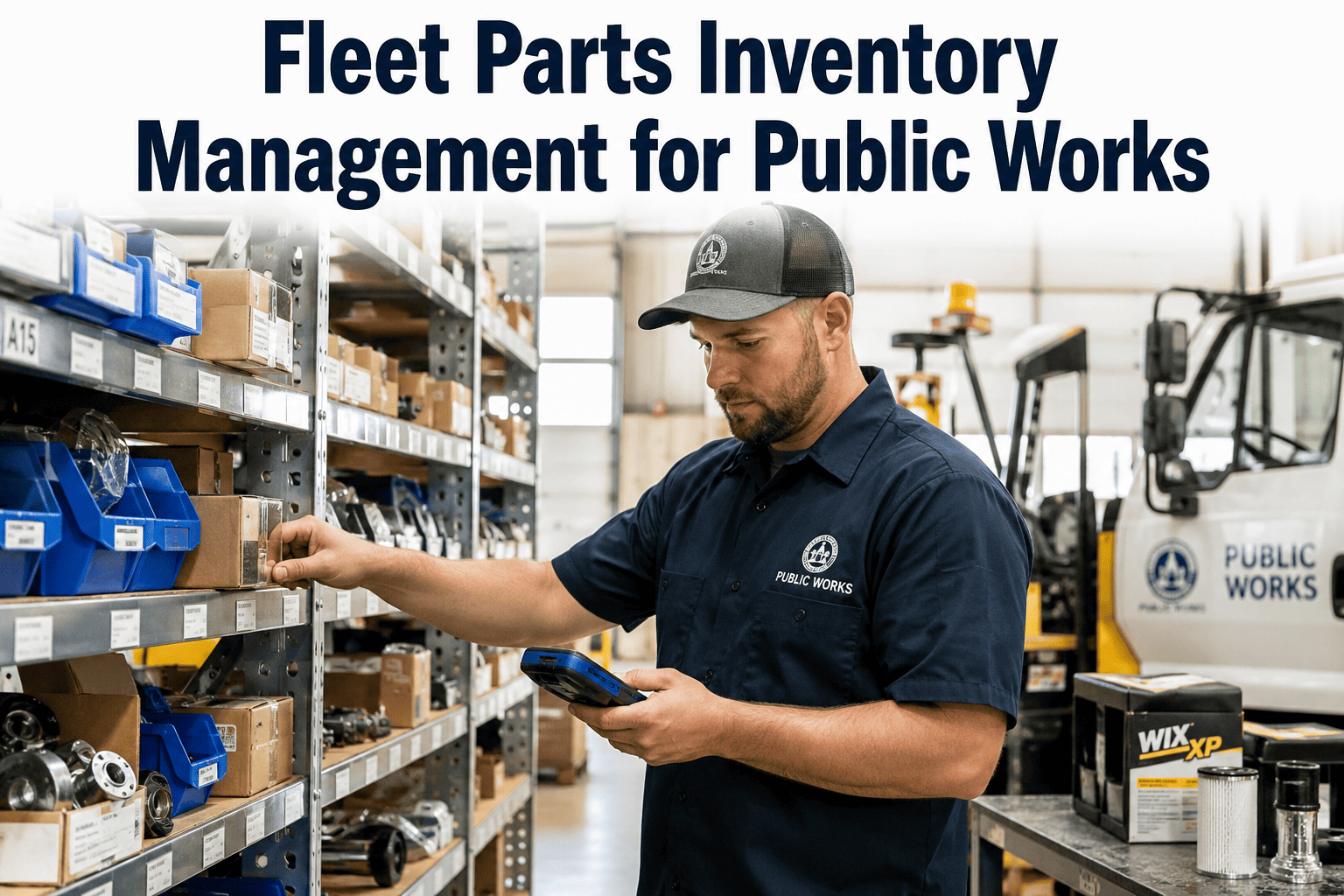
Public works fleets live and die by parts availability — a single missing relay can bench a snowplow for four days while a $7 component sits on backorder. Municipal shops typically carry $250,000 to $900,000 in rolling parts inventory, and when that shelf isn't engineered around criticality and usage velocity, the result is the same everywhere: dead stock on one wall and emergency POs on the other. The mechanics in this guide — criticality-based stocking, min/max tuned to actual lead time, vendor consignment, and a CMMS-driven MRO program — are how high-performing government fleets keep the right part on the shelf without freezing public funds. You can Start Free Trial to put them to work this week, or read on for the full framework.
Is your parts room funding uptime — or quietly stockpiling public money on a shelf?
A 200-vehicle public works fleet carries roughly $480K in parts at any moment. When stocking decisions ride on memory instead of data, 28% of that shelf becomes dead stock within 18 months — while the same shop still pays overnight freight on critical filters.
What poor parts inventory actually costs a public works fleet
Carrying cost in a government shop runs 18–25% of inventory value annually — storage, obsolescence, shrink, insurance, and the labor spent hunting for parts that should already be on the shelf.
Worked example
A 180-asset public works department in the Midwest audited its parts room and found $128,000 of oil filters, brake chambers, and hydraulic seals purchased for vehicles that had since been retired or surplused. Another $61K sat in overstock of high-velocity items the shop would have used eventually — but at 20% carrying cost, holding it a year cost roughly $12,200 in trapped working capital. The same shop spent $34,000 on overnight freight the prior winter because critical plow hydraulic parts weren't stocked at all. Both failures come from the same root cause: no criticality tier and no data-driven min/max.
Tier every part by operational consequence, not by price
A $6 relay that grounds an entire spreader truck is more critical than a $400 seat cover. Stocking decisions should follow the consequence of the part being absent, ranked against fleet mission readiness.
Stop-the-asset parts
Filters, brake chambers, hydraulic hoses, alternators, starter motors, relays, and any wear part whose failure parks a snowplow, refuse truck, or emergency-response vehicle during a service window.
Run-with-degradation parts
Wiper blades, belts, minor sensors, lighting components, and cabin filters. The vehicle can run a shift without them, but uptime and safety erode quickly across the week.
Convenience and comfort parts
Seat covers, trim, decals, auxiliary power outlets. These should never absorb shelf space or working capital — order on demand or move to vendor consignment.
Design min/max around lead time and usage — not memory
Most municipal shops set reorder points five years ago and never touched them again. A defensible min/max resets every part against actual lead time and rolling 12-month usage pulled from the CMMS.
Safety stock = Z-score for target service level (1.65 for 95%) × σ(demand during lead time). For a part used 2.4× per day with a 7-day lead time and a 95% service target, Min ≈ 24 units including safety stock.
Avg daily usage: 1.8 units across 38 powered units · Lead time: 5 business days · Safety stock at 95%: 9 units · Min = 18, Max = 36 · Reorder triggers automatically at 18, lands at 36 before the next drain cycle.
| Part class | Usage velocity | Lead time | Service target | Reorder at | Stock up to |
|---|---|---|---|---|---|
| Tier 1 — filters, relays | High (1–3/day) | 3–5 days | 99% | 18 units | 40 units |
| Tier 1 — hydraulic hoses | Medium (1/week) | 5–10 days | 98% | 4 units | 10 units |
| Tier 2 — belts, sensors | Medium (2/month) | 7 days | 95% | 3 units | 8 units |
| Tier 2 — wipers, lighting | Low (1/month) | 3 days | 90% | 2 units | 5 units |
| Tier 3 — trim, comfort | Variable | 5–14 days | On demand | 0 | 0 (consignment) |
Let the supplier carry Tier 3 until the moment you pull it
Consignment puts supplier-owned inventory physically on your shelf, billed only on consumption. For non-critical, high-variety, low-velocity parts it eliminates carrying cost without sacrificing access.
What belongs on consignment
Hardware, fasteners, fittings, low-velocity sensors, common electrical connectors, consumable shop supplies, and any Tier 3 part where variety is high but per-SKU usage is under two units per month.
What never belongs on consignment
Tier 1 mission-critical parts. Consignment gives the supplier ownership of the reorder decision, and a supplier stockout on a brake chamber benches a plow truck. Tier 1 stays under your min/max and your CMMS.
Typical recovery
Public works fleets that move 30–40% of SKUs (but only 5–8% of spend) onto consignment free up $40K–$90K of working capital in the first year while reducing administrative PO volume by 200–400 transactions.
The four-month rollout that turns the parts room into a program
Without a CMMS, min/max is a spreadsheet someone updates once and forgets. With one, reorder points recalibrate against actual consumption every quarter, and every wrench-turn ties back to a part and an asset.
Baseline audit and parts cleansing
Physical count every shelf, reconcile against the CMMS master list, retire SKUs for surplused vehicles, and tag each remaining part with a criticality tier. Target: 100% shelf-to-record match.
Set min/max from 12-month usage history
Pull 12 months of issues per SKU from the CMMS, calculate avg daily usage and lead time per supplier, and load new reorder points. Flag any part with zero issues in 12 months for disposal or return.
Stand up consignment and auto-replenishment
Sign consignment agreements for identified Tier 3 categories, install barcode or RFID scanning at the parts counter, and enable CMMS-driven auto-PO when a part hits its reorder point.
Tune and lock the quarterly review cadence
Review stockout incidents, dead-stock movement, and usage-trend changes. Recalibrate min/max for the 10% of SKUs whose demand shifted most. Lock the cycle and report KPIs to fleet leadership.
What a tuned parts program returns to the fleet budget
The payoff shows up in three lines of the public works budget: lower carrying cost, lower emergency freight, and lower vehicle downtime. The table below maps a typical 200-asset municipal fleet before and after a four-month rollout.
| Metric (200-asset fleet) | Before | After | Annual impact |
|---|---|---|---|
| On-hand inventory value | $480,000 | $345,000 | $135,000 released |
| Annual carrying cost (20%) | $96,000 | $69,000 | $27,000 saved |
| Emergency freight spend | $34,000 | $9,500 | $24,500 saved |
| Vehicle downtime from part stockouts | 4.3 days/yr per unit | 1.1 days/yr per unit | 640 service-days recovered |
| Dead stock share of shelf | 28% | 6% | $48,300 freed |
| PO transactions (manual) | 3,100/yr | 1,400/yr | 1,700 admin hours saved |
We cut our parts room value by $112,000 in the first year and still cut stockouts in half. The trick wasn't buying less — it was buying against data instead of habit.
— Fleet Supervisor, 240-asset municipal public works department
Stop guessing at reorder points. Start stocking against data.
Oxmaint loads your parts master, calculates min/max from CMMS usage history, and auto-triggers reorders — so your shelf funds uptime instead of dead stock.
Common questions on fleet parts inventory for public works
How often should min/max be recalculated for a municipal fleet?
Review the top 10% of SKUs by usage volatility quarterly, and run a full recalculation annually against rolling 12-month CMMS data. Seasonal fleets (snow, leaf collection, mowing) should also run a pre-season pass on Tier 1 parts 30 days before peak demand hits.
What's a healthy inventory turnover ratio for a public works parts room?
A well-run municipal fleet parts room turns inventory 3 to 4 times per year. Below 2 means too much dead stock; above 6 often means under-stocking that drives emergency freight. Track it as (annual issues cost) ÷ (average on-hand value) in the CMMS.
Should Tier 1 critical parts ever go on consignment?
No. Consignment hands the reorder decision to the supplier, which is fine for Tier 3 but unacceptable when a stockout parks a plow or refuse truck. Tier 1 stays under your own min/max with safety stock sized to a 98–99% service target. You can Book a Demo to see how Oxmaint enforces that boundary automatically.
How do we handle parts for vehicles we're about to surplus?
When a unit is flagged for surplus in the CMMS, freeze reorders on its unique SKUs immediately, drain remaining stock through scheduled service, and return or scrap residuals before the asset leaves the fleet. This single discipline prevents the bulk of the $50K–$130K in orphaned parts most shops carry.
Can a CMMS really pay for itself on parts alone?
Yes. A 200-asset fleet typically recovers $50K–$135K in working capital plus $20K–$30K in carrying cost and emergency freight savings in year one — well above CMMS licensing. You can validate the math on your own shelf when you Start Free Trial and load your parts master in an afternoon.
Build a parts room that funds uptime, not obsolescence.
Criticality tiers, data-driven min/max, consignment for Tier 3, and CMMS-driven auto-reorder — set up in days, not quarters.
Free 14-day trial · No credit card