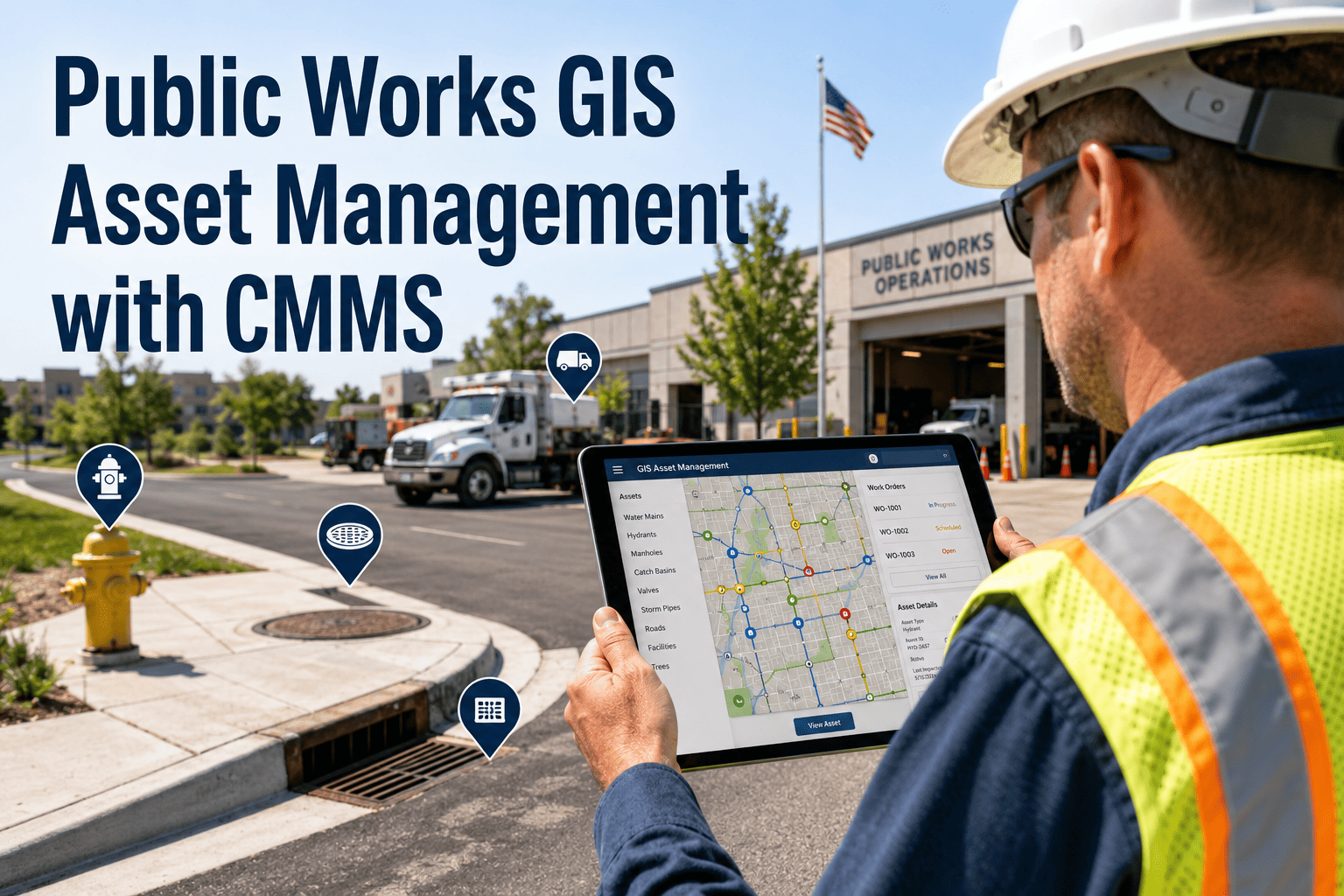
Government assets span entire cities and counties, often hidden in plain sight or buried beneath the pavement. For municipal departments, managing thousands of geographically dispersed units—from fire hydrants and streetlights to sprawling park facilities and critical water infrastructure—requires more than just a spreadsheet; it requires spatial intelligence. Traditional maintenance methods often fail when crews spend more time locating an asset than actually repairing it.
A single overlooked fire hydrant or a malfunctioning streetlight in a high-traffic intersection can lead to significant public safety risks and municipal liability. Oxmaint CMMS bridges the gap between digital record-keeping and geographic reality. By integrating GIS mapping directly into the maintenance workflow, departments can visualize every asset, optimize travel routes for field crews, and ensure that location-based work orders are executed with surgical precision. Start free trial today.
Municipal Infrastructure 2026
GIS-Integrated Maintenance Management for Government Assets
Transform how your city manages its physical footprint. GIS-integrated CMMS maps every asset—fire hydrants, parks, and infrastructure—for location-based work order management and resource optimization across entire counties.
30%Reduced Travel Time
100%Asset Visibility
GISNative Integration
Real-TimeLocation Tracking
Asset Location Intelligence
Municipal asset management typically follows a journey of data maturity. While many agencies still operate in a "Reactive" state—responding to citizen complaints about broken streetlights or leaking pipes—Oxmaint enables a shift toward "Spatial Proactivity." By using geographic data to cluster work orders, departments can move from random repairs to optimized, zone-based maintenance cycles.
GIS-Integrated (Spatial)
20%
Managing geographically dispersed government assets requires a unified digital framework. Whether it's a park pavilion or an underground water main, every asset must be accounted for spatially and mechanically. Oxmaint centralizes these pillars to ensure that location-based maintenance is both efficient and verifiable.
Government Asset CheckpointsGeospatial Audit
Hydraulic
Fire Hydrants
Annual pressure testing and flushing. Mapping of non-functional units to ensure fire departments have real-time access to reliable water sources during emergencies.
Safety Critical
Electrical
Streetlight Grids
Monitoring circuit health and bulb lifespan. Grouping repairs by neighborhood to minimize bucket truck deployment and reduce energy waste.
Visibility Risk
Public Space
Parks & Facilities
Routine inspections of playground equipment, HVAC units in municipal buildings, and roofing. Tracking maintenance costs by individual park location.
Public Safety
Underground
Pipe Infrastructure
GIS-tracked leak detection and pipe wall thickness monitoring. Preventing catastrophic main breaks through age-based and material-based replacement.
Service Interruption
Signage
Traffic Controls
Retroreflectivity testing and structural integrity checks of highway signs and signals. Mapping high-accident zones for prioritized maintenance.
Liability Risk
Sanitation
Waste Containers
IoT-enabled fill-level tracking integrated with GIS to optimize collection routes, reducing fuel consumption and labor hours.
Sanitation Risk
Service Interruption Matrix
In municipal management, not all asset failures impact the community equally. A flickering light in a park is a nuisance; a failed water main serving a hospital is a crisis. This matrix helps directors prioritize work orders based on the geographic and social impact of the failure.
5
Catastrophic
Total failure of critical infrastructure (e.g., bridge structural issue, major main break). Public safety endangered.
4
High Impact
Failure affecting critical facilities like hospitals or schools. Emergency response crews deployed immediately.
3
Moderate
Non-critical asset failure affecting a neighborhood (e.g., localized power outage or streetlight cluster).
2
Low Impact
Single asset failure with localized effect (e.g., broken park bench or small pothole). Scheduled for weekly repair.
1
Minor
Aesthetic or non-functional issue (e.g., faded paint on a municipal building or cracked curb).
Map Your Success with Oxmaint
Simplify city-wide maintenance with GIS-integrated CMMS. Map every hydrant, track every streetlight, and manage work orders by location in one secure, cloud-based platform designed for government scale.
Spatial Maintenance Modules
A robust municipal maintenance program relies on interconnected digital modules. Implementing these as spatial workflows ensures that data flows seamlessly from the field map to the budget report, maintaining transparency and accountability for public funds.
Core
Geographic Inventory
Always Live
Maintain a spatial record of every asset. Update location coordinates and asset attributes in real-time as new infrastructure is installed.
GIS LayersAsset IDsGPS SyncCity Map
Critical
Route Optimization
Per Shift
Cluster work orders based on geographic proximity. Reduce fuel costs and technician "windshield time" by planning the most efficient path.
Smart RoutingFuel TrackingLabor HoursZone Assign
Audit
Field Compliance
Weekly
Verify that inspections were performed at the correct location using GPS timestamps. Ensure all municipal ordinances for safety are met.
GPS ProofSafety LogsPermit AuditSite Photos
Prevention
Predictive Zoning
Monthly
Identify "hot spots" of frequent failures. Use spatial trends to prioritize infrastructure replacement in high-risk geographic areas.
Failure MapsRisk TrendsAging DataZone Health
Supply
Mobile Warehousing
Continuous
Track parts inventory across multiple depot locations. Ensure that the right spares are available at the closest maintenance hub.
Depot StockTruck StockReorder TriggersAsset Spares
Action
Citizen Request Sync
Real-Time
Integrate 311 or citizen portals with GIS work orders. Automatically map reported issues and assign them to the nearest available crew.
311 IntakeMobile AlertsPublic MapStatus Update
Asset Operational Environments
Dispersed assets face different environmental stressors depending on their location. Maintenance strategies must account for the specific challenges of urban, suburban, and rural infrastructure to ensure longevity and service reliability.
Urban Center / Downtown
High Traffic Interaction
Vandalism & Graffiti Control
Utility Congestion
24/7 Accessibility Needs
Strict Work Windows
Suburban / Residential
Stormwater Management
Park Facility Wear
Streetlight Continuity
Pedestrian Safety Audit
Seasonal Tree Trimming
Remote / Rural Boundaries
Long Travel Distances
Cellular Connectivity Gaps
Aging Bridge Structures
Vegetation Overgrowth
Resource Staging Logistics
Inefficient asset tracking is a silent budget killer. When you don't know exactly where your assets are or their current health, you overspend on reactive emergency repairs. A GIS-integrated approach pays for itself by preventing catastrophic failures and optimizing the use of every tax dollar.
$15 - $200
Spatial PM
Routine inspection, cleaning, and testing grouped by location. Zero emergency mobilization costs.
Savings: High
$5k - $25k
Unplanned Repair
Emergency pipe fix or signal replacement. High overtime labor, rush shipping, and citizen disruption.
Risk: Medium
$500k+
Legal & Infrastructure
Liability from preventable accidents, EPA fines, or full infrastructure failure requiring reconstruction.
Severity: Critical
Connect Your Maps to Your Maintenance
Don't let dispersed assets become forgotten assets. Oxmaint provides the digital map to manage government infrastructure, track field teams, and automate inspections across your entire jurisdiction.
CMMS Features for Government GIS
A specialized CMMS is the engine of a smart city. It turns geographic layers into actionable work, connecting fire hydrants to flow tests, streetlights to circuit repairs, and parks to maintenance schedules—all while providing the data needed for long-term capital planning.
A
Interactive Map Dashboard
View a real-time heatmap of asset health. Instantly see which areas have pending work orders or overdue inspections at a city-wide glance.
B
Mobile Field Mapping
Field technicians use tablets to see their daily tasks on a map. They can add new assets or update GPS locations with a single tap.
C
Condition-Based Work Orders
Integrate IoT sensors from water mains or waste bins. Automatically generate a work order and pin it to the map when a sensor triggers an alert.
D
Spatial Cost Tracking
Analyze maintenance spending by district, neighborhood, or council zone. Justify budget requests with hard geographic evidence.
E
Compliance & Permitting
Store digitised permits and regulatory docs directly on the asset map. Ensure all field work complies with state and federal infrastructure mandates.
F
Unified Asset Lifecycle
Track an asset from installation to decommissioning. Use spatial history to decide when repair costs outweigh the benefits of full replacement.
Frequently Asked Questions
Q. How does GIS integration help with fire hydrant maintenance?
GIS allows you to map every hydrant and its current operational status. When a flow test is logged in Oxmaint, the map updates automatically. This ensures that fire departments have accurate, real-time data on which hydrants are ready for use, significantly improving emergency response safety.
Q. Can we use existing ArcGIS or QGIS data in Oxmaint?
Yes. Oxmaint is designed to integrate with standard geospatial data formats. You can import your existing municipal layers to populate the CMMS, ensuring that your maintenance workflows are built on the same "single source of truth" as your urban planning maps.
Q. Is the system accessible for field crews in remote areas?
Oxmaint’s mobile platform includes offline capabilities. Technicians can view asset maps and log work in areas with poor cellular reception; the data then syncs automatically once they return to a connected zone, ensuring no maintenance record is lost.
Q. How does location-based maintenance reduce operational costs?
By clustering work orders geographically, you minimize travel time and vehicle wear. Instead of driving across town for separate repairs, crews can address all pending issues in a single neighborhood, allowing more tasks to be completed per shift with less fuel.
Q. How secure is our city's infrastructure data in the cloud?
Oxmaint employs enterprise-level encryption and SOC-compliant security protocols. Role-based access ensures that only authorized personnel can view or edit sensitive infrastructure data, providing a secure environment for municipal asset management.